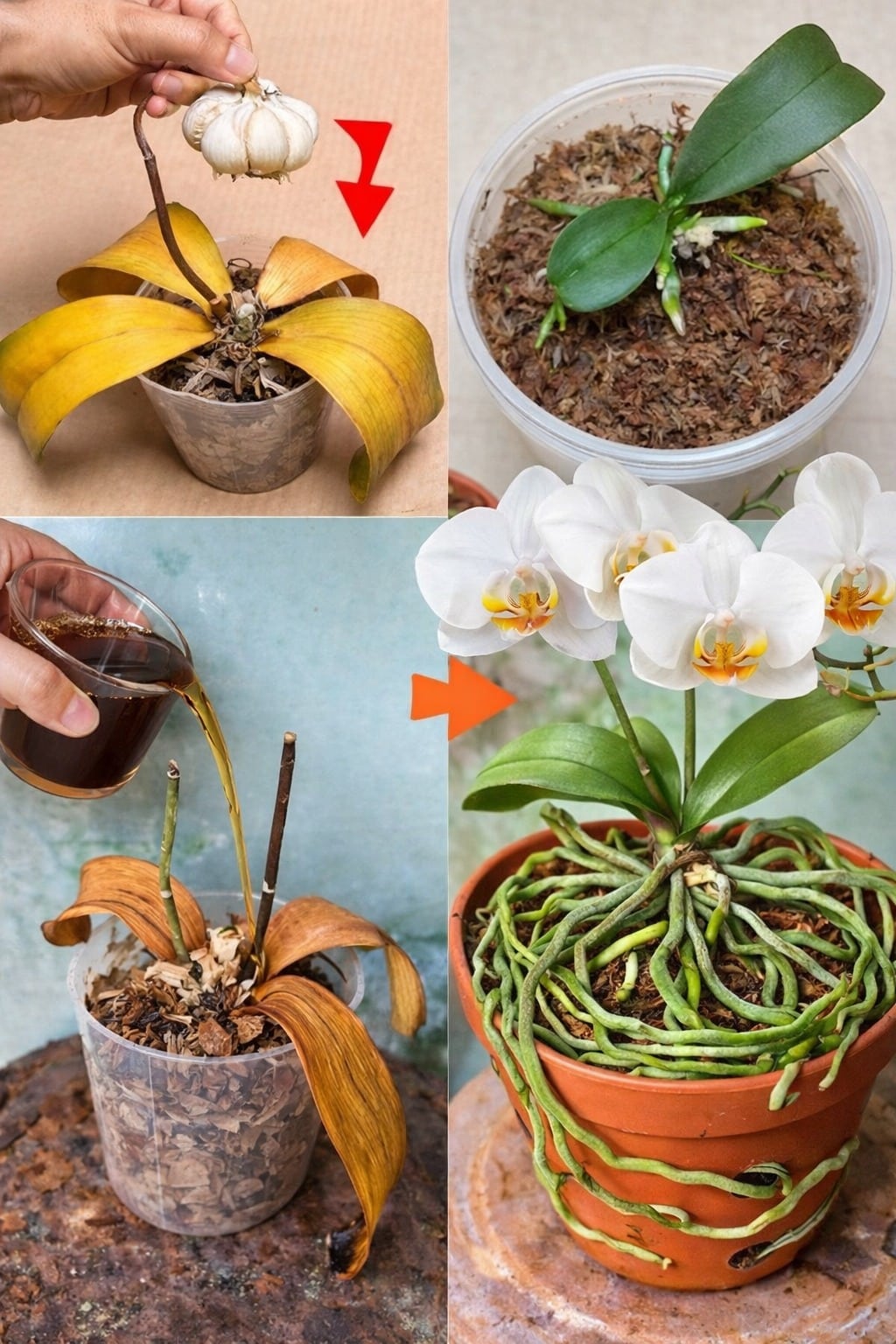
Is your orchid dying with yellow leaves and no roots? Don’t throw it away. Learn the truth about viral garlic water and the proven steps to revive orchids, grow new roots, and bloom again.
Let’s be honest: few things are more disappointing than watching your once‑beautiful orchid turn into a sad, leafless mess. The flowers are gone. The leaves are yellow and drooping. The roots are either dry and shriveled or brown and mushy. You’re ready to toss it in the trash and buy a new one.
But here’s the truth: orchids can come back to life – even from very bad condition. With the right care, an orchid that looks dead can grow new roots, new leaves, and even bloom again.
You may have seen viral videos showing a “simple liquid” (often garlic water) that supposedly revives orchids overnight. The videos are dramatic: a dying orchid, a splash of liquid, and suddenly – new roots! It looks like magic.
But does it really work? And more importantly, is it safe?
In this guide, I’ll give you an honest, science‑backed look at the viral garlic water trick, explain what it can and cannot do, and – most importantly – walk you through the proven, step‑by‑step method to revive a dying orchid and grow new roots fast. No hype, just real, practical advice.
Let’s save that orchid.
⚠️ Signs Your Orchid Is in Trouble – Before You Try Any Trick
Before you attempt any revival method, you need to diagnose the problem. Orchids don’t decline overnight. Look for these common symptoms:
| Symptom | What It Means |
|---|---|
| Yellow, drooping leaves | Often a sign of root rot (overwatering) or severe dehydration (underwatering). |
| Leaves are wrinkled and floppy | The orchid is dehydrated – either from lack of water or from roots that can’t absorb water (rot). |
| Roots are brown, mushy, and flat | Root rot – caused by overwatering or poor drainage. |
| Roots are dry, shriveled, and papery | Severe underwatering or old, dead roots. |
| No new growth for months | The plant is stressed – likely root problems or insufficient light. |
| No flowers for over a year | Usually a light or temperature issue, but root health is also a factor. |
The most common cause of a dying orchid is root rot from overwatering. Orchids are epiphytes – their roots need air. When they sit in soggy potting mix, roots suffocate and die. Without healthy roots, the orchid cannot take up water or nutrients, and it slowly declines.
Good news: Even orchids with no roots can sometimes be saved. The key is to encourage new root growth before the plant completely dehydrates.
🧄 The Viral “Liquid Trick” – Garlic Water Explained
You’ve probably seen the videos: a dying orchid, a glass of cloudy liquid, and within days – new roots sprouting. The “secret” ingredient is often garlic water.
Why Garlic?
Garlic (Allium sativum) contains natural compounds with antimicrobial and antifungal properties, including allicin. In theory, garlic water could help:
- Protect damaged orchid roots from fungal or bacterial infections.
- Create a slightly “sterile” environment that gives the orchid a chance to recover.
Some gardeners have used garlic as a natural fungicide for decades. However, using it on orchids is controversial because orchids are sensitive to strong substances.
Does Garlic Water Actually Revive Orchids?
The short answer: It can help prevent infection, but it does NOT directly grow new roots. The real root growth comes from proper humidity, warmth, and care – not from the garlic itself.
If someone sees success after using garlic water, it’s usually because they also improved other factors (better humidity, proper potting, correct watering) at the same time. The garlic water may have helped prevent rot, but it’s not a miracle root‑grower.
✅ How to Use Garlic Water Safely (If You Want to Try It)
If you decide to use garlic water as a preventive measure, follow this safe method. Do not overdo it – garlic can burn roots.
Ingredients:
- 1–2 fresh garlic cloves
- 1 liter (4 cups) of room‑temperature water
Instructions:
- Crush or finely chop the garlic cloves. This releases the allicin.
- Soak the garlic in water for 24 hours at room temperature.
- Strain the liquid through a fine‑mesh strainer or cheesecloth. Remove all solid pieces – they can burn roots.
- Dilute further? For orchids, it’s safest to dilute the garlic water with equal parts fresh water (1:1). Start with a weaker solution.
- Use immediately – do not store.
How to apply:
- Water your orchid with the diluted garlic water once every 2–3 weeks at most.
- Pour it through the potting medium, allowing it to drain completely.
- Do not use on leaves – garlic can burn leaf tissue.
- Do not use on orchids with no roots – the liquid won’t be absorbed and may pool around the crown, causing rot.
⚠️ Important Warnings
| Don’t | Why |
|---|---|
| Don’t overuse (more than once every 2–3 weeks) | Garlic can build up and burn roots. |
| Don’t pour on leaves | Garlic oil can damage leaf cells, causing spots or burns. |
| Don’t use undiluted | Straight garlic water is too strong for orchids. |
| Don’t use as a replacement for proper care | Garlic water is a supplement, not a cure. |
If you notice any leaf yellowing or root browning after using garlic water, stop immediately and flush the pot with plain water.
Can Banana Peels Really Boost Orchid Growth? Continue to Page 2
Discover the safer method, the real risks, and the smart orchid care details that many gardeners miss on the first page.