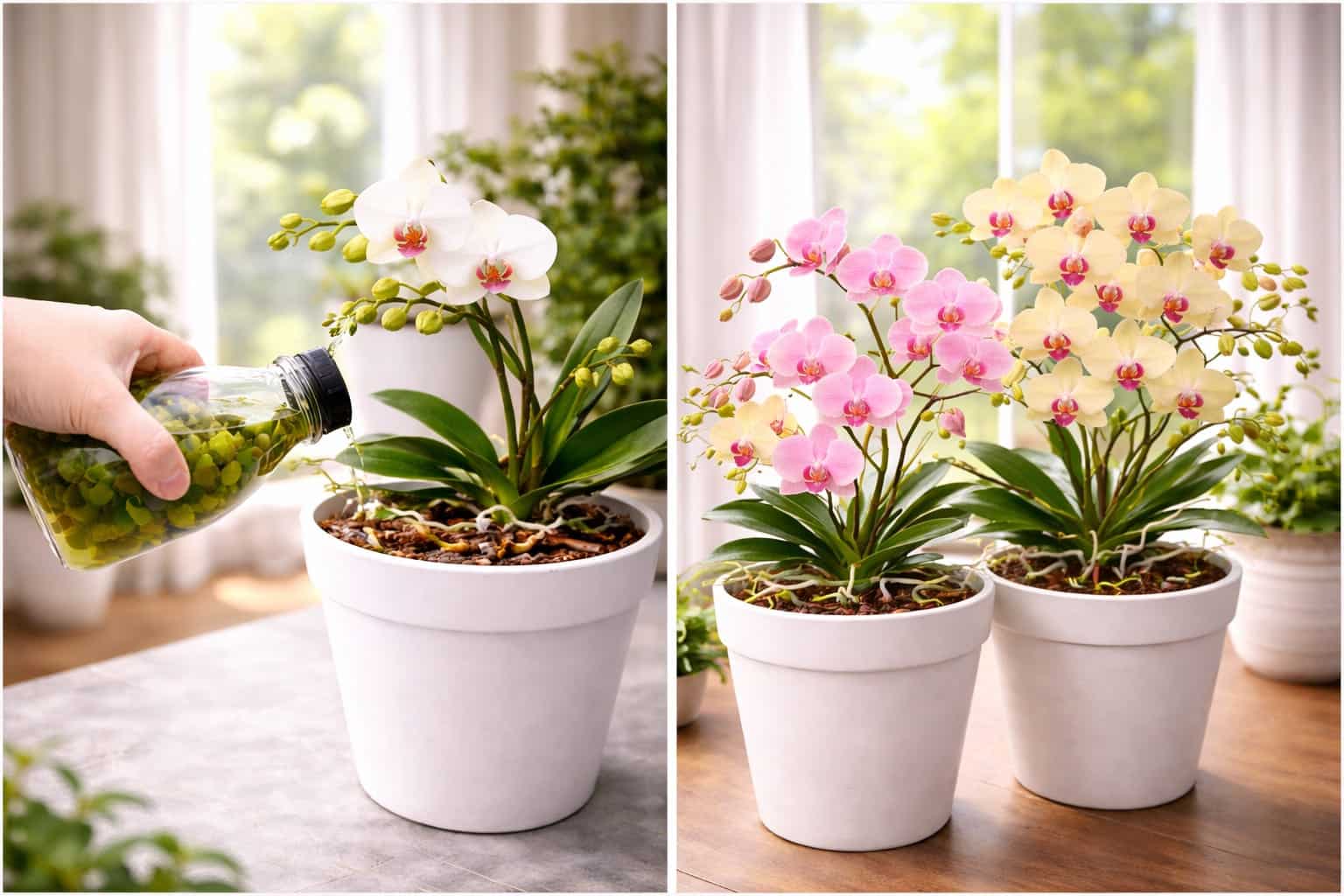
Can aloe vera water really make orchids bloom year‑round? We separate fact from fiction. Learn what aloe can actually do, how to use it safely, and what truly triggers orchid flowers.
Let’s be honest: orchid care is full of “miracle” tips. Every few months, a new homemade remedy goes viral – garlic water, rice water, banana peels, and now, aloe vera water. The latest claim is that a simple glass of aloe vera water can make an orchid bloom continuously for four seasons. It is the kind of promise that gets attention fast – especially if you have an orchid that looks healthy but refuses to produce new roots or flowers.
The truth is a little more balanced.
Aloe vera water is not magic, and it will not override poor light, bad watering habits, or weak roots. But used carefully, it can act as a gentle supplement in an orchid routine. The source article centers on aloe vera water as a natural boost for orchids, especially for root support, leaf gloss, and overall vigor.
In this guide, I’ll give you an honest, science‑backed look at what aloe vera water can and cannot do for orchids. You’ll learn how to make it safely, when it might help, and – most importantly – what actually makes orchids bloom. No hype, just real advice.
Let’s separate the viral claims from the horticultural reality.
Why Aloe Vera Gets So Much Attention in Plant Care
Aloe vera has a reputation for being packed with useful compounds. The source article describes it as rich in vitamins, minerals, enzymes, and amino acids, and claims those can support root development, nutrient uptake, and disease resistance in orchids.
What’s Inside Aloe Vera?
Component Potential Benefit for Plants
Polysaccharides (e.g., acemannan) May stimulate root growth and act as a mild biostimulant.
Salicylic acid A natural plant hormone that can trigger defense responses.
Enzymes (bradykinase, catalase) May help break down organic matter in the potting medium.
Vitamins (A, C, E, B12) Antioxidant properties; potential mild stress relief.
Minerals (calcium, magnesium, zinc) Trace nutrients that support general plant health.
That sounds promising, and it helps explain why so many orchid growers experiment with it. However, even the most respected orchid guidance still comes back to the basics: orchids need the right balance of light, air, water, growing medium, and fertilizer to grow and flower well. The American Orchid Society is very clear on that point.
So aloe vera water is best thought of as a bonus, not the main reason an orchid thrives.
What the Article Recommends
According to the source, the suggested mix is simple:
· Take fresh aloe gel (from an aloe leaf).
· Blend it with water at about 1 part aloe to 3 parts water.
· Strain it well to remove solid pieces.
· Use it as either a foliar mist or a light watering treatment.
It also recommends using the mix once every two to three weeks, ideally in the morning, then watching how the orchid responds. Signs they suggest looking for include glossier leaves, stronger roots, and possibly better blooming. The same article also warns that overuse can lead to root rot or fungal issues.
That warning matters more than the promise.
What Aloe Vera Water Can Actually Do for Orchids (Realistic Benefits)
Let’s be clear: aloe vera water is not a fertilizer. It does not contain significant amounts of nitrogen, phosphorus, or potassium – the primary macronutrients orchids need to grow and bloom. However, it may offer mild, supportive benefits in specific situations.
✅ 1. May Support Root Recovery After Repotting
A freshly repotted orchid can be stressed. The mild polysaccharides in aloe may help stimulate root growth and reduce transplant shock. Some growers use aloe water as a gentle root soak during the recovery phase.
✅ 2. Can Improve Leaf Appearance (Temporary Gloss)
When used as a foliar mist (diluted properly), aloe water can remove dust and leave a subtle, natural shine on leaves. This is purely cosmetic but can make the plant look healthier.
✅ 3. May Offer Mild Antifungal Properties
Aloe contains compounds that can inhibit certain fungi. A light mist may help prevent surface mold on leaves, but it is not a substitute for proper airflow and dry conditions.
✅ 4. Provides Trace Nutrients
The minerals in aloe (calcium, magnesium, etc.) are beneficial in tiny amounts. However, these are already present in most tap water and orchid fertilizers.
❌ What Aloe Vera Water Does NOT Do
Claim Reality
Makes orchids bloom for four seasons No – blooming depends on light, temperature, and maturity.
Replaces fertilizer No – aloe lacks NPK.
Cures root rot No – it may even worsen rot if overused.
Fixes poor lighting No – light is non‑negotiable.
Works overnight No – any effects are subtle and gradual.
Continue to Page 2
Continue to page 2 for more details about this article and the key points many readers miss on the first page.