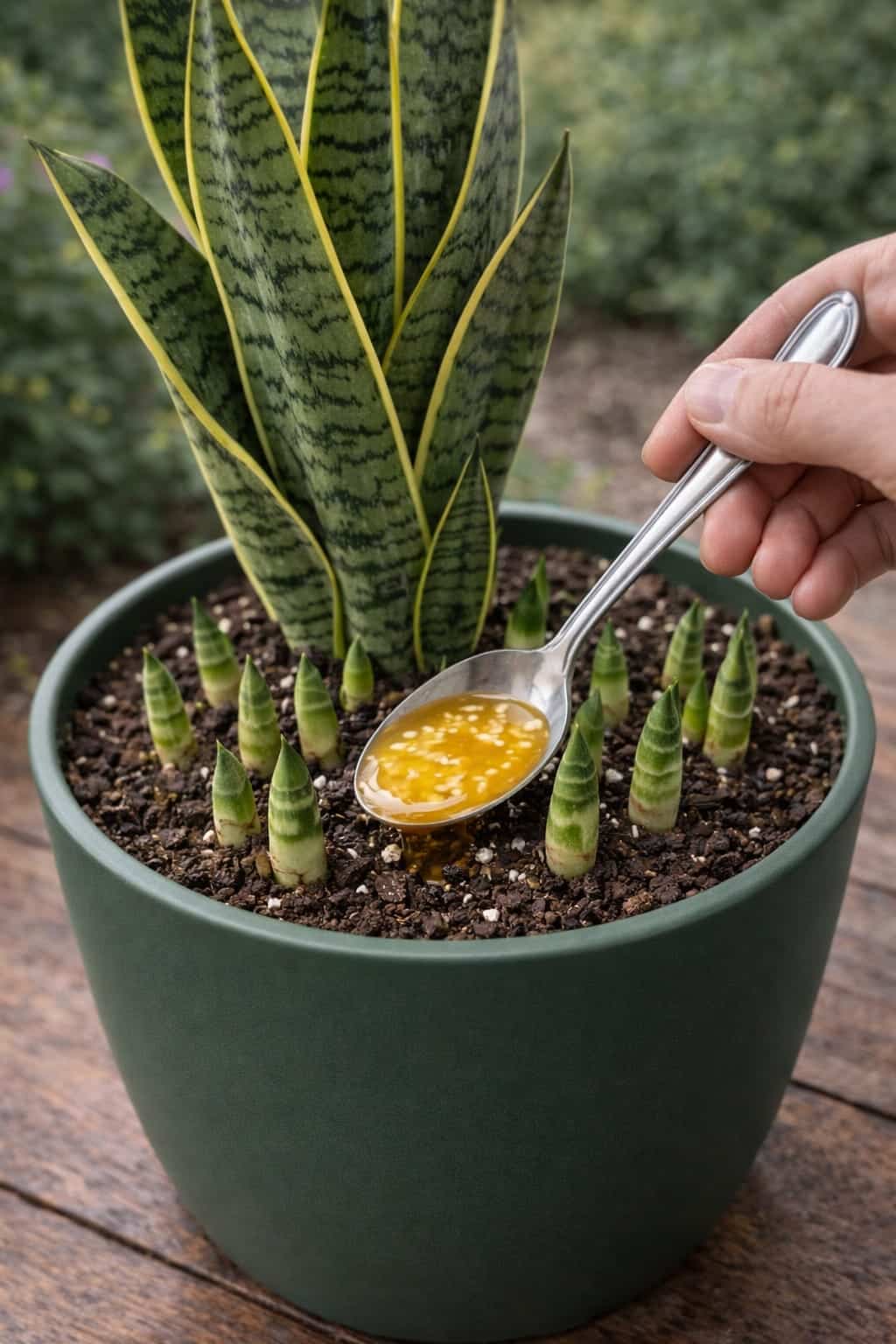
Want your snake plant to produce more pups? Learn why gardeners use a golden liquid (diluted seaweed extract or mild fertilizer) to encourage new shoots – and the real secrets: light, soil, and watering.
Let’s be honest: snake plants (Sansevieria, now Dracaena) are among the most durable and adaptable houseplants in the world. Known for their upright leaves and ability to survive with minimal care, these plants are a favorite in homes, offices, and modern interiors. One of the most exciting things about snake plants is their ability to produce new shoots, often called “pups,” which grow from the soil near the base of the plant.
Recently, many indoor gardeners have been experimenting with pouring small amounts of natural golden‑colored liquid solutions around the base of snake plants. The goal is usually to gently support soil nutrients and encourage stronger root activity that may lead to new shoots appearing over time.
But here’s the truth: the golden liquid is not magic. It works best as a gentle supplement when used correctly – and only when the plant already has the right conditions: bright indirect light, well‑draining soil, and proper watering. In this guide, you’ll learn why snake plants produce new shoots, what the golden liquid really is, how to use it safely, and the ideal environment for encouraging pups.
Let’s help your snake plant grow a whole new family.
🌿 Why Snake Plants Produce New Shoots
Snake plants grow from underground structures called rhizomes. These are thick, potato‑like stems that store water and nutrients. Rhizomes spread slowly beneath the soil and can send up new shoots when conditions are favorable.
Healthy Rhizomes Respond Well To:
· Balanced soil moisture – not too wet, not too dry.
· Loose, well‑draining soil – allows rhizomes to expand.
· Moderate nutrients – light feeding supports growth.
· Bright indirect light – energy for new shoots.
· Stable indoor temperatures – prevents stress.
When these factors align, the plant may begin producing clusters of new shoots (pups) around the base. This is how snake plants naturally propagate and fill out a pot.
🪴 Why Some Gardeners Use Natural Liquid Solutions
Many gardeners prefer gentle plant care methods that rely on light feeding rather than heavy fertilizers. Natural liquid solutions are sometimes used because they may help maintain a more balanced soil environment.
The “Golden Liquid” Is Usually One Of These:
Liquid What It Is Why Used
Diluted seaweed or kelp extract Rich in trace minerals and natural growth hormones Encourages root development and shoot growth
Diluted compost tea Nutrient‑rich, full of beneficial microbes Improves soil health gradually
Very weak balanced fertilizer (10-10-10) Provides nitrogen, phosphorus, potassium in small amounts Supports overall plant vigor
Diluted worm casting tea Gentle, organic nutrient source Feeds soil life slowly
Gardeners experiment with these liquids to:
· Support root activity
· Improve nutrient availability
· Encourage steady growth
· Maintain healthy soil conditions
· Promote stronger rhizome development
However, these liquids are typically used in small amounts and only occasionally. Overuse can harm the plant.
💧 How Gardeners Typically Apply the Liquid
When using liquid feeding methods, most plant enthusiasts follow a cautious routine. Snake plants prefer light feeding and moderate watering, so less is usually better.
Typical Method – Step by Step
- Choose a mild golden liquid – diluted seaweed extract or a balanced fertilizer at quarter strength.
- Dilute heavily – use half or quarter of the recommended strength.
- Pour a small amount near the base of the plant – about ¼ cup for a standard pot.
- Avoid soaking the soil excessively – do not flood the pot.
- Keep the leaves dry – apply to soil only.
- Allow soil to dry slightly between watering – do not water again until the top 2–3 inches are dry.
- Repeat occasionally – once every 4–6 weeks during spring and summer.
What to Avoid
· Pouring directly on the leaves or crown – can cause rot.
· Using full‑strength fertilizer – burns roots.
· Applying too frequently – more than once a month.
· Using on already wet soil – increases risk of root rot.
⚠️ Common Snake Plant Care Mistakes
Snake plants are extremely forgiving, but a few mistakes can slow growth or prevent new shoots from forming. The golden liquid will not fix these problems.
Frequent Problems to Avoid
Mistake Why It’s Harmful Correct Approach
Watering too often Roots rot, leaves yellow Let soil dry completely between waterings.
Soil that stays constantly wet Suffocates rhizomes Use well‑draining cactus mix.
Pots without drainage holes Water pools at bottom Always use pots with holes.
Heavy fertilizer use Burns roots, brown tips Use diluted fertilizer sparingly.
Very dark indoor spaces No energy for growth Move to bright indirect light.
Because snake plants store water in their leaves and rhizomes, they prefer slightly dry soil conditions. Overwatering is the #1 killer.
🌱 Ideal Conditions for Snake Plant Growth (and Pups)
For consistent growth and new shoots, snake plants benefit from stable indoor conditions. The golden liquid can help, but only if these basics are already right.
Recommended Environment
Factor Ideal Condition Why It Matters
Light Bright, indirect (east/west window) Energy for photosynthesis and shoot production
Soil Loose, well‑draining cactus/succulent mix Allows rhizomes to spread, prevents rot
Water Moderate – let soil dry completely Mimics natural dry cycles
Temperature Warm indoor climate (18–30°C / 65–86°F) Steady growth year‑round
Feeding Light nutrients (occasional, diluted) Supports new shoots without burning
Under these conditions, snake plants often develop new pups around the base of the plant. If you haven’t seen pups in over a year, check these factors first.
How to Encourage New Shoots (Pups) – Step by Step
If your snake plant is mature (2–3+ years old) and healthy, you can encourage pups with this simple plan.
- Move to bright indirect light – an east or west window is ideal.
- Repot if soil is old or compacted – use fresh cactus mix with perlite.
- Water correctly – let soil dry completely between waterings.
- Use a diluted golden liquid (seaweed extract or weak fertilizer) once a month in spring and summer.
- Be patient – pups may take 4–8 weeks to appear after conditions improve.
Pro tip: Slightly root‑bound snake plants often produce more pups. Don’t repot too often – every 2–3 years is enough.
Snake Plant Care Overview – Quick Reference Table
Factor Ideal Condition Benefit
Light Bright, indirect Encourages growth and pups
Soil Fast‑draining cactus mix Protects rhizomes
Water Infrequent (every 2–3 weeks) Prevents root rot
Temperature Warm indoor climate Stable development
Feeding Light nutrients (occasional, diluted) Supports new shoots
Golden liquid Occasional, diluted (spring/summer) Gentle supplement – optional
Signs Your Snake Plant Is Ready to Produce Pups
· Mature plant – at least 2–3 years old.
· Healthy, firm leaves – no yellowing or soft spots.
· Visible rhizomes near soil surface – you may see thick, root‑like structures.
· Pot is slightly crowded – roots filling the container.
· Recent growth – new leaves have appeared in the past year.
If these signs are present, a little golden liquid (diluted seaweed extract) may give the plant a gentle nudge.
Frequently Asked Questions (FAQs)
Q: Why do snake plants produce new shoots?
They spread through underground rhizomes that generate new plants. Pups are the plant’s natural way of reproducing and filling out the pot.
Q: How often should snake plants be watered?
Every 2–3 weeks depending on light and temperature. Always check that the soil is completely dry before watering.
Q: Can snake plants grow in low light?
Yes, but they grow faster and produce more pups in bright indirect light. Low light = slow growth, fewer shoots.
Q: Why do snake plant leaves become soft?
Usually caused by overwatering. Check soil moisture and roots. If roots are rotten, trim them and repot in dry, well‑draining soil.
Q: Do snake plants need fertilizer often?
Only occasionally during active growth (spring and summer). Once a month with a diluted balanced fertilizer is plenty.
Q: Can snake plant pups be replanted?
Yes, they can easily be divided into new plants. Wait until the pup is at least 4–6 inches tall with its own roots, then gently separate and pot in fresh soil.
Q: Are snake plants beginner‑friendly?
Yes, they are among the easiest houseplants to grow. They forgive neglect and are perfect for new plant owners.
Q: How long do snake plants live?
They can live for many years – even decades – with proper care. Some are passed down through generations.
Q: Do snake plants improve indoor decor?
Yes, their vertical structure suits modern interiors – minimalist, luxury, or bohemian.
Q: Do snake plants need frequent repotting?
Usually only every few years – when roots are crowded or soil is old. Snake plants like to be slightly root‑bound.
Printable Snake Plant Care Checklist (for Pups)
☐ Place in bright, indirect light (east/west window)
☐ Use a pot with drainage holes (terracotta preferred)
☐ Fill with fast‑draining cactus/succulent soil (add perlite)
☐ Water only when soil is completely dry (check with finger)
☐ Water deeply, then empty saucer
☐ Do not water again for 2–4 weeks (depending on light)
☐ Fertilize lightly once every 4–6 weeks in spring/summer (diluted)
☐ Use golden liquid (seaweed extract or weak fertilizer) occasionally – optional
☐ Do not feed in fall/winter
☐ Be patient – pups may take 4–8 weeks to appear
☐ When pups are 4–6 inches tall, you can separate or leave for a fuller cluster
Final Thoughts – Gentle Support, Strong Fundamentals
The “golden liquid” trend is not magic. A diluted seaweed extract or weak fertilizer can provide trace nutrients and gentle growth hormones that may encourage new shoots. But it will never replace the fundamentals: bright indirect light, well‑draining soil, proper watering, and a mature, healthy plant.
If your snake plant isn’t producing pups, don’t reach for a bottle first. Move it closer to a window, check the soil, and adjust your watering. Once those basics are right, a little golden liquid every few weeks can give it a gentle nudge – but it’s never the cure.
With patience and the right care, your snake plant will reward you with new pups, a fuller cluster, and years of beauty.
Now it’s your turn! Have you tried a golden liquid on your snake plant? Did new shoots appear? Drop a comment below – I’d love to hear your experience.
And if you found this guide helpful, share it with a friend who wants more snake plant pups. Pin it for later, and subscribe to our newsletter for more practical plant care.
Stay bright, stay dry, and watch your snake plant grow. 🌿✨