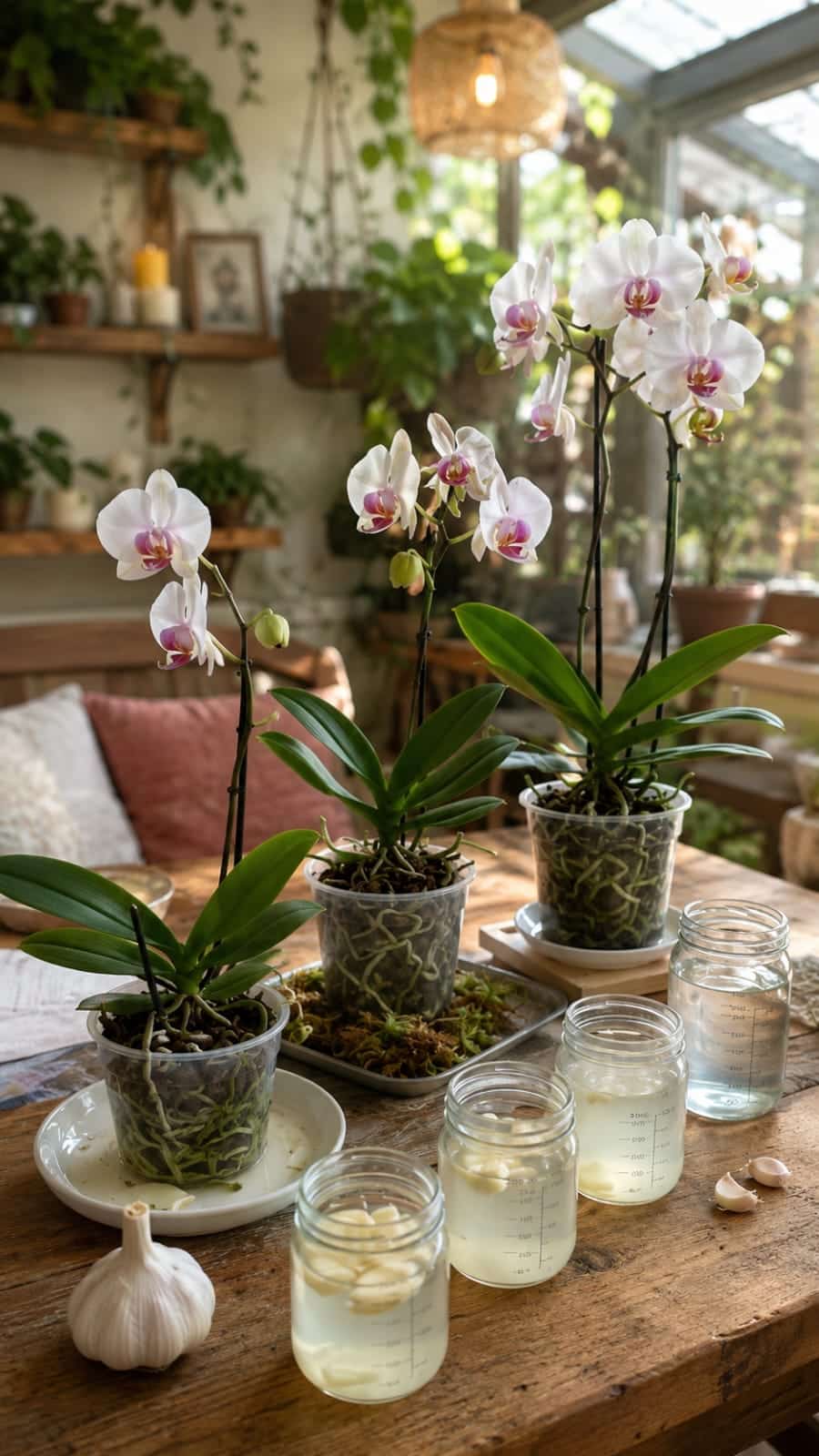
Orchids are elegant, delicate-looking houseplants, but they are not as difficult as many people think. When their roots are healthy, their leaves are firm, and their growing conditions are stable, orchids can bloom again and again inside the home. The image shows beautiful white orchids in clear pots, surrounded by jars of garlic water being prepared for plant care.
Garlic water is one of the most popular homemade orchid care tricks. Many gardeners use it as a gentle natural plant tonic because garlic contains sulfur compounds and a strong aroma that may help discourage some pests while refreshing the root zone. Some growers also believe that diluted garlic water can support stronger roots and help orchids prepare for blooming.
But orchids are sensitive plants. Garlic water must be made correctly, diluted properly, and used only occasionally. A strong garlic mixture can burn roots, leave odor in the potting medium, attract problems, or stress the orchid instead of helping it.
This guide explains exactly how to make garlic water for orchids, how to dilute it, how often to use it, when to avoid it, and how to apply it safely for healthy roots and long-lasting flowers.
What Is Garlic Water for Orchids?
Garlic water is a simple homemade plant solution made by soaking crushed garlic cloves in clean water. After soaking, the liquid is strained and diluted before being used around the orchid roots.
It is not a true complete fertilizer. Garlic water does not replace orchid fertilizer, fresh bark, proper watering, bright indirect light, or good airflow. Instead, it is best used as an occasional natural support method for orchids that are already healthy.
For orchids, the safest garlic water should be:
- Fresh
- Strained
- Lightly diluted
- Used only around roots
- Never poured into the crown
- Never left standing in the saucer
- Used occasionally, not every week
Why Gardeners Use Garlic Water on Orchids
Garlic has a strong smell and natural sulfur compounds. In home gardening, diluted garlic water is often used as a mild natural plant care solution. Orchid growers sometimes use it when they want to gently refresh the roots, discourage tiny pests, or support a plant after flowering.
When used carefully, garlic water may help:
- Support healthy orchid roots
- Reduce unpleasant root-zone buildup
- Discourage some small pests
- Refresh old potting medium temporarily
- Support stronger leaf growth
- Encourage a cleaner growing environment
- Prepare orchids for future blooms
However, garlic water should always be treated as a gentle homemade tonic, not a miracle cure. If an orchid has root rot, old broken-down bark, yellow leaves, or crown rot, garlic water alone will not fix the problem.
The Safest Garlic Water Recipe for Orchids
This is the simple method shown in the image: garlic cloves soaking in jars of water. The goal is to extract a mild garlic infusion, not create a strong, burning concentrate.
Ingredients
- 2 fresh garlic cloves
- 1 liter clean water
- Glass jar with lid
- Knife or garlic press
- Fine strainer or cheesecloth
- Extra water for dilution
Step-by-Step Method
- Peel 2 fresh garlic cloves.
- Crush or slice the cloves to release the natural compounds.
- Place the garlic into a clean glass jar.
- Add 1 liter of room-temperature water.
- Cover the jar loosely.
- Let it sit for 6 to 12 hours.
- Strain the liquid very well.
- Dilute before using on orchids.
Do not leave garlic soaking for several days. Long soaking can make the mixture too strong, sour-smelling, or fermented.
How to Dilute Garlic Water for Orchids
Dilution is the most important step. Orchids have sensitive roots, especially Phalaenopsis orchids grown in bark or clear pots.
A safe beginner dilution is:
1 part garlic water + 3 parts clean water
For weak orchids or orchids with tender roots, make it even lighter:
1 part garlic water + 5 parts clean water
The final liquid should smell lightly of garlic, not strongly like a kitchen marinade. If the smell is overpowering, dilute it more.
How to Apply Garlic Water to Orchids
Garlic water should be applied to the root zone only. Never pour it into the crown, the center of the leaves, or directly over open flowers.
Safe Application Steps
Check that the orchid pot has drainage holes.
Make sure the orchid roots are firm and healthy.
Use only fresh, strained, diluted garlic water.
Pour slowly through the orchid bark around the roots.
Avoid the crown of the plant.
Let the liquid drain completely.
Empty the saucer after watering.
Return the orchid to bright indirect light.
Do not let the orchid sit in garlic water. Standing liquid around orchid roots can lead to rot.
How Often Should You Use Garlic Water?
Garlic water should not be used too often. Orchids do best with simple, consistent care. Too many homemade treatments can build up in the potting medium and stress the roots.
A safe schedule:
- Healthy orchid: once every 4 to 6 weeks
- Orchid after blooming: once, then return to normal care
- Orchid with pests: use carefully, then monitor closely
- Weak orchid: avoid until roots are checked
- Orchid in old bark: repot first instead of relying on garlic water
If you use regular orchid fertilizer, do not use garlic water on the same day. Keep homemade tonics and fertilizer separate.
Best Time to Use Garlic Water
The best time to use garlic water is in the morning. This gives the potting medium time to drain and dry slightly during the day.
Use garlic water when:
- The orchid is actively growing
- Roots look firm and healthy
- The bark is nearly dry
- The plant is not in extreme heat or cold
- You can allow full drainage afterward
Avoid using it late at night because moisture sitting around orchid roots overnight can increase the risk of rot.
When Not to Use Garlic Water
Garlic water is not safe for every orchid situation. Sometimes it is better to use plain water, fresh bark, or root cleaning instead.
Do not use garlic water if:
- The orchid has root rot
- The pot smells sour
- The bark is broken down and soggy
- The roots are mushy or black
- The crown has rot
- The orchid is severely dehydrated
- The plant was recently repotted
- The garlic water smells fermented
- The mixture is strong or cloudy
- The orchid is sitting in a pot with no drainage
If roots are damaged, inspect and repot first. Garlic water cannot save rotten roots.
Can Garlic Water Help Orchids Bloom?
Garlic water may support general orchid health, but it does not force flowers by itself. Orchids bloom when they have enough stored energy, healthy roots, proper light, and the right seasonal conditions.
For better orchid flowering, focus on:
- Bright indirect light
- Healthy roots
- Fresh orchid bark
- Correct watering
- Weak orchid fertilizer during active growth
- Good airflow
- A slight night temperature drop
Garlic water can be part of a gentle care routine, but light and root health are more important for blooming.
Can Garlic Water Kill Orchid Pests?
Garlic water may discourage some pests because of its strong smell, but it is not a guaranteed pest treatment. If your orchid has mealybugs, scale, spider mites, or thrips, you need to inspect the plant carefully and use proper pest control.
Garlic water may help as a mild support, but serious pests require:
- Isolation from other plants
- Manual cleaning
- Rubbing alcohol on mealybugs and scale
- Insecticidal soap when appropriate
- Repeated treatment
- Checking roots and potting medium
Do not rely only on garlic water if pests are spreading.
Can You Spray Garlic Water on Orchid Leaves?
It is better not to spray garlic water on orchid leaves or flowers. Garlic can leave residue, smell strong, and irritate tender plant tissue if the mixture is too concentrated.
For orchids, the safer method is root-zone application. Pour the diluted garlic water through the bark and let it drain.
To clean orchid leaves, use a soft damp cloth with plain water.
Can Garlic Water Touch Orchid Flowers?
No. Avoid getting garlic water on orchid blooms. Flowers are delicate and can develop spots or damage from homemade mixtures. Apply only around the roots.
Can You Use Garlic Powder Instead of Fresh Garlic?
Fresh garlic is better. Garlic powder may contain additives, anti-caking agents, or concentrated particles that can settle in the potting medium. It may also be harder to strain completely.
Use fresh garlic cloves for the safest homemade orchid water.
Continue to Page 2
Continue to page 2 for more details about this article and the key points many readers miss on the first page.