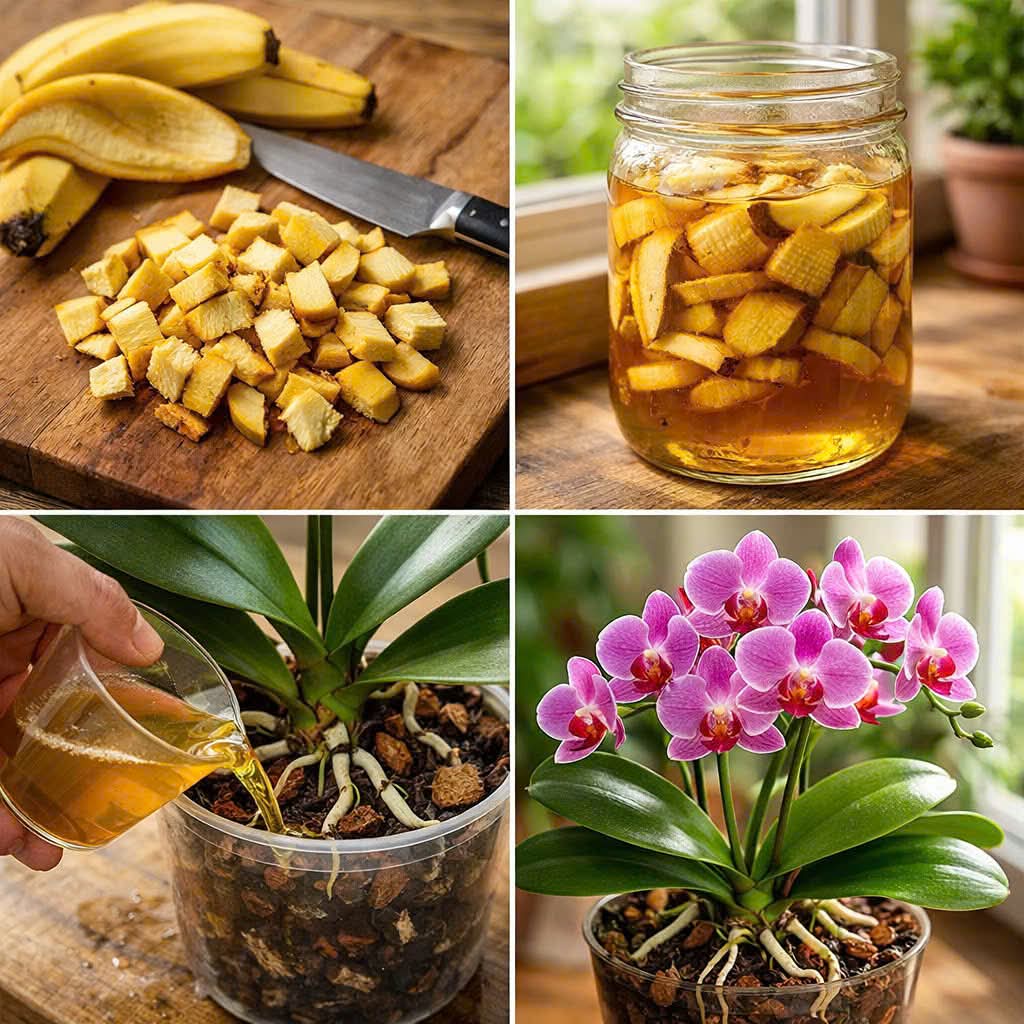
Banana peels are a popular natural fertilizer for orchids, but do they actually work? Learn the safe way to use banana peel tea, the risks of putting peels directly in pots, and the real secrets to stunning orchid blooms.
Let’s be honest: orchid lovers are always searching for that one secret trick that will make their plants bloom bigger, stronger, and more often. You’ve probably seen the viral posts – a banana peel chopped up, dropped into a glass of water, or even buried directly in an orchid pot. The claim is simple: banana peels are rich in potassium and phosphorus, which are essential for flowering and root growth. So it must work, right?
Not so fast.
While banana peels do contain beneficial nutrients, using them incorrectly can harm your orchid. Orchids are not like regular houseplants. They are epiphytes – they grow on trees in nature, with exposed roots that need excellent airflow and quick drying. Adding decomposing banana peels to their potting medium can lead to root rot, pests, and fungal problems.
In this guide, I’ll give you an honest, science‑based look at what banana peels can and cannot do for orchids. You’ll learn the safe way to make banana peel “tea,” why you should never put raw peels directly into the pot, and – most importantly – the proven methods that actually make orchids bloom like crazy.
Let’s peel back the hype.
Why Banana Peels Are Popular for Plants
Banana peels are not just garbage. They contain several nutrients that plants need:
Nutrient Role in Plants Relevance to Orchids
Potassium (K) Supports flowering, disease resistance, and overall plant health Very important – orchids need potassium for strong blooms
Phosphorus (P) Promotes root development and flower production Important for root growth and spike formation
Magnesium (Mg) Central component of chlorophyll (photosynthesis) Helps keep leaves green
Calcium (Ca) Cell wall structure and growth Supports new root and leaf development
These nutrients are useful for orchids. That’s why many gardeners try to use banana peels as a natural, free, and eco‑friendly fertilizer. In theory, it makes sense: give your orchid the nutrients it needs, and it will bloom more.
But theory and practice are different when it comes to orchids. The way you apply the banana peels matters enormously.
⚠️ The Problem with Putting Banana Peels Directly in Orchid Pots
If you’ve seen videos of people chopping up banana peels and sprinkling them on top of orchid bark or sphagnum moss, be warned: this method is risky.
❌ 1. They Rot Quickly – And Rot Is an Orchid’s Enemy
Orchids are epiphytes. In nature, their roots are exposed to air and dry out quickly between rain showers. They are not adapted to sitting in decomposing organic matter.
When you add fresh banana peels to an orchid pot:
· The peels break down rapidly in the warm, moist environment.
· Decomposition releases heat, acids, and gases that can damage delicate orchid roots.
· The rotting material holds moisture, preventing the bark or moss from drying out properly.
· Excess moisture leads to root rot – the #1 killer of orchids.
Signs of root rot: Black, mushy roots; yellowing leaves; foul smell from the pot.
❌ 2. Attracts Pests and Mold
Decomposing banana peels are a magnet for:
· Fungus gnats – tiny black flies that breed in moist, organic matter. Their larvae feed on fungi and roots.
· Ants – attracted to the sweet, fermenting sugars.
· Mold and mildew – white or green fuzzy growth on the surface of the potting medium.
None of these are beneficial to your orchid. Once pests or mold establish, they can spread to other plants.
❌ 3. Nutrients Are Not Immediately Available
Plants cannot absorb nutrients from fresh banana peels directly. The peels must first be broken down by soil microbes – a process that takes weeks or months. In the meantime, the peels are just sitting in the pot, rotting.
Orchid potting mix (usually bark or moss) does not have the same robust microbial community as garden soil. Decomposition is slower and less efficient. By the time any nutrients become available, the peels may have already caused root damage.
❌ 4. Alters the pH of the Potting Medium
As banana peels decompose, they can lower the pH (make it more acidic). Orchids generally prefer a slightly acidic to neutral pH (5.5–6.5). A sudden shift can stress the plant and inhibit nutrient uptake.
The Right Way to Use Banana Peels for Orchids – Banana Peel “Tea”
If you want to harness the nutrients in banana peels without the risks, the safest method is to make banana peel tea (also called banana water). This liquid extract allows you to feed your orchid without introducing solid organic matter into the pot.
🍶 How to Make Banana Peel Tea – Step by Step
What you need:
· 2–3 organic banana peels (non‑organic are fine, but wash them well)
· 1 liter (about 4 cups) of water
· A clean glass jar or container
· Strainer or cheesecloth
Instructions:
- Chop the peels into small pieces (1–2 inches). This increases the surface area for nutrient extraction.
- Place the peels in the jar and cover them with water. Use room‑temperature or lukewarm water – not boiling (heat can destroy some nutrients).
- Let it soak for 24–48 hours at room temperature. Stir occasionally. The water will turn a murky brownish color.
- Strain the liquid through a fine‑mesh strainer or cheesecloth to remove all solid particles. You want only the liquid.
- Dilute the tea with an equal amount of fresh water (1:1 ratio). Banana peel tea can be concentrated; diluting prevents over‑feeding.
- Use immediately – do not store for more than 24 hours. The tea will ferment and become acidic, which can harm roots.
How to Apply Banana Peel Tea to Orchids
· Frequency: Once every 2–3 weeks during the active growing season (spring and summer). Do not use in fall or winter when the orchid is resting.
· Method: Water your orchid with the diluted tea as you would normally water – pour it through the pot, allowing it to drain completely. Do not let the orchid sit in the liquid.
· Alternate with plain water: In between banana tea applications, use plain water to flush the pot and prevent salt buildup.
Important Tips for Banana Peel Tea
Do Don’t
Use only as a occasional supplement Use as your primary fertilizer
Dilute with water (1:1) Pour undiluted tea on roots
Strain out all solid pieces Leave peel pieces in the tea
Use within 24 hours Store for days or weeks
Stop using when orchid is in bloom Continue feeding during flowering
What Banana Peel Tea Actually Provides – A Realistic Look
Banana peel tea is not a complete fertilizer. It provides potassium and trace minerals, but it is low in nitrogen (N) and phosphorus (P) . Orchids need all three macronutrients – N for leaf growth, P for roots and flowers, K for overall health.
Nutrient Amount in Banana Peel Tea Orchid Need
Nitrogen (N) Very low Moderate – for leaf growth
Phosphorus (P) Low Moderate – for roots and blooms
Potassium (K) Moderate to high High – for flowering and disease resistance
Bottom line: Banana peel tea can supplement potassium, but it should not replace a balanced orchid fertilizer. Use it as an occasional boost, not a complete feeding plan.
Can Banana Peels Really Boost Orchid Growth? Continue to Page 2
Discover the safer method, the real risks, and the smart orchid care details that many gardeners miss on the first page.