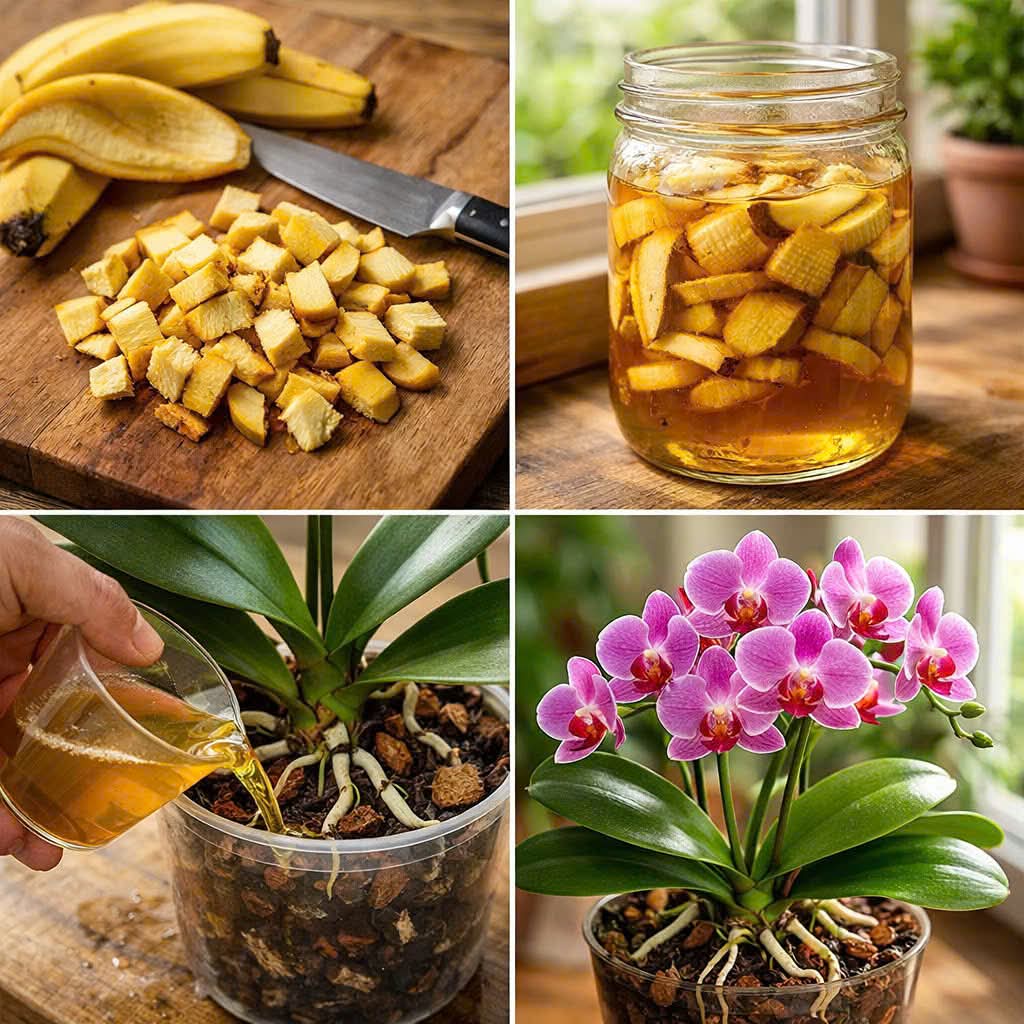
What Actually Makes Orchids Bloom Better – The Real Secrets
Banana peels can help a little – but they are NOT the main secret. If your orchid isn’t blooming, the problem is almost always light, temperature, or watering, not a lack of banana peels.
☀️ 1. Light Is Everything
Orchids (especially Phalaenopsis) need bright, indirect light to produce flower spikes. In low light, they grow leaves but rarely bloom.
Light Level Effect on Orchid
Low (north window, dark corner) Dark green leaves, no blooms
Medium (few feet from east/west window) Occasional blooms
Bright, indirect (right by east/west window) Regular, abundant blooms
Pro tip: If your orchid’s leaves are dark green and floppy, move it closer to a window. If leaves are yellowish or have red edges, it’s getting too much direct sun.
🌡️ 2. Temperature Change – The Proven Bloom Trigger
This is the single most effective technique to induce flowering. Orchids need a temperature drop at night to simulate the change of seasons.
· Daytime: 70–80°F (21–27°C)
· Nighttime (for 2–4 weeks): 55–65°F (13–18°C)
Place your orchid near a cool window (but away from frost) or in a cooler room. After 2–4 weeks, a new flower spike should emerge. This works reliably and is used by professional growers.
💧 3. Proper Watering – Balance Is Key
Overwatering is the #1 cause of orchid problems. Underwatering also stresses the plant.
· When to water: When the potting medium is almost dry. For bark, about once every 7–10 days. For moss, less often.
· How to water: Run room‑temperature water through the pot for 1–2 minutes. Drain completely.
· Signs of overwatering: Yellow, mushy leaves; black, rotten roots.
· Signs of underwatering: Wrinkled, floppy leaves; shriveled roots.
🌿 4. Real Orchid Fertilizer – The Right Way
Instead of relying on banana peels alone, use a fertilizer specifically formulated for orchids.
Fertilizer Type N-P-K Ratio Best For
Balanced (general purpose) 20-20-20 or 10-10-10 Overall health, leaf and root growth
Bloom booster 10-30-20 Encouraging flower spikes (use before blooming season)
Application method: “Weakly, weekly” – dilute to ¼ strength and apply every week during spring and summer. Flush with plain water once a month to prevent salt buildup.
🌱 5. Healthy Roots = Healthy Blooms
Check your orchid’s roots regularly. Healthy roots are firm, green or silvery. Rotten roots are brown, mushy, and flat. Dehydrated roots are wrinkled and papery.
· If you see rot: Remove the orchid from the pot, cut off rotten roots with sterilized scissors, and repot in fresh medium.
· If roots are dehydrated: Increase watering frequency or soak the pot for 10–15 minutes.
Common Orchid Mistakes That Prevent Blooming (Even with Banana Peels)
Mistake Why It’s Harmful Correct Approach
Putting raw banana peels in pot Causes rot, pests, mold Use banana peel tea instead (strained, diluted)
Overwatering Root rot, no blooms Let medium dry between waterings
Too little light Dark leaves, no flower spikes Move to brighter indirect light
No temperature drop Orchids need cool nights to spike Provide 55–65°F nights for 2–4 weeks
Fertilizing while in bloom Shortens flower life Stop fertilizing during bloom
Cutting flower spikes too soon Misses potential secondary blooms Cut spike above a node if still green
Frequently Asked Questions (FAQs)
Q: Can I use banana peels for other orchids (like Dendrobium or Cattleya)?
The same principles apply. Banana peel tea (diluted, strained) can be used occasionally, but never put raw peels in the pot. These orchids also need excellent drainage and airflow.
Q: How often should I use banana peel tea?
Once every 2–3 weeks during the growing season (spring and summer). Do not use in fall and winter.
Q: Can I use banana peel tea on orchids in bloom?
It’s best to avoid any fertilizer (including banana tea) while the orchid is actively flowering. Fertilizer can shorten bloom life. Wait until after the flowers fade.
Q: Is banana peel tea better than commercial orchid fertilizer?
No. Commercial orchid fertilizers are formulated with the correct balance of nitrogen, phosphorus, potassium, and trace minerals. Banana peel tea is a supplement, not a replacement.
Q: My orchid’s leaves are turning yellow after using banana peel tea – why?
Yellowing leaves can indicate over‑watering, root rot, or nutrient imbalance. Stop using the tea, check the roots, and flush the pot with plain water.
Q: Can I freeze banana peels to use later?
Yes – you can freeze peels and thaw them when ready to make tea. Do not use frozen peels directly in the pot.
Q: What about banana peel powder (dried and ground)?
Dried, ground banana peel powder can be mixed into water and used similarly to tea. It still needs to be strained and diluted. Do not sprinkle powder directly into the pot.
Final Verdict – Should You Use Banana Peels for Orchids?
Aspect Verdict
Do banana peels contain beneficial nutrients? Yes – potassium, magnesium, calcium
Can raw peels be placed in orchid pots? No – causes rot, pests, and mold
Is banana peel tea safe? Yes – when made correctly (soaked, strained, diluted)
Does banana peel tea replace regular fertilizer? No – it’s a supplement, not a complete feed
Will banana peels make orchids bloom? Only if light, temperature, and watering are already correct
The bottom line: Banana peels can provide a gentle potassium boost, but they are not a magic solution. The orchids that bloom the most are the ones cared for correctly – with bright indirect light, proper watering, a temperature drop to trigger spikes, and a balanced orchid fertilizer.
If you want to try banana peel tea, use it safely: soak, strain, dilute, and apply occasionally. But don’t expect it to fix underlying care issues. Fix light and temperature first – and you’ll see results faster than any hack.
Now it’s your turn! Have you tried banana peels on your orchids? What worked – or didn’t? Drop a comment below – I’d love to hear your experience.
And if you found this guide helpful, share it with a friend who’s been tempted to bury a banana peel in their orchid pot. Pin it for later, and subscribe to our newsletter for more evidence‑based plant care.
Stay natural, stay smart, and let your orchids thrive. 🌸🍌✨