Why Jade Plant Leaves Turn Yellow – Overwatering Warning
Yellow leaves are often a sign of overwatering. They can also appear from poor drainage, low light, cold temperatures, or nutrient issues. Before adding Epsom salt, check the roots and soil moisture.
If the plant has yellow, mushy leaves, do not fertilize. Let the soil dry and inspect for rot.
Best Soil for Jade Plants – Fast-Draining Potting Mix
Jade plants need a gritty, fast-draining mix. Regular potting soil alone often stays too wet. A succulent mix is better, but even some commercial succulent mixes can benefit from extra drainage material. Choosing the best potting mix for jade plants is half the battle.
Simple Jade Plant Soil Mix
- 2 parts cactus or succulent mix
- 1 part pumice or perlite
- 1 part coarse sand or fine bark
This mix allows water to pass through quickly while still holding enough moisture for roots. The goal is not bone-dry dust; it is airy soil that does not remain soggy.
Best Pot for Jade Plants – Terracotta and Drainage
Terracotta pots are excellent for jade plants because they breathe and help soil dry faster. Plastic pots can work, but they hold moisture longer. Ceramic pots are fine if they have drainage holes. Using a pot with drainage for jade plants is non-negotiable.
A jade plant should not be placed in a pot that is much too large. Extra soil holds extra moisture, and that can cause root rot. Choose a pot only slightly bigger than the root ball.
How to Repot a Jade Plant – Gentle Transplanting
Jade plants do not need frequent repotting. They can live happily slightly root-bound. Repot only when the plant is too crowded, top-heavy, or the soil has broken down. This how to repot jade plants without stress guide will help.
Repotting Steps
- Wait until spring or early summer.
- Let the soil dry before repotting.
- Gently remove the plant from the pot.
- Shake away old compacted soil.
- Trim dead or rotten roots.
- Place in fresh dry succulent mix.
- Do not water immediately if roots were cut.
- Wait several days, then water lightly.
Do not use Epsom salt right after repotting. Let the plant settle first.
How to Prune a Jade Plant – Shaping for Fuller Growth
Pruning helps jade plants become bushier and stronger. A jade plant can become leggy if it does not receive enough light or if it grows without shaping. This how to prune jade plants for bushier growth guide will help.
Pruning Steps
- Use clean sharp scissors or pruners.
- Choose long or weak stems.
- Cut just above a leaf node.
- Remove crossing or damaged branches.
- Let cut ends dry naturally.
- Give the plant bright light after pruning.
New branches often grow below the cut. This creates a fuller plant over time.
How to Propagate Jade Plant Cuttings – Grow New Plants for Free
Jade plants are easy to propagate from stem cuttings or leaves. This how to propagate jade plants from cuttings method is simple and effective.
Stem Cutting Method
- Cut a healthy stem section.
- Remove the lower leaves.
- Let the cut end dry for 3 to 7 days.
- Place in dry succulent mix.
- Wait a few days before watering lightly.
- Keep in bright indirect light.
Leaf Propagation Method
- Gently twist off a healthy leaf.
- Let the end callus for a few days.
- Place it on top of succulent soil.
- Mist very lightly only when needed.
- Wait for roots and a baby plant.
Do not apply Epsom salt to fresh cuttings. Young cuttings need gentle moisture control, not extra salts.
How to Feed Jade Plants Properly – Balanced Nutrition
Jade plants are light feeders. They do not need rich feeding. Too much fertilizer can create weak, soft growth and salt buildup. The best fertilizer for jade plants is used sparingly.
Simple Feeding Schedule
- Feed only during spring and summer
- Use cactus or succulent fertilizer
- Dilute to half strength
- Feed once every 6 to 8 weeks
- Do not feed in winter if growth slows
- Do not combine fertilizer and Epsom salt on the same day
A balanced fertilizer is more complete than Epsom salt. Epsom salt provides magnesium and sulfur, but it does not provide nitrogen, phosphorus, potassium, or a complete trace mineral profile.
Epsom Salt vs Balanced Fertilizer – Understanding the Difference
Epsom salt is a supplement. Balanced fertilizer is nutrition. That distinction matters. This Epsom salt vs succulent fertilizer comparison helps you choose.
A balanced fertilizer gives a plant multiple nutrients. Epsom salt gives mainly magnesium and sulfur. If your jade plant is low in nitrogen, potassium, or phosphorus, Epsom salt will not solve that. If your plant is already high in magnesium, adding more may create imbalance.
Use Epsom salt only occasionally and lightly. For regular feeding, use a proper succulent fertilizer.
How to Prevent Salt Buildup – Soil Maintenance for Potted Succulents
Because potted plants live in a limited amount of soil, minerals can build up over time. This is especially common when using tap water, fertilizer, or mineral supplements. This how to prevent fertilizer salt buildup in succulents guide will help.
Signs of Salt Buildup
- White crust on soil
- White crust on pot rim
- Brown leaf edges
- Slow growth
- Soil surface looking chalky
How to Flush the Soil
- Wait until the plant needs water.
- Place the pot in a sink or outdoors.
- Pour plain water slowly through the soil.
- Let it drain fully.
- Repeat once if needed.
- Let the soil dry completely afterward.
Do not flush too often, because jade plants dislike excess moisture. Flush only when necessary and only if the pot drains well.
Can You Use Table Salt on Jade Plants? – Never
No. Never use table salt on jade plants. Table salt contains sodium chloride, which can damage roots and soil structure. The white crystals used in this trick should be Epsom salt, not kitchen salt, not sugar, and not unknown powder.
If you do not know what the white powder is, do not use it.
Can You Use Sugar on Jade Plants? – No, Attracts Pests
No. Sugar should not be sprinkled on jade plant soil. Sugar can attract ants, fungus gnats, mold, and unwanted microbial growth. Plants make their own sugars through photosynthesis. They do not need sugar poured into the pot.
Can You Use Baking Soda on Jade Plants? – Not Recommended
Baking soda is not a fertilizer and should not be sprinkled into jade plant soil. It contains sodium, and sodium buildup can harm plants. Baking soda is sometimes used in specific diluted sprays for fungal issues, but it is not a general jade plant booster.
Can You Use Eggshell Powder? – Use Sparingly
Eggshell powder is another white powder people use in plant care. It contains calcium carbonate, but it breaks down slowly and may raise soil pH over time. Jade plants do not usually need eggshell powder in pots. If you use it, use only a tiny amount, and do not pile it around the stem.
How to Tell If a Jade Plant Has Magnesium Deficiency – Diagnosis Guide
Magnesium deficiency can show as yellowing between leaf veins, usually on older leaves first. But diagnosis can be difficult because many problems look similar. Low light, overwatering, root damage, and general nutrient deficiency can all cause pale or yellow leaves. This jade plant nutrient deficiency signs guide will help.
Before assuming magnesium deficiency, ask:
- Is the plant getting enough light?
- Is the soil drying between waterings?
- Is the pot draining well?
- Has the plant been fertilized at all?
- Is the soil old and depleted?
- Are the roots healthy?
If the basics are wrong, fix them first.
What to Do If You Used Too Much Epsom Salt – Emergency Fix
If you accidentally sprinkled too much Epsom salt on the soil, remove as much as possible with a spoon. If crystals are on leaves, brush or wipe them away gently. Do not leave piles on the plant.
At the next watering, flush the soil with plain water if the pot drains well. Then let the plant dry fully. Do not fertilize again for several months.
What If the Jade Plant Is Already Blooming? – Minimal Interference
If your jade plant is already blooming, avoid heavy feeding or dramatic treatments. Blooming means the plant is already responding to its environment. During flowering, keep care stable. Give bright light, water only when dry, and avoid moving the plant too much.
A tiny diluted Epsom salt treatment is usually unnecessary during active bloom. If the plant looks healthy, leave it alone.
Why Jade Plants Sometimes Bloom Indoors – Seasonal Cues
Indoor jade plants bloom when they experience the right combination of maturity, light, and seasonal cues. Cooler nights and shorter days can help trigger buds. A plant that spends summer outdoors in bright light and then experiences cooler fall nights may bloom more readily than one kept in the same warm dim room all year.
The flowers are a reward for long-term care. They are not usually the result of one quick trick.
Best Seasonal Care for Jade Plants – Year-Round Guide
Spring
Spring is the beginning of active growth. Increase light gradually, resume light feeding, and prune if needed. This is a good time to repot if the plant needs it.
Summer
Summer is strong growth season. Give bright light, water when dry, and protect from extreme heat. Outdoor jade plants should be acclimated slowly to sun.
Fall
Fall is a good time to reduce watering slightly and allow cooler nights. Mature jade plants may begin preparing for bloom.
Winter
Winter growth slows. Water less often. Do not fertilize heavily. Keep the plant away from cold drafts and freezing windows.
Common Jade Plant Mistakes – What to Avoid
- Watering too often
- Keeping the plant in low light
- Using heavy potting soil
- Choosing a pot without drainage
- Feeding too much
- Sprinkling unknown powders
- Repotting too often
- Moving suddenly from shade to strong sun
- Letting water sit in the saucer
- Trying too many homemade tricks at once
A jade plant responds best to consistency. Keep the care simple.
Safe Natural Alternatives for Jade Plant Care – Gentle Practices
If you prefer natural plant care, focus on safe basics rather than strong kitchen mixtures. This natural jade plant care guide offers simple, effective practices.
Safe Natural Practices
- Use terracotta pots
- Use gritty succulent soil
- Clean leaves with a damp cloth
- Use compost only in very small amounts in the mix
- Give natural sunlight gradually
- Collect rainwater if tap water is very hard
- Prune and propagate regularly
Natural care does not have to mean pouring kitchen scraps into the pot. For succulents, natural often means dry, airy, bright, and simple.
Quick Recipe Card: Epsom Salt Water for Jade Plants – Homemade Tonic
Ingredients:
- 1 liter water
- 1/4 teaspoon Epsom salt
Steps:
- Dissolve Epsom salt completely in water.
- Use only when the soil is dry.
- Pour lightly onto the soil, not the leaves.
- Let the pot drain fully.
- Empty the saucer.
- Do not repeat for 8 to 12 weeks.
Quick Jade Plant Care Checklist – Essential Tips
- Give bright light
- Use gritty succulent soil
- Choose a pot with drainage
- Water only when dry
- Never let the pot sit in water
- Feed lightly in spring and summer
- Use Epsom salt rarely
- Do not sprinkle heavy crystals
- Prune for shape
- Protect from frost
Short Caption for This Trick
“To use the white crystal trick safely on a jade plant, dissolve 1/4 teaspoon Epsom salt in 1 liter of water and apply a small amount only to completely dry soil. Do not sprinkle heavy crystals over the leaves or flowers. Let the pot drain fully and repeat only once every 2 to 3 months during active growth. For real results, give the jade plant bright light, fast-draining soil, careful watering, and a pot with drainage – this natural succulent fertilizer is a gentle supplement, not a miracle cure.”
Frequently Asked Questions – Epsom Salt for Jade Plants Q&A
Can I sprinkle Epsom salt directly on my jade plant?
It is better not to sprinkle it directly. Dissolve it in water first so it spreads evenly and does not create concentrated salt spots.
How much Epsom salt should I use for a jade plant?
Use only 1/4 teaspoon per liter of water. Jade plants do not need strong solutions.
How often can I use Epsom salt on jade plants?
Once every 2 to 3 months during active growth is enough. Many jade plants do not need it at all.
Can Epsom salt make jade plants bloom?
Not by itself. Blooming depends mostly on plant maturity, bright light, cooler nights, dry periods, and overall health.
Can Epsom salt hurt jade plants?
Yes. Too much can cause salt buildup and root stress. Use it lightly and rarely.
Can I use table salt instead?
No. Table salt can harm plants. Never use it as fertilizer.
Should I spray Epsom salt on jade leaves?
No. Soil application is safer. Spraying can leave residue on the leaves.
Why are my jade leaves falling off?
Common causes include overwatering, underwatering, low light, root rot, or sudden environmental changes.
Why is my jade plant not blooming?
It may be too young, not getting enough light, kept too warm year-round, or watered too often. Jade plants need maturity and seasonal cues to bloom.
What is the best fertilizer for jade plants?
A diluted cactus or succulent fertilizer used during spring and summer is usually best. Epsom salt is only a supplement, not a complete fertilizer.
Final Thoughts – The Best Natural Supplement for Healthy Jade Plants
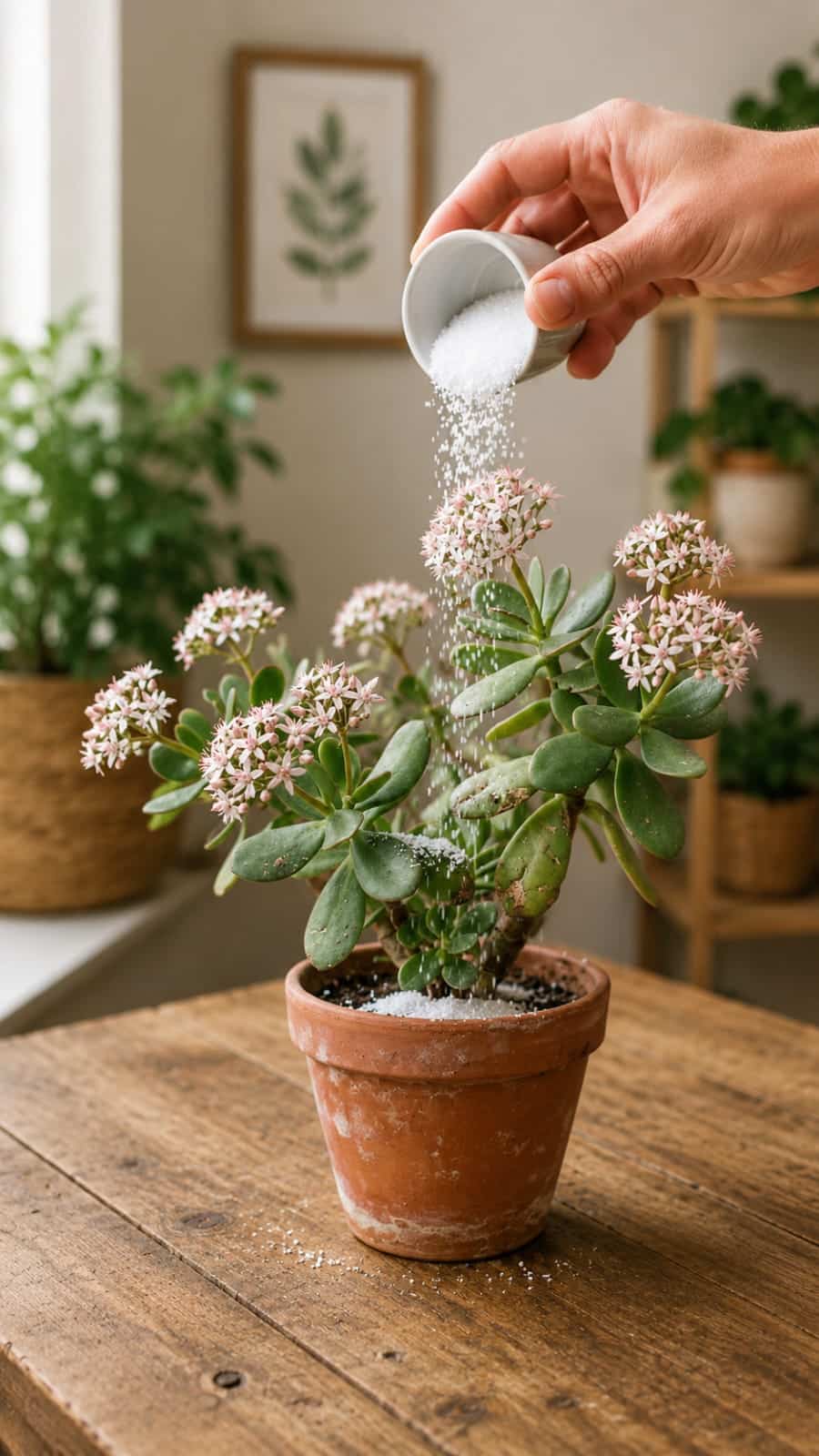
The white crystal trick for jade plants can be useful only when it is used carefully. If the crystals are Epsom salt, they may provide magnesium and sulfur, which can support healthy green growth when a plant truly needs those nutrients. But jade plants are succulents, and succulents do not like heavy feeding, excess salts, or wet soil. That means the dramatic method shown in the image should be softened into a safer routine. This natural jade plant care method is best used as an occasional supplement, not a primary treatment.
Do not shower your jade plant with dry crystals. Do not cover the leaves, flowers, or soil surface with a thick layer. Instead, dissolve a tiny amount of Epsom salt in water and apply it lightly to dry soil only during active growth. Use it rarely, no more than once every 2 to 3 months. If the plant is already healthy, you may not need it at all. Following this complete jade plant care guide will keep your plant thriving for decades.
The strongest jade plants are not created by one trick. They are created by bright light, proper watering, gritty soil, drainage, warmth, and time. A jade plant can live for decades if you avoid overwatering and give it the light it needs. Flowers are possible, but they come from maturity and seasonal care, not from a single spoonful of powder. These professional succulent care secrets will help you succeed.
Use the Epsom salt trick as a small optional boost, not as the foundation of care. Keep the plant dry between waterings. Give it a sunny window. Feed lightly. Prune when needed. Protect it from frost. If you do that, your jade plant can grow into a strong, sculptural, long-lived succulent with firm leaves, woody stems, and, one day, perhaps even clusters of delicate starry flowers.