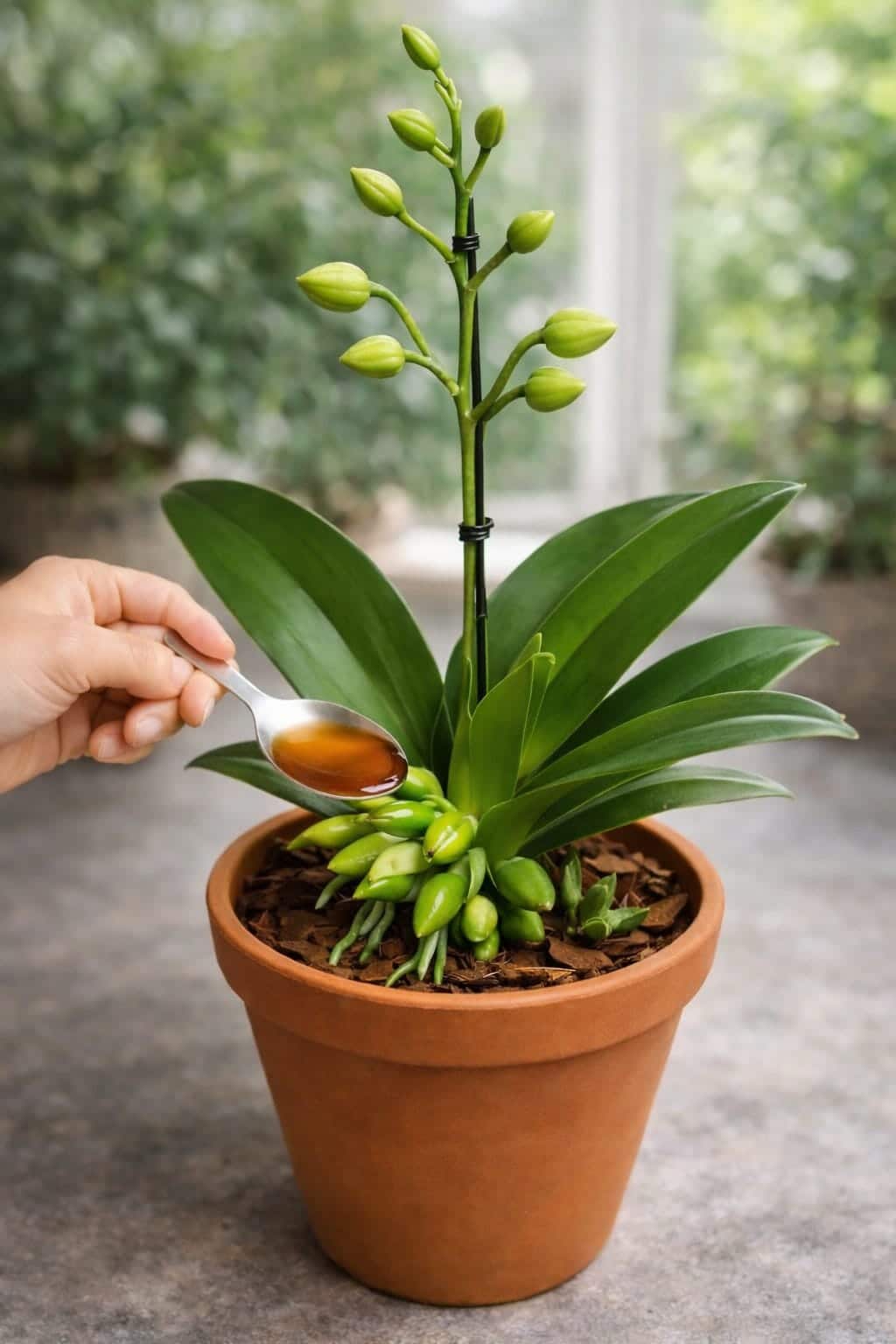
one spoon of honey, sugar, or milk makes orchids bloom like crazy. Does it work? We reveal the truth – plus the real secrets to stunning, long‑lasting orchid flowers.
Let’s be honest: orchids are breathtaking. Their elegant, long‑lasting blooms can transform any room into a tropical paradise. But they also have a reputation for being finicky. You bring home a beautiful flowering orchid, enjoy the blooms for weeks… and then it sits there, year after year, with nothing but leaves and air roots. No flowers. No spike. Just… green.
So when a viral gardening tip promises “one spoon a week for orchids” to trigger “crazy blooming,” it’s hard not to pay attention. The videos are simple: someone pours a spoonful of honey, sugar water, or another kitchen liquid into the pot, and the caption promises more blooms, faster root growth, and a healthier plant.
It sounds almost too good to be true – and that’s because it usually is.
In this guide, I’ll break down what the “one spoon” trick actually is, why most versions are harmful to orchids, and – most importantly – the proven, science‑backed methods that will make your orchid bloom again and again. No magic spoons, just real care.
Let’s separate the viral hype from the horticultural reality.
What Is the “One Spoon” Orchid Trick?
The viral posts show someone adding a spoonful of a common kitchen ingredient to the base of an orchid. The most common substances are:
· Honey – claimed to provide natural sugars and antibacterial properties.
· Sugar water – supposedly gives the plant “energy.”
· Milk – said to provide calcium and nutrients.
· Rice water – starch and trace nutrients.
· Cinnamon water – antifungal claims.
The promise is that one spoonful per week will lead to:
· More and bigger blooms 🌸
· Faster root growth 🌱
· A healthier, more vigorous plant overall
Visually, the videos are convincing. The liquid pours smoothly, the orchid looks happy, and the caption sells hope. But orchids are not like regular houseplants. They are epiphytes – they grow on trees in nature, with exposed roots that absorb moisture and nutrients from the air and rain. Adding sugar, honey, or milk to their potting medium (usually bark or sphagnum moss) can cause serious problems.
⚠️ The Reality: Why Most “One Spoon” Hacks Backfire
Orchids have unique needs. Their roots are covered in a spongy tissue called velamen, which absorbs water quickly but also needs to dry out between waterings. They are adapted to low‑nutrient environments. Adding sugary or protein‑rich liquids disrupts this delicate balance.
❌ Honey – Sticky, Sweet, and Dangerous
Problem Explanation
Encourages bacteria and mold Honey is a sugar. In the warm, moist environment of an orchid pot, it feeds harmful microbes.
Can rot orchid roots Honey residue coats the velamen, preventing proper water and gas exchange. Roots suffocate and rot.
Attracts pests Ants, fungus gnats, and other insects are drawn to sugar.
Does not provide usable nutrients Orchids cannot absorb sugars through their roots. They produce their own through photosynthesis.
Verdict: Do not use honey on orchids.
❌ Sugar Water – The Same Problems
Sugar water is just honey without the antibacterial claims. It still:
· Feeds harmful bacteria and fungi
· Attracts pests
· Coats roots, leading to rot
Verdict: Never pour sugar water into an orchid pot.
❌ Milk – Sours and Clogs
Problem Explanation
Sours and smells Milk spoils quickly in potting medium, creating foul odors.
Clogs air spaces Milk proteins coat bark and roots, reducing airflow.
Promotes mold The fats and proteins in milk are food for mold and bacteria.
Verdict: Milk has no place in orchid care.
❌ Rice Water – Ferments and Attracts Pests
Rice water contains starch, which breaks down into sugars. It:
· Ferments quickly, creating alcohol and acids
· Attracts fungus gnats and fruit flies
· Can cause root rot
Verdict: Not recommended for orchids.
❌ Cinnamon Water – The Only Possible Exception (But Not a Growth Aid)
Cinnamon has mild antifungal properties. A very dilute cinnamon water (a pinch in a cup of water) can be used to water an orchid if you suspect minor fungal issues. However, it does not promote blooming or growth. It is a treatment, not a fertilizer.
Verdict: Not a weekly “blooming” trick.
The Real Secrets to Making Orchids Bloom Like Crazy
If you want your orchid to produce those stunning flower spikes again, forget the kitchen hacks. Focus on the five factors that orchids actually need.
☀️ 1. Bright, Indirect Light – The #1 Bloom Trigger
Orchids (especially Phalaenopsis, the most common type) need plenty of light to bloom. In low light, they grow leaves but rarely flower.
Light Level Effect on Orchid
Low light (north window, dark corner) Dark green leaves, slow growth, no blooms
Medium light (few feet from east/west window) Moderate growth, occasional blooms
Bright, indirect light (right by east/west window, or filtered south window) Light green leaves, strong growth, regular blooms
Pro tip: If your orchid’s leaves are dark green and floppy, it needs more light. Move it closer to a window. If leaves are yellowish or have red edges, it’s getting too much direct sun.
💧 2. Proper Watering – The Foundation of Health
Overwatering is the #1 killer of orchids. It also prevents blooming.
Watering Guideline Details
When to water When the potting medium is almost dry. For bark, this is about once every 7–10 days. For sphagnum moss, less often.
How to check Stick your finger or a wooden skewer into the medium. If it’s dry, water. If damp, wait.
How to water Run room‑temperature water through the pot for 1–2 minutes, allowing it to drain completely. Never let the pot sit in standing water.
Signs of overwatering Yellow, mushy leaves; black, rotten roots; foul smell.
Signs of underwatering Wrinkled, floppy leaves; shriveled roots; slow growth.
Pro tip: Water in the morning so the leaves have time to dry before night. Wet leaves overnight can lead to crown rot.
🌿 3. Use Orchid Fertilizer – The Right Way (Not Kitchen Hacks)
Instead of sugar or honey, use a fertilizer specifically formulated for orchids.
Fertilizer Guideline Details
When to fertilize Spring through fall (active growing season). Reduce in winter.
What to use Balanced orchid fertilizer (e.g., 20-20-20 or 10-10-10) or a bloom‑booster formula (higher phosphorus, like 10-30-20).
How often “Weakly, weekly” – dilute to ¼ strength and apply every week, or follow label directions.
How to apply Water your orchid first (to prevent root burn), then apply the diluted fertilizer. Do not fertilize dry roots.
When to stop When the orchid is in bloom, stop fertilizing. Resume after flowers fade.
Pro tip: Flush the pot with plain water once a month to prevent salt buildup from fertilizer.
🌡️ 4. Temperature Drop Trick – The Real “Secret” That Works Fast
This is the most powerful technique to trigger orchid blooms – and it’s completely free.
Orchids (especially Phalaenopsis) are triggered to bloom by a temperature drop at night. In nature, cooler nights signal the change of seasons and prompt flower spike development.
Step Action
1 During the day, keep your orchid at normal room temperature (70–80°F / 21–27°C).
2 At night, move it to a cooler spot where temperatures drop to 55–65°F (13–18°C) for 2–4 weeks.
3 A cool windowsill (but away from frost) or a cooler room works well.
4 After 2–4 weeks, a new flower spike should emerge from the base of the leaves.
5 Once the spike appears, return the orchid to normal temperatures.
This works reliably and quickly. It’s the “secret” that professional growers use to time orchids for holidays.
🌱 5. Healthy Roots = More Flowers
An orchid with healthy roots will bloom. An orchid with rotten or dehydrated roots will struggle.
Root Condition What to Do
Green or silvery, firm Healthy – continue normal care.
Brown, mushy, flat Rotten – cut off with sterilized scissors. Repot in fresh medium if more than half the roots are rotten.
Wrinkled, papery, dry Dehydrated – increase watering frequency. Soak the pot for 10–15 minutes to rehydrate.
Pro tip: When repotting, use a clear orchid pot with ventilation holes. This allows you to monitor root health without disturbing the plant.
Can Banana Peels Really Boost Orchid Growth? Continue to Page 2
Discover the safer method, the real risks, and the smart orchid care details that many gardeners miss on the first page.