Best Light for Orchid Flowering – Optimal Placement
Orchids need bright indirect light to bloom. Too little light produces dark green leaves but few flowers. Too much direct sun can burn leaves. Providing optimal light for orchid blooming is essential.
Good locations include:
- East-facing window
- Bright balcony with filtered light
- Near a south-facing window with a sheer curtain
- Bright indoor shelf near a window
- Greenhouse with shade cloth
Healthy orchid leaves should usually be medium green. Very dark green leaves often mean the plant needs more light. Yellow scorched patches may mean too much direct sun.
Best Potting Mix for Orchids – Chunky Bark for Airflow
Most common orchids do not grow well in regular soil. They need chunky, airy potting media. Using the best orchid potting mix is half the battle.
A good orchid mix may include:
- Orchid bark
- Charcoal
- Perlite
- Coconut husk chips
- A small amount of sphagnum moss
If your orchid is planted in dense potting soil, it may suffer from root rot. Repotting into proper orchid bark is more important than any homemade trick.
How to Know If Orchid Roots Are Healthy – Root Inspection Guide
Healthy orchid roots are the foundation of flowering. Before using onion water, inspect the roots if possible. This orchid root health check is essential.
Healthy Orchid Roots
- Firm
- Green when wet
- Silver-gray when dry
- Plump
- Not slimy
Unhealthy Orchid Roots
- Brown or black
- Mushy
- Hollow
- Bad smell
- Slimy coating
If most roots are rotten, remove the plant from the pot, trim dead roots with sterilized scissors, and repot in fresh orchid bark.
Should You Use Onion Slices on Orchid Leaves? – No, Avoid This
No. Do not rub onion on orchid leaves. Onion juice can leave residue, smell bad, and irritate delicate leaf tissue. It may also attract insects.
If orchid leaves are dusty, clean them with plain water and a soft cloth. If pests are present, use a proper pest control method such as insecticidal soap, neem oil used carefully, or manual cleaning depending on the pest.
Can Onion Water Replace Orchid Fertilizer? – No, Use Balanced Feeding
No. Onion water is not a balanced fertilizer. Orchids need proper nutrients, especially when they are growing new leaves and roots. The best orchid fertilizer for blooming is a balanced formula used at weak strength.
Use a balanced orchid fertilizer at a weak dose during active growth. Many growers follow the “weakly, weekly” idea, but for beginners, fertilizing every 2 to 4 weeks at weak strength is safer.
A good orchid feeding routine:
- Use orchid fertilizer diluted to half or quarter strength
- Fertilize during active growth
- Flush with plain water occasionally
- Reduce feeding in winter
- Do not fertilize dry, damaged roots heavily
Best Watering Routine for Orchids – When to Water
Orchids usually fail from overwatering more than underwatering. Watering depends on the pot, bark, temperature, humidity, and light. This orchid watering guide for beginners will help you.
A simple rule:
Water when the roots turn silvery and the bark is nearly dry.
When watering, soak the bark thoroughly and let the pot drain completely. Never leave the orchid standing in water.
Onion Water vs Plain Water vs Fertilizer – Comparison Table
| Method | Purpose | How Often |
|---|---|---|
| Plain water | Regular hydration | When bark is nearly dry |
| Orchid fertilizer | Balanced nutrition | Every 2–4 weeks during growth |
| Diluted onion water | Occasional mild support | Every 6–8 weeks at most |
| Fresh bark mix | Root health and airflow | Every 1–2 years or when decomposed |
How to Help a Weak Orchid Recover – Emergency Rescue Plan
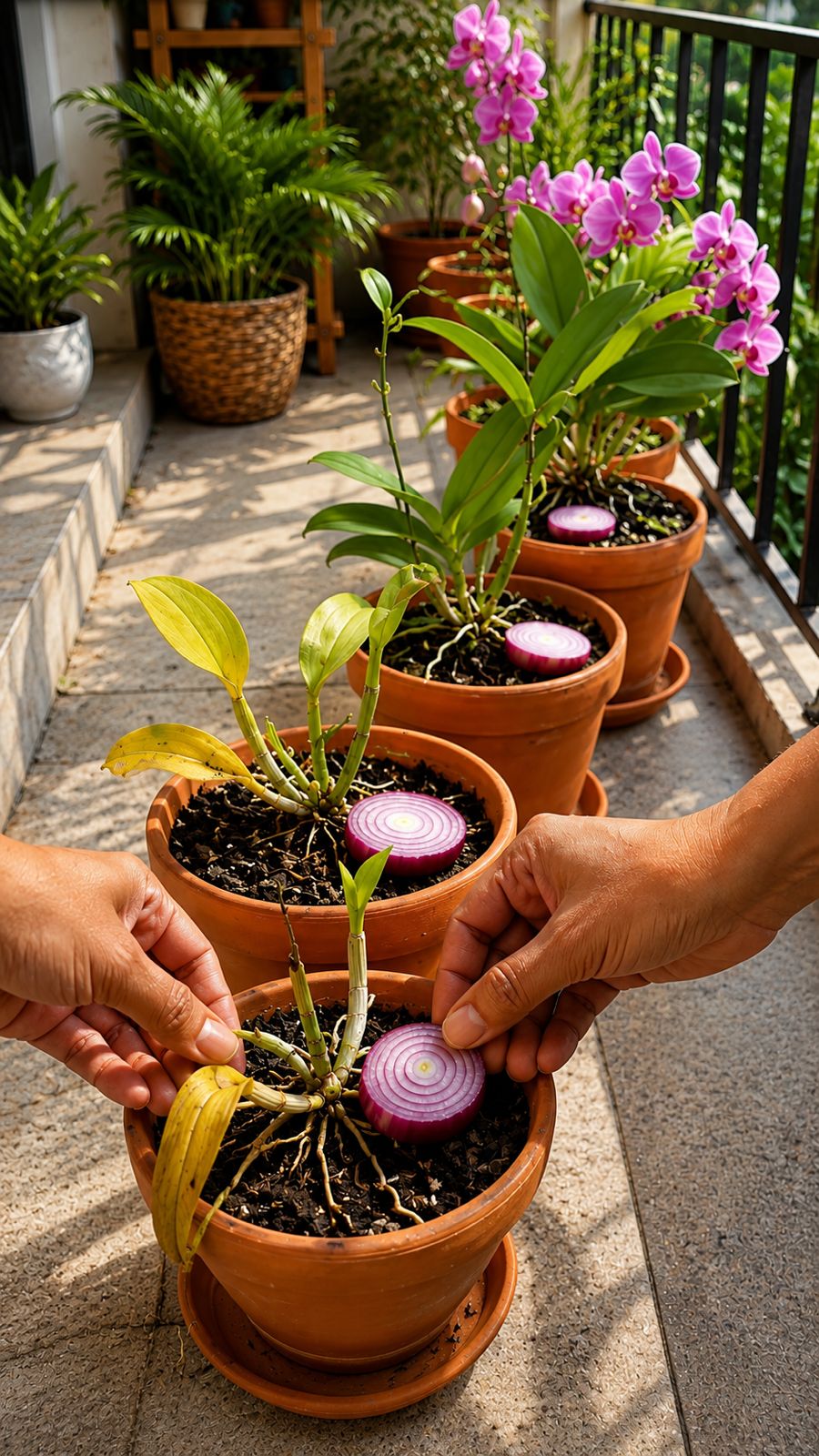
If your orchid looks like the weak plant in the front of the image, follow this recovery plan. This how to save a dying orchid guide is your first step.
Remove any fully yellow or dead leaves only if they detach easily or are clearly dying.
Check the crown for softness or rot.
Inspect the roots if the plant is declining.
Trim rotten roots with sterilized scissors.
Repot into fresh orchid bark if the old mix is broken down.
Place the orchid in bright indirect light.
Water only when the bark is nearly dry.
Use weak orchid fertilizer during active growth.
Use onion water only as an optional mild rinse, not as the main cure.
How to Encourage Orchid Flower Spikes – Proven Techniques
Once the orchid has healthy leaves and roots, you can encourage flowering with proper conditions. These orchid reblooming tips will help you succeed.
- Give bright indirect light
- Keep roots healthy and airy
- Use orchid fertilizer during growth
- Allow a slight nighttime temperature drop
- Avoid overwatering
- Do not repot constantly
- Be patient after the old flowers fall
A healthy Phalaenopsis orchid may bloom once or twice a year, and flowers can last for weeks or months.
Common Mistakes With the Onion Orchid Trick – What to Avoid
- Leaving onion slices in the pot
- Using onion juice directly
- Making the mixture too strong
- Using onion water every week
- Pouring into the orchid crown
- Using it on rotten roots
- Skipping proper orchid fertilizer
- Ignoring old decomposed bark
- Expecting instant flowers
Quick Safe Recipe Card – Onion Water for Orchids
Ingredients
- 1 small onion slice
- 1 liter water
- Extra plain water for dilution
Method
- Place the onion slice in 1 liter of water.
- Soak for 2 to 4 hours only.
- Remove the onion slice.
- Strain the water well.
- Mix 1 cup onion water with 2 cups plain water.
- Pour a small amount through the orchid bark, avoiding the crown.
- Let the pot drain completely.
- Use only once every 6 to 8 weeks at most.
Short Caption for This Trick
“To use onion safely on orchids, do not leave onion slices in the pot. Soak one small onion slice in 1 liter of water for 2 to 4 hours, strain it, dilute it again, and pour a small amount through the orchid bark only when the roots are ready for watering. Keep the crown dry and use rarely – this natural orchid root tonic is gentle when done correctly.”
Frequently Asked Questions – Onion Water for Orchids Q&A
Can I put onion slices directly in orchid pots?
It is not recommended. Onion slices can rot, smell bad, attract pests, and keep the potting mix too wet.
Is onion water good for orchids?
Very diluted onion water may be used occasionally as a mild support rinse, but it is not a complete fertilizer or cure.
Can onion water make orchids bloom?
Onion water alone will not force blooms. Orchids need healthy roots, bright indirect light, proper watering, and balanced nutrition to flower.
How often should I use onion water on orchids?
Use it no more than once every 6 to 8 weeks, and only when the orchid is not rotting.
Can onion water damage orchid roots?
Yes, if it is too strong, unstrained, used too often, or applied to already rotten roots.
Should I spray onion water on orchid leaves?
No. Apply only through the potting media and avoid the crown and leaves.
What is the best fertilizer for orchids?
A balanced orchid fertilizer diluted to weak strength is best during active growth.
Why are my orchid leaves turning yellow?
Yellow leaves can be caused by old age, overwatering, root rot, too much sun, nutrient imbalance, or stress after blooming.
What is the best potting mix for orchids?
Most common orchids grow best in chunky orchid bark with good airflow and drainage.
How do I get my orchid to bloom again?
Provide bright indirect light, healthy roots, correct watering, weak fertilizer, and a slight nighttime temperature drop when appropriate.
Final Thoughts – The Best Way to Use Onion for Orchids
The onion slice trick for orchids is popular because it looks simple, natural, and inexpensive. But orchids are delicate plants with special root needs, so the method must be used carefully. Do not leave onion slices in orchid pots. Do not pour strong onion juice onto the roots. Do not use onion water as a replacement for orchid fertilizer. This natural orchid care guide emphasizes gentleness over gimmicks.
The safe version is a weak onion water infusion, strained and diluted, used only occasionally as a gentle root-zone rinse. Even then, it should be combined with proper orchid care: bright indirect light, fresh orchid bark, good drainage, careful watering, and weak balanced fertilizer during active growth. Following this complete orchid care guide will keep your plant thriving.
If your orchid is weak, focus first on the roots. If the roots are healthy, the leaves can recover and the plant may bloom again later. If the roots are rotten, no kitchen trick will fix the problem until the orchid is cleaned, trimmed, and repotted. These professional indoor plant care secrets will help you succeed.
Used wisely, onion water can be a small natural support step in your orchid care routine. But the real reason an orchid goes from yellow leaves to glossy growth and pink flowers is consistent care, patience, and a healthy root system. Start your orchid recovery journey today with the right fundamentals.