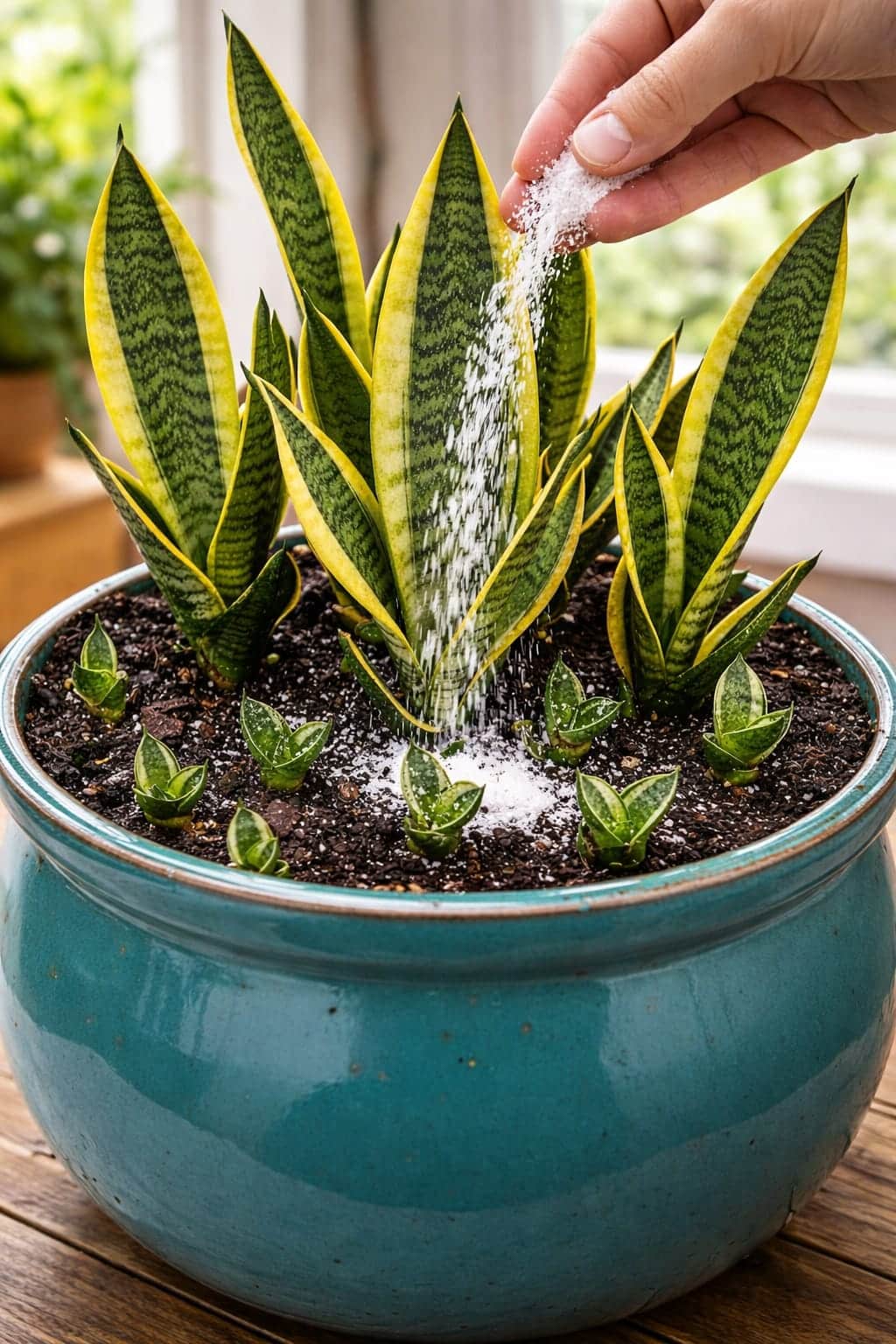
Let’s be honest: snake plants (Sansevieria, now Dracaena) are already superstars. They’re tough, beautiful, and can survive in almost any indoor condition – low light, infrequent watering, and general neglect. But recently, a viral trend has been spreading online: sprinkling white powder (like sugar, salt, or baking soda) on snake plants to boost growth.
The videos look convincing. You see a spoonful of white granules dusted over the soil, and the caption promises “more pups,” “faster growth,” and “stronger roots.” It sounds simple. It sounds effective. But is it actually safe?
Here’s the truth: most of these powders can harm your snake plant. Salt dehydrates roots. Sugar feeds harmful bacteria and attracts pests. Baking soda alters soil pH and doesn’t promote growth. The viral “hack” is not only ineffective – it can kill your plant.
In this guide, I’ll explain why you should avoid these powders, what the real science says about snake plant growth, and – most importantly – the proven methods to encourage more pups, stronger leaves, and a thriving plant.
Let’s separate the viral hype from the horticultural reality.
Why the “Sprinkling Powder” Trend Went Viral
The trend follows a classic viral formula:
- Simple visual: A spoonful of white powder looks like a “secret ingredient.”
- Big promise: “More pups,” “faster growth,” “stronger roots.”
- Engagement bait: Viewers are encouraged to try it and share results.
But simplicity and engagement don’t equal effectiveness. In most cases, these powders do nothing beneficial – and often cause harm.
What Are People Actually Sprinkling?
Powder Claimed Benefit Actual Effect
Sugar Provides energy, boosts growth Feeds harmful bacteria and fungi; attracts pests; causes root rot
Salt Kills pests or diseases Dehydrates roots; causes root burn; can kill the plant
Baking soda Prevents fungus, promotes growth Alters soil pH; can stress roots; does not provide nutrients
Cinnamon Natural antifungal Mild antifungal effect on surface, but does not promote growth
None of these are fertilizers. They do not provide the nitrogen, phosphorus, and potassium that snake plants need to grow. In fact, they disrupt the delicate balance of soil microbes and can lead to long‑term damage.
Why You Should Avoid These Methods – The Science
❌ Salt – The Silent Killer
Salt (sodium chloride) is hygroscopic – it pulls moisture out of plant roots through osmosis. When salt accumulates in soil:
· Roots lose water, causing dehydration and wilting.
· Leaf tips turn brown and crispy.
· In high concentrations, salt burns roots and kills the plant.
Snake plants are succulents adapted to dry conditions, but they cannot tolerate high soil salinity. Even a small amount of salt can cause long‑term damage. Never add salt to your snake plant’s soil.
❌ Sugar – Feeds the Wrong Things
Plants produce their own sugar through photosynthesis. Adding sugar to the soil does not provide usable energy – roots cannot absorb sucrose. Instead, sugar:
· Feeds harmful soil bacteria and fungi, leading to root rot.
· Attracts ants, fungus gnats, and other pests.
· Encourages mold growth on the soil surface.
Sugar water is sometimes used for cut flowers (to extend vase life), but it has no place in potted plant soil. Skip the sugar.
❌ Baking Soda – Not a Growth Booster
Baking soda (sodium bicarbonate) is sometimes used in gardens to treat powdery mildew on leaves. It is not a fertilizer. Adding it to soil:
· Raises soil pH, making it more alkaline. Snake plants prefer slightly acidic to neutral pH (6.0–7.0).
· Can cause nutrient lockout – essential minerals become unavailable.
· Does not provide nitrogen, phosphorus, or potassium.
If you have a fungal issue on leaves, a very diluted baking soda spray (1 tsp per quart of water) can be used as a treatment – but do not sprinkle dry powder on soil or leaves.
✅ Cinnamon – The Only Exception (But Not a Growth Aid)
Cinnamon has natural antifungal properties. Sprinkling a small amount on the soil surface can help prevent mold and fungus gnats. It is not a fertilizer and does not promote growth or pups. It’s a mild preventive measure – not a growth hack.
What Actually Makes Snake Plants Grow Faster and Produce More Pups?
If you want a thriving, pup‑producing snake plant, forget the powders. Focus on these five proven factors.
☀️ 1. Give Them Bright, Indirect Light – The #1 Growth Factor
Snake plants are famous for tolerating low light, but they thrive – and produce more pups – in brighter conditions.
Light Level Effect on Snake Plant
Low light (north window, dark corner) Survives, but grows very slowly; few or no pups; leaves may become dark green and floppy
Medium light (few feet from east/west window) Moderate growth; occasional pups
Bright, indirect light (right by east/west window, or filtered south window) Fast growth, vibrant color, abundant pups
Pro tip: If your snake plant hasn’t produced a pup in over a year, move it closer to a window. The difference can be dramatic.
🌱 2. Keep Them Slightly Root‑Bound – The Pup Trigger
Snake plants naturally produce pups (offsets) when their roots feel “tight” in the pot. This is a survival mechanism – when the plant senses it’s running out of space, it reproduces.
· Do not rush to repot. Snake plants like being crowded. Repot only every 2–3 years, or when roots are visibly growing out of the drainage holes.
· Choose the right pot size. When you do repot, go up only 1–2 inches in diameter. A pot that’s too large encourages root growth instead of pup production.
· If you want pups, keep the plant slightly root‑bound. This is one of the most effective tricks.
💧 3. Water the Right Way – Where Most People Go Wrong
Overwatering is the #1 killer of snake plants. It also slows growth and prevents pup production.
Watering Guideline Details
When to water Only when the soil is completely dry all the way through. Stick your finger 2–3 inches into the soil – if dry, water; if damp, wait.
How often In bright light: every 2–3 weeks. In low light: every 4–6 weeks or even less.
How to water Water thoroughly until it runs out the drainage holes. Empty the saucer immediately.
Signs of overwatering Yellowing, mushy leaves; foul smell from soil; root rot.
Signs of underwatering Wrinkled, curling leaves; brown, crispy tips.
Pro tip: Snake plants produce more pups when they experience mild drought stress. Let the soil dry out completely between waterings – this signals the plant to reproduce.
🌿 4. Use Proper Fertilizer – Not Kitchen Hacks
Skip the sugar, salt, and baking soda. Use real fertilizer designed for houseplants.
Fertilizer Guideline Details
When to fertilize Spring and summer (active growing season). Stop in fall and winter.
What to use Balanced, water‑soluble houseplant fertilizer (e.g., 10-10-10) diluted to half strength. Or use worm castings (a natural, gentle fertilizer).
How often Once every 4–6 weeks during spring and summer.
What to avoid High‑nitrogen fertilizers (they encourage leaf growth at the expense of pups). Balanced is best.
Worm castings are excellent for snake plants. Mix 1–2 tablespoons into the top inch of soil every 2–3 months. They provide slow‑release nutrients and beneficial microbes without the risk of over‑feeding.
🌡️ 5. Maintain Warm Indoor Conditions
Snake plants are tropical. They grow fastest in warm temperatures.
· Ideal temperature: 65–85°F (18–29°C).
· Avoid: Temperatures below 50°F (10°C) – cold slows growth and can damage leaves.
· Humidity: Average indoor humidity is fine. They don’t need misting.
Pro tip: In winter, if your home is cool, reduce watering even further. The plant goes semi‑dormant and needs very little water.
Common Mistakes That Slow or Stop Growth
Mistake Why It’s Harmful Correct Approach
Adding sugar, salt, or baking soda Damages roots, disrupts soil, attracts pests Use proper fertilizer or worm castings
Overwatering Root rot, yellow leaves, no pups Water only when soil is completely dry
Repotting too often Plant focuses on root growth, not pups Repot every 2–3 years only
Too large a pot Excess soil holds moisture, roots stay wet Use a pot only 1–2 inches larger than root ball
Low light Slow growth, no pups Move to brighter, indirect light
Cold temperatures Stunted growth, leaf damage Keep above 60°F (15°C)
Pro Tip: How to Get More Snake Plant Pups (The Right Way)
Want to see those baby plants popping up? Here’s a step‑by‑step plan:
- Move your snake plant to bright, indirect light – an east or west window is ideal.
- Allow the soil to dry out completely between waterings. Slight drought stress triggers pup production.
- Keep it slightly root‑bound. Do not repot unless roots are bursting out.
- Fertilize lightly with a balanced liquid fertilizer once a month in spring and summer.
- Be patient. Pups usually appear in spring and summer. They may take several weeks to emerge after you improve conditions.
What to expect: Once conditions are right, you’ll see small green shoots emerging from the soil near the mother plant. These are pups. Let them grow to at least 4–6 inches before separating (or leave them to create a fuller cluster).
Frequently Asked Questions (FAQs)
Q: Can I use cinnamon on my snake plant?
Yes – cinnamon has mild antifungal properties. A light dusting on the soil surface can help prevent mold. It does not promote growth or pups. Use sparingly.
Q: Is Epsom salt good for snake plants?
Epsom salt (magnesium sulfate) is sometimes used to correct magnesium deficiency. If your plant has yellowing between leaf veins, a very diluted solution (1 tsp per gallon of water) once a month can help. It is not a general fertilizer. Do not overuse.
Q: How do I know if my snake plant needs fertilizer?
Signs of nutrient deficiency: pale or yellow leaves, slow growth, no pups. If your plant is otherwise healthy (good light, proper water) but still not performing, it may need feeding.
Q: Can I use coffee grounds on my snake plant?
No. Coffee grounds are acidic and can lower soil pH too much. They also tend to compact, reducing drainage. Compost them first, then use sparingly in outdoor gardens – not on indoor snake plants.
Q: Why isn’t my snake plant producing pups?
Most likely: not enough light, too much water, or the pot is too large. Move to brighter light, let soil dry out completely between waterings, and ensure the pot is not oversized. Pups often appear in spring and summer.
Q: How long does it take for a snake plant pup to grow?
Once a pup emerges, it can take several months to reach a good size (4–6 inches). Be patient – snake plants are slow growers.
Q: Can I propagate a snake plant from a leaf cutting?
Yes – cut a leaf into 2–3 inch sections, let the cut ends callus for 2–3 days, then plant in moist soil. New roots and pups will form in 2–3 months. This is slower than waiting for natural pups.
Final Thoughts – No Hacks, Just Good Care
Snake plants don’t need hacks – they just need the right care. While viral tricks may look convincing, many of them (sugar, salt, baking soda) can actually harm your plant over time. Instead, focus on the fundamentals:
· Bright, indirect light – more light = faster growth, more pups.
· Proper watering – let the soil dry completely between waterings.
· Slightly root‑bound – don’t repot too often or use oversized pots.
· Gentle feeding – a balanced fertilizer or worm castings in spring and summer.
· Warm temperatures – keep above 60°F (15°C).
That’s the real secret behind a thriving, fast‑growing snake plant. And when you get it right, you’ll suddenly see multiple baby plants popping up at once – no powder required.
Now it’s your turn! Have you tried any of these viral “powder” tricks? What worked – or didn’t? Drop a comment below – I’d love to hear your experience.
And if you found this guide helpful, share it with a friend who’s been tempted by snake plant hacks. Pin it for later, and subscribe to our newsletter for more evidence‑based plant care.
Stay green, stay patient, and let your snake plant thrive. 🌿✨