When Is the Best Season to Use It?
The best time to use the white crystal trick is during the growing season, usually spring or summer. This is when the plant has more light and warmth, and when it is more likely to produce new leaves and pups.
Avoid using mineral supplements in winter unless the plant is actively growing under bright conditions. In winter, snake plants often slow down and use less water. Adding supplements during a slow period can lead to buildup in the soil.
If you see new pups emerging, that is a sign the plant is active. This is the best time for a very light support treatment if you choose to use one.
Season matters because plants use nutrients more effectively when they are actually growing.
Can the White Crystals Make Leaves Brighter?
If a snake plant is truly low in magnesium, a very weak Epsom salt treatment may help support greener growth over time. But it will not dramatically change existing leaves overnight.
The yellow edges on variegated snake plants are natural. They are not a problem to fix. The green patterns and yellow stripes are part of the plant’s beauty.
If leaves look dull, they may simply be dusty. Wipe them with a damp cloth. If leaves look pale, the plant may need more light. If leaves are yellow and soft, the plant may be overwatered.
Color problems are not always nutrient problems. Diagnose before adding anything.
How to Keep Snake Plant Leaves Glossy
The easiest way to make a snake plant look healthier is to clean the leaves. Dust can hide the plant’s natural shine and reduce the light reaching the leaf surface.
Use a soft damp cloth. Support each leaf gently and wipe from base to tip. Do not use oils, mayonnaise, milk, or commercial leaf shine products. These can leave residue and attract dust.
If white crystals land on the leaves, wipe them off. Do not leave mineral particles sitting on the foliage. They can leave marks when wet or dry.
Clean leaves make the plant look instantly brighter and allow it to use light more efficiently.
Can White Crystals Burn the Pups?
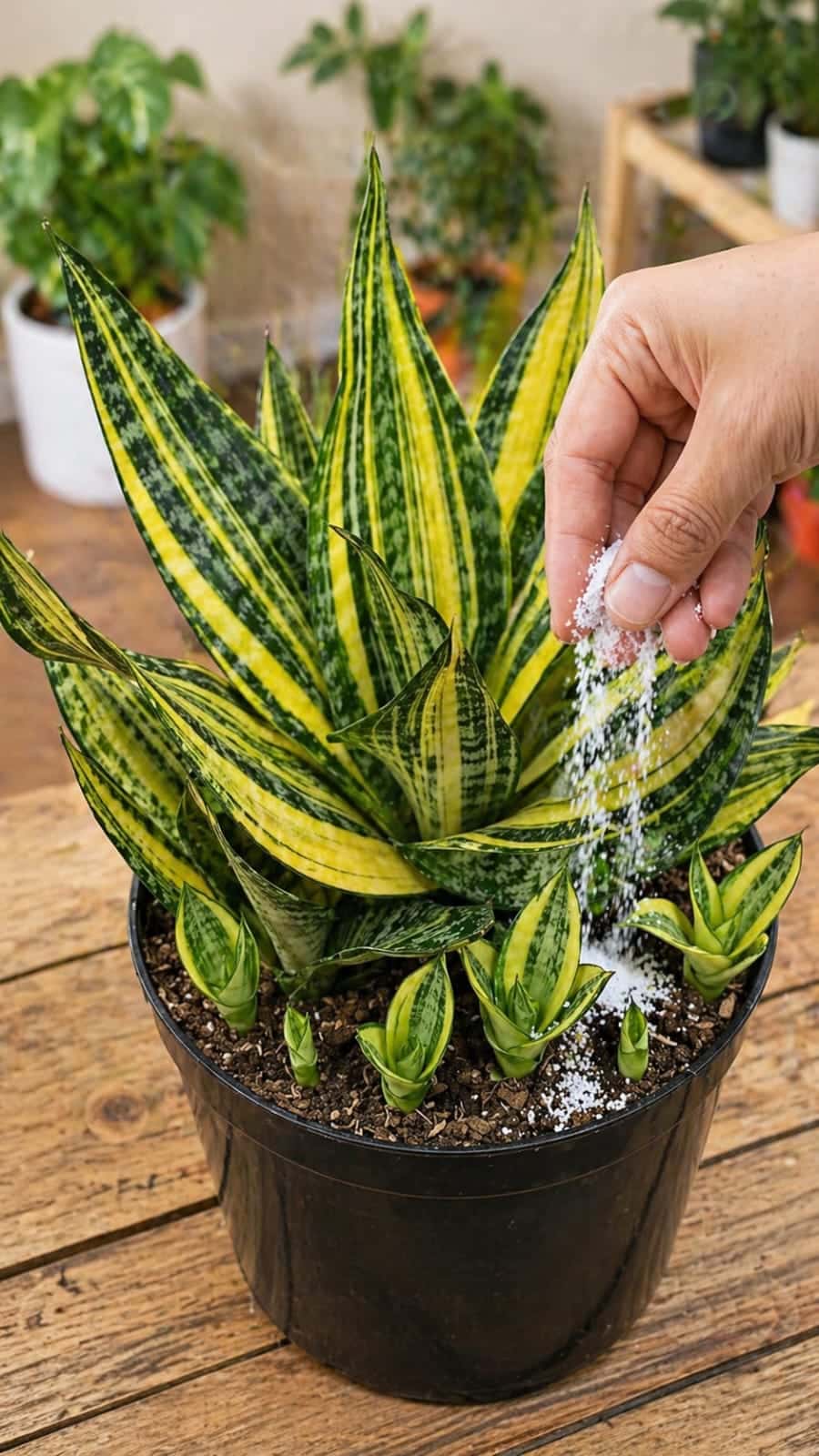
They can if used too heavily or piled directly around small pups. Young shoots are tender, and concentrated mineral salts can stress delicate tissues. This is why the sprinkle should be very light and spread out.
Keep crystals away from the tight center of the pups. Apply around the soil surface, not inside the leaf rosettes. If crystals fall into a pup, gently brush them away.
For pots with many tiny pups, the dissolved weak solution may be safer than dry crystals because it spreads more evenly.
Young growth is exciting, so protect it from concentrated treatments.
Can This Trick Help a Weak Snake Plant?
Only in very specific cases. If the plant is weak because it lacks magnesium, a tiny Epsom salt treatment may help over time. But most weak snake plants are struggling because of watering, light, soil, or root problems.
If leaves are mushy, stop watering and inspect the roots. If leaves are wrinkled and dry, water properly. If the plant is not growing, move it to brighter indirect light. If the soil is heavy, repot into gritty mix.
Do not sprinkle minerals on a plant that is already stressed without knowing the cause. A stressed plant can be more sensitive to salt buildup.
The white crystal trick is best for maintenance, not emergency rescue.
What If the Soil Turns White or Crusty?
A white crust on soil can be a sign of mineral buildup. This may come from fertilizer, hard water, or too much Epsom salt. If you see crust, stop using mineral supplements.
Remove the top layer of soil and replace it with fresh gritty mix. When watering, water deeply enough that excess drains out, then empty the saucer. This helps flush some buildup from the pot.
If buildup is severe, repot the plant into fresh soil. Use filtered water if your tap water is very hard.
A light sprinkle is one thing. A crusty soil surface is a sign that minerals are accumulating.
What If Leaves Turn Brown After Using It?
Brown tips or edges after using white crystals may indicate salt stress, underwatering, overfertilizing, or inconsistent care. If the browning appears soon after a strong application, you may have used too much.
Flush the soil with plain water if the pot drains well, or repot if you are worried about buildup. Avoid adding more supplements. Keep the plant in bright indirect light and water only when dry.
Trim brown tips only if they bother you visually, but do not cut into healthy green tissue too aggressively.
Brown leaves are a signal to simplify the care routine.
What If Leaves Turn Yellow?
Yellow leaves are often caused by overwatering, especially if they are soft or mushy. Epsom salt will not fix that. If leaves turn yellow after using the trick, check the soil moisture and root health.
If the soil is wet, let it dry. If several leaves are yellowing from the base, remove the plant from the pot and inspect the rhizomes. Healthy rhizomes are firm. Rotten rhizomes are soft, dark, or smelly.
Cut away rotten sections and repot into fresh dry gritty mix. Do not add more white crystals until the plant is healthy again.
Yellowing is usually a care issue, not a sign that the plant needs more minerals.
Can You Combine White Crystals With Fertilizer?
It is better not to combine them at the same time. Fertilizer already contains nutrients and salts. Adding Epsom salt on top can increase the risk of buildup.
If you use a balanced fertilizer, skip the white crystal trick unless there is a specific reason. If you use Epsom salt, wait several weeks before fertilizing.
Snake plants do not need a lot of feeding. Too much nutrition can cause weak growth or root stress.
One light supplement at a time is safer than stacking multiple treatments.
Can You Use This Trick With Rice Water or Banana Peel Water?
Do not use all these tricks together. Rice water, banana peel water, Epsom salt, eggshell powder, coffee, and fertilizer can create a confusing mix of residues and minerals in the soil.
If you want to try the white crystal trick, use plain water for the next several waterings. Watch how the plant responds. If the plant stays healthy, you can repeat very rarely.
Mixing many homemade tricks does not make a plant grow faster. It often creates soil problems.
Simple care is best for snake plants.
Can This Trick Be Used on Other Houseplants?
A weak Epsom salt solution is sometimes used on certain houseplants, but not every plant needs it. Some plants are more sensitive to salts than others. Succulents and slow-growing plants should be treated carefully.
Do not sprinkle white crystals on every plant in your home. Use supplements only when there is a reason and only in small amounts.
For most houseplants, a balanced fertilizer used correctly is more reliable than random mineral treatments.
Snake plants are tough, but even they can be stressed by too much salt.
A Safe White Crystal Snake Plant Routine
Here is a simple routine for using the trick safely:
- Use only Epsom salt or another known plant-safe mineral amendment.
- Make sure the snake plant is healthy and actively growing.
- Apply only during spring or summer.
- Use a tiny amount, or dissolve 1/4 teaspoon in 1 gallon of water.
- Apply only when the soil is dry and ready for watering.
- Keep crystals away from leaf centers and small pups.
- Let excess water drain completely.
- Do not repeat for at least two to three months.
- Use plain water most of the time.
- Stop immediately if the soil becomes crusty or the plant reacts badly.
This routine keeps the trick gentle and avoids the biggest risk: overuse.
Common Mistakes With the White Crystal Trick
Using Too Much
A large handful of crystals can stress the roots. Use only a tiny amount.
Using Table Salt by Mistake
Table salt can harm plants. Only use Epsom salt if you are doing this trick.
Sprinkling Inside Pup Centers
Small pups are tender. Keep crystals on the soil, not inside the leaves.
Using It on a Sick Plant
Root rot, yellow mushy leaves, and wet soil need correction, not minerals.
Repeating Too Often
Once every two to three months during growth is enough, if needed.
Combining With Other Tricks
Do not mix Epsom salt with banana water, rice water, coffee, fertilizer, or baking soda treatments.
Ignoring Light
Light drives growth. A mineral sprinkle cannot replace bright indirect light.
Signs the Trick Is Working Safely
If the trick is working safely, the plant should remain firm and upright. The pups should continue growing without browning or softening. The soil should not become crusty. There should be no sour smell, no mold, and no sudden yellowing.
Over time, the plant may produce stronger new growth if it was missing magnesium or if the light and care routine are good. But the improvement will be gradual. Snake plants grow slowly.
The best sign is a stable plant that continues producing healthy leaves and pups.
Do not expect instant transformation. The trick is a gentle support, not a dramatic cure.
Signs You Should Stop Using It
Stop using the white crystal trick if the leaf tips brown, soil develops a white crust, pups look burned, leaves yellow, or the plant stops looking healthy. Return to plain water and simple care.
If you suspect buildup, flush the soil with plain water if the pot drains well. If the soil is old or compacted, repot into fresh gritty mix.
Do not keep adding more minerals to fix a problem caused by too many minerals.
When in doubt, simplify.
Frequently Asked Questions
What is the white crystal sprinkled on snake plants?
It is most commonly interpreted as Epsom salt, which is magnesium sulfate. It should be used very lightly and rarely.
Is Epsom salt good for snake plants?
It can be used occasionally in a very weak amount, but snake plants do not always need it. Too much can cause salt buildup.
How much Epsom salt should I use?
A safe weak recipe is 1/4 teaspoon Epsom salt dissolved in 1 gallon of water. Use only during active growth and not often.
Can I sprinkle it dry on the soil?
You can use a tiny pinch, but dissolving it in water is usually safer and more even.
Can I use table salt?
No. Table salt can damage plant roots and should never be used as a plant supplement.
Can this make my snake plant grow more pups?
It may support growth slightly if the plant needs magnesium, but pups mainly come from healthy rhizomes, bright light, good soil, and proper watering.
Can this fix yellow leaves?
Usually no. Yellow leaves are often caused by overwatering, root rot, or stress. Check the roots and soil first.
Can I use this every week?
No. That is too often. Use it rarely, about once every two to three months during the growing season, if needed.
Can I combine it with fertilizer?
It is better not to use both at the same time. Too many minerals can build up in the soil.
What is more important than this trick?
Bright indirect light, fast-draining soil, drainage holes, careful watering, and healthy rhizomes are much more important.
Final Thoughts
The white crystal snake plant trick looks simple and powerful because it gives the plant a visible boost. A pinch of white crystals falling around fresh pups makes it seem like the secret to a fuller snake plant is sitting right in your hand. And used carefully, this trick can be a small part of a healthy care routine.
The safest version is a very weak Epsom salt treatment used rarely during the growing season. Epsom salt contains magnesium and sulfur, and magnesium can support green growth when a plant truly needs it. But snake plants are slow-growing and do not need frequent supplements. Too much can create salt buildup and stress the roots.
Never confuse Epsom salt with table salt. Never use sugar, flour, cornstarch, baking soda, or random white powders in snake plant soil. Keep any crystals away from small pup centers and leaf bases. Do not use the trick on a sick, mushy, or overwatered plant.
If your snake plant is healthy, actively growing, and producing pups, a tiny mineral boost may support the process. But the real reason snake plants become full and beautiful is not one sprinkle. It is bright indirect light, gritty soil, proper drainage, careful watering, warm conditions, and time.
Use the white crystal trick as a gentle seasonal touch, not a regular habit. Keep the plant clean, let the soil dry between waterings, and protect the rhizomes from rot. With patience and steady care, your snake plant can continue sending up strong leaves and fresh pups, becoming fuller and more impressive year after year.