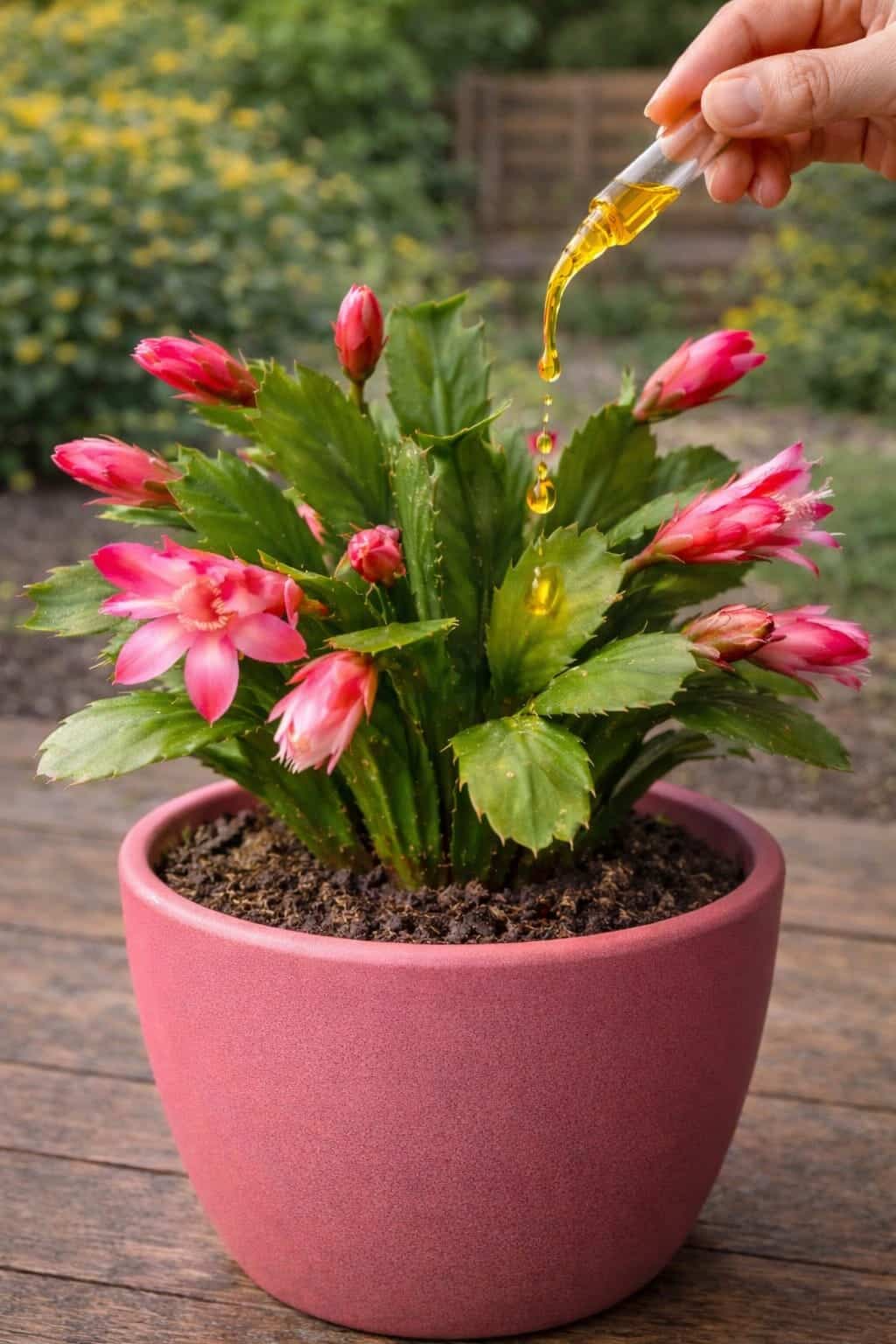
⚠️ The Truth About Blooming: It’s Not About Feeding
Many gardeners assume: “More nutrients = more flowers.” But with Christmas cactus, the opposite is often true.
What Over‑Feeding Does
Mistake Consequence
Too much nitrogen Promotes leafy growth at the expense of flowers.
Over‑fertilizing Salt buildup burns roots, stresses the plant.
Feeding during bud formation Can cause bud drop or weak blooms.
Strong, undiluted solutions Damages tender roots.
👉 Blooming is triggered by environmental signals, not fertilizer strength. The golden liquid only helps after the plant is already healthy and conditions are correct.
🌸 The Real Bloom Trigger (What Professionals Know)
If you want flowers, focus on this proven system. The golden liquid is optional; these factors are essential.
✅ The Bloom Triggers
Factor Ideal Condition Why It Works
Cool nights 50–60°F (10–15°C) for 6–8 weeks Signals seasonal change → bud initiation.
Long, uninterrupted darkness 12–14 hours of darkness each night Mimics shorter winter days.
Stable environment No moving, no drafts, no temperature swings Prevents bud drop.
Slightly reduced watering Allow top inch to dry out before watering Mild stress encourages reproduction (blooms).
Bright indirect light during the day East or north‑east window Energy for growth and bud development.
👉 This is what actually triggers blooming. The golden liquid only helps support the plant once these conditions are met.
🌿 When to Use the Golden Liquid (Correct Timing)
If you want to use a golden liquid, timing is everything. Use it strategically, not randomly.
✅ Safe Feeding Schedule
· During active growth (spring and summer) – when the plant is producing new segments.
· Once every 3–4 weeks – not weekly.
· Always diluted – use quarter strength or less.
❌ When to Avoid
· During bud formation (late summer to early autumn) – can interfere with flowering.
· During full bloom – shortens flower life.
· During cold stress or dormancy (winter) – the plant rests.
· When soil is already moist – wait until dry.
👉 Feeding at the wrong time = fewer flowers (or none at all).
🌱 Step‑by‑Step Care Routine for Maximum Blooms
Follow this system instead of relying on shortcuts. The golden liquid is a small part of a larger, proven routine.
- Light – Bright Indirect Light Year‑Round
· Ideal: East or north‑east window. Bright, indirect light.
· Avoid: Direct afternoon sun (scorches leaves) and deep shade (no blooms).
- Watering – Consistent but Light Moisture
· When to water: When the top inch of soil feels dry.
· How to water: Thoroughly, until it runs out the drainage holes. Empty the saucer.
· During bud formation (autumn): Slightly reduce watering – let the top inch dry out a little more than usual.
- Soil – Light, Airy, Well‑Draining Mix
· Best mix: 2 parts potting soil + 1 part perlite + 1 part orchid bark or coarse sand.
· Avoid: Heavy, water‑retentive soil – causes root rot.
- Feeding – Light, Seasonal, Diluted
· Spring & summer: Once every 3–4 weeks with diluted balanced fertilizer (e.g., 10-10-10 at quarter strength).
· Autumn & winter: Stop feeding – the plant is preparing to bloom or resting.
- Rest Period – The Bloom Trigger (Autumn)
· Start 6–8 weeks before desired bloom time (e.g., early October for Christmas blooms).
· Provide 12–14 hours of complete darkness every night. Cover with a box or place in a dark closet. Even a hallway light can disrupt bud formation.
· Keep night temperatures at 50–60°F (10–15°C).
· Reduce watering – allow the top inch of soil to dry out before watering.
· Do not move the plant once buds appear – stability is critical.
- After Blooming – Rest and Recover
· Remove spent flowers.
· Reduce watering for 4–6 weeks.
· Resume normal care in spring.
Christmas Cactus Growth Optimization Table – Quick Reference
Factor Ideal Condition Impact on Plant
Light Bright, indirect (east/north‑east window) Energy for growth and buds
Water Slightly moist – water when top inch dries Healthy stems, no rot
Soil Airy, well‑draining (potting soil + perlite + bark) Root stability
Feeding Light & seasonal (spring/summer, diluted) Growth support
Temperature (night) 50–60°F (10–15°C) for 6–8 weeks (autumn) Flower trigger
Darkness 12–14 hours uninterrupted nightly Bud development
Stability Do not move during budding Prevents bud drop
Frequently Asked Questions (FAQs) – Christmas Cactus Care
- Why is my Christmas cactus not blooming?
Most common reasons: insufficient light, lack of cool nights, or no long darkness period. Also, moving the plant during budding causes bud drop.
- How long does it take to rebloom?
Typically once a year, after the autumn rest period. With proper care, some varieties may bloom again in spring.
- Can I use fertilizer year‑round?
No – only during the active growing season (spring and summer). Stop feeding in autumn and winter.
- What type of fertilizer is best?
A balanced, water‑soluble fertilizer (e.g., 10-10-10) diluted to quarter strength. Avoid high‑nitrogen formulas.
- Should I prune my Christmas cactus?
Yes – after blooming, twist off 1–2 segments from the ends of branches to encourage bushier growth and more flowers next year.
- Why are the buds falling off?
Bud drop is caused by environmental stress: moving the plant, temperature swings, drafts, overwatering, or underwatering during bud formation.
- Can it tolerate direct sunlight?
No – direct afternoon sun scorches the leaves. Bright, indirect light is best.
- How often should I water it?
When the top inch of soil feels dry. In bright light, every 7–10 days; in lower light, less often.
- What soil is best for Christmas cactus?
Light, well‑draining soil – a mix of potting soil, perlite, and orchid bark or coarse sand.
- Can I propagate it easily?
Yes – stem cuttings root very easily. Twist off 2–3 segments, let them callus for 2 days, then plant in moist soil.
- Does humidity matter?
Yes – it prefers moderate humidity (50–60%). In dry homes, use a pebble tray or humidifier.
- Can I move the plant during budding?
Avoid moving it – any change in light, temperature, or location can cause buds to drop.
- Why are the leaves wrinkled?
Usually due to watering issues: either too much (root rot) or too little (underwatering). Check soil moisture.
- How do I trigger blooming naturally?
Provide cool nights (50–60°F) and 12–14 hours of uninterrupted darkness for 6–8 weeks in autumn. Reduce watering slightly.
- Is the “golden liquid” necessary?
No – it is only a supportive addition. The real bloom triggers are cool nights, long darkness, and stable care.
Printable Christmas Cactus Bloom Checklist
☐ In spring & summer: provide bright, indirect light; water when top inch dries; feed diluted fertilizer once a month
☐ In early autumn (October): start 6–8 weeks of cool nights (50–60°F / 10–15°C)
☐ Provide 12–14 hours of complete darkness each night (cover with box or place in dark closet)
☐ Reduce watering – let top inch dry out before watering
☐ Do not move the plant during this period
☐ After 6–8 weeks, buds will appear – return to normal light and watering
☐ Once blooming, avoid drafts and sudden temperature changes
☐ After flowers fade, rest the plant (reduce water, no fertilizer) for 4–6 weeks
☐ Prune lightly after rest to encourage branching
Final Thoughts – Support, Not Magic
The “golden liquid” trend is not magic. A diluted, balanced fertilizer can support a healthy Christmas cactus, but it will never replace the real bloom triggers: cool nights, long darkness, stable conditions, and proper seasonal care.
If you want abundant, beautiful flowers, focus on the fundamentals:
· Bright indirect light year‑round.
· Well‑draining soil and a pot with drainage holes.
· Consistent, light moisture – not too much, not too little.
· A cool, dark rest period in autumn.
· Stability – do not move the plant once buds appear.
Use the golden liquid as a gentle supplement during the growing season – but never rely on it as a shortcut. With patience and the right environment, your Christmas cactus will reward you with vibrant, long‑lasting blooms.
Now it’s your turn! Have you tried a golden liquid on your Christmas cactus? What worked – or didn’t? Drop a comment below – I’d love to hear your experience.
And if you found this guide helpful, share it with a friend who’s struggling with Christmas cactus blooms. Pin it for later, and subscribe to our newsletter for more practical plant care.
Stay cool, stay dark, and watch your Christmas cactus shine. 🌵🌸✨