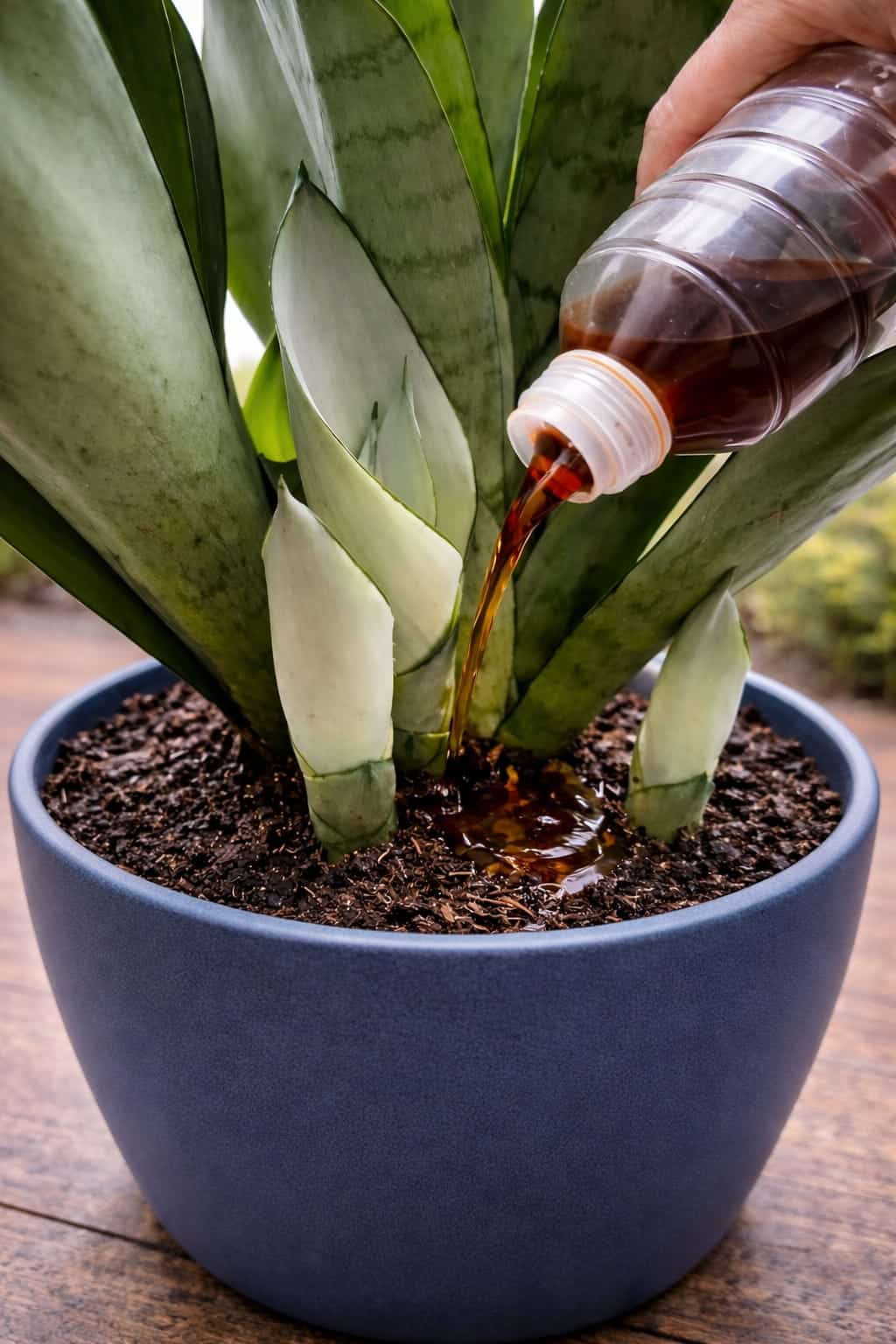
Can dark liquid (compost tea or weak coffee) help your snake plant grow? Learn what these natural solutions do, how to use them safely, and why light, soil, and watering matter most.
Let’s be honest: snake plants (Sansevieria, now Dracaena) are among the toughest and most adaptable houseplants. Their upright leaves and bold patterns make them a favorite for modern homes, offices, and minimalist interiors. Because they are easy to maintain, gardeners are always searching for simple ways to encourage healthier growth.
Recently, some indoor plant enthusiasts have started using natural dark liquid mixtures poured lightly into the soil of snake plants. These liquids are usually diluted organic solutions that gardeners believe may support soil nutrients and overall plant vitality. When used carefully, they can complement a healthy watering and plant care routine.
But here’s the truth: these dark liquids are not magic. They work best as a gentle supplement – but they will never replace the fundamentals: well‑draining soil, infrequent watering, and bright indirect light. In this guide, you’ll learn what the dark liquid is, how to use it safely, and the ideal conditions for a thriving snake plant.
🌿 What Is the Dark Liquid Used for Snake Plants?
The dark liquid often represents mild natural nutrient solutions that gardeners dilute with water before applying to soil.
Examples Sometimes Used Include:
· Diluted compost tea – rich in beneficial microbes and trace nutrients.
· Weak coffee‑water mixtures – very diluted (1 part coffee to 4–5 parts water). Use sparingly.
· Organic plant nutrient blends – commercial organic liquid fertilizers at quarter strength.
· Diluted natural soil conditioners – such as seaweed or kelp extract.
These liquids are typically used in very small quantities to avoid overwhelming the plant’s roots. Snake plants are not heavy feeders.
🌱 Why Snake Plants May Benefit From Gentle Liquid Feeding
Snake plants grow slowly and do not require heavy fertilizing. However, occasional mild nutrient solutions may help support steady development
Possible Benefits Gardeners Look For Include:
· Supporting soil microbial activity
· Providing trace nutrients
· Encouraging healthy root development
· Maintaining balanced soil conditions
Because snake plants store water in their leaves, they typically require only light feeding during active growth periods (spring and summer). Over‑feeding is far more harmful than under‑feeding.
💧 How Gardeners Apply the Liquid
Plant enthusiasts usually apply diluted liquid solutions directly to the soil surface. Moderation is key.
Typical Method – Step by Step
- Mix the natural liquid with water – use a very weak dilution (e.g., 1 part compost tea to 10 parts water, or 1 part weak coffee to 4 parts water).
- Pour a small amount around the plant base – about ¼ cup for a standard pot.
- Avoid soaking the soil excessively – do not flood the pot.
- Use only occasionally during the growing season – once every 4–6 weeks at most.
- Do not use in fall and winter – the plant rests.
Too much liquid fertilizer can lead to root stress, so moderation is key.
What to Avoid
· Using strong, undiluted solutions – burns roots.
· Applying too frequently – more than once a month.
· Pouring on leaves – can cause spots or rot.
· Ignoring light and watering – no liquid fixes poor care.
Continue to Page 2
Continue to page 2 for more details about this article and the key points many readers miss on the first page.