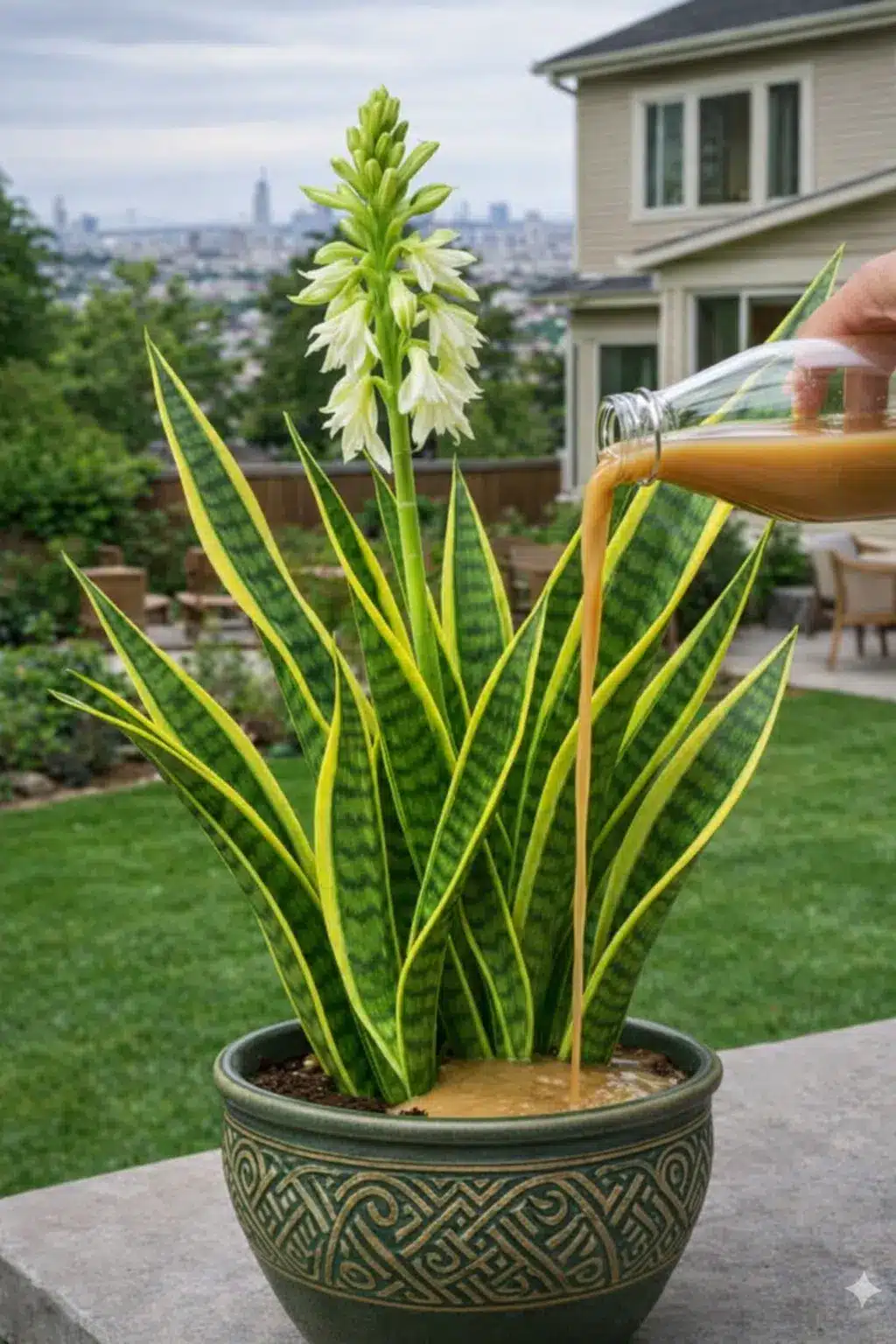
The boost in question is old aquarium water, and it is free if you already keep fish.
Water siphoned out during a routine tank change carries dissolved nitrate, phosphate, potassium, and trace minerals produced by fish waste and the beneficial bacteria in the filter. It is, in effect, an extremely dilute liquid fertilizer that most fishkeepers pour down the drain every week.
For snake plants in particular this suits them better than commercial feed does. Snake plants are slow, low-demand growers that are damaged far more often by overfeeding than by underfeeding, and aquarium water delivers nutrients at roughly the strength they actually want.
Why You Will Love This Method
It costs nothing. If you keep freshwater fish, you are already producing it and discarding it.
The dilution is already correct. Established tank water typically sits between 10 and 40 ppm nitrate, which lands close to a quarter-strength houseplant feed. No measuring, no mixing.
It reduces salt buildup risk. Concentrated fertilizers leave residue that accumulates and burns roots. Very dilute feeding does this far more slowly.
It replaces a task rather than adding one. You have to remove the water anyway. This just changes where it goes.
It is genuinely well-understood. Aquaponics is built entirely on this principle at commercial scale.
Method Overview
Cost: Free with an existing freshwater aquarium Frequency: Every 4 to 6 weeks during spring and summer Time needed: The length of one water change Difficulty: Easy Works for: Snake plants, pothos, philodendron, spider plants, ZZ plants, most foliage houseplants
What You Will Need
Water siphoned from an established freshwater aquarium A clean bucket or watering can A snake plant in a pot with a drainage hole A saucer you can empty afterwards
Meet the Snake Plant
The snake plant, Dracaena trifasciata, formerly classified as Sansevieria, is a rhizomatous evergreen from West Africa. It grows stiff upright leaves from a thick underground stem and spreads by sending out pups from that rhizome.
Its leaves store water, and its roots are adapted to seasonal dryness rather than steady moisture. This single fact explains almost everything about how it should be treated indoors.
It tolerates low light, irregular watering, and long neglect. What it does not tolerate is wet soil, heavy feeding, or a pot without drainage.
It is mildly toxic to cats and dogs if chewed, causing drooling and stomach upset, so place it accordingly in a home with pets.
What Is Actually in Aquarium Water
Nitrate is the main useful component. Fish excrete ammonia, filter bacteria convert it to nitrite and then to nitrate, and nitrate accumulates between water changes. Plants absorb it directly as a nitrogen source.
Phosphate and potassium come from uneaten food and waste breakdown. Both are macronutrients plants need.
Trace minerals, including calcium, magnesium, and iron, come from tap water, substrate, and fish food residue.
Beneficial bacteria in the water contribute mildly to soil microbial activity, though most are aquatic species that will not persist in dry potting mix.
What is not in it is any meaningful concentration of anything harmful, provided the tank is freshwater, unmedicated, and healthy.
How to Use Aquarium Water on a Snake Plant
Step 1: Confirm the tank is suitable
Use freshwater tank water only. Saltwater and brackish water will kill a snake plant quickly, because the sodium accumulates in the soil and destroys the roots’ ability to take up water.
The tank should be fully cycled and free of disease. Skip the water entirely if you have dosed medication, algaecide, or copper treatments in the past two weeks.
Step 2: Collect during a routine water change
Siphon the water into a clean bucket as you normally would. The water from the bottom of the tank, near the substrate, carries the most dissolved nutrients.
Do not rinse filter media into it. Filter sludge is far more concentrated and can go anaerobic and start smelling within hours.
Step 3: Use it the same day
Aquarium water is not a product you store. Left in a bucket it goes stagnant, the beneficial bacteria die off, and it develops an odour.
Use it within a few hours of collection.
Step 4: Check the soil is dry first
Push a wooden skewer to the bottom of the pot. If it comes out damp or with soil clinging to it, the plant does not need water yet, regardless of what is in your bucket.
This is the step most people skip, and it is the one that actually matters. Watering a snake plant on schedule rather than on need is the leading cause of root rot in this species.
Step 5: Water thoroughly
Pour slowly and evenly across the whole soil surface until water runs freely from the drainage hole. Partial watering leaves dry pockets and concentrates salts where the water stops.
Step 6: Empty the saucer
Drain the saucer within 20 minutes. Snake plant roots left standing in water will begin to rot within days.
Step 7: Space it out
Use aquarium water for roughly one watering in every three, during the growing season only. The other waterings should be plain water.
Step 8: Stop in autumn
Snake plants effectively stop growing below about 60°F and in short winter days. Nutrients supplied to a dormant plant simply accumulate in the soil.
Resume in spring when you see new growth.
Tips for Getting It Right
Test your nitrate if you have a kit. Below 5 ppm and the water is nutritionally near-worthless. Above about 60 ppm and you should dilute it half and half with plain water.
A heavily stocked tank produces richer water. A lightly stocked planted tank produces water the aquarium plants have already stripped of nutrients.
Do not use it on cuttings or newly repotted plants. Damaged roots are vulnerable, and unrooted cuttings cannot use the nutrients anyway.
Alternate with a proper flush. Every few months, water heavily with plain water and let it run through freely to clear any accumulated salts.
Keep expectations realistic. This is a mild top-up, not a growth accelerator. Light is what drives snake plant growth, and no liquid substitutes for it.
Common Mistakes to Avoid
Using saltwater tank water. This is the one genuinely destructive error. Sodium is not a plant nutrient and does not leach out easily.
Using water from a medicated tank. Copper-based treatments in particular are toxic to plants at low concentrations.
Treating it as a complete fertilizer. Aquarium water is nitrogen-dominant and low in potassium relative to a balanced feed. Over a full year, a snake plant still benefits from one or two doses of proper diluted houseplant fertilizer.
Watering more often because the water is free. Increased frequency will rot the plant faster than any fertilizer will help it. Frequency stays the same; only the liquid changes.
Storing it in a sealed container. It goes anaerobic and starts producing hydrogen sulphide, which smells like rotten eggs and does the soil no favours.
When Aquarium Water Is Not the Answer
If leaves are yellowing from the base, that is usually overwatering or rot, not a nutrient deficiency. Unpot and check the roots.
If leaves are floppy and leaning, the plant is short of light. Move it to bright indirect light near an east-facing window.
If leaf edges are brown and crisp, look at watering consistency and mineral buildup from tap water. A thorough flush helps more than feeding does.
If the plant has not produced pups, the cause is usually a pot that is too large, or insufficient light. Snake plants pup when the rhizome is crowded and the plant has surplus energy.
Frequently Asked Questions
How often can I use aquarium water? Every fourth to sixth week during spring and summer, in place of a regular watering. Not more.
Can I use it on all my houseplants? Yes, on most foliage plants. Avoid it on cacti and succulents during dormancy and on carnivorous plants, which are adapted to nutrient-poor conditions and will be harmed.
Does it need to sit out to dechlorinate? No. Tank water from a cycled aquarium has already had chlorine removed, since chlorine would kill the fish and the filter bacteria.
Is the smell normal? Fresh tank water should smell earthy at most. A strong sulphurous or rotten smell means it has gone anaerobic. Discard it.
Can I use water from a fish bowl without a filter? It is much weaker and more variable, but harmless. An established filtered tank produces better water.
Does this replace fertilizer completely? Not quite. It covers most of what a snake plant needs, but a balanced diluted feed once or twice a season fills the gaps, particularly potassium.
Final Thoughts
Old aquarium water is the rare free plant tip that holds up, because there is a real mechanism behind it: fish waste becomes nitrate, and nitrate is plant food. It is dilute enough that it suits a plant that resents being fed heavily.
What it will not do is fix a snake plant sitting in a dim corner in soggy soil. Get the light and the watering right first, and treat the aquarium water as the small bonus it is.