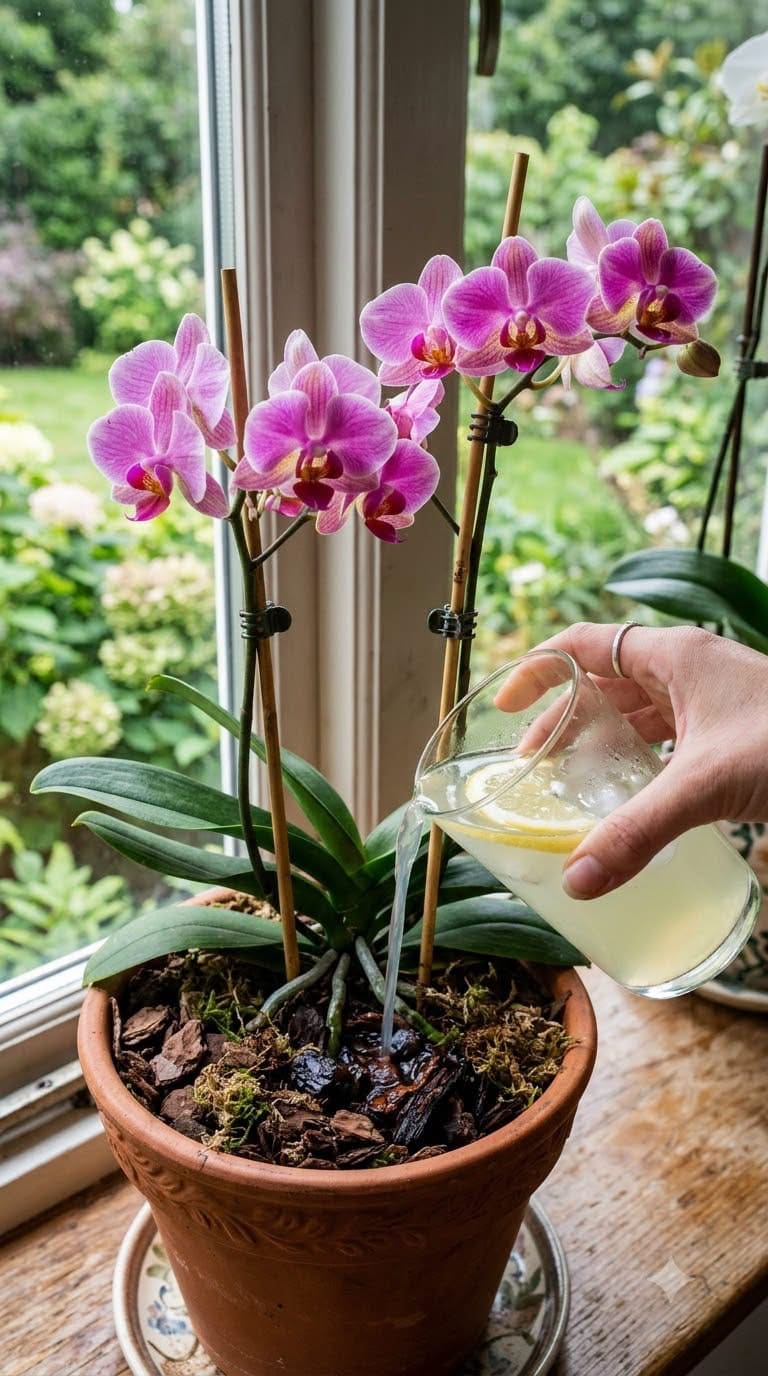
Photos of lemon water being poured over a flowering orchid circulate widely, usually captioned as a way to boost blooms, correct pH, or clean the roots. The image is appealing and the logic sounds reasonable, since orchids do prefer slightly acidic conditions.
The problem is scale. Orchids want a pH between about 5.5 and 6.5. Undiluted lemon juice sits near 2.2, which is thousands of times more acidic. Pouring it into bark chips does not gently adjust anything.
This guide covers what actually happens in the pot, what the plant needs instead, and how to fix the two problems people are usually trying to solve.
Why This Guide Is Worth Reading
It prevents a common loss. Acid damage to orchid roots is often mistaken for root rot, and by the time the leaves respond the roots are already gone.
It explains the mechanism. Not just what to avoid, but what the acid, the sugar, and the bark are each doing.
The alternative costs almost nothing. Rainwater and a diluted orchid fertilizer cover everything.
It targets the real question. Most people pouring things into orchid pots want it to rebloom, and there is a reliable way to trigger that.
Meet the Phalaenopsis Orchid
The moth orchid, Phalaenopsis, is the orchid sold in almost every supermarket and garden centre. It is an epiphyte, meaning that in the wild it grows attached to tree trunks and branches rather than in soil.
Its thick silvery-green roots are covered in a spongy layer called velamen, which absorbs water and nutrients rapidly and then dries. This is why orchids are potted in bark rather than compost, and why they rot so easily in dense soil.
Healthy roots are firm and green when wet, silvery when dry. Brown, soft, or hollow roots are dead.
A well-cared-for Phalaenopsis blooms once or twice a year, with flowers lasting two to four months.
It is non-toxic to cats and dogs.
What Lemon Water Actually Does
The acid overshoots enormously. Even diluted at a tablespoon per litre, lemon water lands well below the range orchid roots tolerate. Velamen is a thin absorbent tissue with no protection against it.
Citric acid strips beneficial microbes. Bark medium hosts fungi and bacteria that help break down the bark and make nutrients available. Repeated acid flushes disrupt that community.
The sugar feeds the wrong things. Lemon juice contains sugars that encourage mold on bark and moss, and fungus gnats breed in the damp organic residue.
It provides essentially no nutrients. There is no meaningful nitrogen, phosphorus, or potassium in lemon juice at these dilutions.
Damage appears late. Orchids store water in their leaves, so a plant with dying roots can look fine for weeks. By the time leaves wrinkle, the roots are usually beyond saving.
What Orchids Actually Need
Water quality matters more than water additives. Phalaenopsis are sensitive to the dissolved minerals and chlorine in hard tap water. Rainwater, filtered water, or distilled water solves most watering complaints on its own.
A balanced orchid fertilizer at quarter strength. Look for 20-20-20 or a formula labelled for orchids. Orchids are light feeders and burn easily.
Air at the roots. Bark medium exists so that roots can dry between waterings. Anything that clogs the gaps, including sugar residue and decomposed moss, works against this.
Repotting every one to two years. Bark breaks down into a fine, water-retaining material that suffocates roots. This is the most commonly skipped part of orchid care.
A pot with drainage holes. Decorative cachepots without holes are the leading cause of orchid death. Keep the plant in a clear slotted pot inside the decorative one.
How to Water and Feed Correctly
Step 1: Water by weight, not schedule
Lift the pot. A pot that feels light needs water. A pot that feels heavy does not. Usually this works out to every 7 to 10 days.
Step 2: Water thoroughly at the sink
Run tepid water through the bark for about 15 seconds, letting it drain completely. Soaking briefly in a bowl for 10 minutes also works.
Step 3: Never leave water in the crown
Tip the plant slightly and blot any water sitting between the leaves at the centre. Water trapped there causes crown rot, which kills a Phalaenopsis quickly.
Step 4: Let it drain fully
Wait until dripping stops before returning the plant to its decorative pot. Standing water is the single most common cause of orchid root loss.
Step 5: Feed weakly, weekly
Use a balanced orchid fertilizer at a quarter of the label strength with most waterings during active growth. This is the standard orchid approach and it suits their light feeding.
Step 6: Flush monthly with plain water
Once a month, water with plain rainwater or distilled water only, to rinse accumulated fertilizer salts out of the bark.
How to Make an Orchid Rebloom
This is what most people are really after, and it does not involve anything poured into the pot.
A temperature drop triggers spiking. Phalaenopsis initiate flower spikes in response to night temperatures around 55 to 60°F for two to four weeks, with warmer days. Moving the plant near a cooler window in autumn is usually enough.
Bright indirect light is required. An east-facing window is close to ideal. Leaves should be a medium olive green. Dark green leaves mean too little light, which is the most common reason a healthy-looking orchid never reblooms.
Do not cut the spike too early. Once flowers drop, cut the spike just above a node partway down and it may branch and rebloom from there. Cut it at the base only if it has turned brown and dry.
Feeding matters less than light and temperature. A well-fed orchid in a dim room still will not bloom.
Common Mistakes to Avoid
Pouring lemon juice, vinegar, tea, or milk into the pot. All add acid, sugar, or organic residue to a medium designed to stay open and airy.
Ice cubes. Widely repeated and widely disputed. Phalaenopsis are tropical, and cold water on roots causes damage over time. Room temperature water is safer and just as easy.
Using a pot with no drainage. Water collects invisibly at the bottom and rots the roots from below.
Watering into the crown. Rot at the centre of the plant is usually fatal and usually preventable.
Never repotting. Broken-down bark holds water like soil, which is exactly what orchid roots cannot handle.
Cutting all roots that look dry. Silvery roots are healthy and dormant. Only brown, mushy, or hollow roots should be removed.
Frequently Asked Questions
I already used lemon water. What now? Flush the pot thoroughly with plain water several times, check the roots by lifting the plant out, and remove any that are brown and mushy. A single application is usually survivable.
Do orchids need acidic water? Slightly, around pH 5.5 to 6.5. Rainwater is naturally in that range. Lemon juice is far outside it.
What about diluted vinegar? Same problem. The dilutions people use are guesswork, and orchid roots have no margin for error.
Should I mist my orchid? Misting the leaves does little and risks water pooling in the crown. A humidity tray or a nearby humidifier is more effective.
Why are my orchid leaves wrinkled? Usually root loss, not underwatering. Check the roots before adding more water, since watering a rotted root system makes it worse.
How often should orchids be repotted? Every one to two years, into fresh bark. Repot after flowering, not during.
Final Thoughts
Lemon water photographs beautifully and does nothing an orchid needs. The acid is orders of magnitude stronger than the plant tolerates, and the sugar invites problems into a medium meant to stay clean and airy.
What produces flowers is unglamorous: bright indirect light, rainwater or filtered water, a quarter-strength orchid feed, fresh bark every couple of years, and a few cool autumn nights. That is the entire method.