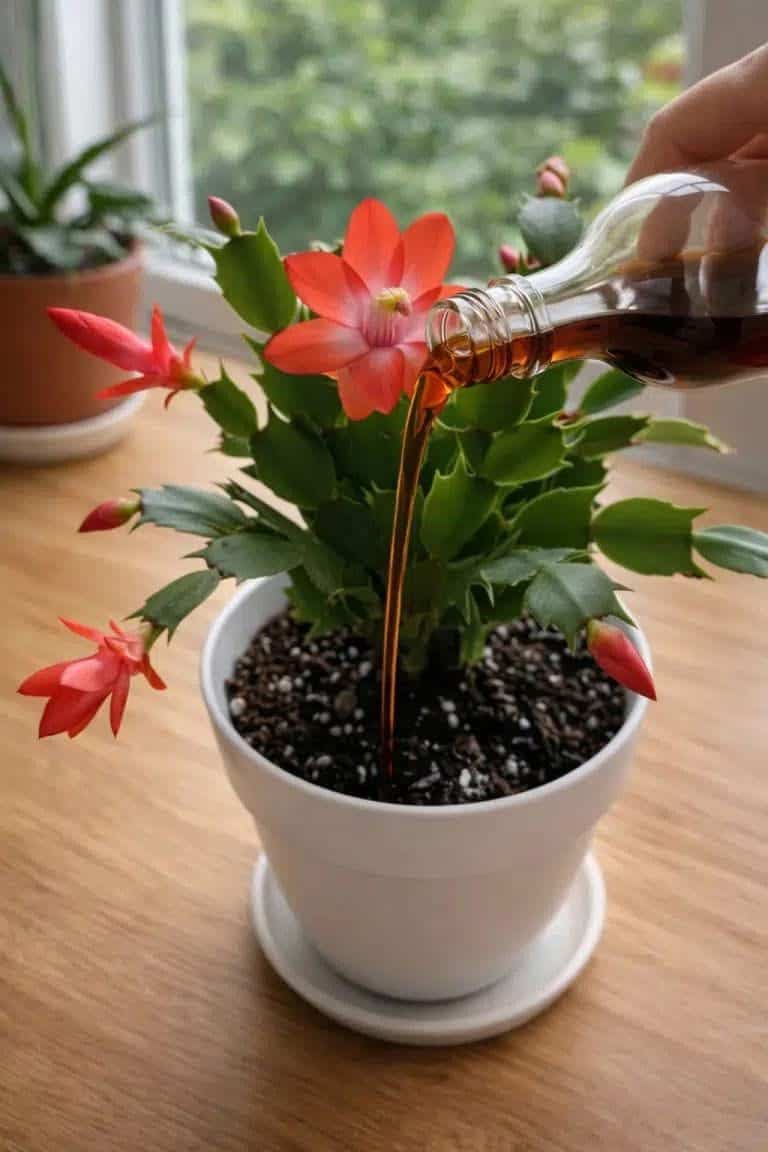
Walk into any indoor plant group in autumn and you will find the same question repeating: how do people get a Christmas cactus covered in buds when yours produces three flowers and calls it a season?
The answer that keeps coming up is a dark amber liquid poured slowly around the base of the pot. It looks like weak tea, it costs almost nothing, and it works because of what it does to the soil rather than any secret ingredient.
Table of Contents
- Meet the Christmas Cactus
- What the Dark Liquid Actually Is
- Why It Suits This Plant So Well
- How to Make It at Home
- How to Use It Correctly
- The Feeding Calendar Through the Year
- What to Expect and When
- Frequently Asked Questions
- Final Thoughts
[AD SLOT 1 — after the table of contents]
Meet the Christmas Cactus
Schlumbergera is not a desert plant, and almost every care mistake begins with assuming it is. In the wild it grows in the coastal mountains of southeastern Brazil, perched in the crooks of trees and in pockets of rock, surrounded by humid air and filtered light.
That habit makes it an epiphyte, meaning it lives on other plants rather than in deep ground soil. Its roots are used to a thin layer of decomposing leaf litter, moss, and bark, which is rich in gentle organic nutrients and drains almost instantly after rain.
The flat green segments people call leaves are actually stems called cladodes. They handle photosynthesis, they store water, and their firmness is the fastest way to read whether the plant is comfortable.
Christmas cactus is also remarkably long-lived. Healthy specimens are routinely passed down through two or three generations of a family, which is one reason people take their blooming so personally.
Blooming is triggered by shorter days and cooler nights in autumn. What feeding does is make sure the plant has the reserves to act on that trigger with a full display rather than a token one.
What the Dark Liquid Actually Is
The dark liquid is diluted compost tea, most commonly made from worm castings. Steeping castings in water produces an amber-brown solution carrying soluble nutrients and a large population of beneficial soil microorganisms.
Worm castings are the finished product of organic matter passing through earthworms. They contain nitrogen, phosphorus, potassium, calcium, magnesium, and a range of trace elements, all in gentle plant-available forms.
The concentrations are low by design, which is exactly what suits an epiphyte. Christmas cactus evolved on a slow trickle of nutrients from decomposing bark and leaves, not on the concentrated salt loads found in synthetic fertilizers.
Compost tea also carries humic and fulvic acids. These organic compounds help bind minerals in forms roots can absorb easily and improve the overall structure of potting mix over time.
There is a simpler kitchen version too. Cooled, unsweetened weak black tea gives a similar dark color and provides a mild nitrogen source plus tannins that gently support soil acidity, which Schlumbergera enjoys.
Both versions share the important quality: they are dilute. The dark color signals dissolved organic matter, not strength, and a properly made batch should look like tea you would consider too weak to drink.
[AD SLOT 2 — after the section on the substance]
Why It Suits This Plant So Well
Christmas cactus prefers a slightly acidic root zone, generally in the range of 5.5 to 6.5 pH. Organic teas sit naturally in that region, so they support root activity rather than fighting the plant’s preferences.
The microbial content matters as much as the minerals. Beneficial bacteria and fungi colonize the potting mix, break down organic matter into simpler compounds, and effectively feed the plant on a continuous slow schedule.
Those same microbes help build soil structure. In a pot that has been sitting for two or three years, this is what keeps the mix open and airy instead of compacted, which directly protects the fine roots.
Nutrients delivered in liquid form reach the roots immediately and evenly. Granular fertilizer can concentrate in one part of the pot, whereas a poured solution distributes across the entire root zone in seconds.
Phosphorus and potassium in particular support flowering. Phosphorus contributes to energy transfer within the plant and bud formation, while potassium regulates water movement and helps blooms hold their color and last longer.
Because the solution is so dilute, it also rinses gently through the mix. Each watering with compost tea carries a little fresh nutrition in while flushing stale material out the drainage holes.
How to Make It at Home
Step 1: Gather what you need
You want a clean 1 gallon jug or bucket, 1 cup of pure worm castings or finished compost, and room-temperature water. A piece of muslin, an old cotton sock, or a paint strainer bag makes straining much easier.
Step 2: Use the right water
Let tap water sit uncovered for 24 hours so chlorine dissipates, or use collected rainwater or filtered water. Chlorine is designed to kill microorganisms, and the microorganisms are the point of this recipe.
Step 3: Steep the castings
Place the castings in the cloth bag, submerge it in the gallon of water, and let it sit at room temperature for 24 hours. Squeeze the bag gently a few times to release more material.
Step 4: Aerate if you can
If you have a small aquarium air pump, run it in the bucket during steeping. Oxygen encourages beneficial aerobic microbes to multiply and produces a noticeably livelier tea.
Step 5: Strain the liquid
Lift out the bag and let it drip, then pour the tea through a fine sieve to catch any remaining solids. What you want is a clean amber liquid with no sediment that could block drainage.
Step 6: Dilute to feeding strength
Mix one part tea with four parts clean water for Christmas cactus. Hold the finished mixture up to the light; it should be the color of weak tea, transparent rather than opaque.
Step 7: Use it fresh
Apply the diluted tea within 24 to 48 hours while the microbial population is at its peak. Store the leftover concentrate in the refrigerator for up to a week if needed.
[AD SLOT 3 — after the recipe]
How to Use It Correctly
Water the plant with plain water first if the mix is completely dry. Moist soil accepts the solution evenly, while bone-dry mix can channel liquid straight down the sides of the pot without touching the roots.
Pour slowly around the edge of the pot rather than into the center. This encourages the tea to spread through the whole root ball and reach the outer roots that do most of the absorbing.
Apply until liquid just begins to appear at the drainage holes, then stop. Christmas cactus roots want moisture followed by air, and standing water is the one thing they genuinely dislike.
Empty the saucer within about fifteen minutes. Anything left sitting underneath keeps the lowest roots submerged, which is the opposite of the airy conditions they evolved in.
Keep the solution off the flat green segments and especially off open flowers. Feeding belongs at soil level, and dry cladodes stay cleaner and more attractive.
Feed roughly once a month during the active growing season, from spring through early autumn. Regular gentle applications beat occasional heavy ones every time with this species.
Ease off once buds form and appear as small pink or red points at the segment tips. At that stage the plant wants stability more than nutrition, so plain water is the better choice.
The Feeding Calendar Through the Year
March through May is the recovery and growth window after flowering finishes. Feed monthly with the diluted tea and expect the plant to start pushing new segments at the tips.
June through August is peak growth. Continue monthly feeding, keep the plant in bright indirect light, and let the top inch of mix dry between waterings.
September through October is the trigger period. Give the plant 12 to 14 hours of uninterrupted darkness each night and cooler evening temperatures around 55 to 60°F, and stop feeding once buds appear.
November through February is the bloom and rest phase. Water lightly with plain water, avoid moving the pot, and resume feeding only when the last flowers have dropped.
[AD SLOT 4 — after the calendar]
What to Expect and When
In the first two weeks you will mostly see changes in the soil rather than the plant. The mix holds moisture a little more evenly and develops the clean, earthy smell of active biology.
By weeks three and four, look at the growing tips. New segments tend to emerge slightly larger and a deeper, glossier green than the ones formed before regular feeding began.
Around the second month, the whole plant firms up. Cladodes feel plumper between your fingers and sit more rigidly rather than drooping softly at the ends of the stems.
Through the third month of the growing season, branching increases. More growing points means more potential flower sites, since Christmas cactus blooms from segment tips.
Come autumn, the difference shows up in bud count. Well-fed plants commonly set buds on a much higher proportion of their tips, which is what produces the fully covered look people photograph.
At bloom time, expect deeper color and longer-lasting flowers. Individual blooms typically hold for several days each, and a well-nourished plant staggers them across several weeks.
Over years, the cumulative effect is a fuller, more architectural plant. Regular gentle feeding is why some heirloom specimens reach three feet across and bloom reliably every single season.
[AD SLOT 5 — before the FAQ]
Frequently Asked Questions
Can I use regular coffee instead? Cooled, unsweetened black coffee diluted heavily with water works occasionally, but compost tea gives you microbes as well as minerals and is the better regular choice.
How dark should the diluted solution look? Aim for the color of weak black tea, light enough to see through clearly. If it looks like coffee, add more water before using it.
Can I use this on other houseplants? Yes, it suits almost everything. African violets, peace lilies, philodendrons, orchids, and ferns all respond well to the same 1 to 4 dilution.
Does it smell? Properly aerated compost tea smells clean and earthy, similar to forest soil after rain. Keeping the bucket oxygenated during steeping is what maintains that pleasant character.
Where do I buy worm castings? Garden centers, plant shops, and online retailers all stock them, and a single bag lasts an extraordinarily long time at one cup per gallon.
Can I feed while the plant is blooming? Switch to plain water once buds appear and through the flowering period. Resume the tea after the last blooms drop and new growth begins.
How long does the tea keep? Use the diluted version within a day or two. The undiluted concentrate holds for about a week in the refrigerator before the microbial population declines.
Is it safe around pets and children? Christmas cactus is non-toxic to cats and dogs, and finished compost tea is simply diluted organic matter. Normal hand washing is all that is needed.
[AD SLOT 6 — before the conclusion]
Final Thoughts
The dark liquid making the rounds online is not a trick or a shortcut. It is diluted compost tea, and it works because it feeds a Brazilian epiphyte the way its native habitat did, in small gentle amounts alongside a living population of soil microbes.
Start one batch this weekend and keep it simple: one cup of castings, one gallon of water, one day of steeping, diluted one to four. Feed monthly through the growing season and stop when buds appear.
By the time the days shorten, you will have a plant with the reserves to bloom properly. That is the whole secret, and it costs about the price of a cup of coffee per year.