Meet the Jade Plant
The jade plant, Crassula ovata, is a succulent shrub from the dry, rocky hillsides of South Africa’s Eastern Cape and KwaZulu-Natal. It is sold as the money plant, lucky plant, or friendship tree, and it is one of the longest-lived houseplants in cultivation.
Its thick oval leaves are water-storage organs. In its native range the plant fills them during brief rainy periods and lives off that reserve through long dry months, which is why it survives being forgotten for weeks indoors.
With age the stems thicken and go woody, forming a miniature tree with a proper trunk. A well-kept jade can live for decades and is regularly passed down through families, which is where the friendship tree name comes from.
Growth is slow and deliberate: an inch or two of new stem in a good year, and mature specimens produce small white or pink star-shaped flowers in late winter when conditions are right.
Popular Jade Plant Varieties
There are dozens of cultivars, differing in leaf shape, colour, and habit. Knowing which one you have tells you how it will look at maturity.
Crassula ovata, the classic jade. Glossy dark green oval leaves, often edged in red where light is strong. Grows to three or four feet indoors over many years.
Hummel’s Sunset. The same shape but with golden yellow leaves rimmed in bright red. The colour is entirely light-dependent and fades to plain green in a dim room.
Gollum. Tubular finger-like leaves with concave red-rimmed tips. Unmistakable and one of the most popular cultivars sold today.
Hobbit. Similar to Gollum but with leaves curled backward rather than tubular. Slightly more compact.
Tricolor. Green leaves streaked with cream and pink. Grows more slowly than the plain form and stays smaller.
Crosby’s Compact. A dwarf form with smaller leaves and dense branching, reaching about a foot. Well suited to a desk or shelf.
Crassula arborescens, the silver jade. A different species with round blue-grey leaves and darker margins. More architectural and slower still.
All of them take identical care. The differences are size and colour.
What Epsom Salt Actually Is
Epsom salt is magnesium sulfate, a simple mineral compound. It supplies two nutrients plants genuinely use: magnesium, which sits at the centre of every chlorophyll molecule, and sulfur, which plants need to build certain proteins.
Magnesium’s role is worth understanding. Without it a plant cannot make chlorophyll, and without chlorophyll it cannot photosynthesise. It is a small requirement in quantity but an absolute one.
It is cheap and widely available. A bag costs very little and lasts years at houseplant doses.
It dissolves completely in water. No residue and no waiting for it to break down.
It is fast-acting. A genuine magnesium deficiency shows visible improvement within a few weeks.
It has a narrow, real use. When a jade shows true magnesium deficiency, this is the correct and effective remedy.
That last point is the important one. Epsom salt is a treatment for a specific deficiency rather than a general feed, and it contains no nitrogen, phosphorus, or potassium.
When a Jade Plant Actually Needs It
Magnesium deficiency has a distinctive appearance, and it is worth confirming before treating.
It starts on the oldest leaves. The plant moves magnesium from mature leaves to new growth when supplies are short, so the lower, older leaves show it first.
The pattern is interveinal. The tissue between the veins yellows while the veins themselves stay green, giving a marbled or net-like look.
New growth stays normal at first. If the newest leaves are the pale ones, the problem is something else, usually nitrogen or light.
It appears in plants that have gone years without repotting. Fresh potting mix contains magnesium, and old exhausted mix does not.
If the leaves are uniformly pale, dropping, or wrinkled, magnesium is not the issue. Those point to light, watering, or root problems instead.
How to Use It Correctly
Step 1: Dissolve it in water first
Mix 1 teaspoon of Epsom salt into 1 gallon of water and stir until it disappears completely. This is the only form in which it should reach the plant.
Step 2: Use room-temperature water
Cold water straight from the tap slows root activity in a succulent. Let it stand for an hour first.
Step 3: Check the soil before applying
Push a finger two inches down. Apply only when the mix is dry at that depth, exactly as you would for a normal watering.
Step 4: Water evenly across the surface
Pour slowly around the whole pot rather than in one place, keeping it off the leaves and away from the base of the trunk.
Step 5: Water until it drains
Continue until liquid runs from the drainage hole. This distributes the magnesium through the full root zone.
Step 6: Empty the saucer
Drain it within twenty minutes. Standing water is the one thing a jade tolerates least.
Step 7: Apply once a month at most, and only in spring and summer
One application a month through the growing season is the ceiling. Stop entirely from autumn onward, when the plant is barely growing.
Step 8: Flush with plain water every few months
Water heavily with plain water once a quarter, letting it run through freely for a minute. Succulents are watered infrequently, so minerals accumulate rather than washing out, and an occasional flush keeps the root zone clean.
What Every Jade Plant Needs
Magnesium is a small piece of a larger picture. These four things determine whether the plant thrives.
Direct sun, at least four hours a day. This is the single biggest factor. A south or west-facing window is ideal. Jade in strong light grows compact with red-edged leaves; jade in dim light stretches, and the stems go thin and leggy.
Infrequent, thorough watering. Every two to three weeks in summer, once a month or less in winter, always letting the mix dry out completely first. Water deeply when you do, then leave it alone.
A gritty, fast-draining mix. Cactus and succulent compost, or standard potting soil cut half and half with perlite or coarse sand. The roots need air as much as water.
A snug pot with drainage holes. Terracotta is the best choice, since it breathes and dries the mix evenly, and its weight steadies a top-heavy plant. Repot every three to four years into a pot only slightly larger.
Feed with a balanced liquid fertilizer at half strength two or three times over spring and summer, and the plant will have everything it needs.
What to Expect
Slow, steady growth. An inch or two of new stem in a good year. Jade is not a fast plant and rapid growth usually means it is stretching for light.
Red leaf margins. A sign of strong light, not stress. It is the plant’s version of a suntan and it is desirable.
Thickening stems. Over several years the trunk goes woody and grey, which is what turns a cutting into a miniature tree.
Firm, plump leaves. A well-watered jade has leaves that feel solid. This is the easiest way to judge whether it needs water.
Flowers on mature plants. Small white or pink stars in late winter, on plants several years old that get a cool, dry rest period.
How to Style a Jade Plant at Home
The sculptural trunk and compact form make jade one of the most decorative houseplants, and it suits spaces where a leafy plant would look untidy.
Put it on a sunny windowsill. This is both the best place for the plant and the best place to see it, with light catching the glossy leaves and the red margins.
Use it as a desk plant. A young jade in a small pot sits neatly beside a monitor and needs almost no attention.
Pair it with a shallow bonsai pot. As the trunk thickens, a wide shallow container emphasises the tree-like form and makes a mature plant look deliberate.
Group three cultivars together. A classic jade, a Gollum, and a Hummel’s Sunset side by side show off how different the leaf shapes are.
Set one on a kitchen windowsill. Jade handles the warmth and dryness of a kitchen better than almost any other houseplant.
Choose a heavy pot. Terracotta or stoneware. Mature jade is top-heavy, and a light plastic pot tips over.
Keep the pot plain. The plant is the sculpture. A simple unglazed terracotta or matte neutral container lets the trunk and leaf shape do the work.
Frequently Asked Questions
How much Epsom salt for one plant? One teaspoon per gallon of water. Mix the full gallon and use what you need, or scale it down proportionally.
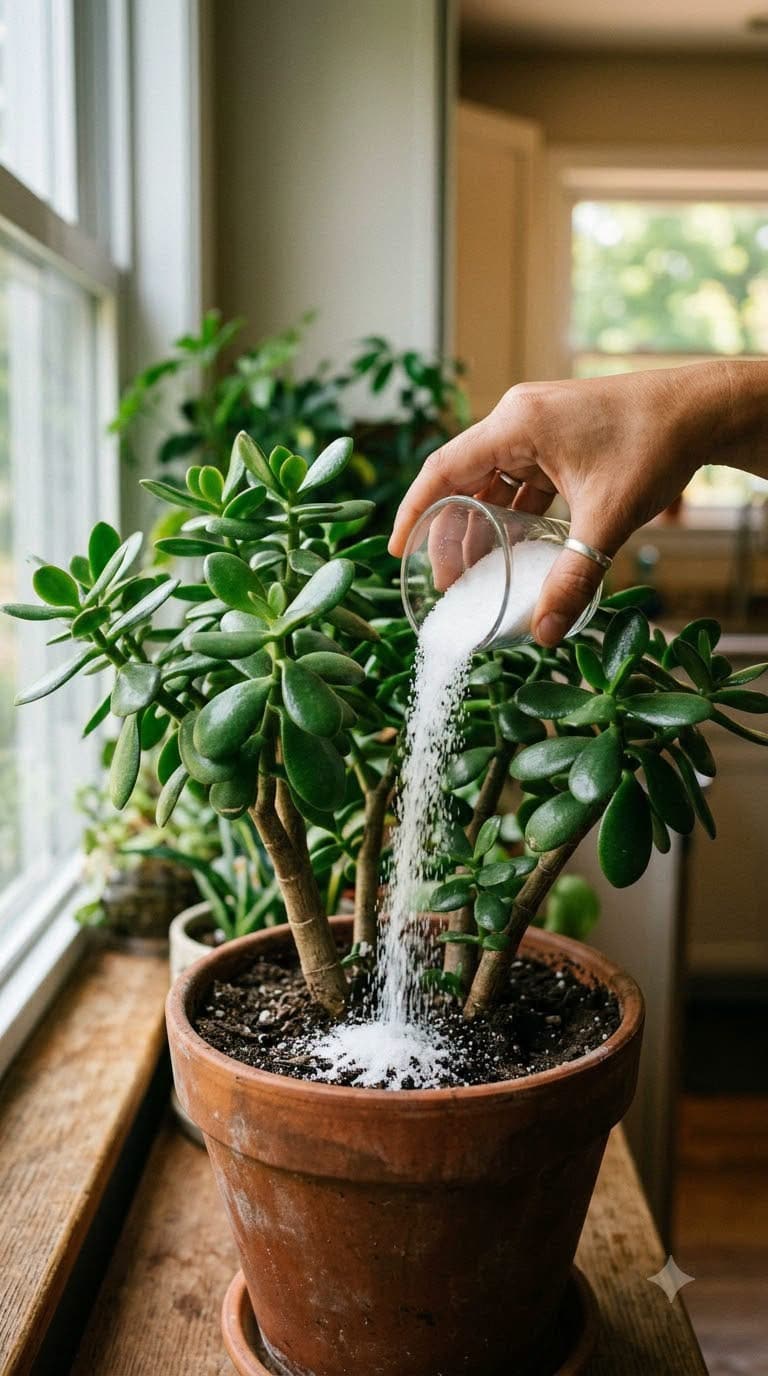
Can I sprinkle it dry onto the soil? No. Always dissolve it first. Undissolved salt creates a concentrated pocket in one part of the pot rather than distributing evenly.
How often should I apply it? Once a month at most, and only during spring and summer. Not at all in autumn or winter.
Can it replace fertilizer? No. It contains only magnesium and sulfur. A jade also needs nitrogen, phosphorus, and potassium, which come from a balanced feed.
Will it make my jade grow faster? Only if the plant was genuinely short of magnesium. Growth rate is set mainly by light, and jade is slow-growing by nature.
My jade is leggy and stretched. Will Epsom salt fix it? No, that is a light problem. Move it to a brighter window and prune the stretched stems back to encourage branching.
Which variety is best for a beginner? The plain Crassula ovata. It is widely available, inexpensive, and the most forgiving of the lot.
Final Thoughts
Epsom salt has a real and useful place in jade plant care, but a narrow one: a teaspoon per gallon of water, once a month in the growing season, when the older leaves show yellowing between green veins. Dissolved and diluted, it does exactly what it is meant to do.
Everything else comes down to the four basics. Four hours of direct sun, deep watering only when the mix has dried out completely, a gritty fast-draining medium, and a snug pot that drains. Get those right and the plant will thicken into a small tree that outlives most of the furniture around it.