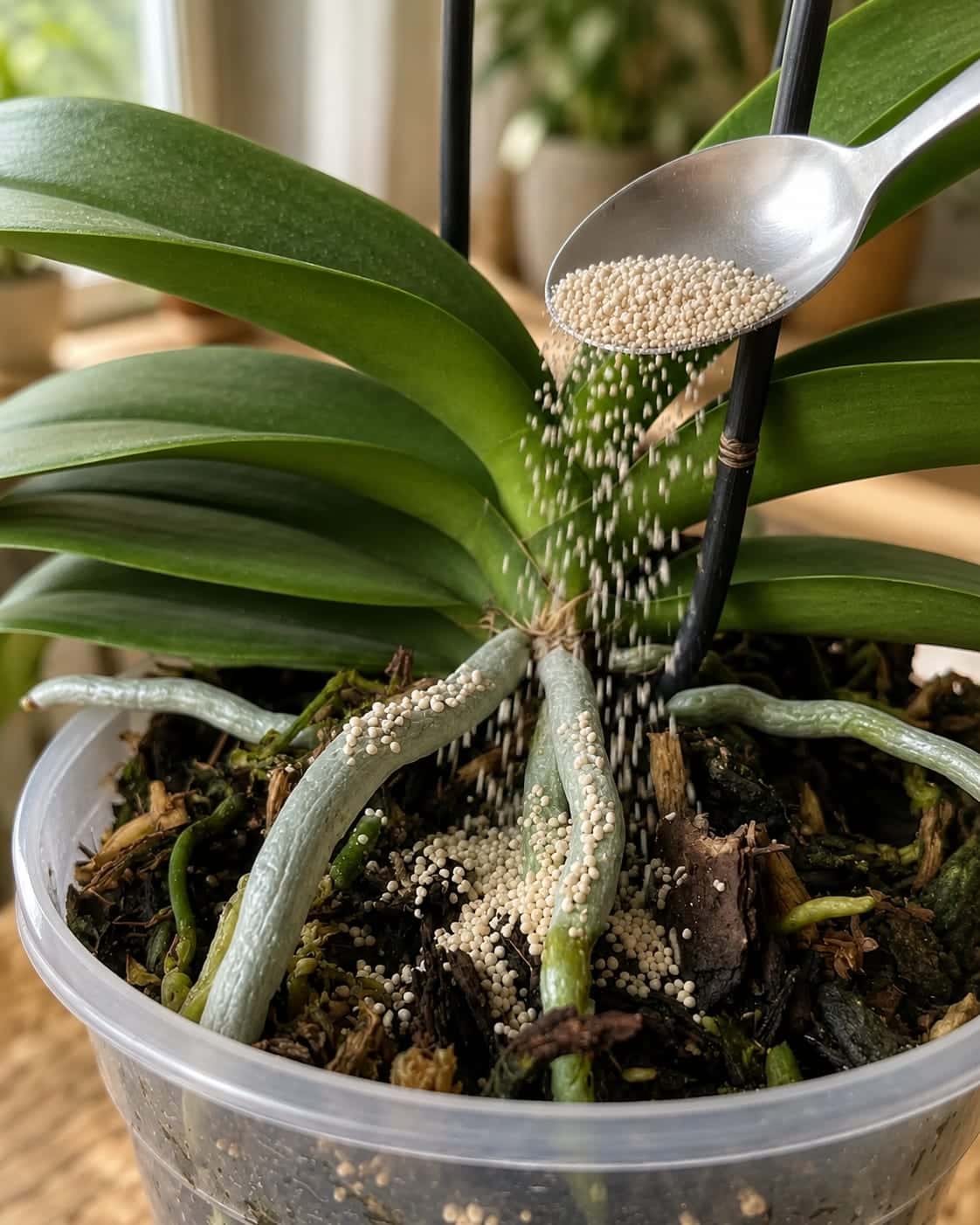
How Often Should You Use Slow-Release Fertilizer?
Slow-release fertilizer is designed to last for weeks or months, depending on the product. This means it should not be applied frequently. One common mistake is adding more granules every time the plant seems slow. This can cause buildup.
Always check the product label for release duration. Some slow-release fertilizers last two months, while others last six months or longer. If the granules are still present, do not add more just because the orchid has not bloomed yet.
Blooming depends on more than fertilizer. Light, temperature changes, plant maturity, root health, and seasonal rhythm all play a role. An orchid may have enough nutrients and still refuse to bloom if the light is too low or the plant is still recovering.
For many indoor orchid owners, using slow-release fertilizer lightly during the active growing season is enough. During cooler or darker months, orchids often grow more slowly and need less fertilizer.
Can Slow-Release Fertilizer Make an Orchid Bloom?
Fertilizer can support blooming, but it does not guarantee flowers. An orchid needs enough stored energy, healthy roots, and the right growing conditions to produce a flower spike. If your orchid is not blooming, fertilizer may be only one small part of the solution.
Phalaenopsis orchids often need bright indirect light and sometimes a slight drop in nighttime temperature to encourage spiking. If the plant is kept in a dark corner, fertilizer alone will not solve the problem. In fact, adding more fertilizer to a plant that is not getting enough light can create weak growth and root stress.
Instead of asking, “What can I add to make it bloom?” ask, “Does this orchid have the conditions it needs to bloom?” Check light, root health, watering, potting mix, and temperature before increasing fertilizer.
Signs You Used Too Much Fertilizer
Orchid fertilizer burn can show up in several ways. The most common signs are brown or black root tips, dry patches on roots, yellowing leaf edges, or a white crust on the potting mix. The plant may also stop growing even though you are feeding it.
A white crust can mean mineral or salt buildup. This can happen when fertilizer accumulates over time, especially if the pot is not flushed with water occasionally. Orchids grown in bark or moss can trap salts, and sensitive roots may suffer.
If you suspect fertilizer burn, remove visible excess granules if possible. Then flush the pot with clean water, allowing plenty of water to drain through. Do this carefully and let the pot drain completely. After that, pause fertilizing and monitor the plant.
Do not try to fix fertilizer burn with more products. The plant needs time, clean water, airflow, and stable conditions.
Why Clear Pots Are Helpful for Orchids
Clear pots are very useful for orchid care because they allow you to see the roots. Instead of guessing when to water, you can look at the root color. Green roots usually mean the plant is still hydrated. Silver-gray roots often mean the orchid is ready for water.
Clear pots also help you notice root problems early. If roots turn brown or black inside the pot, you can respond before the entire plant declines. This is especially helpful when using fertilizer because you can monitor how the roots react over time.
If your orchid is in a decorative pot, make sure the inner pot has drainage holes. After watering, remove any standing water from the outer pot. Orchids dislike sitting in water, and fertilizer granules can make stagnant water even more stressful for the roots.
The Best Watering Routine After Applying Granules
After applying slow-release fertilizer, keep your watering routine steady and careful. Water the orchid only when the potting mix is almost dry. In many homes, this may be once a week, but it can vary depending on temperature, humidity, pot size, and potting mix.
When watering, use room-temperature water and let it flow through the pot. This helps moisten the bark and gradually activate the fertilizer without leaving the roots soaked. Let the pot drain fully before placing it back in a decorative container.
Avoid misting fertilizer granules heavily every day. Constant moisture around the granules may release nutrients faster than expected and keep the surface too wet. Orchids need a wet-dry rhythm, not constant dampness.
Also avoid watering directly into the crown. If water collects between the leaves, gently dry it with a paper towel. Crown rot can happen quickly when water sits in the center of the plant, especially in low-airflow rooms.
What to Do If Granules Fall on the Roots
If a few granules touch the roots, it is not always a disaster. But if many pellets are sitting directly on exposed roots, it is better to move them. Use a clean spoon, tweezers, or your fingers to gently remove excess granules from the root surface.
Do not scrape or damage the roots while removing them. Orchid roots have a spongy outer layer called velamen, which helps absorb moisture. Damaging this layer can make the root less effective.
If the granules have already become wet and stuck to the roots, rinse the area gently with clean water and let the plant dry normally. Then monitor the roots over the next few days.
Natural-Looking Growth Takes Time
One of the most important things to understand about orchids is that visible improvement takes time. A weak orchid will not become lush overnight because you added fertilizer. Healthy recovery usually happens slowly: a new root tip appears, a leaf becomes firmer, or the plant begins to hold water better.
This slow progress is still a good sign. A single new root can be more meaningful than a dramatic but unrealistic before-and-after claim. When an orchid starts producing fresh roots, it is rebuilding its ability to absorb water and nutrients. That is the foundation for future leaves and blooms.
If you are caring for an orchid that has been neglected, focus on small signs of recovery. Look for green root tips, firmer leaves, and stable growth. Do not expect instant flowers. A recovering orchid may need months before it is ready to bloom again.
Common Mistakes to Avoid
The first mistake is using too much fertilizer. Orchids are light feeders, and heavy feeding can damage their roots. A small amount used correctly is better than a dramatic application.
The second mistake is fertilizing a sick orchid before diagnosing the problem. Yellow leaves, limp leaves, or no flowers do not automatically mean the plant needs fertilizer. These symptoms can come from overwatering, underwatering, poor light, root rot, pests, or old potting mix.
The third mistake is placing granules directly in the crown. The crown should stay clean and dry. Anything that traps moisture there can increase the risk of rot.
The fourth mistake is assuming fertilizer replaces repotting. If the bark is broken down, old, or compacted, fertilizer will not fix the lack of airflow. Repotting into fresh orchid mix may be the better solution.
The fifth mistake is adding more fertilizer because the orchid is not blooming. Blooming is not only about nutrients. Without enough light and healthy roots, extra fertilizer will not create flowers.
A Safer Feeding Routine for Beginners
If you are new to orchids, keep the routine simple. First, place the orchid in bright indirect light. Avoid harsh direct midday sun, which can burn the leaves. Second, water only when the roots turn silver and the potting mix is nearly dry. Third, make sure the pot drains completely. Fourth, use fertilizer lightly during active growth.
If using slow-release granules, apply a small amount around the edge of the potting mix and leave the crown clear. Do not reapply until the fertilizer’s release period has passed. During this time, watch the plant rather than constantly changing the care routine.
Orchids often suffer because their owners change too many things at once. They water more, fertilize more, move the plant, cut roots, spray leaves, and repot all in the same week. This makes it hard to know what helped or harmed the plant. A steady routine is usually better.
What If Your Orchid Already Looks Weak?
If your orchid looks weak, start with inspection. Look at the roots first. If the roots are mostly firm and silver-green, the plant may simply need better watering, light, or gentle feeding. In that case, a small amount of slow-release fertilizer may support recovery.
If the roots are mostly rotten, remove the plant from the pot and trim dead roots with sterilized scissors. Repot into fresh orchid mix and give the plant time to recover. Do not add fertilizer immediately after heavy root trimming. Let the orchid adjust and wait for signs of new root growth.
If the leaves are limp but the roots are healthy, the plant may be dehydrated or stressed by inconsistent watering. Correct the watering routine before adding nutrients. If the leaves are yellowing from the bottom, it may be natural aging, especially if the plant is otherwise healthy. If multiple leaves yellow quickly, look for root or crown problems.
Can You Combine Granules With Liquid Fertilizer?
It is usually not a good idea to combine slow-release granules with regular liquid fertilizer unless you are very experienced and using very diluted amounts. Combining both can lead to overfeeding. Since slow-release granules are already releasing nutrients over time, adding liquid fertilizer on top may create too much salt in the potting mix.
If you prefer liquid fertilizer, use that instead of granules. If you prefer granules, keep liquid feeding minimal or avoid it completely. The simpler routine is usually safer for beginners.
When in doubt, choose one feeding method and use it lightly. Orchids respond better to consistency than to aggressive feeding.
How Light Affects Fertilizer Use
Light and fertilizer work together. A plant uses nutrients to support growth, but growth depends heavily on light. If an orchid is kept in low light, it will not use fertilizer efficiently. The nutrients may remain in the potting mix and contribute to buildup.
A Phalaenopsis orchid usually does best in bright indirect light. An east-facing window is often suitable. A bright room with filtered light can also work. Leaves should look medium green, not very dark green and not yellow from sun stress.
If your orchid is not growing, check the light before increasing fertilizer. More nutrients will not help much if the plant does not have enough energy from light.
How to Tell If the Fertilizer Is Helping
Good results from orchid fertilizer are usually subtle. You may notice new root tips, a fresh leaf, stronger leaf texture, or more stable growth. Over time, a well-fed orchid may become strong enough to produce a flower spike.
Do not judge the result after only two or three days. Slow-release fertilizer works gradually. Give the plant several weeks and observe the overall trend. If the orchid remains stable and produces new growth, the feeding routine is likely acceptable.
If the plant declines after fertilizing, reduce or stop feeding and flush the pot. The goal is not to force the plant but to support it.
Frequently Asked Questions
Can slow-release fertilizer save a dying orchid?
Not by itself. Fertilizer cannot save an orchid with severe root rot, crown rot, or no living roots. It can only support a plant that still has healthy roots and the ability to grow.
Should I put fertilizer granules directly on orchid roots?
It is better to avoid placing granules directly on exposed roots. Spread a small amount on the potting mix, preferably away from the crown and not piled on the roots.
How long does it take to see results?
Orchid growth is slow. You may see small signs such as new root tips or a firmer leaf after several weeks, but blooms can take much longer.
Can fertilizer make orchid leaves turn yellow?
Too much fertilizer can contribute to yellowing, especially if it causes root stress or salt buildup. However, yellow leaves can also be caused by natural aging, overwatering, underwatering, poor light, or root problems.
Is slow-release fertilizer better than liquid fertilizer?
Neither is always better. Slow-release fertilizer is convenient, while liquid fertilizer gives more control. For orchids, both must be used gently.
Can I fertilize an orchid while it is blooming?
You can feed lightly while an orchid is blooming if the plant is healthy, but avoid heavy feeding. Many growers focus more on feeding during active leaf and root growth.
What should I do if I added too many granules?
Remove as many excess granules as possible and flush the pot with clean water. Let it drain completely and pause fertilizing until the plant looks stable.
Final Thoughts
Slow-release fertilizer granules can be useful for orchids, but they must be used with care. The safest approach is simple: check the roots first, use a small amount, keep the crown clear, avoid piling granules on exposed roots, and watch the plant over time.
An orchid does not need dramatic treatment to grow well. It needs healthy roots, good drainage, bright indirect light, careful watering, airflow, and gentle nutrition. When these basics are in place, fertilizer can support stronger growth and future blooms. When the basics are missing, fertilizer can do more harm than good.
If your orchid is weak, do not rush to feed it heavily. Look at the roots, understand the problem, and correct the care routine first. If the plant still has living roots and is ready to grow, a light application of slow-release fertilizer may help it recover gradually. The result will not be instant, but with patience and the right care, small signs of progress can turn into a healthier orchid over time.