Meet the Snake Plant
The snake plant, Dracaena trifasciata, is a succulent from the rocky, seasonally dry regions of West Africa. It is sold as mother-in-law’s tongue or sansevieria, and it has become one of the most widely kept houseplants in the world.
Its leaves are thick water-storage organs. The plant fills them during the rainy season and lives off that reserve through months of drought, which is why it tolerates neglect so well indoors.
The upright, sword-like posture comes from internal water pressure inside those leaves, supported by a firm rhizome at the base. A snake plant that is well rooted and correctly watered holds itself vertical on its own.
Growth is slow and seasonal: a few new leaves through spring and summer, then almost nothing from autumn onward.
Popular Snake Plant Varieties
There are more than seventy varieties in cultivation, and they differ enormously in height, leaf shape, and colour. Knowing which one you own tells you how large it will get and where it will look best.
Laurentii. The classic, and the one in most photographs. Tall dark green leaves with wavy pale banding and a clean yellow margin down each edge. Reaches three to four feet. The variety most people picture when they hear “snake plant.”
Zeylanica. Similar height and habit but without the yellow edge. Deep green leaves with silvery grey-green cross-banding. Slightly more tolerant of low light than Laurentii, and less expensive.
Moonshine. Wide, smooth leaves in a pale silvery green with almost no visible banding. Grows to about two feet. It holds its colour only in bright light, and dulls to ordinary green in a dim corner.
Black Coral. Very dark, almost blackish green with faint mottling. Three feet tall and dramatic against a pale wall.
Cylindrica. Round, spear-like leaves rather than flat ones, often sold braided or fanned. Architectural and unmistakable, growing to around three feet.
Hahnii, the bird’s nest. A dwarf rosette that stays under eight inches, forming a tight cup of short leaves. Ideal for a desk, a shelf, or a bathroom windowsill.
Futura Superba. A compact version of Laurentii, shorter and broader, reaching about two feet with the same yellow margins.
All of them take the same care. The difference is size and colour, so choose according to the space you have.
What the Cloudy Liquid Does
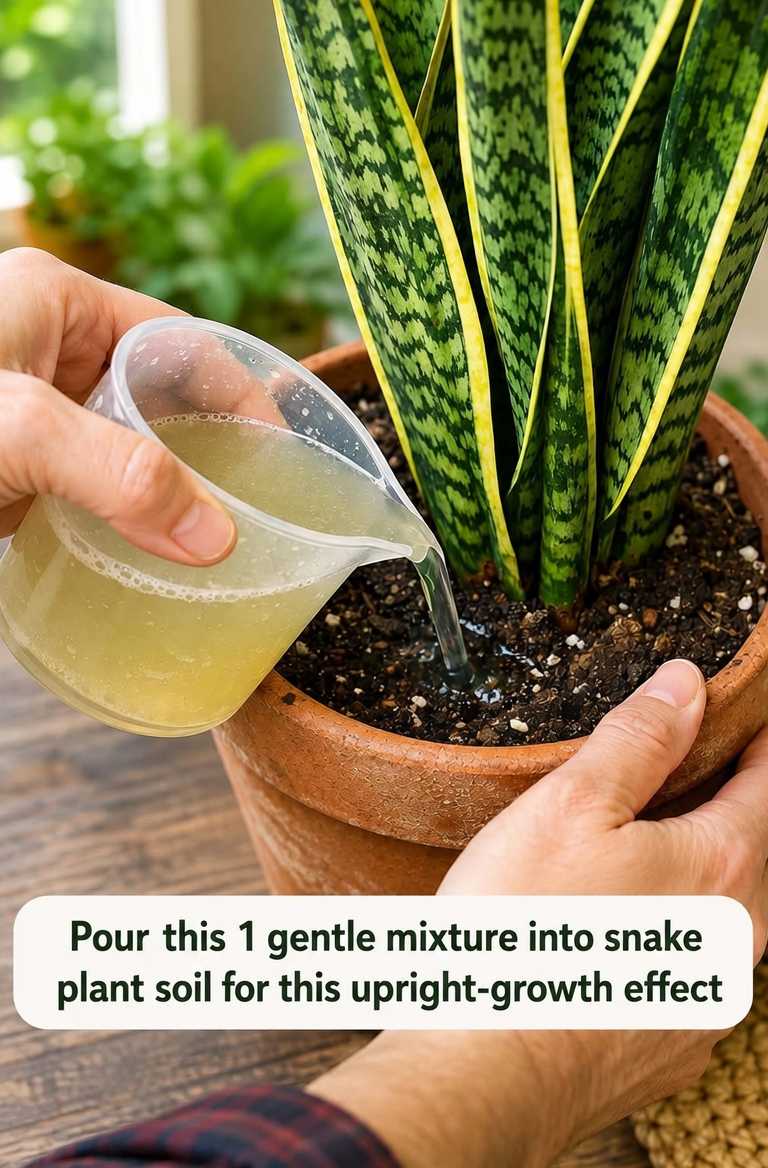
What rice water actually contains is modest but real: small amounts of starch, traces of potassium, phosphorus, magnesium, and B vitamins washed off the grain.
It is a mild soil conditioner, not a fertilizer. The starch feeds beneficial soil bacteria, and a more active microbial population helps release nutrients already present in the potting mix.
It is very gentle. Because the nutrient concentration is so low, there is no risk of the salt buildup that comes from overdosing a commercial feed.
It costs nothing. It is a by-product you already produce.
It suits slow feeders. A snake plant needs very little, and rice water sits at exactly that low level.
Use the water from rinsing raw rice rather than water from boiling it, and never water that has been salted or seasoned.
How to Use It Correctly
Step 1: Collect the rinse water
Rinse raw rice in clean water and keep the first cloudy pour-off. One rinse is enough.
Step 2: Dilute it
Mix one part rice water with three parts plain water. Undiluted starch can sit on the surface, and dilution spreads it evenly through the medium.
Step 3: Let it come to room temperature
Cold water straight from the tap slows root activity in a tropical succulent. Room temperature is ideal.
Step 4: Check the soil first
Push a finger two inches into the mix. Water only if it is dry at that depth. A snake plant should dry out substantially between waterings, and rice water counts as a watering.
Step 5: Pour slowly around the soil surface
Distribute it evenly across the pot rather than in one spot at the base. Keep it off the leaves and out of the crown where the leaves meet the soil.
Step 6: Water until it drains
Continue until liquid runs from the drainage hole. Even a light feed should reach the full root zone.
Step 7: Empty the saucer
Drain it within twenty minutes. Standing water is the single thing a snake plant tolerates least.
Step 8: Use it monthly at most
Once a month through spring and summer is plenty. Use plain water for every other watering, and stop entirely from late autumn through winter.
What Actually Keeps the Leaves Upright
Rice water supports general soil health. The posture of the leaves comes from four things, and getting these right is what produces a plant that stands tall on its own.
Bright indirect light. This is the main driver. In low light the plant stretches, the leaves thin out and lean. An east or west-facing window, or a spot a few feet from a south-facing one, keeps growth compact and vertical. Rotate the pot a quarter turn every couple of weeks so it grows evenly.
Restrained watering. Every two to three weeks in summer, every four to six in winter, always letting the top two inches dry first. Firm, turgid leaves stand up.
A fast-draining, gritty medium. Cactus and succulent mix, or standard potting soil cut with a third perlite or coarse sand. Open structure keeps the roots healthy, and healthy roots anchor the plant.
A snug pot with drainage holes. Snake plants grow better slightly root-bound, and a heavy terracotta pot resists tipping as the leaves gain height. Terracotta also breathes, which helps the mix dry evenly.
What to Expect
Steady seasonal growth. Two to four new leaves over a spring and summer is normal and healthy for this species.
Deeper leaf markings. Good light sharpens the banding and brightens the yellow margins on varieties like Laurentii.
Firm leaves. A well-watered snake plant has leaves that feel solid and slightly springy.
New pups at the base. Offsets pushing up through the soil are the clearest sign the plant is comfortable and can be divided when you repot.
Very little maintenance. Wipe dust off the leaves every month or two so they photosynthesize efficiently, and repot every two to three years.
How to Style a Snake Plant at Home
The vertical lines of this plant make it one of the easiest houseplants to decorate with. It draws the eye upward and fills empty height that furniture cannot.
Frame a doorway or an entryway. A pair of tall Laurentii in matching pots on either side of a door creates instant symmetry and gives a hallway a finished look.
Fill the empty corner of a living room. A three-foot plant in a raised pot occupies the awkward space beside a sofa where nothing else quite fits.
Set one beside a low bookshelf. The contrast between the horizontal lines of the shelf and the vertical leaves is what makes the arrangement work.
Group three in different heights. A tall Zeylanica, a mid-height Moonshine, and a low Hahnii clustered together read as a single considered display rather than three separate plants.
Use a bathroom windowsill. The dwarf bird’s nest variety thrives in the humidity and stays small enough for a narrow ledge, provided the room has a window.
Place one on either side of a bed. Two matching plants on nightstands give a bedroom the same balance as a pair of lamps, and the plant is content with the moderate light of most bedrooms.
Choose the pot deliberately. Matte black or charcoal makes the yellow margins of Laurentii jump out. Plain terracotta suits the silvery tones of Moonshine. A tall cylindrical planter adds height without widening the footprint.
Light it from below. A small uplight at the base of a tall specimen throws the leaf shadows up the wall, which is a simple way to make an evening room look designed.
Keep the plant a few feet back from any window with harsh direct sun, and remember that a decorative spot still has to be a bright one. A snake plant in a dark corner will survive for a long time, but it will lean rather than stand.
Frequently Asked Questions
Can I use water from cooking rice instead of rinsing it? You can, provided it is unsalted and fully cooled. Dilute it more heavily, since it is thicker in starch.
How often should I use it? Once a month during spring and summer, in place of a normal watering. Not at all in winter.
Can it replace fertilizer? Not really. If you want to feed a snake plant properly, use a balanced liquid fertilizer at half strength two or three times over the growing season.
Should I let the rice water ferment? No. Fresh and diluted is the version worth using.
Which variety is best for a beginner? Zeylanica or Laurentii. Both are widely available, forgiving, and grow tall enough to make a visual statement.
How much do I pour? Enough to water the pot thoroughly and see it drain, exactly as you would with plain water. The volume depends on pot size.
Final Thoughts
Rice water is a genuinely useful, genuinely gentle addition to a snake plant’s routine. It costs nothing, it supports the microbial life in the pot, and at one part in four, once a month in the growing season, it does the plant real good.
Everything else comes down to placement. Choose the variety that fits your space, give it bright indirect light, water it only when the top two inches are dry, and put it somewhere its vertical lines have room to work. Handled that way, a snake plant holds itself tall for years and quietly improves every room it stands in.