Best Potting Mix for Weak Orchids – Airy Medium for Recovery
A weak orchid needs a medium that supports airflow. For most Phalaenopsis orchids, fresh bark is a good choice. Using the best orchid potting mix for root recovery is half the battle.
Simple Orchid Recovery Mix
- Medium-grade orchid bark
- A little perlite
- A small amount of sphagnum moss if your home is very dry
- Optional: charcoal pieces
If you tend to overwater, use mostly bark. If your home is very dry and warm, a little moss can help. But avoid packing moss tightly around weak roots.
Best Pot for Orchid Recovery – Clear Plastic with Drainage
A clear plastic orchid pot with drainage holes is very useful. It allows you to see root color and moisture. Side ventilation holes are also helpful. A pot with drainage for orchids is non-negotiable.
A decorative outer pot is fine, but never let water collect inside it. After watering, remove the inner pot, let it drain fully, then place it back.
How to Water a Recovering Orchid – Proper Moisture Management
Watering should be based on root color and medium dryness, not a strict calendar. In bark, many orchids need watering every 7 to 10 days, but this varies. In moss, they may need water less often because moss stays wet longer. This orchid watering guide after root rot will help.
Water when roots look silvery and the medium is nearly dry. After watering, roots should turn green. Let excess water drain fully.
Do not keep the orchid constantly wet. Recovery roots are especially vulnerable to rot.
Should You Mist Orchid Roots? – Limited Use
Misting can help slightly in dry homes, but it should not replace proper watering. If you mist, mist roots lightly in the morning so they can dry before night. Avoid misting water into the crown.
Constant misting in poor airflow can cause fungal problems.
Best Light for Recovering Orchids – Bright Indirect Light
Orchids need light to rebuild energy. A weak orchid in a dark room will struggle to produce new roots. Bright indirect light is best. Providing optimal light for orchid root growth is essential.
Good Locations
- East-facing window
- Bright north-facing window
- Near a south-facing window with a sheer curtain
- Near a west-facing window but protected from harsh sun
- Under a grow light if natural light is weak
Leaves should be medium green. Very dark green leaves can mean too little light. Yellowish scorched patches can mean too much direct sun.
Humidity for Weak Orchids – Moderate Levels Work Best
Orchids often recover better with moderate humidity. Around 40% to 60% humidity is comfortable for many indoor orchids. If your home is dry, use a humidity tray, group plants together, or use a humidifier. This how to increase humidity for orchids guide will help.
Do not create stagnant wet air. Humidity should be paired with airflow.
Airflow Matters More Than People Think – Preventing Fungal Issues
Airflow helps orchid roots dry correctly and reduces fungal issues. A weak orchid in a still, damp corner may decline even if it receives good light. Gentle room airflow is helpful. You do not need strong wind, just fresh air movement.
If using a humidity dome for a rootless orchid, open it daily. Stale air can create mold.
Can Red Onion Water Replace Orchid Fertilizer? – No, Use Balanced Feeding
No. Red onion water is not a complete fertilizer. Orchids need balanced nutrients in small amounts. Once the orchid is stable and growing, use a proper orchid fertilizer at weak strength. The best fertilizer for orchids is a balanced formula used at quarter strength.
A common safe approach is “weakly, weekly,” meaning a very diluted fertilizer applied more often during active growth. But for beginners, feeding every 2 to 4 weeks at half or quarter strength is often easier. Always flush with plain water occasionally to prevent salt buildup.
When to Start Fertilizing After Rescue – Gentle Feeding Schedule
Do not fertilize immediately after heavy root trimming. Wait until the orchid shows signs of stability, such as firm leaves, new root tips, or new growth. This may take 3 to 6 weeks.
When you start, use a very diluted orchid fertilizer. Do not combine fertilizer with onion water in the same week.
Can Onion Water Help Orchid Leaves? – No, Soil Only
Onion water should not be sprayed on orchid leaves. It can leave residue and smell. It may also irritate leaf surfaces if too strong. Use it only as a brief root rinse or very diluted medium flush.
If leaves are dusty, clean them with a soft damp cloth. Do not use onion, oil, milk, or sugary sprays on orchid leaves.
Can Onion Water Help Orchid Flowering? – Focus on Root Health First
Not directly. Flowering depends on plant maturity, healthy roots, light, temperature, and seasonal cues. A weak orchid should not be pushed to flower. It should be encouraged to grow roots and leaves first. For guaranteed orchid reblooming tips, focus on overall health.
Once healthy, Phalaenopsis orchids often bloom after experiencing slightly cooler nights for a period of time. But root health comes first.
Why Orchid Leaves Wrinkle – Dehydration or Root Loss
Wrinkled orchid leaves usually mean the plant is not taking up enough water. This can happen from underwatering or from root rot. That is why checking roots is essential. A plant with rotten roots cannot drink, even if the pot is wet.
Do not assume wrinkled leaves always mean it needs more water. If the medium is wet and leaves are wrinkled, inspect the roots.
Why Orchid Leaves Turn Yellow – Common Causes
Yellow leaves can be normal if one old lower leaf is aging. But multiple yellow leaves may signal overwatering, root rot, crown issues, too much light, cold stress, or nutrient problems. This orchid yellow leaf diagnosis guide will help.
If yellowing happens along with mushy roots or a bad smell, repot immediately.
Why Orchid Roots Grow Out of the Pot – Aerial Roots Are Normal
Aerial roots are normal. Do not cut them unless they are dead. These roots help the orchid absorb moisture from the air. If they are firm and green or silver, they are healthy.
When repotting, some aerial roots can remain outside the pot. Do not force every root into the medium.
How to Prevent Orchid Root Rot – Long-Term Care Routine
Root rot prevention is simple but requires consistency. This orchid root rot prevention guide will keep your plant healthy.
- Use a pot with drainage
- Use fresh airy orchid bark
- Do not water on a fixed schedule
- Let roots approach dryness before watering again
- Never let the pot sit in water
- Keep the crown dry
- Provide bright indirect light
- Improve airflow
- Repot when bark breaks down
If you follow these rules, your orchid will need fewer rescue tricks.
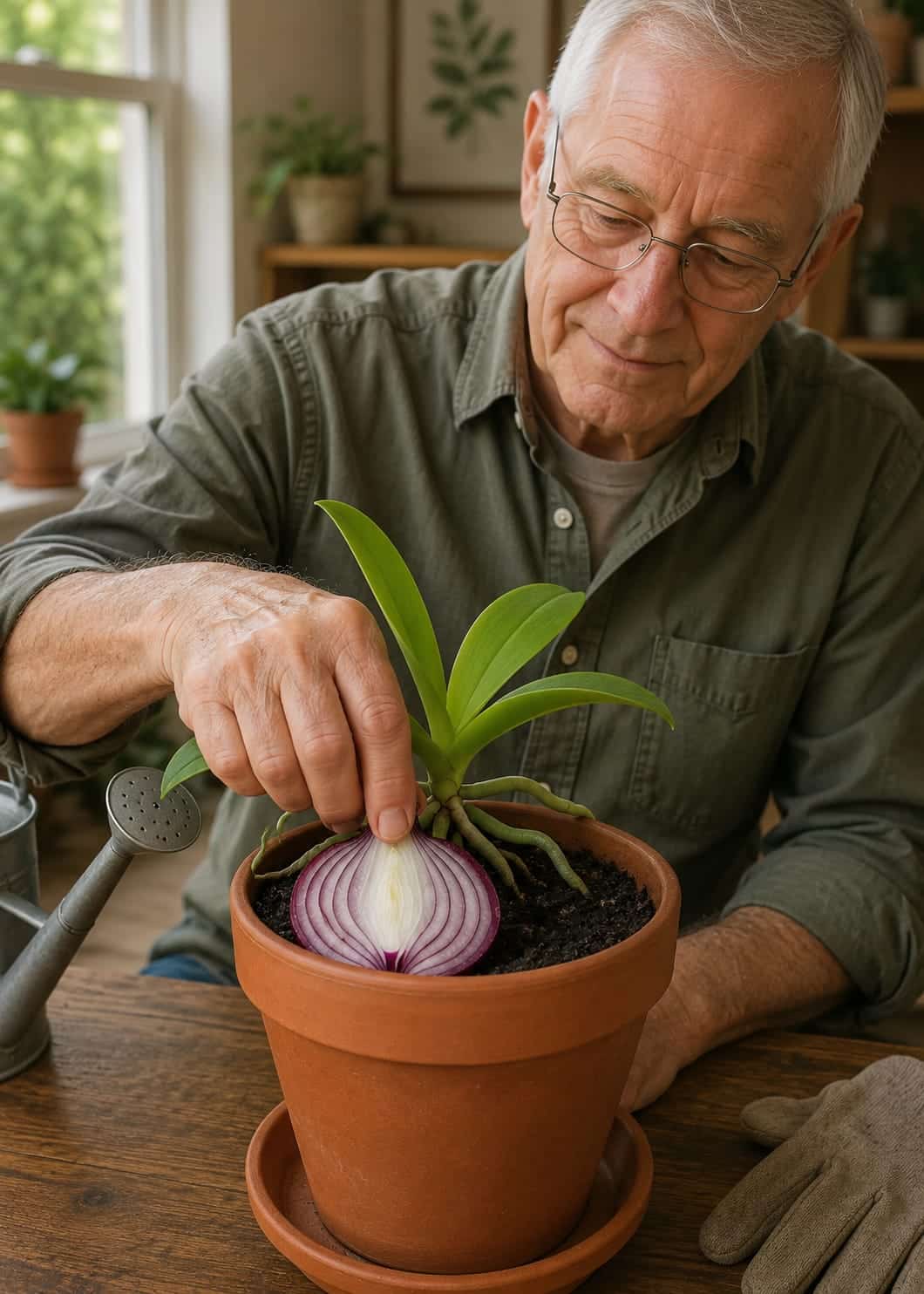
How to Use Red Onion as a Short Surface Trick – For Visual Effect Only
If you still want to place a red onion slice on the pot like the image, do it only as a very brief surface freshening method.
- Use one thin slice only.
- Place it on top of the medium away from the crown.
- Do not press it into the roots.
- Leave it for no more than 2 to 4 hours.
- Remove it before it softens or smells.
- Do not repeat often.
This method is less useful than onion water and more likely to attract pests if forgotten. The strained rinse method is safer.
What If the Onion Smell Stays in the Pot? – Fixing Odor Issues
If the pot smells strongly of onion after using this trick, you probably used too much or left onion pieces behind. Flush the pot with plain water if it drains well, then let it dry properly. If the smell turns sour or rotten, repot into fresh orchid mix.
What If Mold Appears After Using Onion? – Emergency Action
Remove any onion pieces immediately. If mold is only on the surface of bark, remove the affected pieces and improve airflow. If the medium smells sour or the roots look worse, repot.
Mold means the environment is too wet or the organic material is decomposing.
What If Fungus Gnats Appear? – Pest Control Tips
Stop all food-based tricks. Let the medium dry more between waterings. Use yellow sticky traps. Check whether the potting medium is old and decomposed. Fungus gnats often show up when organic material stays wet. This natural fungus gnat control for orchids guide will help.
For orchids, repotting into fresh bark often helps reduce gnat problems.
What If the Orchid Looks Worse After Onion Water? – Stop Immediately
Stop using it immediately. Rinse the roots with plain water if needed. Check the roots and medium. If the plant declines, the onion water may have been too strong, or the orchid may have already had serious root problems.
Return to basic orchid care: fresh bark, correct watering, bright indirect light, and patience.
A Realistic Orchid Recovery Timeline – What to Expect
Orchid recovery is slow. Do not expect dramatic changes in a few days. This orchid recovery timeline sets realistic expectations.
First Week
The plant may look the same. Leaves may remain wrinkled. The goal is to stop further decline.
Weeks 2 to 4
The orchid may begin stabilizing. Roots may firm up if conditions improve. New root tips may start appearing if the plant has enough energy.
Months 2 to 3
You may see stronger roots and possibly a new leaf. The plant is rebuilding.
Months 4 to 6
If care remains steady, the orchid may become strong enough to bloom again in the future.
Do not rush flowering. A rescued orchid needs roots first.
Quick Red Onion Water Recipe for Orchids – Homemade Root Rinse
Ingredients:
- 1 thin slice red onion
- 2 cups water
Steps:
- Soak the onion slice in water for 2 to 4 hours.
- Strain very well.
- Dilute with equal parts plain water.
- Use as a 5 to 10 minute root rinse during repotting.
- Let roots air-dry briefly.
- Repot in fresh orchid bark.
- Discard leftover onion water.
Quick Orchid Recovery Checklist – Essential Steps
- Remove orchid from old pot
- Remove old bark or moss
- Inspect roots carefully
- Trim rotten roots with clean scissors
- Rinse roots with plain water
- Use mild onion water only briefly if desired
- Repot in fresh airy orchid mix
- Use a pot with drainage and airflow
- Keep crown dry
- Place in bright indirect light
- Water only when roots and medium approach dryness
- Wait before fertilizing
Short Caption for This Trick
“To use red onion safely on a weak orchid, do not bury raw onion in the pot. Instead, soak one thin slice of red onion in 2 cups of water for 2 to 4 hours, strain very well, dilute with equal parts plain water, and use it as a brief 5 to 10 minute root rinse during repotting. Then let the roots air-dry slightly and repot the orchid in fresh airy bark. Use this only rarely, and focus on the real recovery basics: clean roots, drainage, airflow, bright indirect light, and careful watering – this natural orchid root tonic is a gentle helper, not a miracle cure.”
Frequently Asked Questions – Red Onion for Orchids Q&A
Can I put red onion directly in my orchid pot?
It is not recommended. Raw onion can rot, smell, attract gnats, and keep orchid roots too wet. A strained and diluted onion water rinse is safer.
Does red onion help orchid roots grow?
Red onion water may be used as a mild natural rinse, but it does not guarantee root growth. New roots depend on proper care, fresh medium, light, moisture balance, and a healthy crown.
How long should I soak orchid roots in onion water?
Use a brief soak of 5 to 10 minutes only, and make sure the onion water is strained and diluted.
Can onion water replace orchid fertilizer?
No. Onion water is not a complete fertilizer. Use a balanced orchid fertilizer once the plant is stable and actively growing.
Can I use onion water on orchid leaves?
No. Do not spray onion water on orchid leaves. It can leave residue and smell. Use it only as a brief root rinse if desired.
How often should I use onion water on orchids?
Rarely. One rinse during rescue repotting is enough. If repeated, wait at least 4 to 6 weeks and only use it on a stable plant.
What is the best way to save a weak orchid?
Remove old medium, trim rotten roots, repot in fresh airy orchid bark, provide bright indirect light, keep the crown dry, and water only when the medium is nearly dry.
Why are my orchid roots mushy?
Mushy roots usually mean rot from too much moisture, old medium, poor airflow, or lack of drainage. Remove mushy roots and repot into fresh bark.
Can a rootless orchid recover?
Sometimes, if the crown is healthy. It needs high humidity, bright indirect light, airflow, and patience. Onion water is not the main solution for rootless orchids.
Should I fertilize a weak orchid?
Do not fertilize immediately if the roots are damaged. Wait until the orchid shows new root tips or stable growth, then use a very diluted orchid fertilizer.
Final Thoughts – The Best Natural Orchid Root Rescue Method
The red onion trick for weak orchids is interesting, affordable, and natural, but it must be used wisely. The safest version is not to bury onion in the pot. The safest version is a mild, strained, diluted onion water rinse used briefly during a proper orchid rescue routine. Raw onion left in orchid bark can rot and cause the very problems you are trying to prevent. This natural orchid root treatment has helped many gardeners, but only when combined with proper care.
If your orchid is weak, start with the roots. Remove the plant from old medium, inspect every root, trim away rot, rinse gently, and repot into fresh airy orchid bark. Use a pot with drainage and airflow. Keep the crown dry. Give bright indirect light. Water only when the roots and medium are approaching dryness. Wait for new roots before expecting flowers. Following this complete orchid root care guide will keep your plant thriving.
Red onion water may support the process as a gentle freshening rinse, but it is not a miracle fertilizer or a guaranteed root-growing solution. The real secret is clean roots and correct care. When those basics are right, even a tired orchid can slowly rebuild itself. Over time, new roots can appear, leaves can firm up, and the plant may become strong enough to bloom again. These professional orchid care secrets will help you succeed.
Smart homeowners use red onion as a small optional tool, not as the whole rescue plan. They do not leave food scraps in the pot. They do not overwater. They do not chase every viral trick. They observe the plant, protect the roots, and create the conditions orchids actually need. That careful approach is what supports healthier roots, stronger growth, and eventually, the beautiful flowers that make orchids so rewarding to grow. Start your orchid rescue journey today with the right fundamentals.