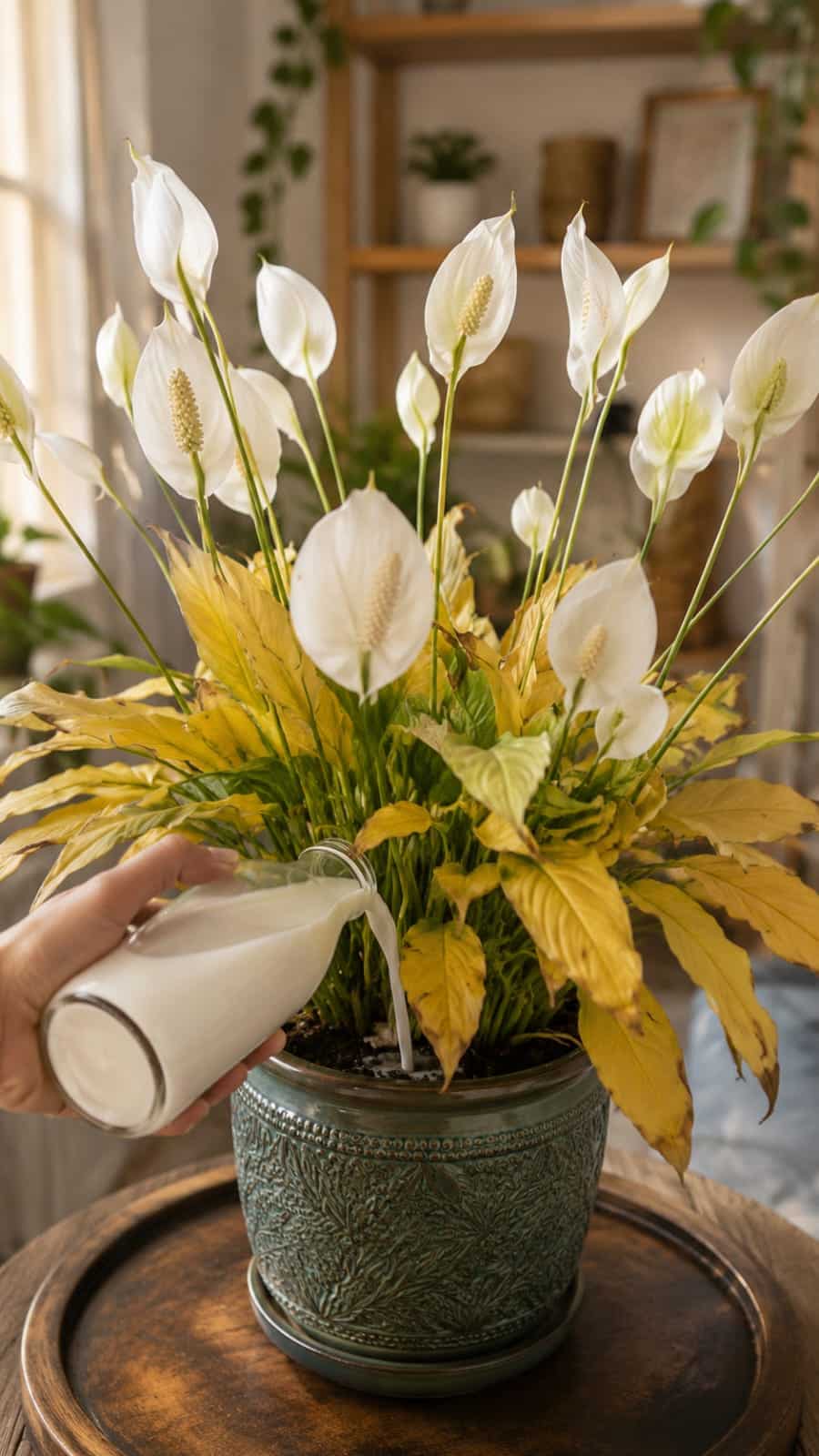
Why Straight Milk Is Risky
Milk contains proteins, fats, sugars, and minerals. While tiny diluted amounts may not harm a plant, straight milk can spoil in soil. Indoors, where airflow is limited, milk can create unpleasant smells and invite pests.
Problems caused by too much milk include:
- Sour odor
- White mold on soil
- Fungus gnats
- Sticky residue
- Soil staying damp too long
- Root stress
For this reason, rice water is usually safer than milk. If milk is used, it should be only a few drops in plenty of water.
Should You Spray This Tonic on Peace Lily Leaves?
No. Do not spray milky liquid on peace lily leaves. It can leave residue, attract dust, and cause spotting. Peace lily leaves look best when cleaned with plain water and a soft cloth.
To clean leaves:
- Dampen a soft cloth with plain water.
- Support the leaf with one hand.
- Wipe gently from base to tip.
- Dry excess water if needed.
Do not use oily leaf shine products. Clean leaves absorb light better and look naturally glossy.
What to Do About the Yellow Leaves in the Image
The plant in the image has many yellow leaves but also many white blooms. That means it is still alive and active, but it may be stressed. The first step is not to pour more and more tonic. The first step is to clean and diagnose.
Step 1: Remove Fully Yellow Leaves
Trim yellow leaves at the base. This immediately improves the plant’s appearance and reduces decaying material around the soil.
Step 2: Check the Pot
Make sure the decorative pot has drainage. If it does not, remove the plant and place it in a nursery pot with holes inside the decorative pot.
Step 3: Smell the Soil
If the soil smells sour or rotten, the plant may need repotting. Do not cover the smell with milk or rice water.
Step 4: Check the Roots
If yellowing is widespread and the soil stays wet, gently remove the plant from the pot and inspect the roots. Healthy roots are firm and pale. Rotten roots are mushy, black, or smelly.
Step 5: Move to Bright Indirect Light
Place the plant near a bright window with filtered light. Avoid harsh direct sun that can scorch leaves.
Step 6: Use the Tonic Only After Stabilizing
Once the plant is in proper light, proper soil, and a draining pot, a mild tonic can be used occasionally.
Best Light for Peace Lilies
Peace lilies tolerate lower light, but they look better and bloom more reliably in bright indirect light. The image shows the plant in a warm indoor room with light nearby, which is a good start. But if the plant is too far from a window, it may bloom less and yellow more.
Ideal light conditions include:
- Bright indirect light near a window
- Morning sun filtered through curtains
- No harsh afternoon sun on leaves
- No dark corners for long periods
If your peace lily has lots of leaves but few blooms, it may need brighter indirect light.
Best Soil for Peace Lilies
Peace lilies need soil that holds moisture without becoming heavy and soggy. A dense mix can suffocate roots. A loose, airy mix is better.
Simple Peace Lily Soil Mix
- 2 parts indoor potting mix
- 1 part perlite
- 1 part fine orchid bark or coco chips
This mix holds moisture but also allows air to reach the roots. If your peace lily is in old compacted soil, repotting may help more than any tonic.
Best Watering Routine for Peace Lilies
Peace lilies prefer consistent moisture, but not soggy soil. The best time to water is when the top inch of soil begins to dry.
Watering Steps
- Touch the top inch of soil.
- If it feels slightly dry, water.
- Water evenly around the pot.
- Let excess water drain out.
- Empty the saucer.
- Wait until the top begins to dry again.
If the plant droops and the soil is dry, water it. If the plant droops and the soil is wet, check the roots.
How to Encourage More Peace Lily Blooms
Milky tonic may support general health, but it does not create flowers by itself. Peace lily blooms come from a combination of light, energy, nutrients, and healthy roots.
To encourage more blooms:
- Place the plant in bright indirect light
- Keep temperatures warm and stable
- Water consistently
- Use a draining pot
- Feed lightly during active growth
- Remove old faded blooms
- Clean leaves regularly
- Avoid overwatering
If your peace lily is blooming heavily but leaves are yellowing, it may be using a lot of energy or dealing with root stress. Balance is important.
How to Fertilize Peace Lilies Correctly
A homemade tonic is not a complete fertilizer. Peace lilies benefit from gentle feeding during active growth. Use a balanced houseplant fertilizer at half strength once every 4 to 6 weeks in spring and summer.
Do not fertilize heavily. Too much fertilizer can cause brown tips and root burn.
A simple schedule:
- Plain water most of the time
- Half-strength fertilizer once every 4 to 6 weeks during growth
- Milky rice-water tonic occasionally instead of fertilizer
- No feeding if the plant is stressed or root-rotting
Do not use fertilizer and milky tonic in the same watering.
How to Repot a Yellowing Peace Lily
If the plant has many yellow leaves and the soil is old, repotting may be necessary.
Step 1: Remove the Plant Gently
Slide the peace lily out of the pot. Be gentle with the roots.
Step 2: Inspect the Roots
Cut away black, mushy, or rotten roots with clean scissors. Keep firm healthy roots.
Step 3: Remove Old Soil
Shake away heavy, sour, or compacted soil.
Step 4: Choose a Pot With Drainage
Use a pot only slightly larger than the root ball. Too large a pot holds too much wet soil.
Step 5: Add Fresh Airy Mix
Use a loose potting mix with perlite and bark.
Step 6: Water Lightly
After repotting, water with plain water. Do not use homemade tonic immediately on stressed roots.
Can This Tonic Attract Fungus Gnats?
Yes, if used too strongly or too often. Fungus gnats love damp organic soil. Milk, rice water, and other homemade liquids can encourage gnats if the pot stays wet.
To avoid gnats:
- Use the tonic rarely
- Dilute heavily
- Never leave food scraps in the pot
- Let the top soil dry slightly between waterings
- Remove dead leaves
- Use sticky traps if gnats appear
- Improve drainage
What If the Soil Smells Sour After Using It?
Stop immediately. Sour smell means the soil is not healthy. It may be too wet, too compacted, or full of decomposing organic material.
To fix it:
- Stop using homemade liquids.
- Let the top soil dry slightly.
- Check drainage.
- Remove yellow leaves and debris.
- Repot if the smell continues.
- Use plain water only until the plant recovers.
Do not add more milk, lemon, coffee, or any other kitchen tonic to sour soil.
Quick Safe Recipe Card
Gentle Milky Peace Lily Recovery Tonic
Ingredients
- 1 tablespoon fresh rice water
- 1 cup clean water
- Optional: 3 to 5 drops plain milk
Instructions
- Rinse a spoonful of rice in clean water.
- Save 1 tablespoon of the cloudy rinse water.
- Mix it into 1 cup of plain water.
- Add only a few drops of milk if desired.
- Use fresh the same day.
- Apply only when the soil is slightly dry and the plant needs watering.
- Pour a small amount around the soil.
- Let the pot drain completely.
- Use once every 4 to 6 weeks at most.
Short Caption for Social Media
Peace Lily Recovery Trick 🌿🤍: If your peace lily has yellow leaves but still blooms, do not pour straight milk into the pot. Use a gentle diluted tonic instead. Mix 1 tablespoon of fresh rice water into 1 cup of clean water, add only a few drops of milk if desired, and pour a small amount onto the soil only when the plant is due for watering. Trim yellow leaves, check drainage, and place the plant in bright indirect light. Fuller green leaves come from healthy roots, steady watering, and good light—not heavy homemade liquids.
Frequently Asked Questions
Can I pour milk on a peace lily?
Straight milk is not recommended. It can sour in the soil, attract pests, and create mold. If milk is used at all, add only a few drops to a full cup of water.
Is rice water good for peace lilies?
Fresh diluted rice water can be used occasionally as a mild tonic, but it should not replace proper watering, light, or fertilizer.
Why are my peace lily leaves turning yellow?
Yellow leaves may come from overwatering, underwatering, low light, old age, root stress, poor drainage, or fertilizer buildup.
Will yellow peace lily leaves turn green again?
No. Once a leaf is fully yellow, it usually will not turn green again. Trim it and focus on healthy new growth.
How often should I use this milky tonic?
Use it no more than once every 4 to 6 weeks during active growth, and only when the plant needs watering.
Can this tonic make my peace lily bloom more?
Not by itself. More blooms come mainly from bright indirect light, healthy roots, proper watering, and gentle feeding.
Should I spray the tonic on the leaves?
No. Milky liquids can leave residue. Clean peace lily leaves with plain water and a soft cloth.
What should I do if the soil smells bad?
Stop using homemade treatments, check drainage, remove dead leaves, and repot if the soil is sour or compacted.
Does a peace lily need fertilizer?
Yes, during active growth. Use a balanced houseplant fertilizer at half strength every 4 to 6 weeks in spring and summer.
What is the best way to keep peace lilies green?
Give bright indirect light, water when the top inch of soil begins to dry, use a pot with drainage, clean the leaves, and avoid overwatering.
Final Thoughts
The milky tonic trick can look gentle and nourishing, especially when a peace lily is yellowing but still blooming. But the safest version is very diluted and used only occasionally. Straight milk is too risky for indoor pots. Thick homemade liquids can sour, attract fungus gnats, and stress roots.
If your peace lily has many yellow leaves, first check the basics. Is the soil too wet? Does the pot drain? Are the roots healthy? Is the plant getting bright indirect light? Are old leaves being removed? These questions matter more than any hack.
Once the plant is stable, a weak rice-water tonic with only a few drops of milk can be used as a light support. Pour a small amount onto slightly dry soil, let the pot drain fully, and then return to normal care. Use plain water most of the time.
Peace lilies become fuller, greener, and more beautiful when their roots are healthy and their care is balanced. Give them bright filtered light, steady moisture, airy soil, drainage, clean leaves, and gentle feeding. Then, if you choose to use the milky tonic, let it be a small finishing touch—not the main solution.