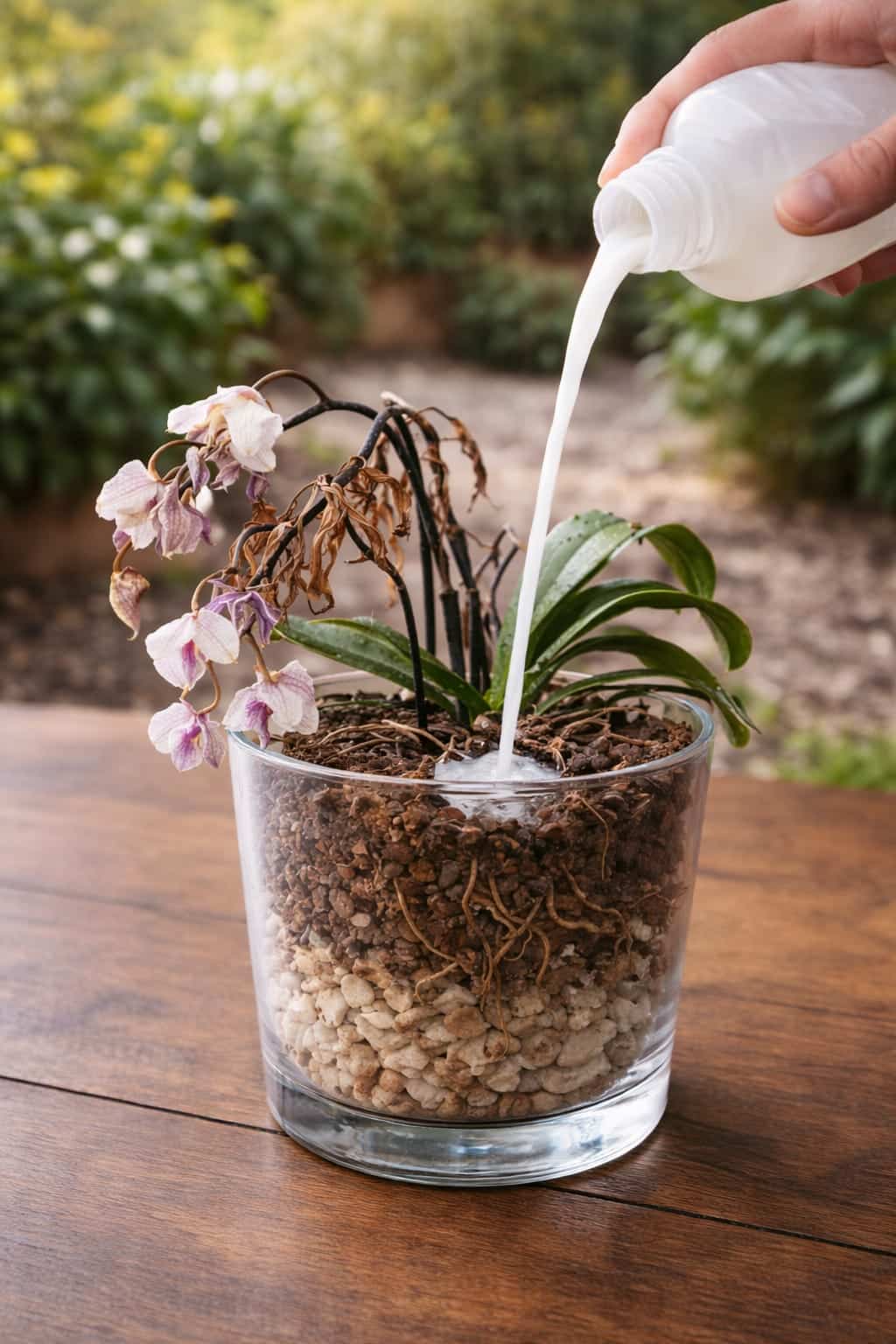
Is diluted milk the secret to reviving orchids? Learn what the “white liquid” really does, the risks of using it incorrectly, and the real steps to save a struggling orchid. Practical care guide inside.
Let’s be honest: orchids are known for their elegance — but also for being one of the most misunderstood houseplants. Their delicate blooms, smooth leaves, and exotic appearance make them a favorite for home decor, yet they have a reputation for being difficult. When leaves droop, roots turn brown, and blooms fade, many people assume the plant is dying and throw it away.
Recently, some homeowners have started using a diluted white liquid (often milk‑based) as part of their orchid care routine. Viral videos show a splash of white liquid, and suddenly – healthier leaves, firmer roots, and even new blooms.
👉 But here’s the reality: it’s not a miracle solution — it’s about how and when it’s used. Used incorrectly, it can harm your orchid. Used correctly, it may offer a tiny boost, but only when the basics are already right.
In this guide, you’ll learn why orchids struggle indoors, what the white liquid really is, the risks most people ignore, and – most importantly – the real steps to revive a dying orchid: checking roots, trimming damage, repotting in fresh bark, improving airflow, and watering properly. No magic, just practical care.
🌿 Why Orchids Struggle Indoors
Orchids are not like regular houseplants. In nature, they are epiphytes – they grow attached to trees, with their roots exposed to air and light. They do not grow in soil. Understanding this is the key to successful orchid care
Common Problems Indoors
Problem Effect
Overwatering Roots suffocate, rot, and die.
Poor drainage Water pools; roots stay wet; rot develops.
Lack of airflow Roots cannot breathe; fungal issues arise.
Weak light exposure No energy for growth or blooms.
Nutrient imbalance Weak leaves, no flowers.
When roots suffocate, the entire plant declines. Most orchid problems start below the surface, not above.
🥛 What Is the “White Liquid” Method?
In viral plant videos, the white liquid is usually diluted milk – typically 1 part milk to 4–5 parts water. Sometimes it’s a very diluted liquid fertilizer (which can also appear white or cloudy).
Some plant owners use this occasionally, believing it can:
· Provide trace nutrients (calcium, proteins)
· Support leaf shine (milk can leave a slight gloss)
· Contribute to a balanced environment
· Offer mild organic compounds
⚠️ However, it must be used very carefully and rarely. It is not a substitute for proper orchid care.
⚠️ The Risks Most People Ignore
Using milk (or any white liquid) incorrectly can harm orchids. Orchids are extremely sensitive – less is always better.
What to Avoid
Mistake Consequence
Pouring undiluted liquid into roots Burns roots; causes rot.
Frequent application Builds up residue; attracts mold and pests.
Letting liquid sit in the pot Stagnant moisture leads to root rot.
Using on already rotting roots Makes rot worse.
Replacing proper watering habits Milk is not water; orchids still need plain water.
If you notice a sour smell, white mold on the bark, or yellowing leaves after using milk, stop immediately. Flush the pot with plain water.
🌱 The Correct Way to Help a Dying Orchid
If your orchid looks like the image (drooping leaves, weak roots, no blooms), focus on recovery basics. The white liquid is at best a tiny supplement; these steps are essential.
Want the full truth and the practical next steps?
Page 2 continues with the real explanation, the key details many readers skip, and the simple takeaways that make this guide more useful.