Discover how a simple, affordable plant elixir (diluted root‑support solution) helped revive a struggling snake plant. Learn why gentle soil balance beats aggressive fertilizer for stronger, upright leaves.
Let’s be honest: snake plants (Sansevieria, now Dracaena) are famous for being low‑maintenance. They survive low light, irregular watering, and general neglect. But “low‑maintenance” doesn’t mean “no care.” Over time, soil becomes compacted, nutrients become unbalanced, and growth can slow down. Leaves that once stood tall and firm may start to lean, curl, or lose their deep green color.
Many people respond by buying expensive fertilizers or concentrated plant food formulas. They assume that more nutrients equal faster growth. But in reality, aggressive feeding often creates more problems than it solves – burnt roots, brown tips, and even weaker leaves.
That’s when I switched to a simple, affordable plant elixir – used in very diluted form – focused on soil balance rather than nutrient overload. The result wasn’t instant overnight growth. It was steady improvement, stronger roots, and firmer upright leaves. My snake plant didn’t just survive; it thrived.
In this guide, I’ll share what this plant elixir is, how to use it safely, why gentle soil support works better than strong fertilizer, and the essential conditions for a truly thriving snake plant. Plus, I’ll explain why healthy snake plants are not just good for you – they’re also a smart investment for modern home staging and real estate appeal.
Let’s get started.
What Is the Plant Elixir in the Image?
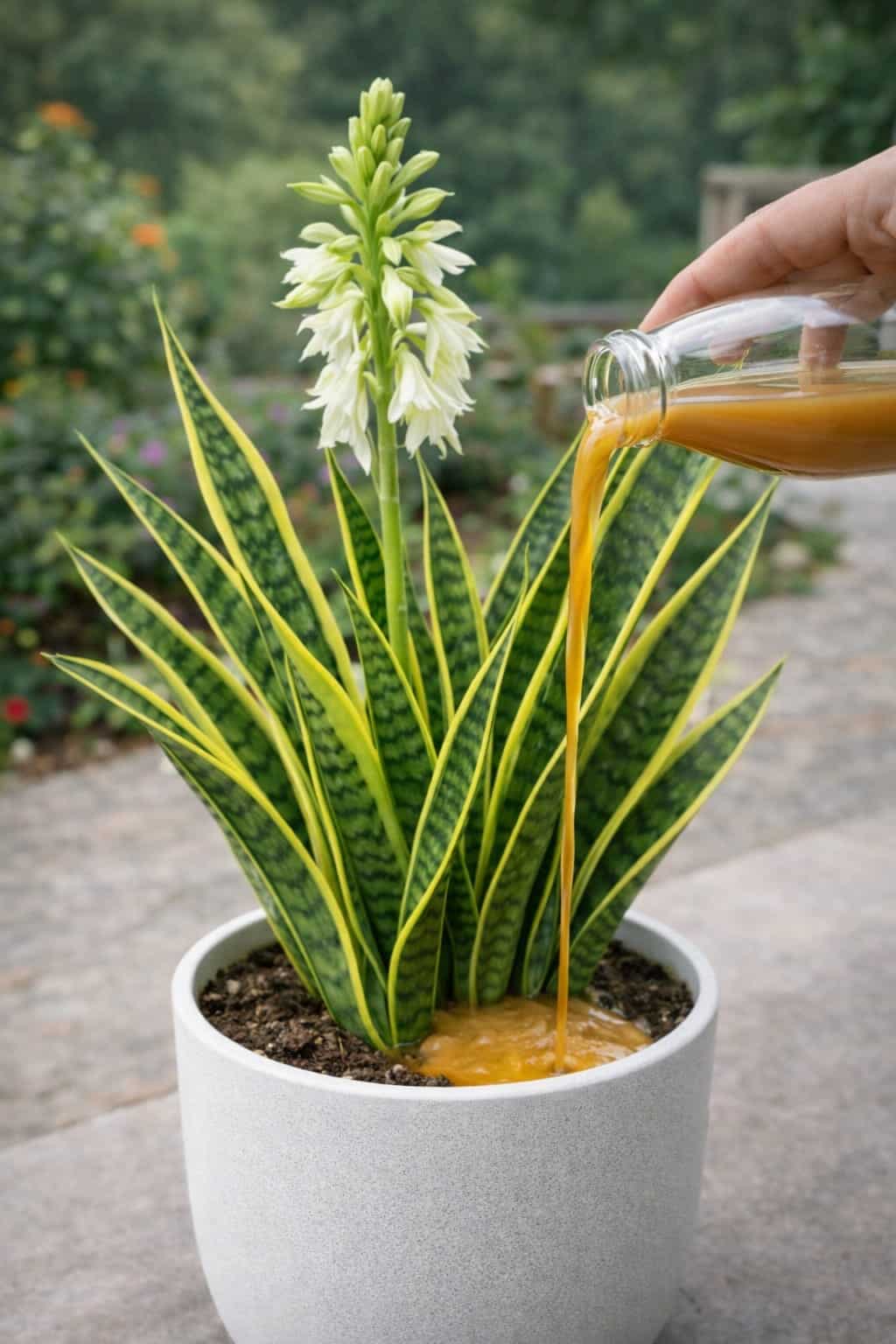
In the image, a small amber bottle labeled “Plant Elixir – Root & Soil” is being poured gently into the soil near the base of a snake plant. This represents a mild, diluted root‑support solution – not a strong fertilizer. Common affordable options include:
· Diluted seaweed or kelp extract – provides trace minerals and natural growth hormones.
· Diluted compost tea – adds beneficial microbes and gentle organic nutrients.
· Very weak balanced fertilizer (e.g., 10-10-10 at quarter strength) – supports overall health without burn.
· Diluted worm casting tea – feeds soil life slowly and naturally.
The purpose of this elixir is to:
· Support root stability – healthy roots anchor the plant and absorb water efficiently.
· Refresh depleted potting soil – adds trace minerals that may have leached out over time.
· Improve moisture absorption balance – helps soil retain just enough water without becoming soggy.
· Reduce mineral salt buildup – flushes excess salts that accumulate from tap water or over‑fertilizing.
· Maintain controlled soil conditions – prevents the extremes of nutrient spikes and deficiencies.
Snake plants store water in their thick leaves. Because of this, they are highly sensitive to strong feeding schedules. The key is dilution, not intensity. A little support goes a long way.
Why I Switched from Strong Fertilizers to a Gentle Elixir
Like many plant owners, I used to believe that if a little fertilizer was good, more would be better. I fed my snake plant with a standard liquid fertilizer at full strength every month. The result? Brown leaf tips, a white crust on the soil, and leaves that felt soft instead of firm. I was slowly harming my plant while thinking I was helping it.
After researching snake plant care, I learned that these succulents are native to dry, low‑nutrient environments. They are not heavy feeders. In fact, they thrive on neglect – and that includes neglect from over‑feeding.
Switching to a diluted, gentle elixir changed everything. I started using a quarter‑strength seaweed extract once a month during spring and summer. Within a few months, the brown tips stopped spreading, new leaves emerged upright and firm, and the overall color deepened. The plant looked healthier – not because I added more, but because I added less.
🧪 How to Use an Affordable Plant Elixir Properly – Step by Step
If you want to try this gentle approach, follow these strict guidelines. Moderation is everything.
Step‑by‑Step Safe Application
- Dilute the solution heavily – use quarter strength or less. The liquid should look like weak tea, not a dark concentrate.
- Apply only when soil is completely dry – never apply to wet soil. Check by sticking your finger 2–3 inches deep.
- Pour slowly around the outer edge of the pot – avoid the crown (center) of the plant. This encourages roots to spread outward.
- Ensure full drainage – water must run out the bottom. Empty the saucer immediately.
- Use occasionally – once a month at most, and only during spring and summer (active growing season). Do not use in fall and winter.
What to Avoid
· Using full‑strength fertilizer – burns roots, causes brown tips.
· Applying weekly – leads to salt buildup and weak growth.
· Pouring directly into the center of the plant – can cause crown rot.
· Using on a plant with soggy soil – fix watering first.
· Expecting overnight results – gentle support works slowly but steadily.
Pro tip: If you notice white crust on the soil or leaf tips turning brown, you’re over‑feeding. Flush the soil with plain water and reduce the frequency or strength.
Continue to Page 2
Continue to page 2 for more details about this article and the key points many readers miss on the first page.