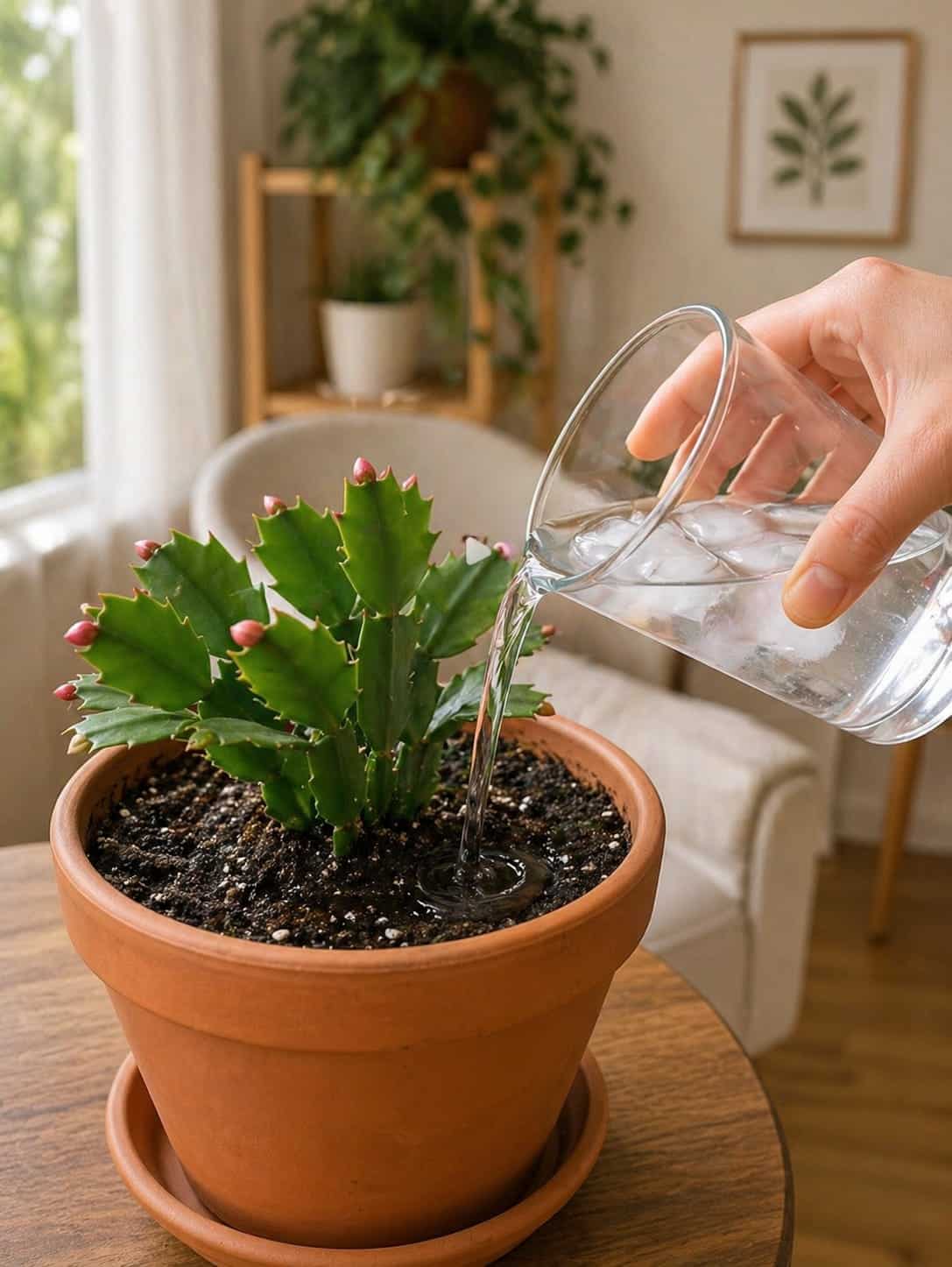
If your Christmas cactus looks healthy but refuses to bloom, the problem might not be light… or fertilizer… or even the season. It is often something much simpler: how you water it. And yes — most people are doing it wrong.
You have probably seen lush green segments, maybe even some growth, but when winter rolls around, there are no buds, no flowers, just a frustratingly bare plant. You move it to a brighter window, you try a special fertilizer, you even talk to it. Nothing works.
The truth is that Christmas cacti (Schlumbergera x buckleyi) are not like desert cacti. They are tropical plants with specific moisture needs. Getting the watering right is the single most important factor for triggering those beautiful, cascading blooms. In this guide, you will learn the most common watering mistake that stops blooms, how to water correctly for each season, the truth about the “ice cube” myth, and a complete year‑round care routine that will have your Christmas cactus flowering spectacularly every holiday season.
Why Christmas Cactus Care Is So Often Misunderstood
Despite its name, a Christmas cactus is not a desert cactus. It is an epiphytic cactus native to the tropical rainforests of Brazil, where it grows on tree branches in shaded, humid conditions. Its roots are adapted to consistent moisture followed by drying periods, but they cannot tolerate prolonged wetness or extreme dryness.
That means it does not like extreme dryness, but it also hates sitting in water. This delicate balance is where many people go wrong. They either treat it like a succulent (watering very infrequently) or like a thirsty tropical plant (keeping the soil constantly wet). Both extremes lead to the same result: a plant that looks okay but never blooms.
Understanding this fundamental difference is the first step toward a holiday season filled with colorful pink, red, or white flowers.
The Most Common Watering Mistake ❌
The biggest mistake is watering too often or keeping the soil constantly wet. Many well‑intentioned plant owners water their Christmas cactus on a schedule (e.g., every Sunday) without checking the soil. Or they keep the potting mix consistently damp because they read that the plant likes moisture.
What happens when the soil stays too wet?
· Roots begin to suffocate – They need oxygen as much as water. Soggy soil excludes air.
· The plant becomes stressed – It shifts into survival mode, focusing on staying alive rather than reproducing (blooming).
· Buds drop before opening – Even if buds form, constant moisture can cause them to fall off.
· Blooms never appear – The plant simply does not have the energy or hormonal signal to flower.
· Root rot develops – Over time, the roots turn brown, mushy, and foul‑smelling, eventually killing the plant.
Even worse, overwatering is a slow, silent killer. The plant may look fine on top for weeks or months while the roots decay underneath.
The Opposite Mistake Isn’t Better
Some people swing the other way and let the soil dry out completely for too long. Because they know the plant is a cactus, they water it like a desert succulent — once a month or even less.
What happens when the soil is too dry for too long?
· Wrinkled, limp segments – The plant becomes dehydrated.
· Weak bud formation – Even if buds start, they may be small or abort.
· Delayed or no flowering – The plant does not have enough energy to produce flowers.
· Segments may drop – Severe drought can cause the plant to shed leaves.
The goal is not “more water” or “less water” — it is correct timing. The Christmas cactus needs a consistent cycle: moist, then allowed to dry slightly, then moist again. It is a balance that mimics its natural habitat.
The Right Way to Water a Christmas Cactus 💧
Here is what actually works, based on the plant’s natural growth cycle and the science of how it triggers blooms.
- Check the Soil First (The Finger Test)
Before you ever pour water, stick your finger about 1 inch (2–3 cm) into the potting mix.
· If it feels dry – Time to water.
· If it feels damp or moist – Wait 2–3 days and check again.
Do not water on a calendar schedule. The plant’s needs change with temperature, humidity, and light.
- Water Deeply, Not Lightly
When it is time to water, pour room‑temperature water slowly over the soil until it runs freely from the drainage holes. This ensures the entire root ball gets moisture. Discard any water that collects in the saucer. Never let the pot sit in standing water.
- Adjust Watering for the Season
· Growing season (spring and summer) – Water more regularly (approximately every 7–10 days, when the top inch of soil dries). This supports leaf and stem growth.
· Bloom prep season (early fall) – Reduce watering slightly. Let the soil dry a bit more than usual. This mild drought stress encourages bud formation.
· Budding and blooming season (late fall through winter) – Keep the soil lightly moist but not wet. Consistency is key; do not let it dry completely or stay soggy.
· Rest period (after blooming, late winter) – Reduce watering significantly (once every 2–3 weeks). This gives the plant a rest before the next growth cycle.
- Use Well‑Draining Soil
Heavy, moisture‑retentive soil traps water and leads to root rot. Use a potting mix designed for succulents or cacti, or make your own by mixing regular potting soil with perlite (2 parts soil, 1 part perlite). A pot with drainage holes is non‑negotiable.
- Use Room‑Temperature Water
Cold water can shock the roots, especially if your plant is budding or blooming. Always use water that is at room temperature. This is especially important if you keep your house cool in winter.
The “Cold Water” Myth ❄️ (Ice Cubes Are a Bad Idea)
You may have seen videos or social media posts suggesting that placing ice cubes on the soil of a Christmas cactus helps it bloom. The theory is that a slow melt mimics a cool, moist environment or that cold shock triggers flowering. This is a myth.
Let us clear that up: cold shock does not help blooming. It can stress or damage the roots. Ice cubes melt slowly, leaving the soil unevenly moist and keeping the root zone too cold for too long. Root damage from cold can cause leaf drop, bud drop, and even plant death.
Room‑temperature water is always the safest choice. If you want to mimic the cooler nights that trigger blooming, focus on air temperature (50–65°F at night), not ice on the soil.
Continue to Page 2
Continue to page 2 for more details about this article and the key points many readers miss on the first page.