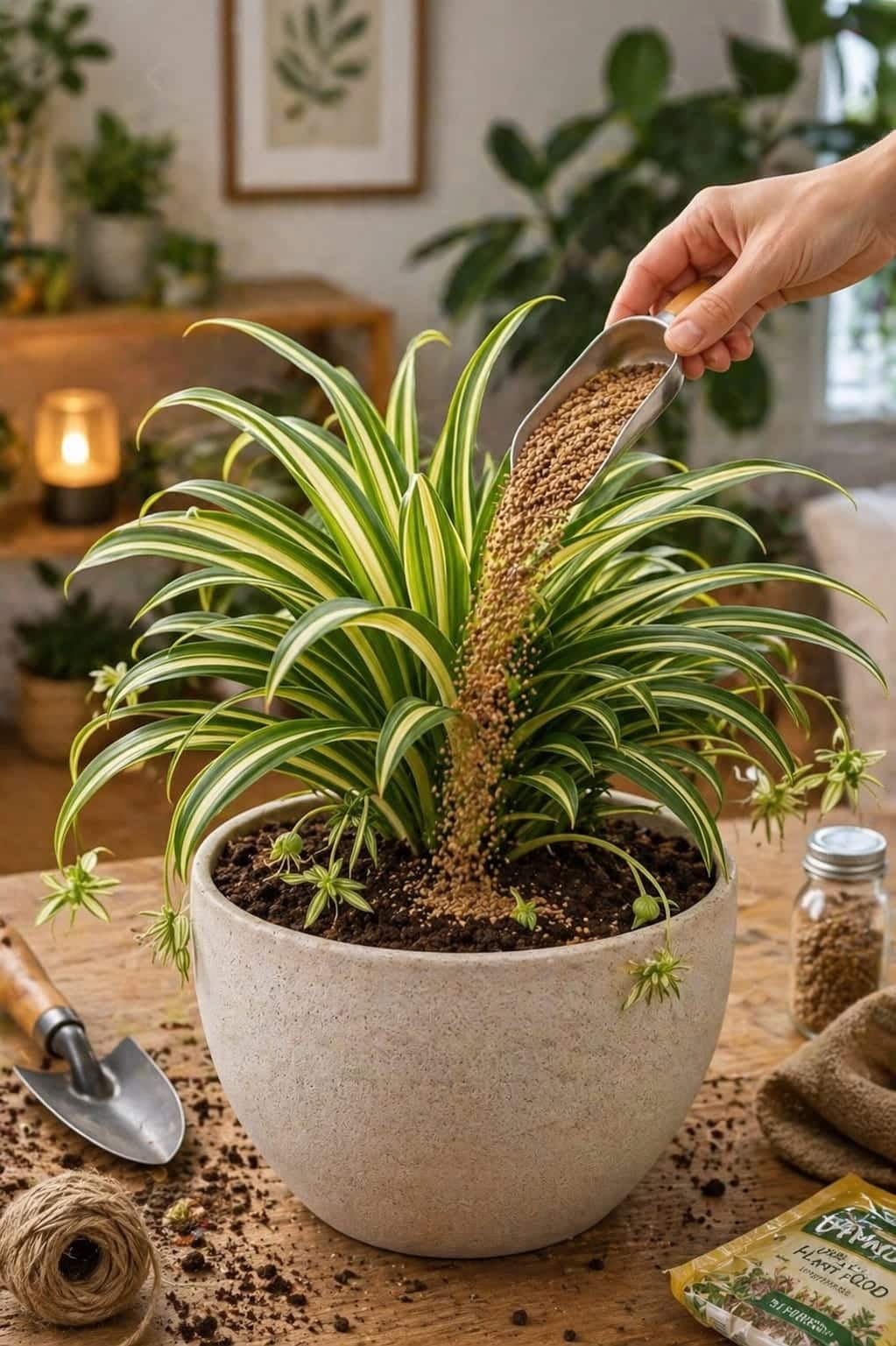
If you’ve ever owned a spider plant, you already know one thing—it’s supposed to multiply like crazy.
Those long, arching leaves… the hanging baby plantlets… the full, overflowing look that makes it feel like a living fountain of green.
But what if yours isn’t doing that?
What if your spider plant just sits there… alive, yes… but not growing, not spreading, not producing babies?
That’s exactly the problem many plant lovers face.
And recently, a simple trick has gone viral—one “forgotten step” that people claim can turn a quiet, slow spider plant into a baby-producing machine.
It looks ridiculously simple.
Just a scoop of tiny natural granules…
A quick sprinkle over the soil…
And suddenly—growth, babies, fullness.
Sounds too easy?
That’s exactly why people are trying it.
But here’s the thing: the real magic isn’t just the granules—it’s the hidden step behind them that most people skip.
And once you understand it, your spider plant can finally start multiplying the way it’s supposed to.
🌿 Why Your Spider Plant Isn’t Multiplying (The Truth Most People Miss)
Spider plants are famous for producing babies—but only when they feel comfortable.
If your plant isn’t multiplying, it’s not because it’s broken…
It’s because something in its environment is telling it:
“Don’t grow yet.”
Most people focus on watering or sunlight—but the real issue is often deeper.
Spider plants need three core conditions to produce babies:
✔ Enough energy (light)
✔ Balanced roots (not stressed)
✔ A slightly “tight” growing environment
If even one of these is off, your plant may stay in survival mode instead of growth mode.
That’s why some spider plants stay small for months… even years.
⚡ “Granule Trick” Everyone Is Talking About
In many viral plant reels, you’ll see someone pouring small brown or golden granules into the soil of a spider plant.
The caption usually says something like:
“Your spider plant isn’t multiplying? You’re skipping this step.”
So what are these granules supposed to do?
According to the trend, they help:
✔ Improve soil structure
✔ Support root activity
✔ Encourage healthier growth
✔ Create better conditions for baby plants
But here’s the part most people don’t realize…
👉 The granules alone are NOT the secret.
They just support the real secret.
🤫 The Real Secret Behind Spider Plant Babies
Spider plants produce babies when they feel slightly “challenged”—but still safe.
Not stressed… just motivated.
This usually happens when:
✔ The roots are slightly crowded
✔ The plant has enough light
✔ The soil drains well
✔ The plant isn’t overwatered
That’s the sweet spot.
And here’s where the “granule trick” comes in.
🌱 Why People Add Granules to Spider Plants
The granules shown in reels are usually presented as a “natural booster” for the soil.
Their purpose is simple:
👉 To make the soil lighter, more breathable, and more balanced
When soil becomes too compact or too wet, roots struggle.
And when roots struggle…
👉 The plant stops producing babies.
By adding a light layer of granules, people believe they are helping:
✔ Airflow around roots
✔ Better drainage
✔ More stable moisture balance
And that creates the perfect environment for growth.
🔹 Step-by-Step: The “Forgotten Step” Routine
This is the exact simple routine shown in viral videos:
1️⃣ Add a small amount of granules
Sprinkle lightly around the soil surface—don’t overload it.
2️⃣ Keep it away from the center
Avoid piling directly on the plant base.
3️⃣ Let it settle naturally
No need to mix deeply—just a surface layer is enough.
4️⃣ Water gently (not heavily)
Spider plants hate soggy soil—keep it light.
5️⃣ Place in bright indirect light
This is where the real growth starts.
📊 Spider Plant Growth Balance Table
| Factor | Ideal Condition | Why It Matters |
|---|---|---|
| Light | Bright indirect light | Fuels energy for baby production |
| Soil | Light + breathable | Prevents root stress |
| Water | Moderate, not soggy | Avoids root damage |
| Pot | Slightly snug | Encourages multiplication |
| Airflow | Good ventilation | Keeps roots active |
| Feeding | Light, occasional | Supports steady growth |
Continue to Page 2
Continue to page 2 for more details about this article and the key points many readers miss on the first page.