Meet the Kalanchoe
The flowering kalanchoe, Kalanchoe blossfeldiana, is a succulent from the highlands of Madagascar. It is sold as flaming Katy or widow’s-thrill, and it is one of the few succulents grown specifically for its flowers rather than its foliage.
The thick scalloped leaves are water-storage organs, the same as in any succulent. What sets this species apart is the flower head: dense clusters of small four-petalled blooms that hold their colour for six to eight weeks, far longer than most flowering houseplants.
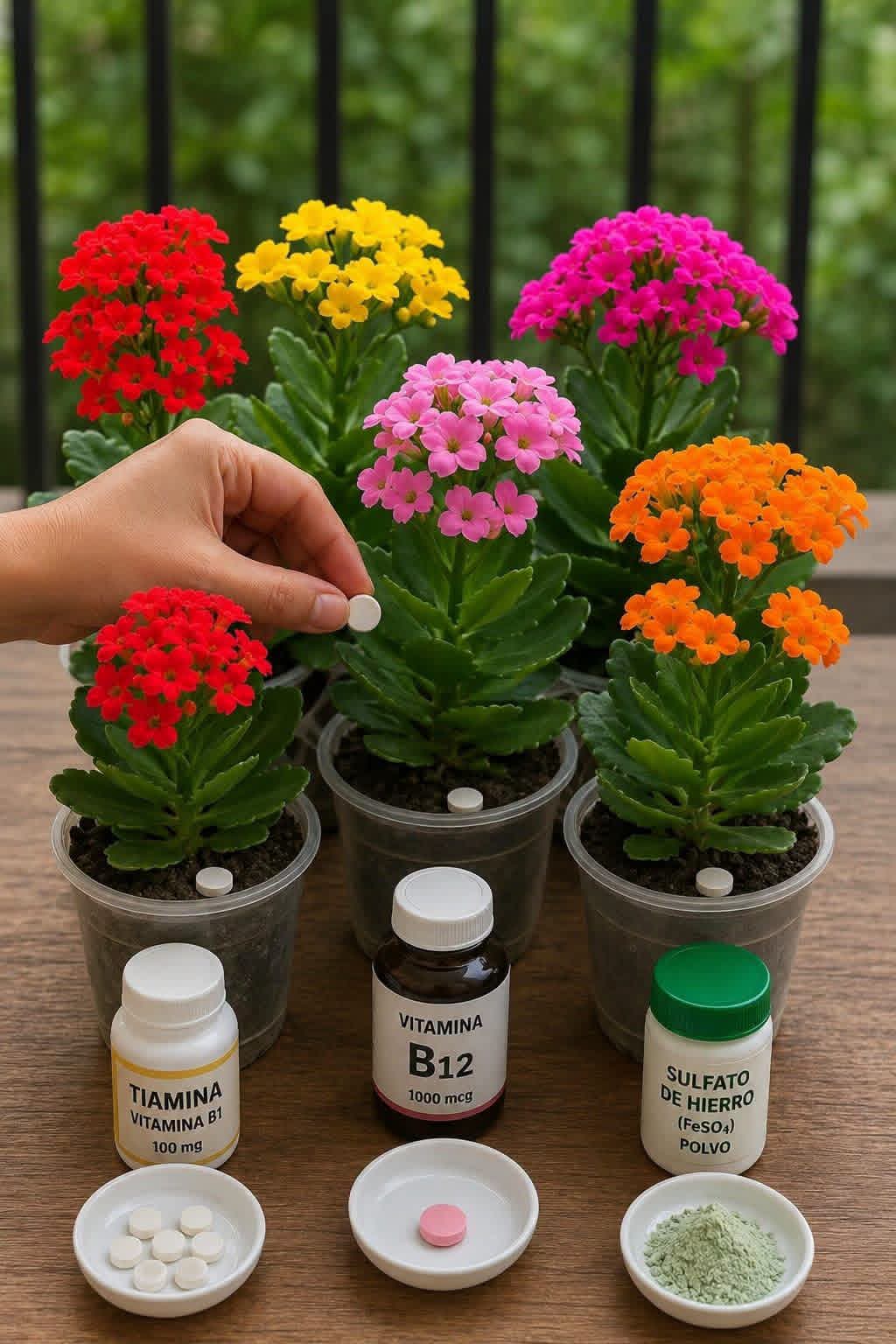
It is sold in red, pink, orange, yellow, white, and magenta, and there are double-flowered forms with rosette-shaped blooms. Most plants sold in shops have been forced into flower under controlled light in a greenhouse.
A well-kept kalanchoe lives for years and can be brought back into bloom season after season, though this requires a specific trigger that most owners never discover.
Popular Kalanchoe Varieties
Calandiva. The double-flowered series, with rosette blooms of around thirty petals each. Longer-lasting flowers and the most widely sold premium form.
Flaming Katy, the standard single form. Four-petalled flowers in dense clusters. The classic supermarket plant and the easiest to find.
Queen series. Compact, heavily branched plants bred for a tight mounded shape and a very high flower count.
Kalanchoe tomentosa, panda plant. A different species grown for its fuzzy silver leaves edged in brown rather than for flowers.
Kalanchoe luciae, paddle plant. Round flat leaves that flush deep red at the margins in strong light. Architectural and increasingly popular.
Kalanchoe pinnata, mother of thousands. Produces plantlets along the leaf edges. Interesting but invasive in warm climates, so keep it contained.
The flowering types all take the same care. The foliage species need the same light and water but are grown for leaves alone.
What the Tablets in the Photo Actually Are
Three products are shown, and they are not equivalent. It is worth separating them.
Vitamin B1, thiamine. This is one of the most persistent myths in gardening. The idea that thiamine reduces transplant shock or boosts root growth was tested repeatedly from the 1930s onward and consistently failed to show any benefit in soil-grown plants. Plants synthesise their own thiamine in their leaves, in the quantities they need. Adding more does nothing, because there was never a shortage to correct.
Vitamin B12. Plants do not use B12 at all. It is produced by bacteria and used by animals, and there is no metabolic pathway in a plant that requires it. A B12 tablet in a pot is simply an object dissolving in soil.
Iron sulfate. This one is genuinely useful, but only in a specific situation. Iron is essential for chlorophyll production, and a plant short of it develops a characteristic yellowing. Where that deficiency exists, iron sulfate corrects it. Where it does not, the iron sits unused and contributes to salt accumulation.
None of the three triggers flowering, which is what the photograph implies.
When Iron Sulfate Is Actually Worth Using
Iron deficiency has a distinctive appearance, and it is worth confirming before treating.
It appears on the newest leaves first. Iron cannot move around inside the plant, so the plant cannot pull it from old leaves to supply new growth. If the oldest leaves are yellowing instead, the problem is nitrogen or magnesium, not iron.
The pattern is interveinal. The tissue between the veins goes pale yellow while the veins themselves stay distinctly green, giving a fine net-like appearance.
It is common in alkaline conditions. Hard tap water raises the pH of potting mix over time, and above about pH 7 iron becomes chemically locked up and unavailable even when it is present in the soil.
It responds quickly. A genuine iron deficiency shows visible greening within two to three weeks of treatment.
If the whole plant is uniformly pale, or leaves are dropping, or the plant simply is not flowering, iron is not the answer.
How to Use Iron Sulfate Correctly, If Needed
Step 1: Confirm the deficiency first
Check that the yellowing is interveinal and on new growth. Treating a plant that is not deficient adds salts to the pot for no benefit.
Step 2: Dissolve it in water
Mix ¼ teaspoon of iron sulfate powder into 1 gallon of water and stir until fully dissolved. Never apply it dry to the surface.
Step 3: Use room-temperature water
Cold water slows root uptake in a tropical succulent. Let it stand for an hour first.
Step 4: Water only when the mix is dry
Push a finger two inches down and apply only if it is dry at that depth, exactly as with a normal watering.
Step 5: Water evenly and thoroughly
Pour slowly across the whole surface until liquid runs from the drainage hole, keeping it off the leaves and flowers.
Step 6: Empty the saucer
Drain within twenty minutes. Standing water is what kalanchoe tolerates least.
Step 7: Apply once, then wait three weeks
One application is enough to see whether it helps. Repeat only if the new growth is still yellowing.
Step 8: Flush with plain water afterwards
Succulents are watered infrequently, so minerals accumulate rather than washing out. Water heavily with plain water every few months to keep the root zone clean.
What Actually Makes a Kalanchoe Bloom
This is the part that matters, and it has nothing to do with tablets.
Kalanchoe is a short-day plant. It initiates flower buds only when nights are long. Fourteen hours of complete darkness a night for six weeks is the trigger, and without it the plant will grow healthy leaves indefinitely and never flower. This is the single reason most kalanchoes bloom once, when bought, and never again.
Complete darkness means complete. A lamp in the room, a streetlight through a window, or a television is enough to interrupt the signal. Put the plant in a closet or a spare room at dusk and bring it out in the morning, or cover it with a box.
Bright light during the day. Six hours of bright indirect light, or a few hours of direct morning sun, through the rest of the year. A south or west-facing window suits it.
Let it dry out completely. Water deeply, then wait until the top two inches are fully dry, usually two to three weeks. Kalanchoe rots faster than almost any common houseplant.
A gritty, fast-draining mix. Cactus and succulent compost, or standard potting soil cut half with perlite. The roots need air.
Deadhead spent flowers. Cut the finished flower stems back to the base. This redirects energy into new growth rather than seed production.
Feed lightly in spring and summer. A balanced liquid fertilizer at half strength once a month is plenty. Stop entirely once buds appear.
What to Expect
Flowers lasting six to eight weeks. Longer than almost any other flowering houseplant, which is why it is sold so widely.
A rest period after blooming. Once the flowers finish, the plant puts out leaves and does nothing dramatic for a few months. This is normal.
Reblooming in six to eight weeks after the dark treatment. Start the long-night routine in early autumn and expect buds by late autumn.
Plump, firm leaves. The easiest indicator of correct watering. Soft or wrinkled leaves mean too little water, mushy ones mean too much.
A leggy plant if light is short. Stretched stems with wide gaps between leaves means the plant needs a brighter position, not more feeding.
How to Style a Kalanchoe at Home
Line several colours along a windowsill. The single most effective way to use this plant. Red, pink, orange, and yellow together make a striking row and they all need the same light.
Use one as a table centrepiece. Compact, tidy, and in flower for two months, which no cut arrangement can match.
Put one in a kitchen window. It handles the warmth and dry air of a kitchen better than most flowering plants.
Choose a plain pot. The flowers carry the colour. Plain white ceramic or unglazed terracotta lets them do it without competition.
Group three of the same colour. Three matching plants in identical pots read as one deliberate display rather than three separate ones.
Pair the flowering type with a paddle plant. The red-edged foliage of Kalanchoe luciae alongside a flowering variety makes an interesting contrast in the same family.
Keep it off the coffee table long term. The centre of a room is rarely bright enough. Display it there for an evening, then return it to the window.
Frequently Asked Questions
Do vitamin B1 tablets help my plants? No. Plants make their own thiamine and repeated trials have found no benefit from adding more.
What about vitamin B12? Plants have no use for B12 at any stage. It is a bacterial and animal nutrient.
Is iron sulfate useful? Yes, but only when the plant is genuinely iron deficient, which shows as yellowing between green veins on the newest leaves.
Why won’t my kalanchoe flower again? Almost certainly because it has not had long nights. Fourteen hours of complete darkness for six weeks is what triggers bud formation.
How often should I water it? Every two to three weeks in summer and less in winter, always letting the top two inches dry out completely first.
Are kalanchoes toxic to pets? Yes. All parts contain cardiac glycosides and they are toxic to cats and dogs. Keep them out of reach.
Can I grow it outdoors? In frost-free climates, yes, in a bright spot with shelter from midday sun. Elsewhere it can go outside for summer and must come in before the cold.
Final Thoughts
Of the three products in that photograph, one has a real and narrow use, and it is not a flowering treatment. Iron sulfate corrects iron deficiency when iron deficiency is what you have. The two vitamin supplements do nothing for a plant at all.
What makes a kalanchoe bloom is darkness. Fourteen hours a night, uninterrupted, for six weeks, and then bright light and very restrained watering for the rest of the year. That routine costs nothing and it is the difference between a plant that flowers once in the shop and one that flowers every year on your windowsill.