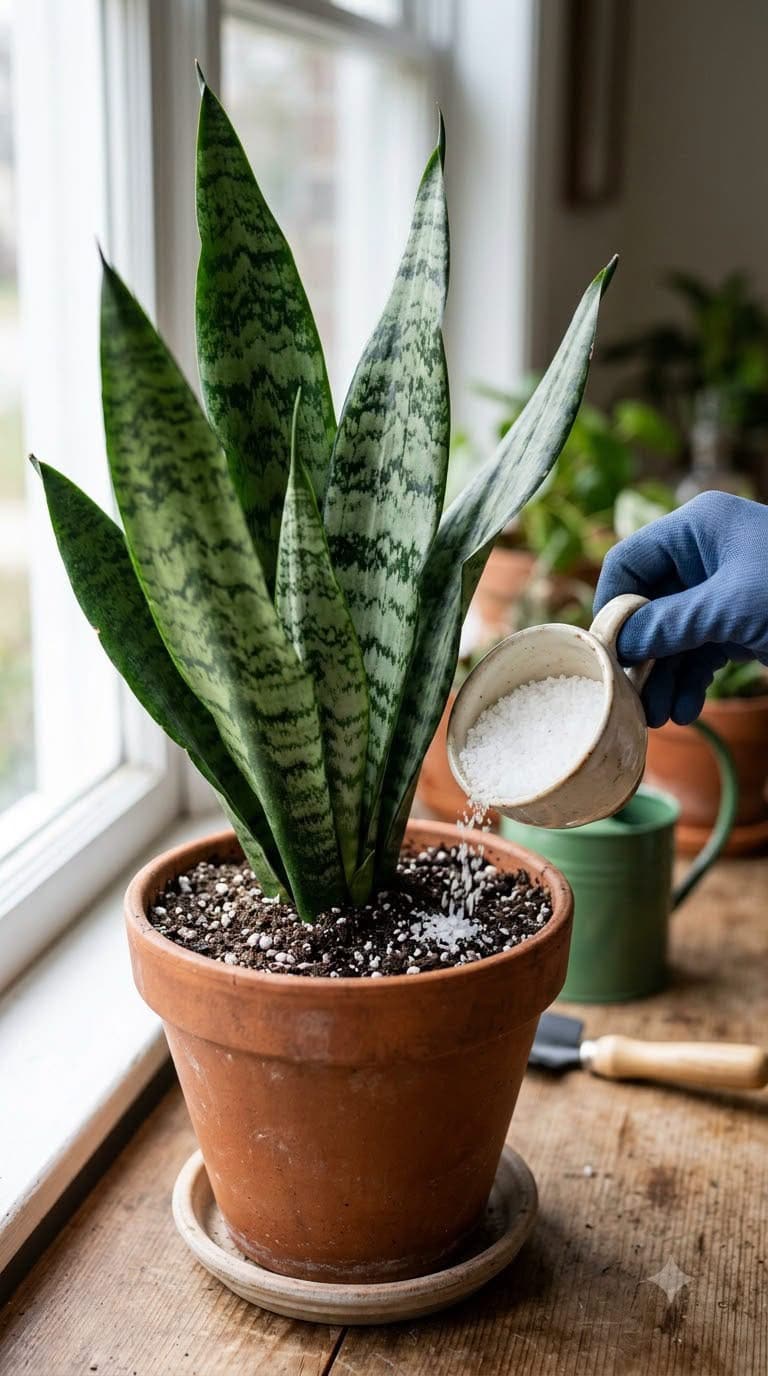
Meet the Snake Plant
The snake plant, Dracaena trifasciata, formerly classified as Sansevieria, is a rhizomatous evergreen native to West Africa. It grows stiff upright leaves from a thick underground stem called a rhizome, and it spreads by sending out pups from that rhizome rather than from seed.
Its leaves are succulent, storing water in their tissue, and its roots evolved for seasonal drought rather than steady moisture. This single adaptation explains almost every rule of snake plant care: why it survives neglect, why it rots in wet soil, and why it needs so little feeding.
Mature plants can reach three or four feet indoors. In bright light with a slightly crowded root system they produce pups around the base, which can be separated into new plants.
It is mildly toxic to cats and dogs if chewed, causing drooling and stomach upset, so place it accordingly in a home with pets.
What the White Powder Is
The white granular powder in these photos is almost always Epsom salt, chemically magnesium sulfate heptahydrate. It is the same product sold in pharmacies for baths, and it is not a fertilizer in any complete sense.
It supplies exactly two of the seventeen nutrients plants require:
• Magnesium — sits at the centre of every chlorophyll molecule. Without it a plant cannot produce chlorophyll properly. • Sulfur — supports protein and enzyme formation. Needed in smaller amounts, and deficiency is rare indoors.
Three other white powders appear in similar photos and behave completely differently:
• Perlite — puffed volcanic glass, used to aerate soil. Useless sprinkled on the surface; it only works mixed through the mix. • Table salt — sodium chloride. Not a plant nutrient. It will destroy the root system. • Slow-release fertilizer pellets — genuinely useful, usually coloured rather than pure white.
Identify what you have before it touches the soil. All four look similar in a cup.
How to Use It Correctly
Step 1: Confirm the plant actually needs it
Look for interveinal chlorosis on the oldest leaves: yellowing between the veins while the veins themselves stay green.
That specific pattern is the signal. General overall yellowing almost always means overwatering, and adding magnesium will not help.
Step 2: Check how old the soil is
Fresh commercial potting mix contains adequate magnesium. A plant repotted within the last two years is very unlikely to be deficient.
Epsom salt is worth considering only for a plant that has sat in the same soil for three or four years.
Step 3: Dissolve it in water
Mix 1 teaspoon of Epsom salt per 1 gallon (about 4 litres) of water and stir until fully dissolved.
Never apply it dry. Dry granules concentrate in one spot instead of dispersing, which is the worst possible distribution.
Step 4: Water the soil lightly first
Apply plain water to moisten the soil before the Epsom solution, or apply it immediately after a normal watering.
Salt solution poured onto bone-dry soil burns the fine root hairs directly.
Step 5: Apply as a normal watering
Pour the solution evenly across the whole soil surface until it runs from the drainage hole.
Do not pour it into the centre of the leaf rosette.
Step 6: Empty the saucer
Drain the saucer within twenty minutes. Standing solution reconcentrates as the water evaporates.
Step 7: Repeat at most twice per season
Once or twice between spring and late summer. Never in autumn or winter, when the plant is dormant and cannot use it.
This is a correction, not a routine.
Step 8: Flush the soil afterwards
Six to eight weeks later, water heavily with plain water and let it run through freely for a full minute to clear any residue.
Warnings and Precautions
It is a salt, and salt accumulates. Applied dry or too often it raises the salt concentration in the soil. Water then moves out of the roots by osmosis rather than into them.
The damage looks like thirst. Brown crispy leaf tips and edges, and a plant that wilts while sitting in damp soil. People respond by watering more, which makes it worse.
Snake plants are especially vulnerable. They are watered every two to four weeks, so salts are rarely flushed out and build up over months.
Excess magnesium causes new deficiencies. Magnesium competes with calcium and potassium for uptake. Overapplying can create a shortage of both.
Never confuse it with table salt. Sodium chloride is toxic to plants at low concentrations and looks identical in the bag.
It is not a substitute for fertilizer. Two nutrients out of seventeen. A plant fed only Epsom salt will slowly starve.
Repotting is usually the better fix. Fresh mix restores magnesium along with everything else the old soil has run out of, and it costs less than diagnosing a deficiency wrongly.
What to Avoid
• Sprinkling any powder dry onto the surface. Concentrates in one spot and forms a crust that repels water. • Using it as a monthly routine. Twice a season is the ceiling, and most plants need none at all. • Applying it in autumn or winter. The plant is dormant and the salts simply accumulate. • Adding perlite to the top of the soil. It only aerates when mixed through. • Diagnosing from a photo online. Interveinal chlorosis is specific. Most yellow snake plant leaves are an overwatering problem. • Pouring anything into the leaf rosette. Water or solution trapped at the centre causes crown rot. • Using it on a plant that is already struggling. Check the roots first. A rotting root system cannot absorb anything.
What Snake Plants Actually Need
Light. Bright indirect light for five hours or more. An east-facing window is ideal. Low light is survivable, not productive, and it is the real limiting factor for most indoor snake plants.
Water. Thoroughly, then not again until the soil is completely dry, usually every two to four weeks.
Soil. Cactus or succulent mix with added perlite, mixed through. Standard potting soil holds far too much water.
Pot. Terracotta with drainage holes, only one or two inches wider than the root ball. Snake plants produce pups when slightly crowded.
Feeding. A balanced liquid fertilizer at 10-10-10 or 20-20-20, diluted to half strength, once a month from spring through summer only. This supplies magnesium along with everything else.
Flushing. Water heavily with plain water every two to three months to clear accumulated fertilizer salts.
Frequently Asked Questions
I already sprinkled it dry. What now? Scrape off what you can with a spoon, then flush the pot thoroughly with plain water several times to dilute what has dissolved.
How much Epsom salt per plant? One teaspoon per gallon of water, applied as a normal watering. Never measured per plant, always per volume of water.
Can I use it on all my houseplants? Dissolved and used sparingly, yes for most. It is unnecessary for anything in fresh potting mix.
Will it make my snake plant produce pups? No. Pups come from light, maturity, and a slightly crowded pot.
Why are my leaf tips brown? Usually mineral buildup from tap water or fertilizer, or inconsistent watering. Flush the soil first before adding anything.
What is the difference between Epsom salt and table salt? Epsom salt is magnesium sulfate and supplies two plant nutrients. Table salt is sodium chloride and is toxic to plants. They look the same.
Final Thoughts
Epsom salt has one narrow legitimate use on a snake plant: correcting a magnesium deficiency in a plant that has been in the same soil for years, applied dissolved at a teaspoon per gallon, once or twice a season.
Everything beyond that is either useless or harmful. Sprinkled dry in the quantity these photos show, it damages a plant that is watered too rarely to ever flush it out.
Get the light right, feed a balanced fertilizer at half strength in summer, and repot every couple of years. That covers what the powder is supposed to be fixing.