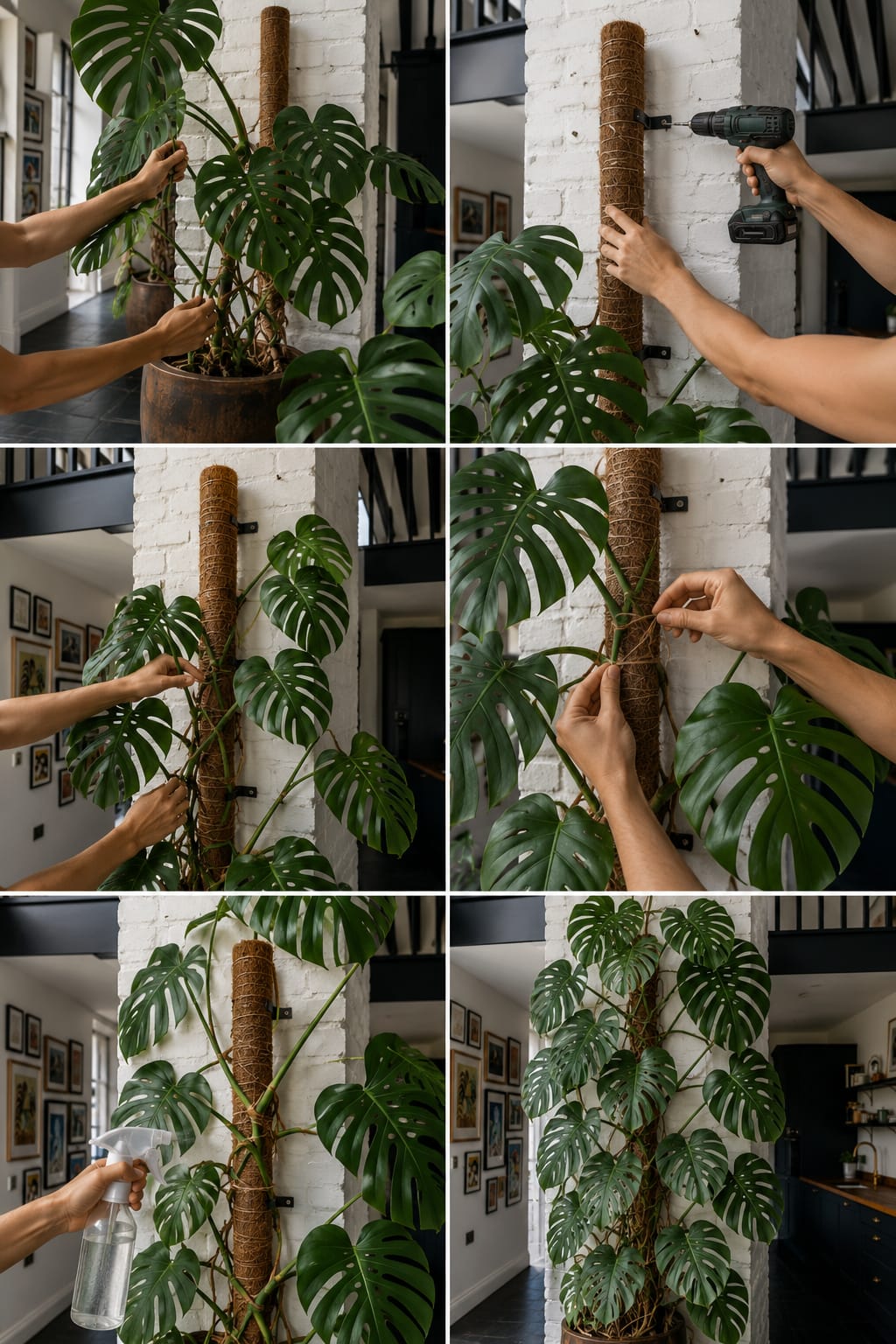
Monstera is one of the most impressive indoor plants for people who want large tropical leaves, dramatic height, and a natural green statement that can transform a plain wall into a beautiful indoor plant feature. Its glossy split leaves, strong climbing habit, and bold jungle appearance make it a favorite for living room styling, modern apartment decor, home office greenery, indoor plant walls, luxury interior plant design, and premium home staging. When a Monstera is trained correctly, it can grow upward instead of spreading across the floor, making the plant look cleaner, fuller, and more architectural.
Many people grow Monstera in pots and allow the vines to trail or lean outward, but this plant naturally wants to climb. In the wild, Monstera uses aerial roots to attach to trees and move upward toward better light. Indoors, the same climbing habit can be supported with a moss pole, coco coir pole, wooden support, trellis, or a secure wall-mounted climbing system. The goal is not to force the plant harshly against a wall. The goal is to guide it gently so the stems grow in the direction they already prefer.
Training Monstera to climb is useful because it helps the plant stay stable, reduces messy sideways growth, supports larger mature leaves, and makes the display look more intentional. A climbing Monstera can become a strong decorative feature in a hallway, living room, loft apartment, stairwell area, dining corner, bright office, or modern plant room. However, the method should be done safely. The support must be stable, the wall must be protected, the stems must be tied loosely, and the plant must be checked regularly so ties do not cut into new growth.
This guide explains how to train a Monstera to climb indoors, how to choose the right support, how to secure the plant without damaging the stems, how to manage aerial roots, how to water and mist correctly, what mistakes to avoid, and how to keep the plant healthy, clean, and suitable for indoor plant styling, commercial interior landscaping, biophilic office design, luxury home staging, and polished property presentation.
Quick Answer
A Monstera can be trained to climb indoors by giving it a stable vertical support such as a moss pole, coco coir pole, trellis, or wall-mounted plant support. The main stems should be guided gently toward the support and tied with soft plant ties, jute string, or flexible garden tape. The ties should hold the stems in place without squeezing them. Aerial roots can be directed toward the pole or left alone, but they should not be ripped off. The plant needs bright indirect light, a well-draining potting mix, controlled watering, enough humidity, and regular checks as it grows. Wall training should be done carefully so the support is secure and the plant does not damage the wall surface.
What Plant This Is
The plant is Monstera deliciosa, one of the most famous tropical houseplants in modern indoor gardening. It is known for its large green leaves that develop splits and holes as the plant matures. These cuts in the leaves are called fenestrations, and they are one of the main reasons Monstera has become a favorite in interior design. A mature Monstera leaf can look bold, sculptural, and naturally artistic.
Monstera is not only a leafy plant. It is also a climber. Its stems grow long and flexible, and it produces aerial roots that help it hold onto nearby surfaces in nature. Indoors, the plant may lean, sprawl, or take over a corner if it has no support. This is why many Monstera plants eventually need a moss pole, stake, trellis, or vertical wall support.
When the plant is trained upward, it often looks more mature and organized. The leaves can face outward toward the room, the stems can become easier to manage, and the plant can develop a strong vertical shape. This makes Monstera especially valuable for interior plant styling because it can create height and greenery without requiring many separate plants.
Why Monstera Likes to Climb
Monstera climbs because that is part of its natural growth habit. In tropical forests, young Monstera plants grow along the ground until they find a tree. Once they reach a trunk, they climb upward by using aerial roots. As the plant gets more light and becomes more mature, it can produce larger leaves with deeper splits and more dramatic fenestration. Indoors, the same instinct remains even though the plant is growing in a pot.
Without support, a Monstera may grow sideways, lean heavily, or send stems in different directions. This can make the plant look messy and unstable. A large unsupported Monstera may also become difficult to water, move, clean, or style. The leaves may crowd each other, and the stems may bend under their own weight.
A climbing support gives the plant a structure to follow. It helps the stems stay upright, encourages a more natural growth pattern, and can make the plant easier to maintain. This does not mean every Monstera will instantly produce giant leaves after being tied to a pole. Leaf size also depends on light, root health, watering, nutrients, humidity, and overall maturity. The support simply gives the plant the physical structure it needs to grow in a better direction.
Why Wall Training Can Improve the Decorative Look
Wall training can turn a large Monstera into a living green feature. Instead of letting the plant sprawl across the room, the stems can be guided upward along a pole or wall-mounted support. This creates a cleaner shape and makes the plant look like part of the room design. A white brick wall, neutral wall, wooden accent wall, or bright interior corner can become a beautiful background for the large green leaves.
This type of plant styling is popular in modern apartments, loft interiors, home offices, plant rooms, boutique spaces, and luxury home staging. A Monstera trained upward adds height, texture, and a tropical mood. It can soften hard architecture, fill empty vertical space, and create a natural focal point without needing artwork or extra decor.
Wall training also helps with space management. A mature Monstera can take up a lot of floor area when it grows outward. Training it vertically allows the plant to use wall height instead of room width. This is especially useful in small apartments, narrow hallways, indoor garden corners, or rooms where a large plant is wanted but floor space is limited.
Choosing the Right Support
The support should be strong enough for the current plant and the future growth. A young Monstera may only need a simple moss pole or coco coir pole. A larger plant may need a thicker pole, a sturdy wooden support, a metal trellis, or a wall-mounted system. The support should not wobble when the plant is attached to it. If the plant is heavy, weak support can lean or fall, damaging the stems and the wall.
A moss pole or coco coir pole is often used because it gives aerial roots something textured to grip. The fibrous surface helps the plant feel more supported than a smooth stake. A wooden plank can also work well, especially for a strong modern look. A trellis can spread the stems across a wider area, creating a fuller wall display.
Wall-mounted supports should be installed carefully. Screws, brackets, hooks, or straps must be secure enough to hold the pole and plant weight. The wall material matters. Brick, concrete, drywall, and wood all require different anchors. If the support is not installed correctly, the plant may pull away from the wall as it grows heavier. A safe support system is more important than a quick decorative setup.
Protecting the Wall
Training a Monstera near a wall should be done with wall protection in mind. Aerial roots can attach to rough surfaces, especially brick, textured plaster, or unfinished wood. Once they attach, they may leave marks if removed later. The plant can also trap moisture near the wall if it is misted heavily or watered carelessly. This can be a problem in homes where paint, plaster, or wallpaper is sensitive to moisture.
The safest method is to train the plant onto a removable pole or trellis rather than directly onto the wall surface. The support can be mounted slightly away from the wall, giving the plant something to climb without allowing roots to attach strongly to the wall itself. This makes future maintenance easier and reduces the risk of damage.
If a Monstera is placed against a wall, airflow should be maintained. Leaves should not stay wet against the surface. Over-misting can create damp spots, especially in corners with low air movement. A clean, dry wall area and a stable support system help the plant display look premium and prevent hidden moisture problems.
How to Attach the Plant Safely
Monstera stems should be attached gently. Soft plant ties, jute string, cotton ties, velcro plant tape, or flexible garden tape can be used. The tie should hold the stem close to the support without squeezing it. A good tie leaves space for the stem to expand as it grows. If the tie is too tight, it can cut into the stem and cause damage over time.
The main stem should be guided toward the pole first. Leaf petioles should not be tied tightly because they need to move and position the leaves toward light. The strongest support should go around the thicker main vine, not around delicate leaf stems. The plant should look guided, not strangled.
As new growth appears, the ties should be checked and adjusted. Monstera grows slowly in some homes and quickly in others, depending on light and care. A tie that fits today may become too tight later. Regular checking prevents stem scars, bending, and stress. This is one of the most important parts of long-term wall training.
How to Handle Aerial Roots
Aerial roots are normal for Monstera. They are not a sign that the plant is unhealthy. These roots help the plant climb and seek support. Indoors, they may grow toward the pole, wall, floor, or nearby furniture. Some people dislike their appearance, but they play an important role in the plant’s natural climbing habit.
The safest approach is to guide aerial roots toward the support or into the potting mix if they are long enough. They can be tucked gently toward a moss pole or coco coir pole. They should not be pulled hard, twisted, or ripped off. Removing aerial roots is not usually necessary, and rough removal can stress the plant.
If an aerial root becomes dry and brown at the tip, it can be left alone. If it is in the way, it may be trimmed with clean scissors, but this should be done sparingly. The plant can continue growing without every aerial root, but the roots are useful for climbing. For a wall-trained Monstera, aerial roots are part of the plant’s natural structure.
Watering a Climbing Monstera
A climbing Monstera should be watered based on soil moisture, not on the appearance of the pole or wall. The top portion of the potting mix can dry slightly before watering again. The deeper root zone should not stay soggy. A Monstera likes moisture more than a cactus, but it does not want stagnant wet soil.
When watering, water should be applied to the soil, not poured over the wall support. The pot should have drainage holes, and extra water should leave the container. If the plant sits in a decorative cachepot, any collected water should be removed. Water trapped at the bottom can cause root rot.
Large climbing Monsteras may use more water than small plants because they have more leaves and more root mass. However, the watering routine still depends on light, temperature, humidity, pot size, and soil mix. A plant in bright indirect light may dry faster than one in a dark corner. Checking the soil is better than following a strict schedule.
Misting and Humidity
Monstera enjoys moderate to high humidity, but misting should be handled carefully when the plant is near a wall. A light spray on the pole may help keep a moss pole slightly moist, but constant spraying against a wall can create damp surfaces. This is especially important near painted brick, plaster, wallpaper, or wood. Humidity should support the plant without damaging the room.
A humidifier can be more effective than constant misting if the air is very dry. It raises the general humidity around the plant without soaking the wall or leaves repeatedly. A pebble tray may help slightly, but it should not keep the pot sitting directly in water. Good airflow is also important because still damp air can encourage fungal issues.
If misting is used, it should be light and controlled. Leaves should not remain wet for long periods. The support should not become moldy. A fresh, clean climbing setup should smell neutral and look dry enough between care sessions. Healthy humidity is about balance, not making the area constantly wet.
Best Soil Mix for Monstera
Monstera grows best in a chunky, well-draining potting mix that holds some moisture but allows air to move around the roots. A good mix often includes indoor potting soil combined with orchid bark, perlite, coco chips, pumice, or coarse material that keeps the soil open. The roots should never be packed into dense heavy soil.
A chunky mix is especially useful for a climbing Monstera because larger plants often stay in the same pot for a while. If the soil compacts, watering becomes uneven and root oxygen decreases. This can lead to yellow leaves, slow growth, brown edges, or root rot. A breathable mix helps the plant support larger leaves and stronger stems.
Garden soil should not be used alone in an indoor Monstera pot. It can compact, hold too much water, and bring pests indoors. Heavy compost mixes should also be used carefully because they may become soggy in large containers. The best soil is rich enough to support growth but airy enough to protect the roots.
Light for Bigger Leaves
Bright indirect light is one of the most important factors for a healthy climbing Monstera. The plant may survive in lower light, but it usually grows slower and produces smaller leaves with fewer splits. If the goal is large dramatic foliage, the plant needs enough light to support that growth. A position near a bright window, filtered by curtains or distance from direct sun, is often ideal.
Direct harsh sun can burn the leaves, especially if the plant has been growing indoors. Brown scorch marks may appear when leaves receive too much intense light. Morning sun or soft filtered light is usually safer. If the room is dark, a grow light can help the plant maintain steady growth and better leaf development.
The plant should also be turned occasionally if it is not fixed too tightly to a support. When training against a wall, the leaves will naturally face the light source. If the light comes from only one side, the plant may lean or twist. A thoughtful placement helps keep the display balanced and attractive.
Feeding a Monstera on a Pole
A climbing Monstera can benefit from light feeding during the active growing season. A balanced indoor plant fertilizer can support leaf production, root strength, and overall growth. The fertilizer should be diluted and used according to the plant’s needs. More fertilizer does not always mean bigger leaves. Light, root health, and support are equally important.
Feeding should usually be reduced during winter or during periods of slow growth. If the plant is in low light, it will not use nutrients quickly, and extra fertilizer can build up in the soil. This may cause brown tips or root stress. A simple feeding routine during spring and summer is usually safer than heavy year-round fertilizing.
Homemade fertilizers should be used carefully with indoor climbing plants. Organic scraps placed on the soil surface can attract pests and create odors. A clean liquid fertilizer, slow-release indoor plant food, or balanced houseplant formula is usually more predictable for premium indoor plant care and professional-looking plant displays.
Pruning and Shaping
Pruning helps keep a wall-trained Monstera balanced. Long wandering stems can be shortened, weak growth can be removed, and cuttings can be propagated if desired. Pruning should be done with clean sharp tools. Cuts should be made near a node, because nodes are where new roots and shoots can form.
Not every stem should be cut. A climbing Monstera needs strong main vines to create its structure. The best approach is to keep the main stems attached to the support while trimming only growth that is damaged, too long, or growing in the wrong direction. If the plant is heavily pruned, it may take time to fill in again.
Shaping should be gradual. As new leaves appear, stems can be guided toward empty spaces on the support. This helps create a fuller wall display. The plant should be arranged in a way that looks natural, not forced. A beautiful Monstera wall should feel like controlled growth rather than a tightly tied decoration.
Possible Damage If Training Is Done Incorrectly
Training can harm a Monstera if the support is unstable, if ties are too tight, or if the stems are bent sharply. Monstera stems are strong but not unbreakable. Forcing a mature stem against a pole too quickly can crack or bruise it. Older stiff stems should be moved gradually over time rather than pulled into position in one session.
Wall damage can also happen if aerial roots attach directly to paint, plaster, wood, or brick. Roots may leave marks when removed. Moisture from misting can also affect surfaces if the area does not dry properly. This is why a separate support structure is safer than allowing the plant to attach directly to the wall.
Another problem is placing a heavy plant on a weak support. As the Monstera grows, the weight increases. Large leaves, thick stems, and moist soil can make the entire setup heavy. If the pole or wall brackets are not strong enough, the plant may fall. A secure installation protects both the plant and the room.
Warning Signs to Watch For
A climbing Monstera should be watched for yellow leaves, soft stems, loose ties, aerial roots damaging surfaces, mold on the pole, wall dampness, brown leaf edges, and soil that stays wet too long. These signs can show that the care routine or support system needs adjustment. A small issue is easier to correct before the plant becomes too large.
If leaves turn yellow and the soil is wet, overwatering or poor drainage may be the problem. If leaves curl and the soil is dry, the plant may need water. If new leaves are small and lack splits, the plant may need better light or more time to mature. If stems are leaning away from the support, they may need gentle retying.
If the moss pole smells musty or develops mold, it may be staying too wet. The pole should be allowed to breathe, and airflow should be improved. If the wall behind the plant feels damp, misting should be reduced and the support should be moved slightly away from the wall. A clean climbing display should not create moisture damage.
Common Mistakes
The biggest mistake is tying the plant too tightly. Monstera stems expand as they grow, and tight ties can cut into them. Another mistake is attaching leaf stems instead of main vines. Leaf stems need flexibility, while the main vine is the structure that should be guided. Tying the wrong part can damage the leaf or cause unnatural bending.
Another common mistake is using a support that is too short. Monstera can grow tall, and replacing a short pole later may be difficult. It is usually better to choose a support that allows future growth. The support should look proportional to the plant and strong enough for mature leaves.
Over-misting is also a mistake, especially when the plant is near a wall. Humidity is helpful, but wet walls, moldy poles, and damp corners are not healthy. The plant needs moisture in the right places, mainly in the root zone and general air, not constant water sitting on surfaces.
Continue to Page 2
Continue to page 2 for more details about this article and the key points many readers miss on the first page.