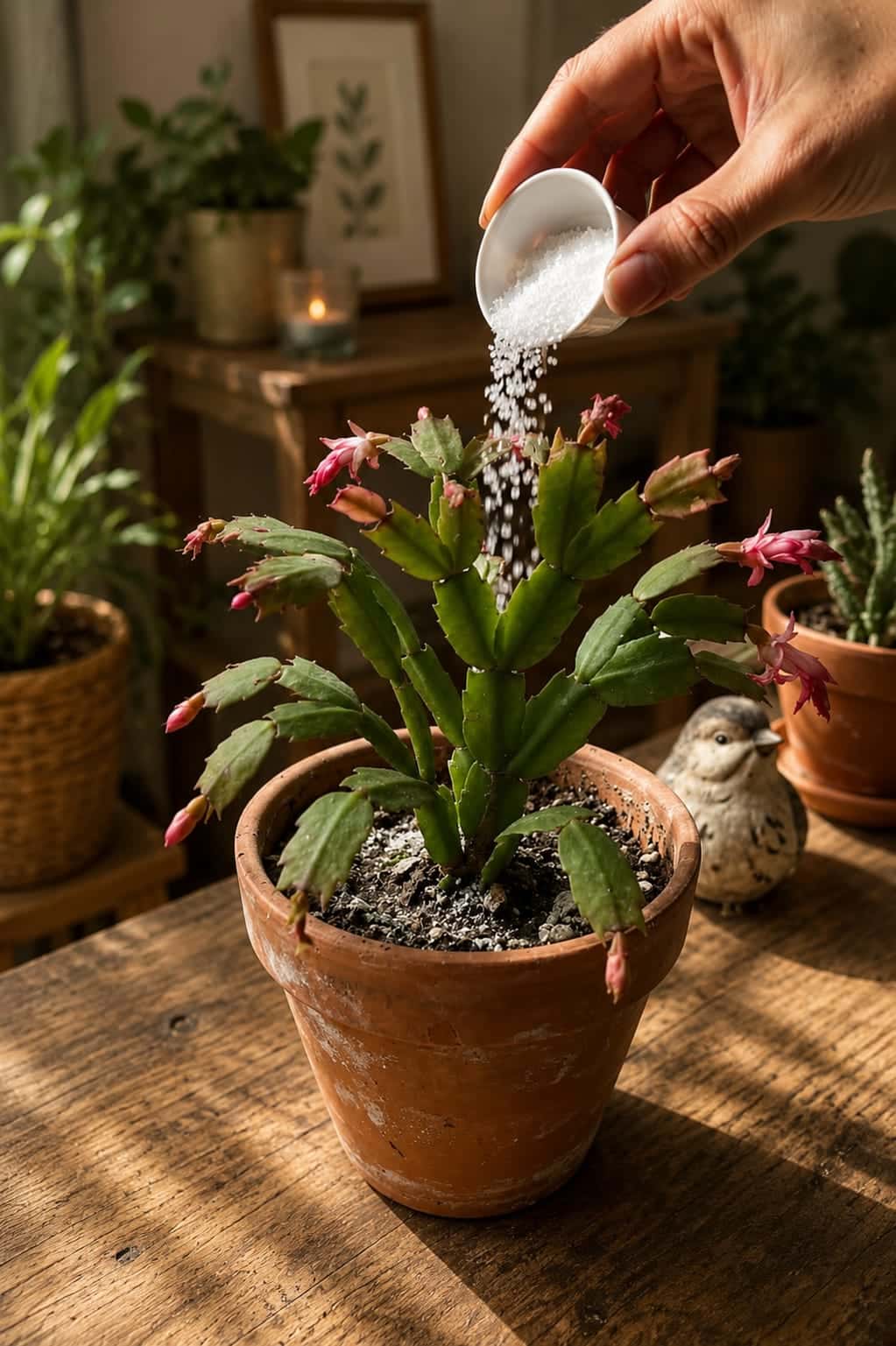
Bright Indirect Light Is Essential
A Christmas cactus near a window can do very well, but light quality matters. Bright indirect light is ideal. Too much harsh direct sun can scorch or redden the stems. Too little light can cause weak growth and poor flowering.
An east-facing window is often excellent. A bright north-facing window may work if the light is strong enough. A south or west window may need a sheer curtain to soften intense afternoon sun.
If the stems are turning reddish or purple, the plant may be receiving too much direct light or experiencing stress. If the stems are weak, thin, or stretched, the plant may need brighter conditions.
Epsom salt cannot compensate for poor light. A plant needs light to create energy. Nutrients only support the growth process. Without enough light, extra supplements will not create strong blooms.
Watering Christmas Cactus Correctly
Christmas cactus prefers a different watering rhythm from desert cactus. It should not be left dry for weeks, but it also should not remain constantly wet. Let the top portion of the potting mix dry slightly, then water thoroughly and allow the excess to drain.
During active growth and blooming, the plant may need more consistent moisture. During rest periods, it may need less. Your home’s temperature, humidity, pot size, and soil mix all affect watering frequency.
Do not water on a strict calendar without checking the soil. A plant in a clay pot near a bright window may dry faster than one in a plastic pot in a cool room. Always observe the plant and potting mix.
If stems become wrinkled, check the soil before reacting. Wrinkling can mean underwatering, but it can also happen when roots are rotting and cannot absorb water. If the soil is dry, water carefully. If the soil is wet and the plant is wrinkled, inspect the roots.
The Best Soil Mix for Christmas Cactus
Christmas cactus needs a potting mix that holds some moisture but drains well. A standard houseplant soil can work if it is improved with airy materials. A good mix may include potting soil, perlite, orchid bark, coco chips, or pumice.
The goal is to prevent the soil from becoming dense and waterlogged. If the soil stays wet for too long, roots can rot. If it dries too quickly and becomes hard, the plant may struggle to hydrate.
Old soil can break down over time. When this happens, it becomes compacted and may hold too much water. If your Christmas cactus has been in the same pot for years and is declining, repotting may help more than Epsom salt.
When repotting, choose a pot only slightly larger than the current root ball. A pot that is too large holds extra moisture and can increase the risk of root problems.
Why Clay Pots Can Be Helpful
The plant in the image is growing in a clay pot. Clay pots can be helpful for Christmas cactus because they allow moisture to evaporate through the sides. This can reduce the chance of soil staying wet too long.
However, clay pots also dry faster. In a warm, bright window, a clay pot may need watering more often than a plastic pot. This is not a problem as long as you check the soil regularly.
Clay pots can also develop white marks on the outside. Sometimes this is from minerals in water or fertilizer. If you see a lot of crust on the pot or soil, it may be time to flush the soil with clean water or review your feeding routine.
How to Prevent Salt Buildup
Because Epsom salt is still a salt, buildup is possible. The best way to prevent buildup is to use a weak solution, apply it occasionally, and water thoroughly enough that excess drains out of the pot.
Every few months, you can flush the pot with plain water. This means watering generously so water runs through the drainage holes, helping wash away accumulated minerals. Only do this if the pot drains well, and let it dry normally afterward.
If your tap water is very hard, mineral buildup may happen more easily. In that case, rainwater, filtered water, or distilled water used occasionally may help reduce residue.
Avoid adding Epsom salt on top of regular fertilizer too often. Too many minerals in a small pot can stress the roots.
What to Do If You Already Added Too Much Epsom Salt
If you sprinkled a heavy amount of Epsom salt on the soil, remove as much as possible from the surface. Use a spoon or your fingers to gently scoop away visible crystals. Try not to damage the stems or roots.
Then flush the pot with plain water, allowing it to drain thoroughly. This can help move excess salts out of the potting mix. After flushing, do not water again until the soil begins to dry appropriately.
If the plant begins to decline after a heavy application, check the roots. If the roots are healthy, the plant may recover with clean water and time. If roots are damaged or the soil smells bad, repotting into fresh mix may be necessary.
Do not try to correct too much Epsom salt by adding another ingredient. Keep the routine simple and give the plant a chance to stabilize.
Should You Spray Epsom Salt on Christmas Cactus?
Some gardeners use foliar sprays for certain plants, but for Christmas cactus, soil application is usually simpler and safer. Spraying the segmented stems with mineral water can leave residue, and moisture sitting between segments may encourage issues if airflow is poor.
If the plant is blooming, avoid spraying the flowers. Wet flowers may become damaged or age faster. Keep the flowers dry and clean.
For most home growers, diluted Epsom salt water applied to the soil occasionally is the better choice.
Can Epsom Salt Replace Fertilizer?
No. Epsom salt cannot replace a balanced fertilizer because it does not provide all essential nutrients. Christmas cactus still needs a complete nutrient profile over time, especially during active growth.
A balanced houseplant fertilizer used at reduced strength can support growth. Some growers fertilize lightly after blooming and during the growing season, then reduce feeding as the plant prepares for its bloom cycle.
Epsom salt can be used separately as a magnesium supplement, but it should not be the only feeding method if the plant needs nutrition. Think of it as a specific supplement, not a full meal.
How to Feed Christmas Cactus Properly
A good feeding routine is light and seasonal. After the plant finishes blooming and begins new growth, you can feed with a diluted balanced fertilizer every few weeks during active growth. Use less than the full strength recommended on the label, especially if the plant is in a small pot.
If you also want to use Epsom salt, use it separately and occasionally. For example, you might use balanced fertilizer during one watering and Epsom salt water several weeks later. Do not apply both heavily at the same time.
As fall approaches and you want the plant to set buds, reduce feeding and focus on the right light and temperature conditions. Too much feeding late in the season may encourage vegetative growth instead of helping the bloom cycle.
How to Encourage More Flowers Naturally
To encourage Christmas cactus flowers, start preparing the plant several weeks before its expected bloom period. Give it bright indirect light during the day and long, uninterrupted darkness at night. Keep temperatures slightly cooler in the evening if possible.
Water moderately. Do not let the plant become extremely dry, but avoid keeping it soggy. Once buds appear, keep conditions stable. Sudden changes can cause bud drop.
Do not move the plant repeatedly after buds form. Christmas cactus can be sensitive to changes in light direction, temperature, or moisture during bud development.
After flowering, allow the plant to rest for a short period with slightly reduced watering. Then resume normal care as new growth begins.
Why Buds Drop Before Opening
Bud drop is a common Christmas cactus problem. It can happen because of sudden temperature changes, inconsistent watering, low humidity, moving the plant, too much heat, or poor root health.
If buds are forming, avoid dramatic treatments. Do not suddenly add a strong dose of fertilizer or Epsom salt. Do not move the plant from one window to another unless necessary. Do not let it dry completely, and do not flood it.
Stable care is the best way to keep buds. Once the plant is in bloom, gentle consistency matters more than extra feeding.
What Healthy Christmas Cactus Growth Looks Like
A healthy Christmas cactus has firm green segments. New growth often appears as small lighter green segments at the ends of stems. During the bloom season, buds form at the tips. The plant may look slightly different throughout the year, with active growth after blooming and a slower period before the next cycle.
Healthy stems should not be mushy. They should not collapse at the base. A few older segments may age or scar over time, but the plant should continue producing fresh growth.
If the plant is leaning, woody at the base, or uneven, this may be normal for an older Christmas cactus. These plants can become large and arching with age. Pruning after blooming can help shape the plant and encourage branching.
How to Prune Christmas Cactus
Pruning is best done after flowering. You can remove a few segments by gently twisting them off at the joint. This encourages branching and helps the plant become fuller over time.
Do not prune heavily while the plant is forming buds. Wait until the bloom cycle is finished. The removed segments can often be rooted as cuttings. Let the cuttings callus for a day or two, then place them in a light potting mix.
A fuller plant with more branch tips may produce more potential bloom points in the future. This is often more effective for long-term flowering than relying only on supplements.
How Long Can a Christmas Cactus Live?
With good care, Christmas cactus can live for many years. Some plants become decades old. Their long lifespan comes from stable care, healthy roots, occasional repotting, proper watering, and seasonal bloom conditions.
No single ingredient guarantees a long life. Epsom salt may support the plant if used correctly, but longevity depends on the full routine. A plant that is overwatered, kept in poor light, or fed too heavily may decline even if it receives magnesium.
If you want your Christmas cactus to last for years, focus on consistency. Keep the soil breathable, water thoughtfully, give bright indirect light, protect it from extreme temperatures, and avoid overfeeding.
A Simple Monthly Care Routine
Once a week, check the soil moisture and inspect the stems. Water only when the top part of the mix has dried slightly. Keep the plant in bright indirect light and rotate the pot occasionally outside the bud-forming period so growth remains balanced.
Once a month during active growth, consider light feeding. This may be a diluted balanced fertilizer or, occasionally, diluted Epsom salt water. Do not use both too strongly or too often.
Every few months, check for mineral buildup, pests, and soil condition. If the soil is compacted, sour-smelling, or staying wet too long, consider repotting after the blooming period.
Once a year, after flowering, prune lightly if needed and remove any dead or damaged segments. This keeps the plant tidy and encourages branching.
Common Mistakes to Avoid
- Sprinkling too much dry Epsom salt directly onto the soil – this can create concentrated areas and increase root stress.
- Using Epsom salt as a cure for every problem – yellowing, wrinkling, bud drop, and poor blooming have different causes.
- Overwatering after applying Epsom salt – always water based on soil moisture, not because a treatment was added.
- Ignoring bloom triggers – Christmas cactus needs specific light and temperature patterns to flower well.
- Treating Christmas cactus like a desert cactus – it needs more moisture but still requires excellent drainage.
Frequently Asked Questions
Can I sprinkle Epsom salt directly on Christmas cactus soil?
It is safer to dissolve Epsom salt in water first. Dry crystals can create concentrated pockets in the soil. A diluted solution spreads more evenly and reduces the risk of root stress.
How much Epsom salt should I use?
A gentle mixture is one teaspoon of Epsom salt per gallon of water. For small or sensitive plants, use an even weaker solution.
How often should I use Epsom salt on Christmas cactus?
Use it occasionally, such as once every four to six weeks during active growth. Do not use it weekly or every time you water.
Will Epsom salt make Christmas cactus bloom?
It may support plant health if magnesium is needed, but it will not force blooms by itself. Flowering depends mainly on light, temperature, darkness at night, watering, and plant maturity.
Can Epsom salt save a dying Christmas cactus?
No. A dying plant needs diagnosis first. Check for root rot, poor drainage, overwatering, underwatering, pests, or light problems. Epsom salt is not a rescue treatment.
Can I use Epsom salt while the plant is blooming?
It is better to avoid changing the routine too much while the plant is blooming or setting buds. If the plant is already stable, wait until after flowering for most feeding routines.
What should I do if I used too much?
Remove visible crystals and flush the soil with plain water, allowing it to drain fully. Then pause all feeding and monitor the plant.
🌿 Remember: Epsom salt is a gentle supplement, not a magic cure. Healthy roots, bright indirect light, proper watering, and seasonal bloom triggers matter far more for your Christmas cactus than any single ingredient.