Orchids are some of the most beautiful indoor plants, but they can also make plant owners nervous. One month they look perfect, with glossy leaves and bright flowers, and the next month they may stop blooming, grow slowly, or show tired roots. Because orchids seem delicate, many people start looking for a natural trick that can bring back strong roots and encourage more blooms.
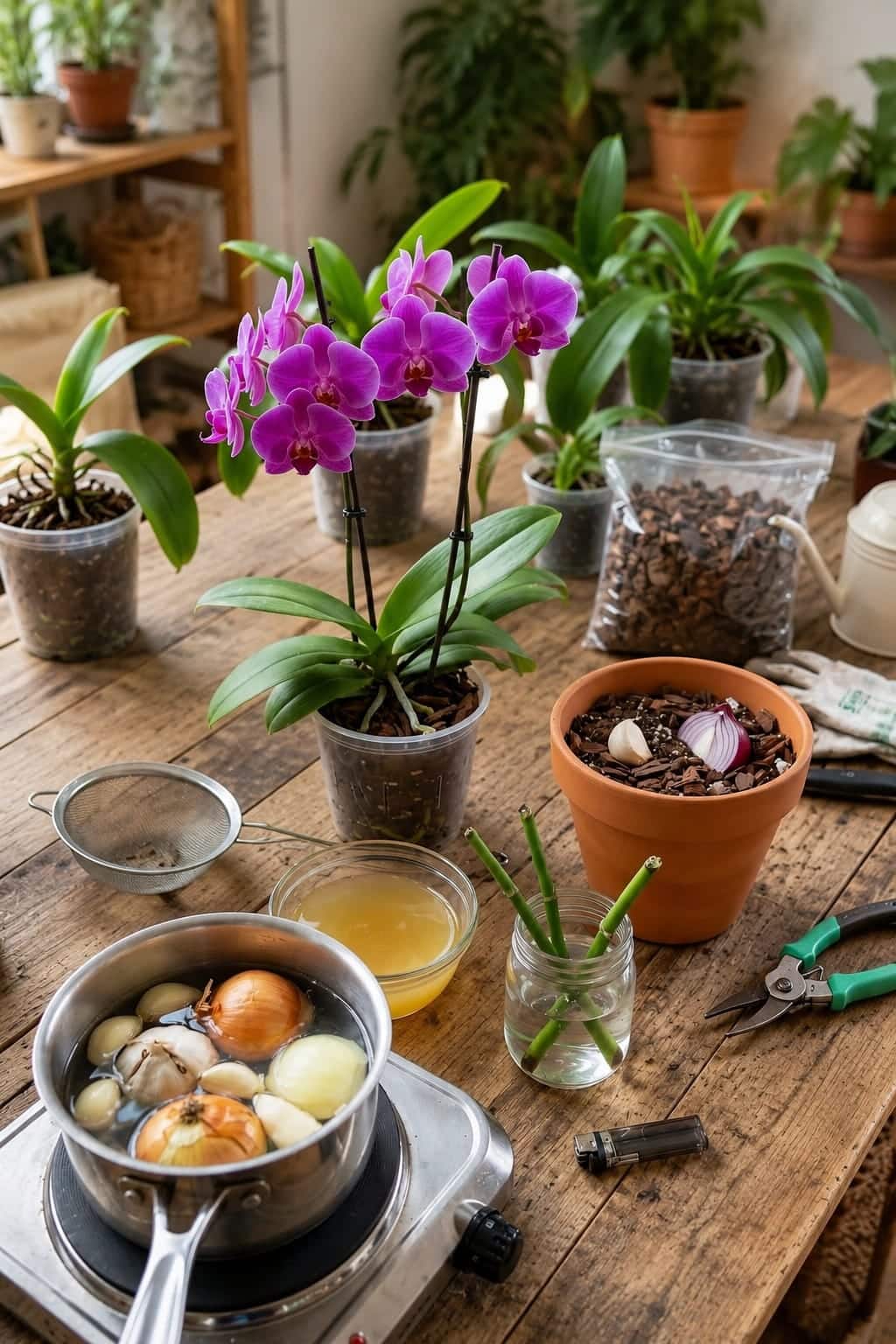
One homemade orchid-care idea that often gets attention is onion and garlic water. In the image, there is a healthy blooming Phalaenopsis orchid, orchid bark, a pot prepared with onion and garlic pieces, a bowl of strained liquid, and orchid cuttings or stems in water. This suggests a natural routine made from onion and garlic infusion, possibly used to support roots, reduce bad smells in the potting mix, and encourage healthier growth.
Onion and garlic water can be used carefully as a mild natural rinse or occasional soil drench, but it must be handled with caution. It is not a miracle treatment. It will not bring a dead orchid back to life overnight. It will not repair completely rotten roots. It will not replace proper light, watering, airflow, fresh bark, or balanced nutrition. But when prepared correctly, strained well, diluted, and used only occasionally, it may become part of a gentle orchid-care routine for plants that still have living roots and a chance to recover.
The safest way to understand this method is simple: onion and garlic water is not a fertilizer bomb. It is a mild homemade plant tonic. It should be used lightly, only on orchids that are suitable for it, and never as a replacement for basic orchid care.
This guide explains how to use onion and garlic water for orchids safely, when it may help, when to avoid it, and how to build a realistic routine that supports orchid roots and future blooms without damaging the plant.
Why Orchids Need Gentle Care
Most common indoor orchids, especially Phalaenopsis orchids, do not grow like normal houseplants in soil. In nature, many orchids grow attached to trees, where their roots receive air, rainwater, humidity, and tiny amounts of nutrients from the surrounding environment. Their roots are designed to breathe. They are not made to sit in heavy, wet soil.
This is why orchids are usually grown in bark, moss, charcoal, perlite, or a mix of chunky materials. The potting medium should hold some moisture but still allow air to reach the roots. When orchid roots stay wet for too long, they can rot. When they dry out too much for too long, they can shrivel and stop functioning properly.
Because orchid roots are sensitive, strong homemade mixtures can easily do more harm than good. Onion and garlic may be natural, but natural does not always mean safe at any strength. A strong, concentrated onion-garlic liquid can smell harsh, ferment quickly, or irritate stressed roots. That is why dilution is extremely important.
For orchids, the best routine is always gentle. A weak, diluted, strained liquid used occasionally is safer than a strong mixture poured directly into the pot.
What Onion and Garlic Water Is Used For
Onion and garlic water is made by soaking or lightly simmering onion and garlic in water, then straining and diluting the liquid before applying it to plants. Gardeners often use onion and garlic in homemade plant routines because these ingredients contain natural sulfur compounds and strong aromas. In outdoor gardening, garlic and onion are sometimes used in pest-related sprays or soil drenches.
For orchids, the goal should not be aggressive pest control or heavy feeding. Orchids are too sensitive for harsh homemade treatments. Instead, onion and garlic water should be seen as an occasional natural rinse that may support a cleaner pot environment when used carefully.
It may be useful when an orchid has slightly tired bark, minor unpleasant odor, or needs a gentle refresh after repotting into new bark. It may also be used as part of a routine when the plant still has healthy roots and is growing slowly. But it should not be used on severe rot, advanced disease, or a plant with almost no living roots.
In simple terms, onion and garlic water may support a stable orchid. It should not be used as a desperate rescue for a collapsing orchid.
Can Onion and Garlic Water Make Orchids Bloom?
Onion and garlic water will not directly force an orchid to bloom. Orchid flowering depends on several important factors: healthy roots, enough stored energy, proper light, correct watering, temperature changes, and plant maturity. A homemade liquid cannot replace these conditions.
If your orchid is not blooming, the first thing to check is light. Phalaenopsis orchids usually need bright indirect light. If they are kept in a dark corner, they may stay alive but refuse to produce a flower spike. No onion water or garlic water can replace light.
The second thing to check is root health. An orchid with rotten roots cannot support flowers well. If the roots are mushy, black, hollow, or foul-smelling, the plant needs repotting and root care before any blooming routine.
The third factor is time. Many orchids bloom once or twice a year. After blooming, they often rest and grow leaves or roots before producing another flower spike. This is normal. A plant that has just finished flowering may not bloom again immediately, even if it is healthy.
So, can onion and garlic water support blooming indirectly? Possibly, if it helps you maintain a cleaner and healthier root environment. But it is not a bloom booster by itself. The real bloom booster is correct care over time.
What the Image Suggests
The image shows several important orchid-care elements. There is a blooming orchid in a clear pot, which is helpful because clear pots allow you to inspect root health. There is a bag of orchid bark, which suggests repotting or refreshing the growing medium. There is a clay pot with bark and pieces of onion and garlic, and there is a strained yellowish liquid, probably an onion-garlic infusion. There are also green cut stems in water, which could represent propagation or plant recovery work.
This setup gives a natural and practical message: use kitchen ingredients carefully, strain the liquid, and apply it as part of a broader orchid-care routine. The most important part is that the orchid is not being shown as dead or magically revived. It is a healthy plant receiving support. That is a much safer and more realistic angle for content.
Instead of saying “Pour onion and garlic water and your orchid will explode with flowers,” the better message is: “This gentle onion and garlic rinse may support orchid roots when used correctly, but only if the plant already has healthy roots and proper care.”
This style feels more trustworthy and avoids exaggerated miracle claims.
When Onion and Garlic Water May Be Useful
Onion and garlic water may be useful for an orchid that is generally healthy but needs a gentle care refresh. For example, if the plant has firm leaves, several living roots, and a potting mix that drains well, you may use a diluted onion-garlic infusion occasionally as a mild soil drench.
It may also be useful after repotting, but not immediately if many roots were cut. If you trimmed rotten roots, the plant needs time to settle. Wait until the orchid looks stable before using any homemade mixture. Freshly cut or damaged roots can be more sensitive.
This routine may also be helpful if you are trying to avoid overusing chemical products and want a very light natural option. However, it should still be used with caution. Natural ingredients can still cause problems if they ferment, are too strong, or are applied too often.
The best time to use it is during active growth, when the orchid is producing new roots, new leaves, or fresh green root tips. An actively growing orchid can handle gentle support better than a dormant or severely stressed plant.
When You Should Avoid Onion and Garlic Water
Do not use onion and garlic water on an orchid with severe root rot. If most of the roots are brown, black, mushy, hollow, or foul-smelling, the plant needs root trimming, fresh bark, and careful watering. A homemade liquid will not cure the problem.
Do not use onion and garlic water if the orchid crown is soft, black, or wet. Crown rot is serious. Pouring any liquid near the crown can make the problem worse. The crown should stay dry.
Avoid this method if your orchid is already weak from dehydration and has very few functioning roots. In that case, plain water, humidity control, and careful recovery are safer than adding strong-smelling organic liquids.
Do not use this mixture if it smells fermented, sour, rotten, or unpleasant. Fresh onion and garlic water already has a strong smell, but it should not smell spoiled. Fermented liquid can attract insects and create problems in the pot.
Avoid using it too often. Orchids do not need constant homemade treatments. Repeated organic drenches can leave residue in the bark, attract pests, or disturb the root environment.
How to Make a Gentle Onion and Garlic Water for Orchids
The safest version of onion and garlic water is mild, fresh, strained, and diluted. You do not need a strong mixture. In fact, strong is exactly what you should avoid with orchids.
To make a gentle infusion, use a small piece of onion and one small garlic clove. Add them to about two cups of water. You can soak them for a few hours, or warm them gently in water and then allow the mixture to cool completely. Do not pour hot liquid on orchids. Hot water can damage roots immediately.
After soaking or cooling, strain the liquid very well. No onion pieces, garlic pieces, pulp, or floating particles should go into the orchid pot. Solid organic pieces can rot in the bark and attract insects.
After straining, dilute the liquid again. A beginner-safe ratio is one part onion-garlic water to three or four parts plain water. The final mixture should be weak. It should smell mild, not overpowering.
Use the mixture fresh. Do not store it for many days. Homemade organic liquids can ferment quickly, especially in warm rooms.
⚠️ Important safety notes:
– Never pour hot liquid on orchids.
– Never place raw onion or garlic pieces into the orchid pot.
– Always strain the mixture completely before use.
– Keep the crown dry – do not pour into the center of the plant.
Why Straining Is Important
Straining is one of the most important steps in this routine. Orchid bark is full of air spaces, and those spaces are essential for root health. If onion or garlic pieces fall into the bark, they can decompose slowly, hold moisture, and create unpleasant smells.
Solid food scraps in orchid pots are rarely a good idea. Orchids are not compost bins. Their roots need air, not rotting kitchen waste. Even small pieces can cause problems if they stay wet inside the pot.
A strained liquid is safer because it passes through the bark more easily and leaves less residue behind. Even then, it should be diluted and used only occasionally.
Step-by-Step Onion and Garlic Water Routine for Orchids
Step 1: Inspect the Orchid Roots
Before applying anything, check the roots. If your orchid is in a clear pot, look through the sides. Healthy Phalaenopsis roots are usually green when wet and silver-gray when dry. They should look firm and plump.
If most roots are mushy, black, brown, or hollow, do not use onion and garlic water. Focus on root recovery first. Remove the orchid from the pot, trim dead roots with clean scissors, and repot into fresh orchid bark.
Step 2: Check the Potting Medium
Look at the bark or moss. If the bark is fresh, chunky, and airy, a mild rinse may be safe. If the bark is broken down, sour-smelling, compacted, or staying wet for too long, repotting is more important than applying a homemade mixture.
Old bark can suffocate roots. Adding any liquid to bad bark does not solve the deeper problem.
Step 3: Prepare the Mixture
Use a small piece of onion and one garlic clove in water. Soak or gently warm the ingredients, then cool completely. Strain the liquid carefully and dilute it with plain water.
The liquid should be weak. If the smell is very strong, dilute it more.
Step 4: Apply Only to the Bark
Pour the diluted liquid through the orchid potting medium, not into the crown of the plant. Keep the crown and leaf joints dry. Water trapped in the crown can cause rot, especially indoors where airflow may be limited.
Apply the liquid the same way you would water an orchid: through the bark and roots, then allow it to drain fully.
Step 5: Let the Pot Drain Completely
After applying the mixture, let all excess liquid drain out. Do not leave the orchid sitting in onion and garlic water. Standing water around orchid roots can cause rot.
If the orchid is inside a decorative pot, remove the inner pot after watering and empty any collected liquid.
Step 6: Observe Before Repeating
Do not repeat the treatment quickly. Watch the orchid for several weeks. Healthy signs include firm leaves, green root tips, fresh roots, and no bad smell from the pot.
If the bark begins to smell sour, if gnats appear, or if roots look worse, stop using the mixture and flush the pot with plain water.
Continue to Page 2
Continue to page 2 for more details about this article and the key points many readers miss on the first page.