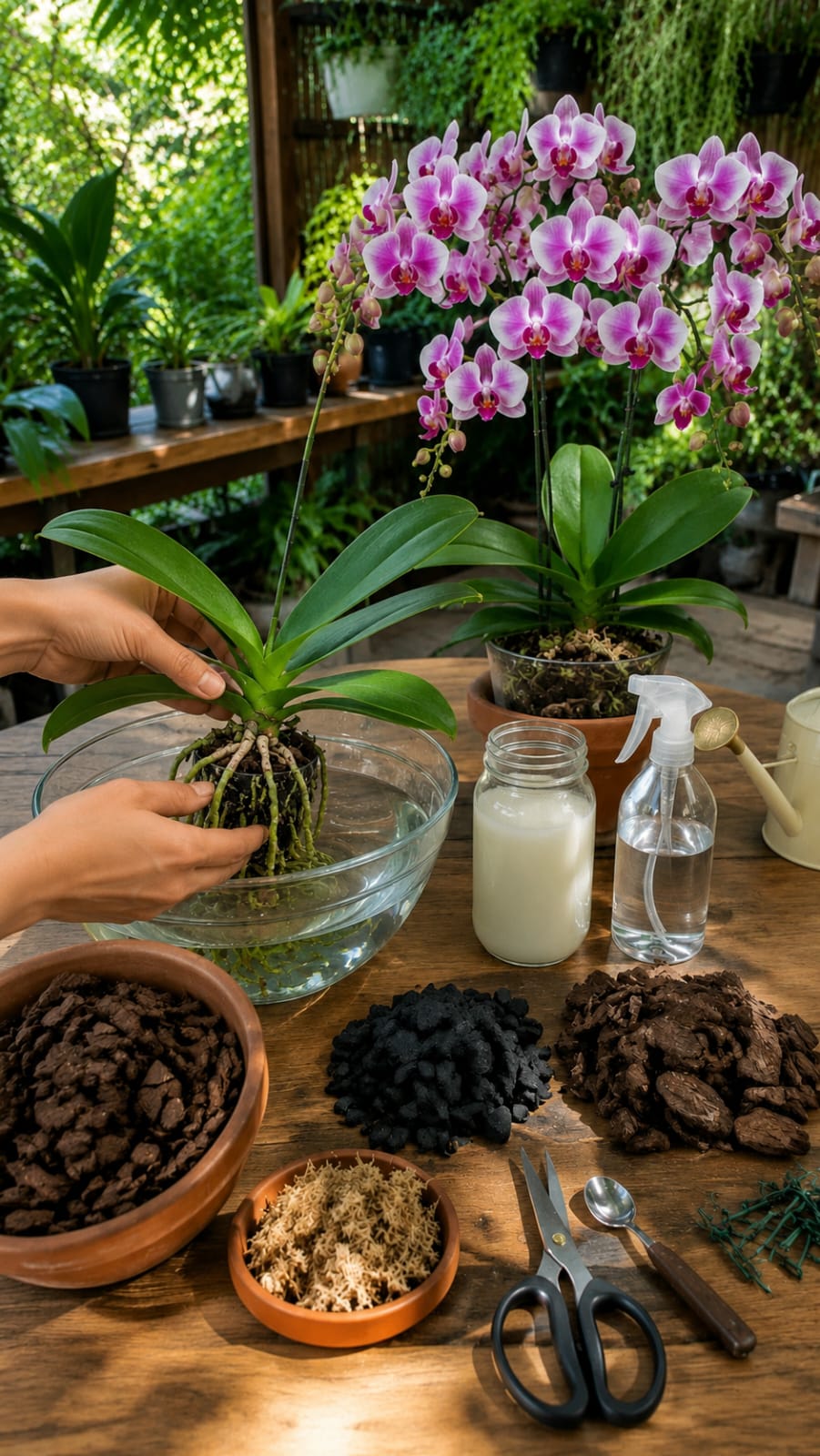
Orchids are among the most elegant plants a homeowner can grow. Their arching flower stems, glossy green leaves, sculptural aerial roots, and soft colorful blooms can make even a simple corner feel refined and expensive. A healthy orchid does not need a crowded display to look beautiful. One clean pot, a bright room, and a graceful flower spike can create the feeling of a luxury indoor garden.
That is why simple orchid-care tricks always get attention. One popular idea is to use a very small spoonful of a light homemade root tonic directly around the orchid’s roots. The goal is not to drown the plant, force instant flowers, or replace proper orchid care. The real idea is more practical: give the root zone a gentle support step while keeping the orchid clean, airy, and stable.
Orchids are different from ordinary houseplants. Many popular orchids, especially Phalaenopsis orchids, naturally grow with thick exposed roots that like air, light moisture, and good airflow. They do not enjoy heavy soil, constant wetness, or strong homemade fertilizers. Because of that, any tonic, liquid, or spoonful method should be used carefully and lightly. With orchids, less is usually safer than more.
This article explains how a one-spoonful orchid root trick can fit into a safe care routine, why orchid roots matter so much, what mistakes to avoid, and how to style orchids beautifully indoors or on a shaded balcony for a cleaner, more elegant blooming display.
Why Orchid Roots Are the Real Secret Behind Beautiful Blooms
When people look at an orchid, they usually notice the flowers first. The blooms get all the attention because they are colorful, delicate, and long-lasting. But the true health of an orchid begins with the roots. If the roots are strong, the leaves stay firm, the plant holds moisture better, and the orchid has a better chance of producing new flower spikes.
Healthy orchid roots are usually thick, firm, and green or silvery depending on moisture level. When freshly watered, they may turn green. When dry, they often look pale silver or gray. This is normal for many orchids. The outer layer of the root helps absorb water quickly and then dry again with airflow.
Healthy orchid roots help the plant:
- Absorb water efficiently
- Anchor the orchid in bark or moss
- Support firm leaves
- Store moisture between waterings
- Recover after blooming
- Produce new root tips
- Prepare for future flower spikes
If the roots become weak, hollow, mushy, or black, the orchid can decline quickly. Leaves may become limp, yellow, wrinkled, or dull. Flower buds may fall before opening. The plant may stop blooming for a long time. That is why a gentle root-care routine is more important than constantly trying new bloom tricks.
What the One-Spoonful Orchid Root Trick Is Meant to Do
The one-spoonful method is best understood as a light root-zone support step. Instead of soaking the entire orchid pot with a strong homemade mixture, the liquid is applied in a small amount near the roots. This gives the grower more control and reduces the chance of overwatering.
A light root tonic may help by:
- Refreshing the root area
- Adding mild moisture without flooding the pot
- Supporting cleaner root care
- Encouraging careful observation of the plant
- Helping dry roots recover gently
- Reducing the temptation to overwater
The important word is “gentle.” Orchids do not need heavy feeding every week. They do not need thick liquids poured into the crown. They do not need strong kitchen mixtures sitting around their roots. A spoonful is used because it is small, controlled, and easy to apply only where needed.
Why Only One Spoonful Is Better Than Pouring Too Much
Many orchid problems begin when a good idea is used too aggressively. A little moisture can help. Too much moisture can cause root rot. A mild tonic may support the plant. A strong mixture can burn or stress the roots. This is especially true for orchids because their roots need oxygen.
Using only one spoonful helps because:
- It avoids soaking the whole pot unnecessarily
- It keeps the root zone from staying wet too long
- It reduces buildup from homemade mixtures
- It allows the orchid to dry properly afterward
- It gives the grower more control
If an orchid is planted in bark, water drains quickly. If it is planted in moss, moisture stays much longer. This means the same spoonful can behave differently depending on the growing medium. Orchids in moss need even more caution because the center of the pot may remain wet while the surface looks dry.
What Kind of Liquid Can Be Used Safely?
The safest root tonic for orchids is always mild. It should be diluted, clean, and used rarely. Many home gardeners experiment with rice water, banana water, garlic water, milk-like liquids, weak compost teas, or other homemade plant tonics. But orchids are sensitive, so anything strong should be avoided.
A safe orchid root tonic should be:
- Very diluted
- Free from salt
- Free from sugar
- Not oily
- Not sour or fermented
- Used in small amounts
- Applied only to the roots or growing medium
Never use thick, sticky, salty, sweet, or spoiled liquids on orchid roots. These can attract pests, create bad smells, encourage mold, or damage the root surface. A liquid that seems harmless in a garden bed may be too strong inside a small orchid pot.
A Gentle Homemade Orchid Root Tonic Idea
For a mild approach, use a very diluted natural tonic rather than a concentrated mixture. The goal is to refresh the roots, not feed the orchid heavily.
A simple gentle version can be made like this:
- Use clean room-temperature water.
- Add only a small amount of a mild plant-safe ingredient.
- Mix well until the liquid is thin and watery.
- Strain the mixture if any particles remain.
- Apply only one spoonful near the root zone.
- Let the orchid drain and dry naturally.
Particles should not sit inside orchid bark because they can decompose and attract fungus gnats. If a mixture contains pieces of banana, rice, peel, or other organic material, it should always be strained well before use.
How to Apply One Spoonful to Orchid Roots
The application should be slow and careful. Do not pour liquid into the center crown of the orchid. The crown is the area where the leaves meet. Water trapped there can cause crown rot, especially if the plant sits in low airflow.
Use this method:
- Check the roots first.
- Make sure the orchid is not already soaking wet.
- Use a clean spoon.
- Add one spoonful near visible roots or around the bark surface.
- Avoid pouring into the leaf crown.
- Let extra moisture drain away.
- Keep the orchid in bright indirect light.
- Do not repeat too often.
This method is best used as an occasional support step, not a daily watering routine. Orchids prefer cycles of moisture and drying. Constant dampness weakens the roots.
When This Trick Makes Sense
A one-spoonful root tonic makes the most sense when the orchid is basically healthy but needs gentle support. It is not a cure for severe rot, pests, or disease. It works best as a maintenance step for orchids that still have firm roots and leaves.
This trick may be reasonable when:
- The orchid has firm green leaves
- The roots are mostly healthy
- The potting medium is not sour or rotten
- The orchid has finished blooming and needs recovery care
- The roots look dry but not dead
- The grower wants a light refresh between normal watering
It is not recommended when:
- The roots are black and mushy
- The pot smells bad
- The orchid crown is soft
- The leaves are collapsing
- The potting medium is old and broken down
- The plant is already overwatered
If the orchid is severely damaged, the first step is root inspection and repotting, not adding more liquid.
How to Recognize Healthy Orchid Roots
Before using any root trick, learn how healthy orchid roots look. This helps prevent mistakes. Many beginners think silvery roots are dead, but in many orchids, silver roots are simply dry. After watering, healthy roots often turn green.
Healthy roots usually look:
- Firm
- Plump
- Green when wet
- Silver-gray when dry
- Strong near the base
- Active with bright green tips when growing
Unhealthy roots may look:
- Black
- Mushy
- Hollow
- Brown and slimy
- Dry and papery
- Bad-smelling
If most roots are unhealthy, a spoonful tonic will not fix the problem. The orchid needs cleaning, trimming, and fresh orchid medium.
Why Orchid Roots Should Not Sit in Water Too Long
Orchid roots are not like roots of many soil-grown plants. They need airflow. In nature, many orchids grow attached to trees where rain wets the roots and then air dries them. Indoors, the potting medium must copy that wet-dry rhythm.
If roots stay wet too long, they can suffocate. The outer layer becomes damaged, and rot can spread. This is why orchid pots often contain bark, charcoal, perlite, or moss instead of regular soil.
To prevent root rot:
- Use a pot with drainage
- Do not let the orchid sit in standing water
- Use orchid bark or a proper orchid mix
- Water only when the medium is nearly dry
- Improve airflow around the pot
- Keep water out of the crown
Best Growing Medium for Orchids
The right growing medium is more important than any tonic. If the orchid is planted in old, compacted, wet material, no spoonful trick will keep it healthy for long. A good orchid mix allows water to pass through while holding just enough moisture around the roots.
Common orchid medium materials include:
- Orchid bark
- Sphagnum moss
- Charcoal
- Perlite
- Coconut husk chips
- Lava rock
Bark is excellent for airflow. Moss holds more moisture and works well for dry homes, but it must be managed carefully. Charcoal can help keep the potting mix cleaner. Perlite improves air pockets. The best mix depends on the home environment and watering habits.
How Often Should You Use a Spoonful Root Tonic?
This kind of trick should not be used every day. Orchids prefer simple routines. Too many homemade treatments can cause buildup, mold, or root stress.
A safer schedule is:
- Use once every few weeks at most
- Use only when the orchid is not soaking wet
- Skip during cold, dark periods if growth is slow
- Stop immediately if mold or smell appears
- Return to plain water if the orchid looks stressed
For most orchids, plain water and proper light are more important than frequent tonics. The spoonful method is only a small support step.
Can This Make Orchids Bloom All Year?
It is tempting to believe one spoonful can make orchids bloom all year, but orchids do not bloom endlessly just because of one liquid. Blooms depend on plant maturity, root health, light, temperature, feeding, and rest cycles.
A root tonic may support the plant indirectly if it helps maintain healthy roots, but it cannot force constant flowers. Orchids usually need a balanced routine and sometimes a slight temperature change to trigger blooming.
Orchids bloom better when:
- The roots are healthy
- The plant receives bright indirect light
- The leaves are firm and green
- The potting medium is fresh
- The plant is not overwatered
- Feeding is light and balanced
- Night temperatures are slightly cooler for some varieties
The real goal should be long-term health. A healthy orchid will bloom more reliably than a stressed orchid pushed with too many tricks.
How to Encourage Orchid Reblooming Naturally
After flowers fade, many people think the orchid is finished. But a healthy orchid can rebloom with patience. The plant needs recovery time after flowering. During this period, it grows roots and leaves to prepare for the next bloom cycle.
To encourage reblooming:
- Place the orchid in bright indirect light
- Water when the medium is nearly dry
- Feed lightly during active growth
- Keep roots airy
- Trim only dead flower spikes
- Allow a gentle nighttime temperature drop if suitable
- Be patient between bloom cycles
A spoonful root tonic can be part of this recovery routine, but it should never replace proper light and root care.
Common Orchid Mistakes to Avoid
Orchids often fail because they are treated like ordinary potted plants. They need different care. The most common mistakes are overwatering, using regular soil, and placing them in dark corners.
Avoid these mistakes:
- Planting orchids in dense garden soil
- Watering every day
- Letting water sit in the crown
- Using strong homemade fertilizers
- Keeping the orchid in direct hot sun
- Leaving old rotten bark in the pot
- Cutting healthy aerial roots
- Using large amounts of organic kitchen scraps
- Ignoring mushy roots
- Fertilizing a sick orchid heavily
Simple care is usually best. Orchids do not need constant interference. They need the right balance.
Continue to Page 2
Continue to page 2 for more details about this article and the key points many readers miss on the first page.