How Often Should You Use This Trick?
Use the Epsom salt trick only once every six to eight weeks during active growth, and only if the plant seems to need support. Do not use it as a weekly routine.
Snake plants are light feeders. Too much powder can build up in the soil and stress the roots. If your plant is already healthy, you may not need this trick at all.
For weak plants, one careful application followed by proper light and watering is enough to begin.
Why Epsom Salt Should Be Used Carefully
Epsom salt can be useful in small amounts, but more is not better. Too much can disturb the soil balance and create salt buildup. Indoor pots do not flush naturally like outdoor soil, so anything you add can stay around the roots.
That is why this trick should be light and occasional. Think of it as a tiny mineral boost, not a replacement for healthy soil and correct watering.
If you are unsure, use less than you think you need.
When This Trick Can Help Most
This white powder trick is most useful when a snake plant has pale, tired growth but still has firm roots and a living center. It may also be useful after you have corrected watering problems and want to support fresh growth.
It is not the first step for a mushy, rotten, or collapsing plant. If the plant is rotting, repotting and root cleanup come first.
Use the trick only when the plant is stable enough to recover.
When Not to Use the White Powder
Do not use this trick if the soil is wet, sour-smelling, moldy, or full of fungus gnats. Do not use it if the leaves are mushy at the base. Do not use it if the plant has no firm green center left.
In those cases, the problem is likely root rot or poor soil conditions. Adding powder will not solve that.
Instead, remove the plant from the pot, inspect the roots, and repot healthy sections into dry, well-draining soil.
How to Repot a Weak Snake Plant
If the plant is badly stressed, repotting may help more than any powder. Remove the plant from its pot and shake away old soil. Look at the roots and rhizomes. Healthy parts should feel firm. Rotten parts will be mushy, dark, or smelly.
Cut away rotten roots with clean scissors. Let the healthy plant sections sit for a few hours so any cuts can dry slightly. Then repot into a well-draining cactus or succulent mix.
After repotting, wait a few days before watering if the roots were damaged. Snake plants can handle dryness better than soggy soil.
Best Soil Mix for Snake Plants
Snake plants need fast-draining soil. A good mix can include cactus soil, perlite, pumice, coarse sand, or small bark pieces. The soil should not stay wet for many days.
If your soil looks heavy, dense, or muddy, improve it before using any trick. Heavy soil is one of the biggest reasons snake plants decline.
A simple mix can be:
- Two parts cactus soil
- One part perlite
- One part pumice or coarse bark
This gives the roots air and reduces the risk of rot.
Why the Pot Matters
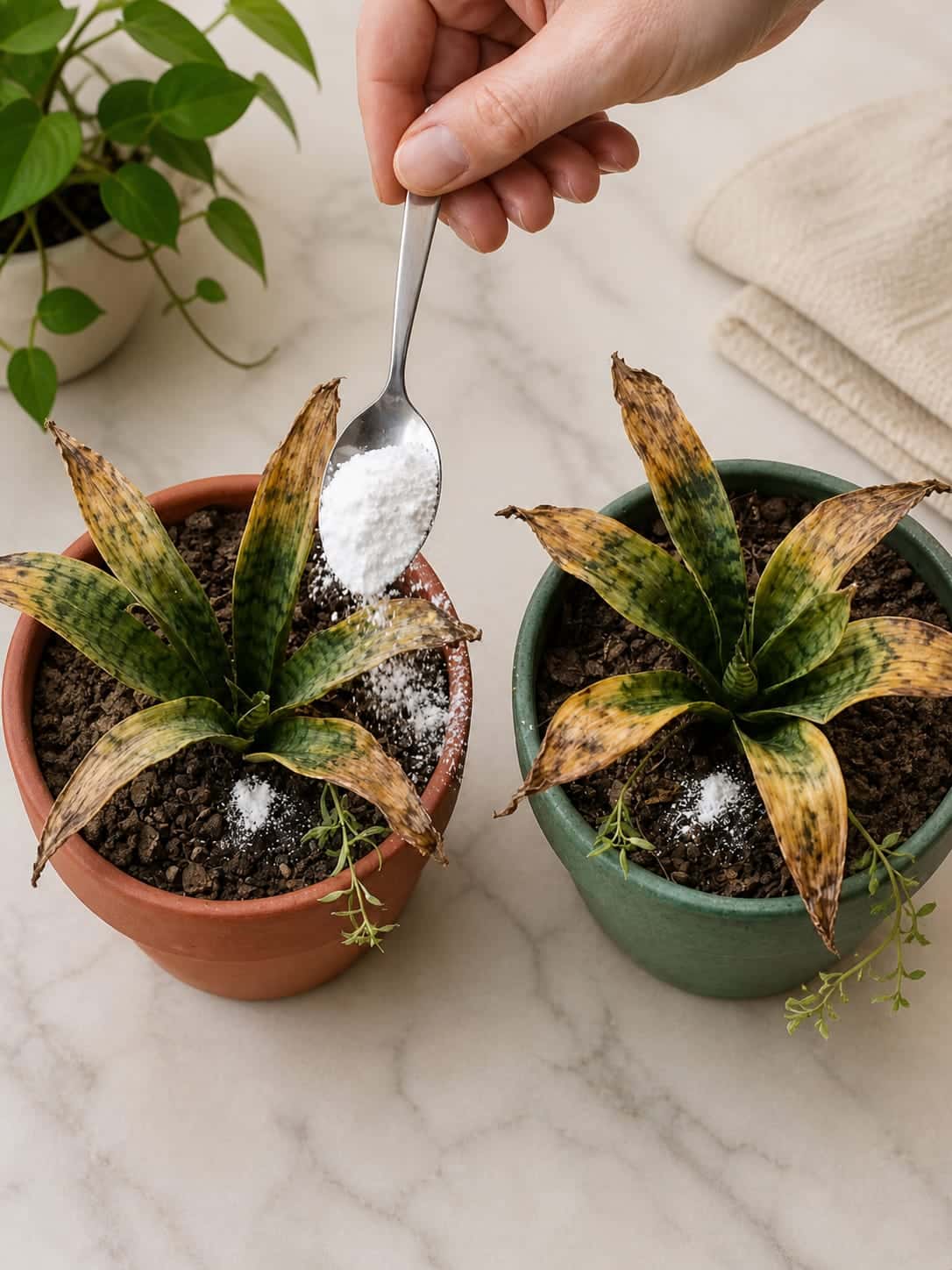
The plants in the image are in small decorative pots. The most important detail is drainage. A snake plant pot must have drainage holes. If water cannot escape, the roots can rot even if you water carefully.
Terracotta pots are often helpful because they dry faster. Glazed ceramic and plastic pots hold moisture longer, so you must water less often.
Never let a snake plant sit in a full saucer of water.
How Much Water Snake Plants Really Need
Snake plants do not need frequent watering. Water only when the soil has dried well. In many homes, this may mean every two to four weeks, depending on light, pot size, soil mix, and season.
In winter, they may need even less. In bright warm rooms, they may dry faster.
Always check the soil instead of following a fixed calendar.
Why the Leaves Look Speckled and Burnt
The leaves in the image show yellowing, brown patches, and dry tips. This can happen from several stresses. Overwatering can cause yellowing and mushy damage. Underwatering can cause dry, crispy edges. Too much sun can cause pale burnt patches. Poor roots can cause the plant to dry out even when watered.
Because the symptoms overlap, the soil and roots tell the real story. If the soil is wet and the plant is yellowing, suspect overwatering. If the soil is bone dry and the leaves are wrinkled or crispy, suspect underwatering.
Do not guess only from the leaves.
Can the Brown Leaves Turn Green Again?
No. Once snake plant leaves are brown, crispy, or badly yellowed, those parts will not turn green again. The plant recovers by producing new growth, not by repairing old dead tissue.
That is why trimming is important. Remove the worst leaves and focus on the healthy center.
A successful rescue may look smaller at first, but later it can become fuller and stronger.
How to Encourage New Snake Plant Pups
Snake plant pups grow from underground rhizomes. To encourage them, give the plant bright indirect light, fast-draining soil, and a consistent dry-down watering routine.
A tiny Epsom salt sprinkle may support the plant if it needs magnesium, but pups depend mostly on healthy roots and enough light.
Do not keep the plant in a dark corner and expect new pups quickly. Light is a major part of growth.
Can You Use Baking Soda Instead?
No, baking soda is not the best choice for this trick. It may look like the powder in the image, but it can affect the soil in ways snake plants do not need. Too much baking soda can stress roots and make the soil less friendly for plant growth.
Use plain Epsom salt if you want a white powder trick. Use it lightly and only occasionally.
Can You Use Eggshell Powder?
Eggshell powder is another white powder used in plant-care content. It can add calcium over time, but it breaks down slowly and does not create quick results. It is better as a long-term soil amendment than a rescue trick.
If using eggshell powder, make sure it is washed, dried, and ground very finely. Use only a small amount.
For the image-style rescue trick, Epsom salt fits better because it dissolves easily when watered.
Can You Use Rice Powder or Flour?
No. Do not sprinkle rice flour, wheat flour, cornstarch, or powdered food onto indoor plant soil. These can clump, mold, smell, or attract pests.
White does not automatically mean plant-safe. Only use known plant-friendly ingredients, and use them sparingly.
Can You Use Regular Fertilizer Instead?
Yes, but only when the plant is stable and actively growing. Snake plants do not need much fertilizer. A diluted balanced fertilizer once during spring or summer can be enough.
Do not fertilize a plant with rotten roots. Fertilizer cannot fix root rot. Repotting and better watering must come first.
If you use fertilizer, do not use Epsom salt at the same time. Keep the routine simple.
What to Do After the White Powder Trick
After applying the trick, leave the plant alone. Do not keep poking, watering, feeding, and moving it every day. Snake plants recover slowly.
Place it in bright indirect light, let the soil dry between waterings, and check for new growth every week or two.
If the plant gets worse, inspect the roots instead of adding more powder.
Signs the Trick Is Working
The best signs are subtle at first. You may notice the center leaves standing more firmly, less drooping, and better color in new growth.
Later, you may see small pups emerging from the soil. That is the clearest sign the plant is recovering.
Do not judge by the old damaged leaves. They are already injured. Judge by the new growth.
Signs You Need to Stop and Repot
Stop using the trick and repot if you notice:
- Mushy leaf bases
- Bad smell from the soil
- Wet soil that never dries
- Blackened roots
- Leaves collapsing from the crown
- Fungus gnats around the pot
- White crust building up on soil
These signs mean the root zone needs attention. Powder will not solve a bad root environment.
Quick White Powder Rescue Routine
- Trim fully dead leaves with clean scissors.
- Check that the center is still firm and green.
- Make sure the soil is dry enough for watering.
- Sprinkle only a tiny pinch of Epsom salt around the soil.
- Water lightly if the soil is dry.
- Let the pot drain completely.
- Move the plant to bright indirect light.
- Wait for new growth from the center.
This is the simple version of the trick. The lighter you keep it, the safer it is.
Common Mistakes to Avoid
- Using baking soda instead of Epsom salt
- Adding a full spoonful to a small pot
- Sprinkling powder on wet soil
- Watering too much after applying it
- Leaving water in the saucer
- Ignoring root rot
- Using heavy compacted soil
- Keeping the plant in a dark corner
- Expecting old leaves to turn green again
- Repeating the trick every week
Caption for This Trick
“Don’t toss a yellowing snake plant yet! Trim the dead leaves, sprinkle a tiny pinch of Epsom salt around dry soil, water lightly, and move it to bright indirect light. The old leaves won’t heal, but the center may push fresh green growth.”
Frequently Asked Questions
What is the white powder for snake plants?
The best safe version is a tiny amount of plain Epsom salt. It should be used lightly and occasionally, not as a heavy layer.
Can Epsom salt help snake plants?
It can support green growth if the plant needs magnesium, but it is not a cure for overwatering, root rot, or bad soil.
How much Epsom salt should I use?
For a small pot, use about 1/8 teaspoon or less. For a medium pot, use no more than 1/4 teaspoon.
Can I use baking soda on snake plants?
No. Baking soda is not recommended for this trick because it can affect the soil and stress roots if overused.
How often should I use the white powder trick?
Use it once every six to eight weeks at most during active growth. Do not use it every week.
Should I water after sprinkling the powder?
Only water if the soil is dry enough. After watering, let the pot drain fully and empty the saucer.
Will yellow snake plant leaves turn green again?
No. Damaged leaves usually stay damaged. Recovery shows through new green leaves or pups from the center.
What if the leaves are mushy?
Mushy leaves usually mean overwatering or rot. Do not use the powder yet. Check the roots and repot if needed.
Can I use eggshell powder instead?
Finely ground eggshell powder can be used lightly as a slow soil amendment, but it will not act quickly as a rescue trick.
What is the best way to revive a snake plant?
Check the roots, trim dead leaves, use fast-draining soil, water only when dry, give bright indirect light, and use any powder trick only as a small support step.
Final Thoughts
The white powder trick can be a simple and eye-catching way to support a weak snake plant, but it must be done carefully. The safest version is a tiny sprinkle of plain Epsom salt on dry soil, followed by light watering and good drainage.
Do not use baking soda, flour, sugar, or random white powders. Do not add too much. Do not use the trick on soggy soil or rotten plants. Snake plants recover best when their roots are healthy, their soil drains fast, and their leaves receive bright indirect light.
The damaged yellow and brown leaves may not become green again, but that does not mean the plant is lost. If the center is firm, the crown is alive, and the roots are healthy, new growth can still appear.
So before giving up on a tired snake plant, try the full rescue routine: trim, check, sprinkle lightly, water carefully, drain well, and brighten the plant’s spot. With patience, the green comeback can begin from the center.