Snake plants are famous for being tough, upright, and almost impossible to kill. Their tall green leaves with yellow edges can make any indoor corner look clean and modern. But even strong plants can run into trouble, especially when hidden pests settle near the base of the leaves. When a snake plant starts showing white cottony clusters around the stems, it is no longer just a watering problem. It may be a pest problem that needs quick attention.
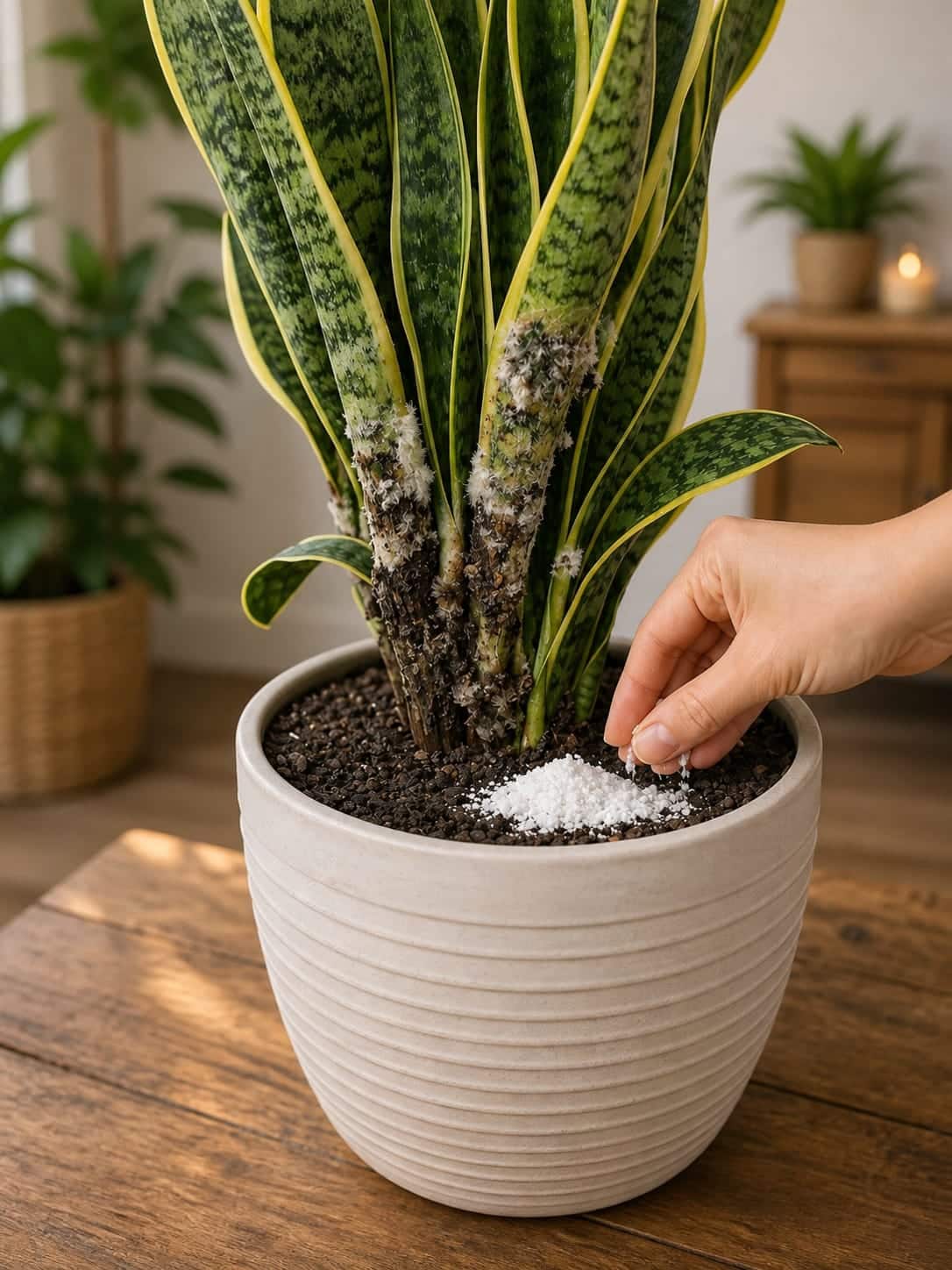
The image shows a large snake plant in a ceramic pot. At the base of several leaves, there are white fuzzy patches clustered around the lower stems. A hand is sprinkling a white powder onto the soil surface. This scene suggests a common indoor plant rescue trick: using a dry white pest-control powder around the soil and base of the plant to help manage crawling pests and create a cleaner surface barrier.
For this trick, the safest plant-care interpretation is food-grade diatomaceous earth, often called DE. It is a fine white powder used by many indoor gardeners as a dry pest-control helper. It is especially popular when dealing with crawling insects around the soil surface, fungus gnats, and pests that move between the potting mix and the plant base. However, it must be used correctly: dry, lightly, carefully, and never as a thick pile against the crown.
This trick is not a magic overnight cure. If the white fuzzy patches are mealybugs, you still need to clean the plant manually, isolate it, and repeat treatment. But a light dusting of food-grade diatomaceous earth on the dry soil surface can become part of a strong pest-control routine for snake plants.
What Are the White Fuzzy Clusters on the Snake Plant?
The fuzzy white patches near the base of the snake plant look like a possible mealybug infestation. Mealybugs are small soft-bodied pests that often appear as white cottony masses on houseplants. They love tight spaces, leaf joints, crowns, and hidden stem bases. Snake plants can hide them well because their leaves grow close together from the soil.
Mealybugs feed on plant sap. Over time, they can weaken the plant, cause yellowing, slow growth, sticky residue, and general decline. They can also spread to nearby houseplants if you do not act quickly.
If you see white fluffy clusters around a snake plant, do not ignore them. The earlier you treat them, the easier they are to control.
What Is the White Powder Trick?
The white powder trick shown in the image is best understood as a light application of food-grade diatomaceous earth on the soil surface. Diatomaceous earth is a dry powder made from fossilized microscopic algae. Gardeners use it as a physical pest-control tool because it can affect small crawling insects when it stays dry.
For snake plants, it can be sprinkled lightly around the soil surface and near the base, but not packed into the crown. It is most useful as part of a wider pest-control routine, not as the only step.
The key word is lightly. The powder should look like a thin dusting, not a thick snowy mound. In photos, the pile may look dramatic, but real plant care works better with a careful, even layer.
Important Safety Note
Use only food-grade diatomaceous earth. Do not use pool-grade diatomaceous earth. Pool-grade DE is processed differently and is not appropriate for plant-care use indoors.
Also avoid breathing in the powder. It is very dusty and can irritate the lungs. Apply it gently, keep your face away, and consider wearing a mask if you are sensitive to dust. Keep it away from children and pets while applying.
Do not sprinkle random white powders into houseplant soil. Baking soda, flour, laundry powder, powdered sugar, salt, or cleaning powders can harm plants or attract pests.
Why Snake Plants Get Mealybugs
Snake plants often look clean from a distance, but their tight leaf bases create hidden spaces where pests can settle. Mealybugs like protected areas where they can avoid being wiped away easily.
They may arrive on a new plant from a store, move from another infested plant, or hide in leaf joints for weeks before you notice them. Dry indoor air and crowded plant shelves can also make pests harder to catch early.
Because snake plants grow slowly, damage may not show immediately. By the time you see fuzzy clusters, the pests may already be tucked deep between the leaves.
Step 1: Isolate the Snake Plant Immediately
The first step is not the powder. The first step is isolation.
Move the snake plant away from your other houseplants. Mealybugs can spread, especially when plants touch each other or when pests crawl from pot to pot. Keep the affected plant in a separate area while you treat it.
If the plant was sitting near pothos, philodendron, peace lily, spider plant, or other indoor plants, inspect those plants too. Look under leaves, at stems, and around the soil surface.
Step 2: Inspect the Whole Plant
Look carefully at the base of every leaf. Mealybugs often hide in the folds where the leaf emerges from the soil. Use a flashlight if needed. Check the front and back of the leaves, the crown, the rim of the pot, and the top layer of soil.
If you see cottony white clusters, sticky residue, tiny oval insects, or brown scale-like specks, the plant needs treatment.
Do not treat only the visible spot. Pests hide. A full inspection gives you a better chance of stopping the infestation.
Step 3: Remove Visible Mealybugs by Hand
Before applying any powder, remove as many visible pests as possible. This is one of the most important steps.
Use cotton swabs dipped in rubbing alcohol and dab the white fuzzy clusters directly. The alcohol helps break down the waxy coating on mealybugs. Work carefully around the leaf bases. Do not pour alcohol into the soil. Use it only on the pests and affected plant surfaces.
You can also use a soft cloth or small brush to wipe away clusters. Be gentle because snake plant leaves can be damaged if you scrape too hard.
Step 4: Trim Severely Damaged Leaves
If some leaves are badly damaged, heavily infested, mushy, or collapsing at the base, trim them off with clean scissors or pruning shears. Cut close to the soil line without damaging healthy leaves.
Do not keep leaves that are completely covered in pests just because you want the plant to look full. Removing the worst sections can reduce the pest population quickly.
After trimming, clean your scissors with alcohol before using them on any other plant.
Step 5: Let the Soil Surface Dry
Diatomaceous earth works best when it is dry. If the soil is wet, wait until the top layer dries before sprinkling the powder.
This is especially important for snake plants because they prefer drying between waterings. A wet snake plant pot is already risky, and adding powder to soggy soil can create clumps instead of a fine dusting.
Let the top inch or two of soil dry before applying the white powder trick.
Step 6: Sprinkle a Thin Layer of Food-Grade Diatomaceous Earth
Once the soil surface is dry, sprinkle a light layer of food-grade diatomaceous earth over the top of the potting mix. Focus on the soil surface and the area around the base of the plant, but do not bury the crown.
Use a small spoon, shaker, or soft brush. Apply gently to avoid creating a dust cloud.
The layer should be thin enough that the soil is still visible in places. A thick pile can trap moisture, look messy, and make watering harder.
Step 7: Keep the Crown Open
Snake plants grow from a crown and rhizomes near the soil line. That area should stay open and breathable. Do not pack white powder into the tight center where leaves emerge.
If powder falls into the leaf bases, gently brush away excess. A little dusting around the base is fine, but a thick mound against the stems is not ideal.
Airflow matters. Pests love hidden, crowded, damp spaces. A clean, open crown helps the plant recover.
Step 8: Avoid Watering Right Away
After applying diatomaceous earth, avoid watering immediately. Water makes the powder less effective as a dry barrier. Let it sit dry for several days if the plant can handle it.
Snake plants are drought-tolerant, so they can usually wait. Only water when the soil has dried well and the plant truly needs it.
When you do water, the powder will get wet and lose some of its dry effect. After the soil surface dries again, you can reapply a very light dusting if pests are still active.
Step 9: Repeat Cleaning Weekly
Mealybugs often need repeated treatment. One cleaning is rarely enough. New insects can hatch or hidden pests can reappear from tight leaf bases.
Inspect the plant every few days and do a deeper cleaning once a week. Dab visible pests with alcohol, wipe leaves, and refresh the dry powder layer only if needed.
Continue until you see no new pests for several weeks.
Step 10: Check Nearby Plants
Do not treat one snake plant and forget the rest of the room. Mealybugs spread quietly. Check nearby plants carefully, especially plants with soft stems or crowded growth.
Common plants that can host mealybugs include pothos, hoya, philodendron, orchids, peace lilies, succulents, jade plants, and spider plants.
If one plant is infested, assume others may be at risk.
Why Diatomaceous Earth Helps
Diatomaceous earth works physically, not chemically. When dry, the fine particles can damage the protective outer coating of small crawling insects. This can help reduce pest activity on the soil surface and around the pot.
It is not a poison in the traditional sense, and it does not move through the plant. That means it will not kill pests hidden deep inside tight leaf folds unless they contact the dry powder.
This is why manual cleaning is still necessary. The powder supports the routine, but your hands, cotton swabs, and repeated inspections do most of the rescue work.
Can Diatomaceous Earth Kill Mealybugs Completely?
It can help, but it may not eliminate a heavy mealybug infestation by itself. Mealybugs hide in protected places and have waxy coverings. Some may never touch the powder.
For a serious infestation, combine methods: alcohol dabbing, manual removal, pruning, isolation, soil surface treatment, and repeated checks. If the infestation is severe, you may need a houseplant-safe insecticidal soap or horticultural oil, used according to label directions.
The white powder trick is useful, but it should be part of a complete plan.
Can You Use Cinnamon Instead?
Cinnamon is another popular plant powder, but it is not the best choice for active mealybug control. Cinnamon can be used as a light soil refresh or around cut areas, but it does not work the same way as diatomaceous earth for crawling pests.
If the problem is fuzzy bugs, food-grade diatomaceous earth is a better fit for the white powder trick.
Use cinnamon for gentle soil-refresh content, not as your main pest-control tool.
Can You Use Baking Soda?
No. Baking soda is not recommended for this snake plant pest trick. It can affect the soil environment and may stress the roots if overused.
It may look like the white powder in the image, but it is not the right choice here. Many white powders look similar, but they behave very differently in soil.
For pest-control dusting, use food-grade diatomaceous earth only.
Continue to Page 2
Continue to page 2 for more details about this article and the key points many readers miss on the first page.