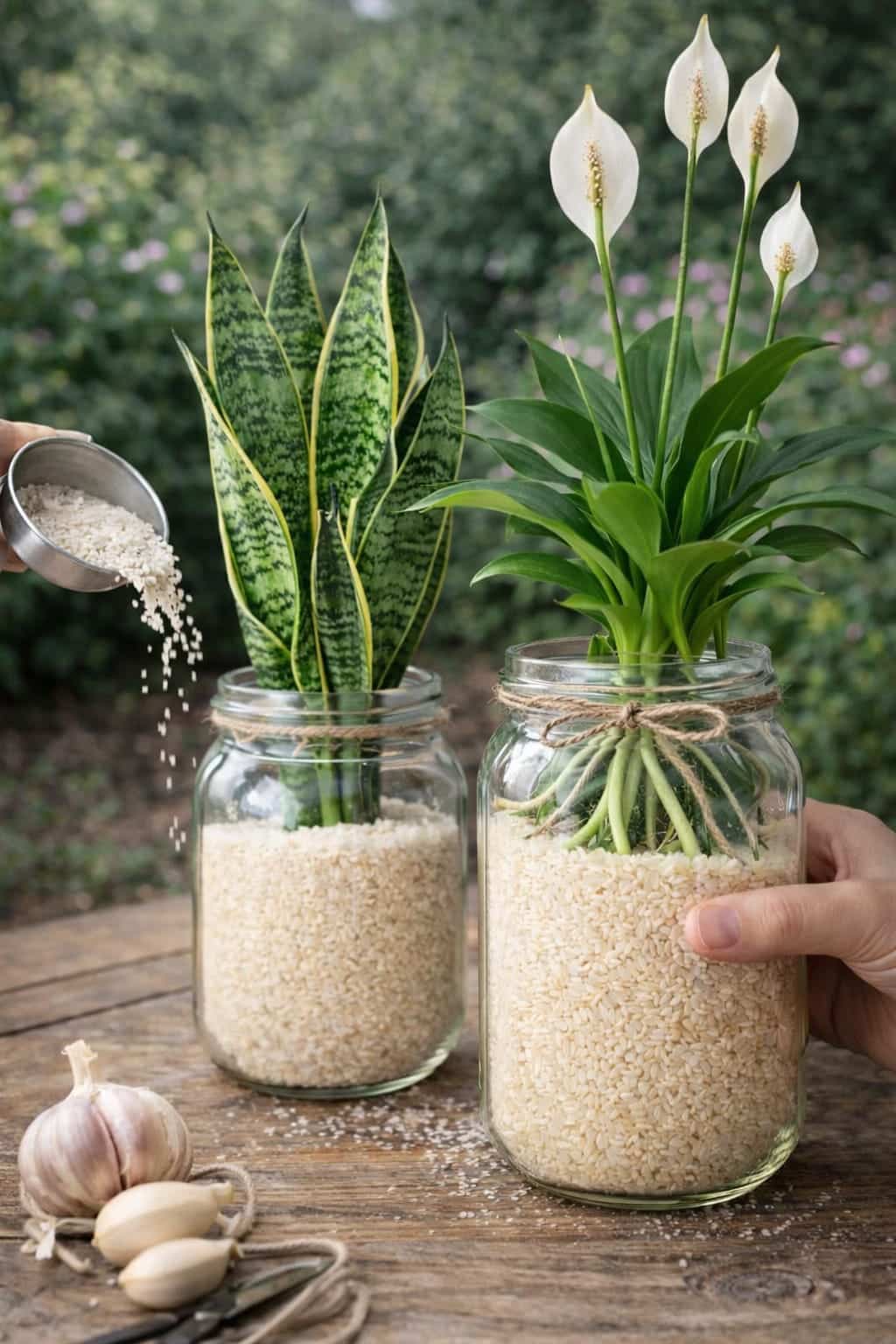
Can adding rice to your indoor plants really help? Learn why some gardeners experiment with rice, the risks of mold and root stress, and why proper soil, water, and light matter more.
Let’s be honest: indoor plants like snake plants and peace lilies are loved for their beauty, resilience, and ability to thrive in home environments. Recently, a surprising trend has been gaining attention: using rice as part of the growing medium or soil environment. Viral videos show a layer of rice at the bottom of a glass container, a plant placed on top, and the promise of “amazing results.”
While it may sound unusual, some indoor gardeners experiment with this method to explore how natural materials affect plant growth and root conditions. But here’s the truth: rice is not a traditional growing medium, and it comes with significant risks. It may be interesting for decorative experiments, but it is not a reliable substitute for proper soil.
In this guide, you’ll learn why indoor plants depend on healthy root systems, why some gardeners try rice, how the method is usually attempted, the important risks to consider, and the ideal conditions that truly matter for long‑term plant health.
🌿 Why Indoor Plants Depend on Healthy Root Systems
All indoor plants rely heavily on their roots to absorb water, oxygen, and nutrients. Healthy roots lead to:
· Strong leaf development – upright, vibrant leaves.
· Better moisture regulation – prevents overwatering stress.
· Steady growth over time – consistent new leaves or stems.
· Improved plant stability – roots anchor the plant.
· Resistance to stress – tolerates minor neglect.
For plants like snake plants and peace lilies, root health is everything. Without healthy roots, the plant cannot take up water or nutrients, and it will decline quickly.
🪴 Why Some Gardeners Are Using Rice
Rice is a natural organic material, and gardeners experimenting with it believe it may influence soil conditions. This trend is more common in decorative setups – like clear glass jars or vases – where the rice creates an interesting visual layer.
Possible Reasons for Trying Rice
· Improving texture in decorative setups – rice adds a unique look to transparent containers.
· Acting as a temporary organic layer – believed to retain moisture or provide trace nutrients.
· Supporting moisture balance – in theory, rice absorbs excess water (but can also swell and compact).
· Creating an aesthetic transparent display – popular for propagation or temporary arrangements.
· Encouraging curiosity‑driven plant care experiments – fun for plant lovers who like to try new things.
However, rice is not a traditional growing medium and should be used carefully, temporarily, and experimentally – not as a permanent soil replacement.
Continue to Page 2
Continue to page 2 for more details about this article and the key points many readers miss on the first page.