Should You Use Rooting Hormone?
Rooting hormone is optional. Snake plants can root without it. However, some homeowners like using rooting hormone to encourage faster rooting and reduce failure.
If using rooting hormone, dip only the dry callused bottom end lightly into the powder. Tap off excess. Do not coat the entire leaf. Then plant the cutting in dry or lightly moist propagation mix.
How to Water Snake Plant Cuttings
Watering is the biggest challenge. Cuttings without roots cannot drink much water. If the soil stays wet, the cutting may rot. If it stays bone dry forever, rooting may be slow. The balance is light moisture and plenty of drying time.
A safe watering routine:
- Water lightly after planting.
- Wait until the mix is almost completely dry.
- Water lightly again.
- Never leave the pot sitting in water.
- Use a pot with drainage holes.
- Reduce watering in cool weather.
Do not water on a fixed schedule. Check the soil first.
Best Pot for Snake Plant Cuttings
Use a small pot with drainage holes. A small pot dries faster and reduces the risk of soggy soil. Terracotta is a good choice because it breathes and helps moisture evaporate. Plastic also works if you are careful not to overwater.
Avoid large deep pots for new cuttings. Too much soil holds moisture for too long.
Best Light for Propagating Snake Plants
Snake plant cuttings root best in bright indirect light. They can tolerate lower light, but rooting will be slower. They can tolerate some direct sun once established, but fresh cuttings should be protected from harsh light.
Good locations include:
- A bright windowsill with filtered light
- Near an east-facing window
- A few feet from a south or west window
- Under a grow light
- A warm bright shelf
Avoid dark corners during propagation. The cutting needs energy to form roots.
Temperature for Best Results
Snake plant cuttings prefer warmth. Rooting is faster when temperatures are comfortable and stable. Aim for a warm indoor range. Avoid cold windowsills, drafts, air conditioners, and chilly nights.
If the room is cold, the cutting may sit for months without rooting or may rot slowly. Warmth encourages activity.
Will Variegated Snake Plant Cuttings Keep Yellow Edges?
This is one of the most important things to know. Many variegated snake plants, especially those with yellow leaf edges, may lose that yellow variegation when propagated from leaf cuttings. The new pups often emerge plain green.
If you want to preserve the exact yellow-edged look, division is usually better. Division means separating a pup or rhizome from the mother plant with roots attached. That method keeps the plant genetically identical and more likely to preserve variegation.
Leaf cuttings are still useful, but the babies may look different from the parent.
How to Propagate Snake Plant by Division Instead
If your goal is to keep the same variegation, division is the safer method.
- Remove the snake plant from its pot.
- Shake away loose soil.
- Find natural clusters or pups with roots.
- Use a clean knife to separate a section with roots attached.
- Let any cut rhizome dry for a day.
- Plant the division in fresh well-draining soil.
- Water lightly and place in bright indirect light.
Division gives you a new plant faster because it already has roots and growing points.
Common Mistakes With the V-Notch Trick
Mistake 1: Planting the Cutting Upside Down
This is the exact problem the V notch helps prevent. Always plant the notched bottom end into the soil or water.
Mistake 2: Skipping the Callus Period
Fresh cuts placed into wet soil often rot. Let the cut dry first.
Mistake 3: Using Dirty Tools
Dirty blades can introduce disease. Always clean the blade before cutting.
Mistake 4: Overwatering
Cuttings rot easily. Keep the soil lightly moist only when needed, never soggy.
Mistake 5: Using Heavy Soil
Dense soil holds too much water. Use cactus mix with perlite or pumice.
Mistake 6: Expecting Fast Results
Snake plants are slow. Rooting and pup growth can take months.
Mistake 7: Cutting Weak Leaves
Weak, mushy, or diseased leaves usually fail. Use firm healthy tissue.
What If the Cutting Turns Mushy?
If the cutting becomes soft, translucent, smelly, or mushy, it is rotting. Remove it from the pot immediately. If only the bottom is affected, you may be able to cut above the rot, let the fresh cut callus, and try again. But if rot has spread high into the cutting, discard it.
Rot usually happens because of too much moisture, poor airflow, dirty tools, or planting before callusing.
What If the Cutting Shrivels?
Slight wrinkling can happen while the cutting is trying to root. Severe shriveling may mean it is too dry, too hot, or taking too long to root. Check the soil. If it has been bone dry for weeks, water lightly. If the cutting is in direct sun, move it to bright indirect light.
What If Nothing Happens?
Nothing visible may happen for a long time. This does not always mean failure. Snake plant cuttings can sit for weeks or months before producing pups. If the cutting is still firm, leave it alone.
Do not keep pulling it out to check. That can damage tiny new roots.
Can You Propagate From a Broken Leaf?
Yes, if the broken leaf is healthy and firm. Cut away any damaged or ragged tissue, create clean sections, mark the bottom with a V notch, let the pieces callus, and plant them.
This is a great way to save a leaf that broke during moving, cleaning, or repotting.
Can You Propagate a Leaf Tip?
A leaf tip can sometimes root if it has enough healthy tissue, but it must still be planted with the original bottom end downward. If you cut off only the tip and do not know its orientation, it may fail. Larger sections are usually more successful than tiny tips.
How Many Cuttings Can You Make From One Leaf?
A long snake plant leaf can produce several cuttings. Each cutting should be about 3 to 5 inches long. If the pieces are too small, they may dry out before rooting. If they are too large, they may become unstable.
A single large leaf might provide 3 to 6 cuttings depending on its length.
Should You Cover the Cuttings With Plastic?
Usually no. Snake plant cuttings do not need a humidity dome. Too much humidity can encourage rot. Unlike delicate tropical stem cuttings, snake plant leaves store moisture and prefer a drier rooting environment.
Keep them warm and bright, but not sealed in wet air.
How to Transplant Rooted Cuttings
Once a cutting has strong roots and begins producing a pup, you can leave it in the same pot or move it to a slightly larger pot. Do not rush. Young snake plants like snug pots.
When transplanting:
- Choose a small pot with drainage.
- Use cactus or succulent mix with extra perlite.
- Handle roots gently.
- Plant at the same depth.
- Water lightly after transplanting.
- Keep in bright indirect light.
How to Care for the New Baby Snake Plant
Once pups appear, care for them like young snake plants. They still need careful watering because their root systems are small.
Care tips:
- Bright indirect light is best.
- Water only when soil is dry.
- Use a small pot.
- Do not fertilize heavily.
- Keep away from cold drafts.
- Rotate the pot for even growth.
As the pup grows, the original leaf cutting may remain for a while. Eventually it may dry or decline after supporting the new plant. That is normal.
How to Make the Propagation Look Decorative Indoors
Propagation does not have to look messy. You can create a beautiful plant station using clean tools, matching jars, terracotta pots, and labels. Snake plant cuttings have a sculptural look even before they root.
Decor ideas:
- Place water cuttings in clear glass jars on a windowsill.
- Use small terracotta pots for soil propagation.
- Label each cutting with the date.
- Group cuttings on a wooden tray.
- Use a bright shelf with indirect light.
- Mix upright cuttings with small established plants.
This turns propagation into part of your home decor rather than a hidden chore.
Safety Tips
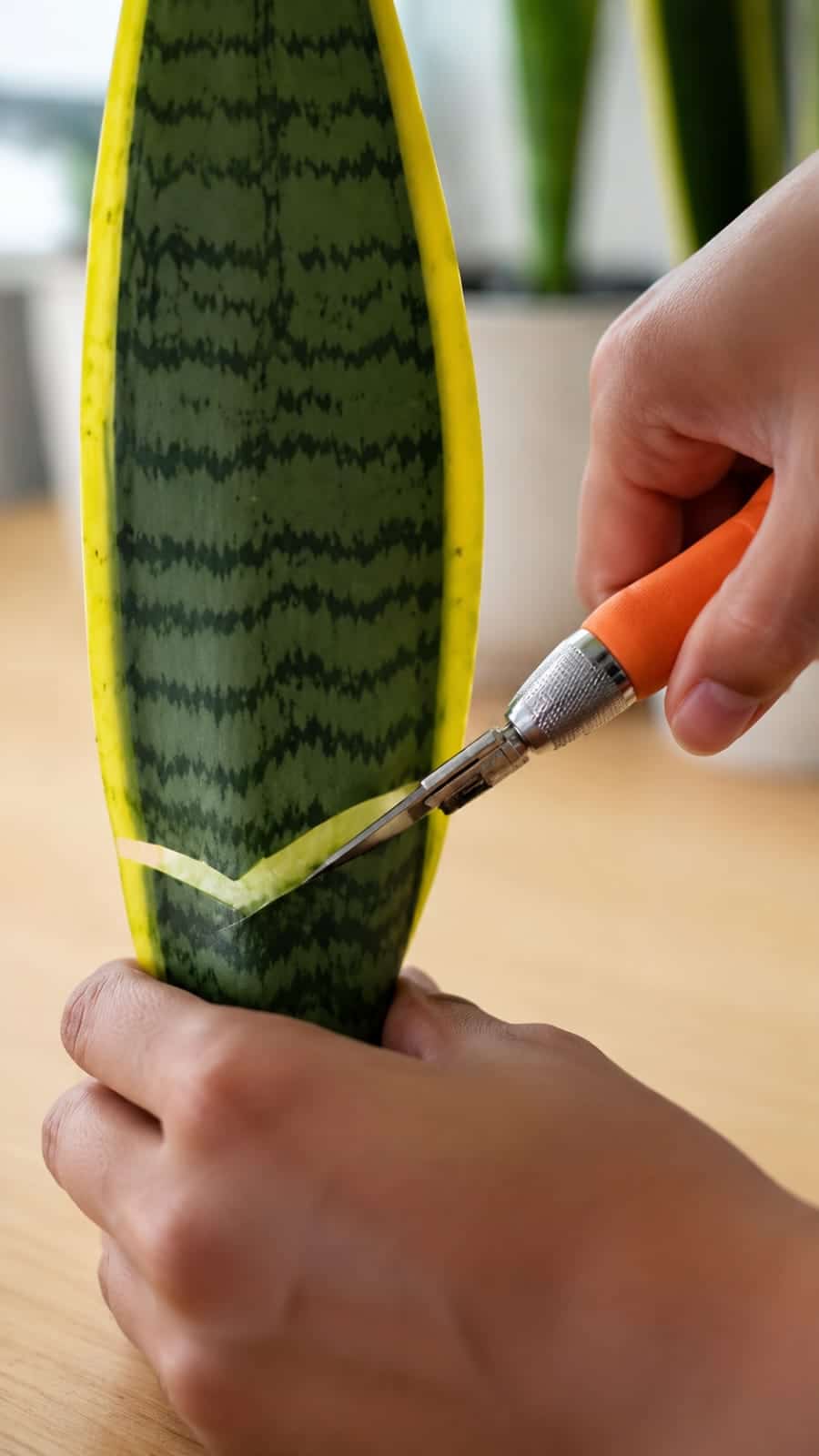
The image shows a sharp craft knife being used close to fingers. Be careful. Snake plant leaves are firm and can slip while cutting.
- Cut on a stable surface when possible.
- Keep fingers away from the blade path.
- Use a clean sharp blade.
- Do not cut toward your hand.
- Wear gloves if needed.
- Keep tools away from children and pets.
Also remember that snake plants are considered toxic if eaten by pets or children. Keep cuttings and leaves out of reach.
Quick Propagation Recipe Card
V-Notch Snake Plant Propagation
You Need:
- Healthy snake plant leaf
- Clean sharp knife
- Cactus mix
- Perlite or pumice
- Small pot with drainage
Steps:
- Choose a firm healthy leaf.
- Clean the blade with rubbing alcohol.
- Cut the leaf into 3 to 5 inch sections.
- Cut a small V notch into the bottom end of each piece.
- Let the cuttings callus for 2 to 5 days.
- Plant the V-notched end about 1 inch deep in fast-draining mix.
- Water lightly.
- Place in bright indirect light.
- Water only when the soil is nearly dry.
- Wait patiently for roots and pups.
Short Caption for This Trick
Smart homeowners are cutting a small V-shaped notch into snake plant leaf cuttings to mark the correct planting direction and support better propagation. The notched end goes into the soil or water, while the straight end stays up. After cutting, let the leaf callus for a few days, then plant it in fast-draining cactus mix and water lightly. This simple trick helps prevent upside-down planting and can turn one healthy snake plant leaf into several new plants.
Frequently Asked Questions
Why cut a V notch in a snake plant leaf?
The V notch marks the bottom end of the cutting so you know which side to plant. It may also increase the exposed cut surface slightly, but its biggest benefit is preventing upside-down planting.
Can snake plant leaves grow roots from cuttings?
Yes. Healthy snake plant leaf cuttings can grow roots and eventually produce new pups, but the process is slow.
How long should snake plant cuttings dry before planting?
Let them dry and callus for 2 to 5 days before planting. This helps reduce rot.
Which end of the snake plant cutting goes into the soil?
The original bottom end goes into the soil. If using the V-notch trick, the V-notched end is the bottom.
Can I root snake plant cuttings in water?
Yes. Place the bottom end in about 1 inch of water and change the water every 5 to 7 days. Move to soil once roots are 1 to 2 inches long.
Will a variegated snake plant cutting keep yellow edges?
Not always. Many variegated snake plants propagated from leaf cuttings produce green pups. Division is better for preserving variegation.
How long does it take for new pups to grow?
It can take 3 to 6 months or longer for new pups to appear. Snake plant propagation requires patience.
Why did my cutting rot?
Rot usually happens from overwatering, heavy soil, dirty tools, or planting before the cut had time to callus.
Should I use rooting hormone?
Rooting hormone is optional. Snake plants can root without it, but some growers use it to support faster rooting.
Can I propagate a broken snake plant leaf?
Yes, if the broken leaf is still firm and healthy. Cut clean sections, mark the bottom, let them callus, and plant them.
Final Thoughts
The small V-shaped notch in a snake plant leaf may look like a tiny detail, but it can make propagation much easier. It helps you remember which end is the bottom, prevents upside-down planting, and gives each cutting a clear direction. For homeowners who want to multiply snake plants without buying more, this is a simple and clever method.
The key is patience and cleanliness. Use a healthy leaf. Sterilize your blade. Make clean cuts. Mark the bottom with a V notch. Let the cuttings callus before planting. Use fast-draining soil. Water lightly. Give bright indirect light. Then wait.
Snake plants are slow growers, so this trick will not produce a full plant overnight. Roots may take weeks. Pups may take months. But when the first baby shoot appears at the base of the cutting, the wait feels worth it.
This method is also a beautiful reminder that houseplant care does not have to be expensive. One mature leaf can become several new plants. A damaged leaf can become a fresh start. A simple cutting can become a gift, a shelf plant, or a new decorative accent for your home.
Just remember: do not overwater, do not skip the callus stage, and do not expect variegated babies every time from variegated leaf cuttings. If you want to preserve yellow edges, divide the plant instead. If you want an easy and satisfying propagation project, the V-notch leaf cutting method is a smart place to start.
With the right cut, the right direction, and a little patience, your snake plant can quietly multiply into a whole new collection of strong, upright, stylish indoor plants.