Orchids have a special way of making a balcony, windowsill, or indoor plant corner feel elegant. Even one healthy orchid with glossy green leaves and a tall spray of soft pink flowers can make a space look calm, expensive, and carefully loved. But orchids can also be frustrating. One month they look like luxury decor, and the next they seem weak, yellowing, rootless, or unwilling to bloom again.
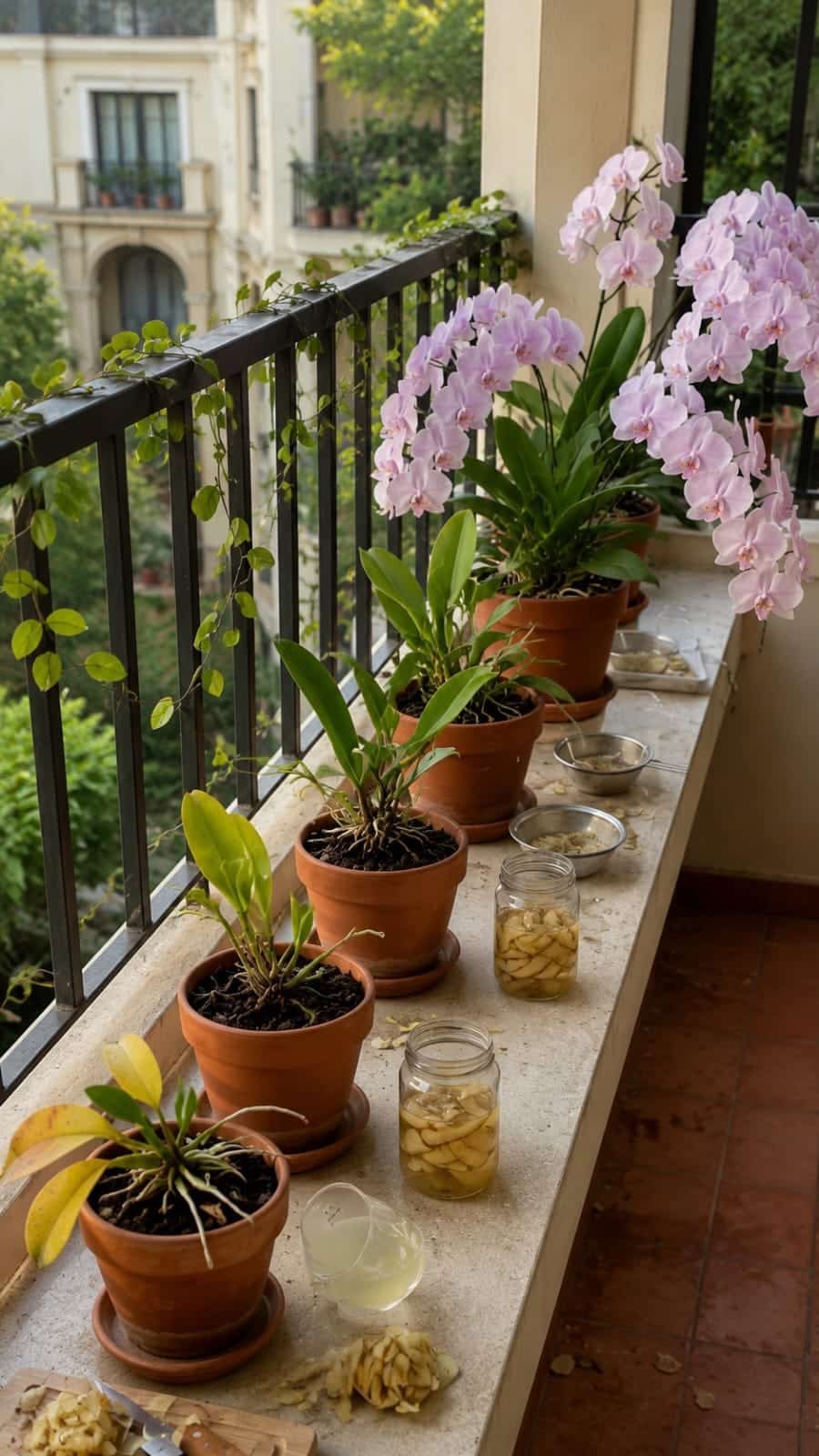
In the image, several orchids are lined along a balcony ledge. Some are full of pale pink flowers, while others look weaker, with yellowing leaves, exposed roots, or tired growth. Nearby, there are jars filled with sliced garlic or garlic-colored liquid, small bowls of prepared pieces, and a pale strained liquid. This scene suggests a homemade orchid recovery method using garlic water, a gentle kitchen-based tonic that many plant lovers use to support weak orchids, refresh the root zone, and encourage healthier growth.
Garlic water has become popular because it feels simple and natural. Garlic is already known in gardening circles as a strong-smelling ingredient that may help discourage some pests and support a cleaner plant-care routine. When turned into a mild infusion, strained well, and diluted properly, it can be used as an occasional rinse around orchid roots or as a very light support treatment for orchids that look tired.
But there is an important warning: garlic water is not magic. It will not instantly revive a dying orchid. It will not fix rotten roots if the orchid remains in soggy old bark. It will not force a weak plant to bloom overnight. It will not replace fresh orchid mix, correct watering, bright indirect light, or proper root care. Garlic water can be useful only when it is used gently and as part of a complete recovery routine.
The smartest homeowners use this trick carefully. They do not dump raw garlic into the pot. They do not leave garlic pieces on top of the bark to rot. They do not spray the crown every day. They do not use strong fermented liquid indoors. Instead, they make a mild garlic infusion, strain it completely, dilute it, apply it lightly, and then focus on the real foundation of orchid health: clean roots, airy bark, stable moisture, and good light.
This guide will show you exactly how to make garlic water for orchids, how to use it safely, when not to use it, how to inspect weak orchid roots, how to repot a struggling orchid, and how to build a recovery routine that helps your orchid look fresh, decorative, and strong again.
What Is Garlic Water for Orchids?
Garlic water is a homemade plant tonic made by soaking crushed or sliced garlic in water, then straining and diluting the liquid before applying it to plants. For orchids, it is usually used as a mild root-zone rinse or occasional support treatment.
It is not a complete fertilizer. It is not a replacement for orchid food. It is not a guaranteed pest killer. It is not a bloom booster by itself. It is better understood as a gentle cleansing-style infusion that may support a healthier growing environment when the orchid is already receiving good care.
Orchids are different from many common houseplants. Most popular indoor orchids, especially Phalaenopsis orchids, do not grow naturally in dense soil. Their roots are adapted to cling to trees and absorb moisture from humid air, rain, and organic debris. That is why they are often grown in bark, sphagnum moss, charcoal, perlite, or airy orchid mix rather than regular potting soil.
This root structure makes orchids sensitive to heavy homemade remedies. A strong garlic liquid can become irritating. Garlic pieces can rot inside the bark. A thick organic mixture can clog air spaces. So the correct method is always light, clean, strained, and occasional.
Why Homeowners Use Garlic Water on Weak Orchids
Homeowners often use garlic water on orchids because it seems to offer several gentle benefits. The strong scent may discourage some small pests. The infusion may help freshen stale bark when used as a rinse. The routine encourages the plant owner to inspect roots, remove dead material, and pay attention to watering. Most importantly, it gives people a simple recovery ritual when an orchid begins to look tired.
Garlic water may be helpful for orchids that show mild weakness, such as slightly limp leaves, slow root growth, old but not rotten bark, or a plant that has stopped looking fresh. It may also be used after repotting as a very gentle support rinse, though plain water is often enough.
The possible benefits include:
- Helping refresh the root zone when used lightly
- Discouraging some minor pests because of the garlic odor
- Supporting a cleaner plant-care routine
- Encouraging the grower to inspect and improve root conditions
- Providing a mild natural rinse for orchids recovering from stale care
- Reducing the temptation to use harsh chemical treatments unnecessarily
Still, garlic water should always be treated as optional. A healthy orchid does not need it. A severely damaged orchid needs root correction first. A blooming orchid should not be disturbed with strong experiments.
What Garlic Water Can and Cannot Do
Garlic water can support an orchid care routine, but it cannot replace the essentials. Understanding this prevents disappointment and protects the plant.
Garlic Water May Help With:
- Mildly stale orchid bark
- Minor root-zone odor when the plant is not rotting
- General freshness around the pot
- Light pest discouragement
- Recovery support after improving root conditions
- Occasional natural maintenance
Garlic Water Cannot Fix:
- Severe root rot
- A pot with no drainage
- Old bark that has turned into sludge
- Orchids growing in regular dense soil
- Sunburned leaves
- Cold damage
- Severe dehydration from having no roots
- Bud drop caused by sudden environmental changes
- Lack of blooms caused by poor light
- Weakness caused by overwatering
Think of garlic water as a supporting rinse, not a rescue miracle. The real rescue comes from fixing the growing conditions.
Why Weak Orchids Usually Decline
Before using any homemade tonic, it helps to understand why orchids become weak in the first place. Orchids rarely decline for no reason. Most problems are connected to roots, water, light, or old growing medium.
1. Old Orchid Bark
Orchid bark breaks down over time. Fresh bark is chunky and airy. Old bark becomes soft, dark, compacted, and moisture-retentive. When that happens, roots cannot breathe properly. They may rot or stop growing. If your orchid has been in the same bark for two years or more, weakness may come from old medium rather than a lack of garlic water.
2. Overwatering
Overwatering is one of the most common orchid problems. Many homeowners water orchids like regular houseplants, keeping the medium constantly wet. Orchid roots need moisture, but they also need air. If the pot stays wet for too long, roots can turn brown, hollow, or mushy.
3. Underwatering
Some orchids decline because the owner is afraid of overwatering and lets the plant dry too severely for too long. Bark can become hydrophobic, roots can shrivel, and leaves may wrinkle.
4. Poor Light
Orchids need bright indirect light to grow and bloom. A plant kept in a dark corner may survive but fail to produce strong roots, leaves, or flowers. Weak light often leads to weak growth.
5. No Drainage
Decorative containers are beautiful, but orchids need drainage. If water collects at the bottom of a glass pot or ceramic cachepot, roots may rot. Clear pots are useful only if water is managed correctly.
6. Stress From Constant Treatments
Too many homemade treatments can weaken an orchid. Garlic water, rice water, banana peel water, cinnamon, peroxide, milk, and fertilizer all used together can overwhelm the plant. Orchids recover best with simple, stable care.
Signs Your Orchid May Benefit From a Gentle Garlic Water Routine
Garlic water is most appropriate when the orchid is mildly weak but still has a chance to recover with good care. Look for signs that the plant is tired but not completely rotting.
Your orchid may be a candidate if:
- It has some firm roots remaining
- The leaves are slightly limp but not collapsing
- The bark is a little stale but not sour and rotten
- The plant has not produced roots in a while
- There are minor fungus gnats from overly moist bark
- The orchid was recently repotted into fresh bark
- You want a gentle occasional root-zone rinse
Do not use garlic water as the first step if the orchid is severely mushy, blackened, or rotten. In that case, the plant needs emergency root care.
When Not to Use Garlic Water on Orchids
Garlic water is natural, but natural does not always mean safe for every situation. There are times when it is better to avoid it completely.
Do not use garlic water if:
- The orchid crown is soft or rotting
- Most roots are black and mushy
- The bark smells sour or rotten
- The pot has no drainage and water sits at the bottom
- The orchid is in full bloom and already dropping buds
- The plant was recently treated with fertilizer or chemicals
- The garlic water is old, fermented, or foul-smelling
- The mixture contains garlic chunks
- The plant is severely dehydrated and rootless
- You are unsure whether the plant is an orchid or another species
When in doubt, use plain water and fix the roots first.
The Safest Garlic Water Recipe for Orchids
The safest garlic water for orchids is mild, fresh, strained, and diluted. Strong garlic mixtures are not better. They may irritate roots or leave a lingering smell indoors.
Ingredients
- 1 small garlic clove
- 2 cups room-temperature water
- 2 additional cups plain water for dilution
- 1 clean glass jar
- 1 fine strainer, cheesecloth, or coffee filter
- 1 small watering cup or spray bottle
Step-by-Step Preparation
- Peel one small garlic clove.
- Crush it lightly with the side of a knife.
- Place the crushed clove in a clean jar.
- Add 2 cups of room-temperature water.
- Let it sit for 2 to 4 hours only.
- Strain the liquid through a fine strainer.
- Strain again through a coffee filter if particles remain.
- Add 2 more cups of plain water to dilute it.
- Use the liquid the same day.
This creates a gentle garlic water that is safer for occasional orchid use. Do not soak garlic overnight for orchids unless you plan to dilute it heavily. Do not use multiple cloves in a small jar. Do not add salt, oil, vinegar, sugar, fertilizer, or soap.
Why You Must Strain Garlic Water Very Well
Straining is one of the most important parts of this trick. Garlic pieces should never remain in orchid bark. They can decay, smell bad, attract fungus gnats, and create unwanted organic buildup. Orchids need clean air spaces between bark pieces. Garlic chunks can interfere with that.
The final liquid should be free of visible solids. If it looks cloudy with floating pieces, strain it again. A coffee filter works well for making a cleaner liquid.
How to Apply Garlic Water to Orchids Safely
Step 1: Check the Roots First
Before applying garlic water, inspect the orchid roots. If the pot is clear, look through the sides. If roots are green when wet or silver when dry, and they feel firm, the plant has healthy roots. If roots are black, mushy, hollow, or sour-smelling, the plant needs repotting and trimming.
Step 2: Make Sure the Medium Is Not Soaking Wet
Do not apply garlic water to an already wet orchid pot. Wait until the bark is close to dry, just as you would before normal watering. Applying more liquid to soggy bark can worsen root stress.
Step 3: Apply Lightly to the Bark
Pour a small amount of diluted garlic water through the bark, around the root zone. Do not pour into the crown. Do not soak flowers. Do not flood the pot.
Step 4: Let It Drain Completely
The pot must drain well. After applying garlic water, allow all excess liquid to run out. Empty the saucer or decorative pot. Orchids should never sit in garlic water.
Step 5: Watch the Plant
After using garlic water, observe the orchid for one to two weeks. Look for firmer leaves, stable roots, and no worsening. If the plant reacts poorly, stop using it and return to plain water.
Can You Spray Garlic Water on Orchid Leaves?
You can lightly mist orchid leaves with a very diluted garlic water, but it is usually not necessary. If you do spray, do it in the morning and keep the spray away from the crown, buds, and flowers. Wipe away extra moisture from leaf joints.
For weak orchids, spraying leaves is less important than caring for the roots. Most orchid recovery begins below the surface, not on top of the leaves.
Can You Soak Orchid Roots in Garlic Water?
A short root rinse with very diluted garlic water may be used during repotting, but long soaking is not recommended. Weak orchid roots can be sensitive, and soaking them for too long may cause stress.
If you decide to rinse roots:
- Use only weak, diluted garlic water
- Soak or rinse for no more than a few minutes
- Do not soak mushy roots
- Do not soak the crown
- Let the roots air briefly before repotting
For most homeowners, a light bark watering is safer than a root soak.
How Often Should You Use Garlic Water?
Use garlic water rarely. Orchids do not need it often. Too much can create odor, residue, or stress.
A safe schedule is:
- Use once during a recovery routine
- Wait at least 4 to 6 weeks before considering another use
- Stop once the orchid begins producing healthy new roots
- Do not use during every watering
- Do not use during heavy blooming unless there is a specific reason
Most orchids will do better with plain water most of the time.
Continue to Page 2
Continue to page 2 for more details about this article and the key points many readers miss on the first page.