Should You Repot a Weak Geranium?
Sometimes a weak geranium needs repotting more than feeding. If the plant is root-bound, the soil is compacted, or water runs straight through without soaking, repotting may help.
Repot if:
- The roots circle tightly around the pot
- The soil is old and hard
- The pot dries out within hours
- The plant is top-heavy and unstable
- The pot has poor drainage
- The soil smells sour
Choose a pot only one size larger. Too large a pot can hold too much wet soil around the roots.
Best Soil for Geranium Recovery
Geraniums like a well-draining potting mix. They do not need heavy garden soil. A good mix supports roots while allowing excess water to drain.
Simple Geranium Potting Mix
- 2 parts quality potting mix
- 1 part perlite
- 1 part compost or fine bark
This mix holds enough moisture but does not become heavy and soggy. If your climate is very wet or humid, add extra perlite.
Light Needs for Geraniums
Geraniums bloom best with plenty of bright light. Indoors, they need the brightest window you can provide. Outdoors or in a greenhouse, they enjoy sun but may need protection from extreme heat.
Good light signs:
- Compact growth
- Strong stems
- More flower buds
- Healthy green leaves
Poor light signs:
- Long weak stems
- Few flowers
- Pale leaves
- Plant leaning toward light
If your geranium is weak and not blooming, light may be a bigger issue than fertilizer.
Watering Weak Geraniums Correctly
Water deeply, then allow the soil to dry slightly. Do not keep geraniums constantly wet.
A good watering routine:
- Check the top 1 to 2 inches of soil.
- Water only when it feels dry.
- Pour water onto the soil until it drains from the bottom.
- Empty the saucer.
- Wait before watering again.
In hot weather, pots dry faster. In cool weather or indoors, they dry slower. Always check before watering.
Can the Tonic Help Brown Flowers Turn Pink Again?
No. Once geranium flowers are brown and dried, they will not turn fresh again. The goal is to remove them so the plant can produce new flower clusters.
The tonic may support the plant as it grows future blooms, but it will not reverse old dead flowers.
Can Yellow Leaves Turn Green Again?
Usually no. Yellow leaves rarely return to full green. Remove leaves that are mostly yellow or brown. Focus on encouraging new healthy growth.
If many leaves are yellowing, investigate watering, roots, light, and pests.
What If the Plant Looks Worse After the Tonic?
If the plant wilts more, the soil smells sour, or leaves collapse after applying the tonic, stop using it. Flush the pot lightly with plain water if the soil is not already wet, then allow it to drain and dry. Improve airflow and check roots if the decline continues.
Homemade tonics should never be forced. If the plant dislikes it, return to basic care.
Can You Use Banana Peel Water Alone?
Yes, but keep it weak and fresh. Banana peel water is popular because bananas contain potassium, but soaking peels does not create a complete fertilizer. It can also smell or attract pests if left too long.
Safe method:
- Use a small piece of banana peel.
- Soak in 2 cups water for 4 to 8 hours.
- Strain completely.
- Dilute with 2 to 3 cups water.
- Use the same day.
Do not bury banana peel pieces in a small geranium pot. They may rot and attract gnats.
Can You Use Rice Water Alone?
Yes. Plain unsalted rice rinse water is milder than many kitchen tonics. It should still be diluted for weak potted plants.
Use only rice water that contains no salt, oil, spices, or cooking additives. The first rinse from uncooked rice is usually best. Dilute it before applying.
Can You Use Fermented Kitchen Tonic?
For weak potted geraniums, avoid strong fermentation unless you are experienced. Fermented liquids can become acidic, smelly, and too strong. They may attract pests indoors or in greenhouse settings.
Fresh, mild, strained, diluted tonic is safer.
Can You Use Coffee, Milk, or Sugar Water?
No. These are risky for potted geraniums.
- Coffee can alter the soil and may be too strong.
- Milk can sour and smell.
- Sugar water can attract pests and feed microbes rather than the plant.
Keep the recovery tonic simple and clean.
How to Encourage Geraniums to Bloom Again
After the plant is cleaned and stabilized, blooming depends on light, pruning, nutrition, and watering.
To encourage blooms:
- Deadhead old flowers regularly
- Give bright light or several hours of sun
- Avoid overwatering
- Use well-draining soil
- Feed lightly during active growth
- Pinch leggy stems for fuller growth
- Remove dead leaves quickly
Geraniums often respond well to regular deadheading. This single habit can make a big difference.
How to Prune a Leggy Geranium
If your geranium has long bare stems, pruning can help it branch. Use clean scissors and cut stems back above a leaf node. Do not remove all growth at once if the plant is very weak. Prune gradually.
After pruning, place the plant in bright light and water carefully. New side shoots may appear from the nodes.
Should You Fertilize After Using the Tonic?
Wait. Do not use homemade tonic and store-bought fertilizer on the same day. Give the plant time to respond. After 2 to 3 weeks, if new growth appears, you can begin a weak balanced flowering plant fertilizer according to label directions.
Geraniums need nutrients to bloom, but too much fertilizer can produce leafy growth with fewer flowers or burn stressed roots.
How to Prevent This Problem in the Future
Once your geranium recovers, prevention is easier than rescue.
- Deadhead weekly during bloom season.
- Remove yellow leaves immediately.
- Water only when the soil begins to dry.
- Use pots with drainage holes.
- Give bright light.
- Feed lightly during active growth.
- Refresh soil if it becomes compacted.
- Check for pests often.
- Improve airflow around crowded plants.
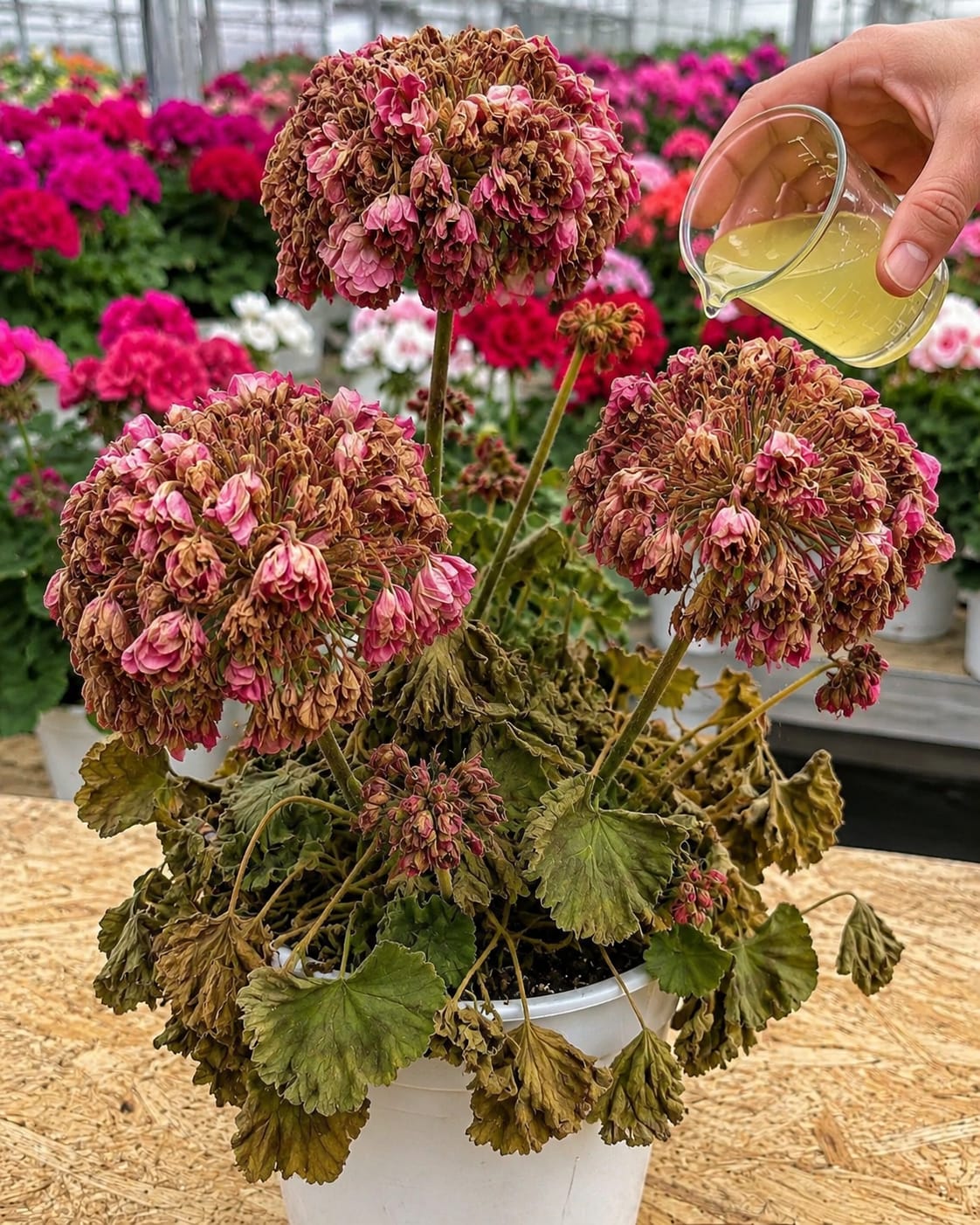
A few minutes of weekly care can prevent the plant from reaching the wilted stage shown in the image.
Quick Recovery Recipe Card
Gentle Pale Tonic for Weak Geraniums
Ingredients
- 1 cup plain unsalted rice water
- 1 small piece banana peel, optional
- 3 cups plain water
Method
- Place the rice water in a clean jar.
- Add a small piece of banana peel if desired.
- Soak for 2 to 4 hours.
- Strain completely.
- Dilute with 3 cups plain water.
- Use the same day.
- Apply only to the soil when the plant is ready for watering.
- Use once every 3 to 4 weeks at most.
Short Caption for This Trick
Smart homeowners are using a mild diluted kitchen tonic to support weak geraniums, but the real recovery starts with cleanup. Remove dead flower heads, trim yellow leaves, check the soil, and only apply the tonic when the pot is ready for watering. A safe version can be made with plain unsalted rice water, a small piece of banana peel, and plenty of dilution. Pour it on the soil, not over the flowers, and use it only occasionally. Fresh blooms come from clean pruning, bright light, good drainage, careful watering, and patience.
Frequently Asked Questions
What is the pale liquid being poured on the geranium?
It can be interpreted as a mild diluted kitchen tonic, such as plain rice water or weak banana peel water. It should be strained, diluted, and used carefully.
Can this tonic revive dead geranium flowers?
No. Brown flowers will not turn fresh again. Remove dead flower heads so the plant can produce new blooms.
How often should I use the tonic?
Use it no more than once every 3 to 4 weeks. Use plain water between applications.
Should I pour it on the leaves and flowers?
No. Pour it onto the soil around the base of the plant. Wet faded flowers can rot faster.
Can I use banana peel water on geraniums?
Yes, but only weak, fresh, strained, and diluted. Do not bury banana peels in a small pot.
Can I use rice water on geraniums?
Yes, if it is plain and unsalted. Dilute it before use and do not apply it to soggy soil.
Why are my geranium leaves turning yellow?
Common causes include overwatering, underwatering, old soil, root stress, poor light, or natural aging.
Why are my geranium flowers drying out?
Flowers dry naturally after blooming, but heat stress, underwatering, and lack of deadheading can make the plant look worse.
Should I repot a weak geranium?
Repot if the soil is compacted, sour, root-bound, or poorly draining. Use a well-draining potting mix.
What helps geraniums bloom again?
Regular deadheading, bright light, proper watering, good drainage, and light feeding during active growth help geraniums rebloom.
Final Thoughts
A weak geranium covered in brown flower heads can look hopeless, but it often has more life left than it seems. The key is not to panic and pour random mixtures over the plant. The smart approach is slower and more careful.
Start by removing what is dead. Deadhead the faded blooms. Trim away yellow leaves. Clear debris from the soil surface. Check the stems. Check the moisture. Make sure the pot drains. Give the plant bright light and fresh air.
Only after those basics are handled should you use a mild pale kitchen tonic. A diluted rice water or banana-rice tonic can provide gentle support, but it must be fresh, strained, and weak. Pour it onto the soil, not over the flowers. Use it occasionally, not constantly.
The plant will not transform overnight. Old flowers will not become pink again. Yellow leaves will not turn green again. But with the right care, the geranium can redirect energy into new leaves, stronger stems, and future flower clusters.
Smart homeowners know that plant recovery is not about one miracle liquid. It is about reading the plant, correcting the stress, and supporting it gently. When you combine cleanup, proper watering, bright light, good drainage, and a careful mild tonic, a tired geranium has a much better chance of returning to the full, colorful display that makes it such a favorite home and garden plant.