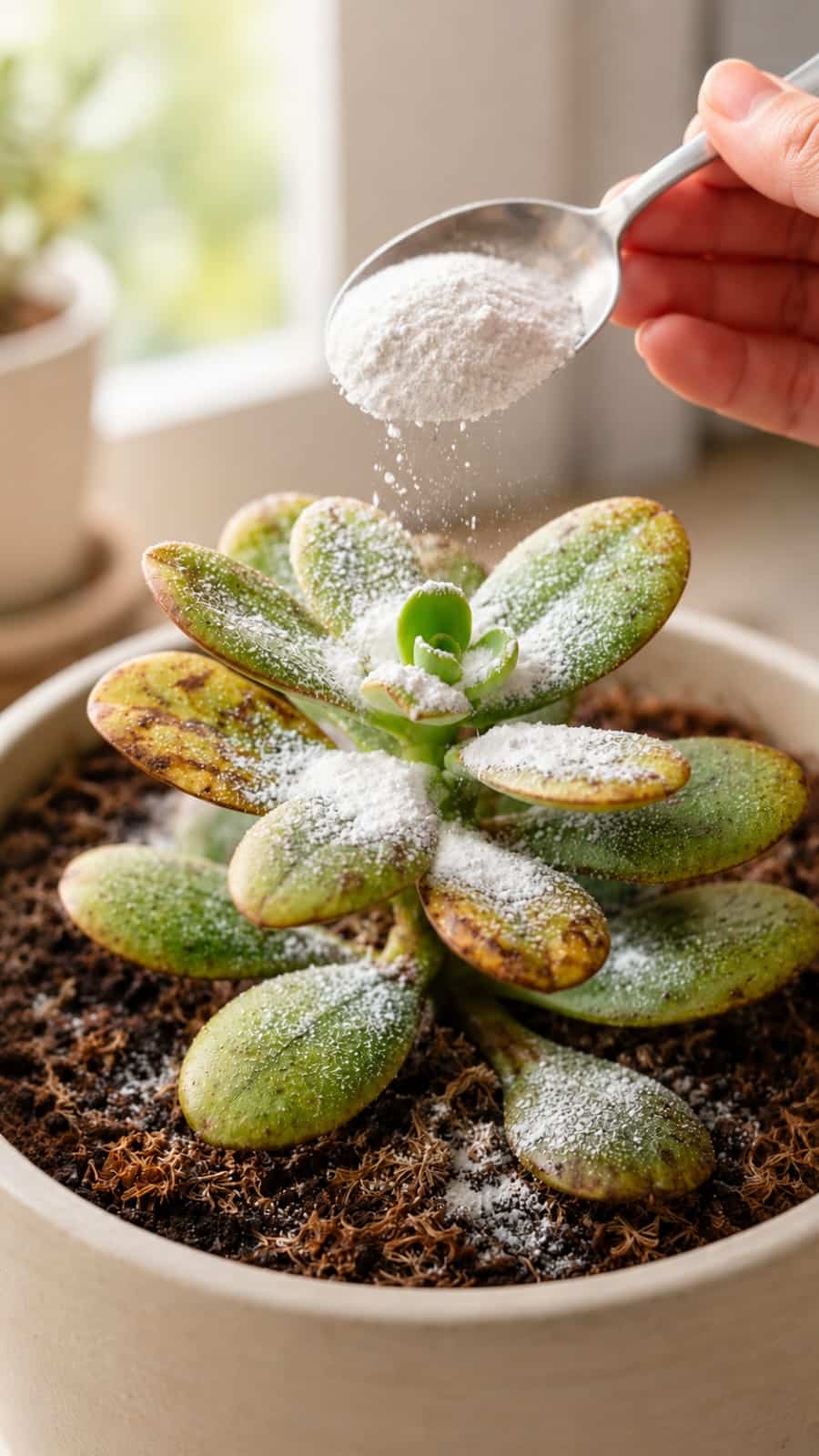
How Much Powder Should You Use?
Less is better. For a small to medium jade plant pot, use about 1/4 teaspoon or less, spread thinly across the soil surface. For a larger pot, use up to 1/2 teaspoon, but only if needed. The plant should not look like it has been covered in snow.
If the leaves are completely white, you used too much. If the soil surface forms a thick crust, remove some of the powder and replace the top layer of soil if needed.
Should You Put the Powder on the Leaves?
In general, avoid heavy leaf application. Jade leaves are thick and waxy, and they need light to photosynthesize. A little accidental dust on the leaves is not usually a disaster, but a heavy coating can look messy and may reduce light reaching the leaf surface.
If pests are visible on leaves, clean them directly:
- Use a soft damp cloth to wipe leaves
- Use a cotton swab for mealybugs
- Use insecticidal soap if appropriate
- Improve airflow and light
- Isolate the plant from others
Use diatomaceous earth mainly on dry soil and around the pot surface.
When to Avoid the White Powder Trick
Do not use this trick in every situation. Sometimes it is unnecessary or even unhelpful.
Avoid it if:
- The soil is wet
- The plant is severely overwatered
- The leaves are mushy
- The plant has root rot
- The pot has no drainage hole
- You cannot avoid inhaling the dust
- The plant is near pets or children who may disturb the powder
- You are unsure what the powder is
- The plant is already coated from a previous application
If the jade plant is sick because of root rot, repotting and drying are more important than powder.
What the Brown Spots on Jade Leaves May Mean
The jade plant in the image shows yellowing and brown areas on some leaves. These marks can come from several causes. It is important not to assume a powder will fix them.
Overwatering
Overwatering can cause yellow leaves, soft leaves, and brown damaged patches. If the soil stays wet for too long, roots cannot breathe.
Sunburn
Jade plants like bright light, but sudden harsh direct sun can burn leaves. Sunburn often appears as dry brown patches.
Edema
Edema can happen when the plant absorbs more water than it can use. It may create corky or blister-like spots on leaves.
Pests
Mealybugs, scale, or mites can weaken leaves and cause spotting. Check leaf joints and undersides.
Old Leaves
Older leaves sometimes yellow and drop naturally, especially if lower on the plant. But widespread yellowing signals stress.
Before using any powder, look for the true cause.
How to Check If Your Jade Plant Has Root Rot
Root rot is one of the most serious jade plant problems. A plant with root rot may look yellow, limp, or soft. The soil may smell sour. Leaves may drop even when they look full of water.
To check:
- Gently remove the jade plant from its pot.
- Shake away some soil.
- Look at the roots.
- Healthy roots are firm and pale to tan.
- Rotten roots are black, mushy, slimy, or smelly.
If roots are rotten, trim the damaged parts with clean scissors. Repot in dry, fast-draining succulent mix. Wait several days before watering. Do not apply powder as a substitute for repotting.
Best Soil for Jade Plants
Jade plants need fast-draining soil. Regular indoor potting mix can hold too much moisture unless amended.
Simple Jade Plant Soil Mix
- 2 parts cactus or succulent mix
- 1 part perlite or pumice
- 1 part coarse sand or fine gravel
The mix should drain quickly and feel gritty, not heavy and muddy. If the soil stays wet for more than a few days indoors, it may be too dense.
Best Pot for Jade Plants
A pot with drainage holes is essential. Terracotta is often a good choice because it helps moisture evaporate. Ceramic pots can also work if they drain well. Plastic pots hold moisture longer, so watering must be more careful.
The pot should not be too large. A huge pot holds extra soil, and extra soil holds extra water. Jade plants often prefer being slightly snug rather than swimming in a large damp pot.
How to Water Jade Plants Correctly
Proper watering matters more than any powder trick. Jade plants prefer deep watering followed by a dry period.
Watering Steps
- Check the soil with your finger or a wooden stick.
- Water only when the soil is dry several inches down.
- Water thoroughly until excess drains out.
- Empty the saucer completely.
- Wait until the soil dries again before watering.
Do not water a jade plant a little every day. Frequent small watering keeps the surface damp and encourages gnats while the deeper roots may still suffer.
How Often Should You Water a Jade Plant?
There is no exact schedule for every home. In a bright warm room, a jade plant may need water every 2 to 3 weeks. In a cooler darker room, it may need water far less often. In winter, growth slows and watering should usually decrease.
Water based on dryness, not calendar habit.
Signs the jade may need water:
- Soil is dry deep down
- Leaves feel slightly less firm
- Pot feels light
- Lower leaves begin to wrinkle slightly
Signs you should wait:
- Soil is damp
- Leaves are plump
- Pot feels heavy
- There is condensation inside a cover pot
- Leaves are yellow and soft
Best Light for Jade Plants Indoors
Jade plants need bright light to stay compact and strong. A sunny window is often best. Without enough light, stems stretch, leaves space out, and the plant becomes weak.
Good light options include:
- Bright south-facing window
- Bright west-facing window with care
- East-facing window with several hours of morning sun
- Grow light if natural light is weak
If moving a jade plant into stronger sun, do it gradually. Sudden intense sun can scorch leaves.
How to Make a Jade Plant Bushier
The white powder will not make a jade plant bushy. Pruning and light create bushiness. Jade plants branch when trimmed correctly.
Pruning Steps
- Choose a leggy stem.
- Use clean scissors or pruners.
- Cut just above a leaf node.
- Let the cut dry and callus.
- Place the plant in bright light.
- Wait for new side branches.
Do not prune a severely stressed jade heavily. Let it recover first.
How to Propagate Jade Plant Cuttings
Jade plants are easy to propagate from stem or leaf cuttings.
Stem Cutting Method
- Cut a healthy stem section.
- Let it dry for several days until the cut end calluses.
- Place it in dry succulent mix.
- Wait a few days before watering lightly.
- Keep in bright indirect light.
Leaf Cutting Method
- Gently twist off a healthy leaf.
- Let the end callus.
- Place it on dry succulent soil.
- Mist very lightly only after roots begin forming.
- Be patient, because leaf propagation is slow.
If using diatomaceous earth for pest prevention, keep it away from new tender cuttings until they are established.
How to Manage Fungus Gnats Around Jade Plants
Fungus gnats are common when soil stays too moist. Adult gnats are annoying, but the larvae live in damp organic soil.
To manage them:
- Let the soil dry more thoroughly
- Remove dead plant material from the pot
- Use yellow sticky traps for adult gnats
- Apply a thin layer of food-grade diatomaceous earth to dry soil
- Improve drainage
- Repot if the soil is old and soggy
Diatomaceous earth works best as part of this routine, not alone.
How to Manage Mealybugs on Jade Plants
Mealybugs look like tiny white cottony clumps, often hiding where leaves meet stems. They are common on succulents.
To remove them:
- Isolate the plant.
- Dip a cotton swab in rubbing alcohol.
- Touch the swab directly to visible mealybugs.
- Wipe the area gently.
- Repeat every few days.
- Check nearby plants.
A little diatomaceous earth on the dry soil may help with crawling stages, but direct removal is still necessary.
Should You Use Fertilizer With This Trick?
Diatomaceous earth is not fertilizer. Jade plants do not need heavy feeding, but they may benefit from light fertilizer during active growth.
Use a diluted succulent fertilizer or balanced houseplant fertilizer during spring and summer. Use it at half strength or weaker. Do not fertilize in winter if the plant is not actively growing.
Do not apply fertilizer and powder at the same moment if the plant is stressed. Keep care simple.
How to Clean Powder From Jade Leaves
If too much powder lands on leaves, remove it gently.
Cleaning Method
- Use a soft dry brush first.
- Brush powder off the leaves gently.
- If needed, wipe leaves with a barely damp cloth.
- Do not soak the plant.
- Keep water out of tight leaf joints.
- Let the plant dry in bright indirect light.
Jade leaves are sturdy, but they can still scar if scrubbed roughly.
How Often Can You Reapply Diatomaceous Earth?
Reapply only when needed. If you are managing fungus gnats, you can apply a thin dusting after the soil dries, then repeat after watering only if gnats remain. Once the problem is gone, stop.
Do not keep adding powder every week forever. Too much can make the pot messy and can interfere with checking soil moisture.
Safety Tips for Indoor Use
Food-grade diatomaceous earth is commonly used by gardeners, but it is still a fine dust. Handle it with respect.
- Do not inhale the powder
- Apply slowly and carefully
- Keep away from fans while applying
- Wear a mask if sensitive
- Keep away from children and pets during application
- Wash hands afterward
- Store the powder clearly labeled
Natural does not mean you should breathe it in.
What to Do If Your Jade Plant Looks Like the Image
The jade plant in the image appears stressed, with yellowing and brown-spotted leaves. If your plant looks similar, do not rely only on the white powder. Follow a recovery routine.
Step 1: Stop Watering Temporarily
If the soil is damp, wait. Let it dry before doing anything else.
Step 2: Check for Pests
Look under leaves, around stems, and at the soil surface. Identify whether pests are present.
Step 3: Remove Dead Leaves
Remove leaves that are fully dead, mushy, or rotting. Do not tear healthy stems.
Step 4: Check Drainage
Make sure the pot has drainage holes. If not, repot into a proper container.
Step 5: Inspect Roots if Needed
If the plant is soft or the soil smells bad, inspect the roots for rot.
Step 6: Move to Better Light
Give the plant bright light, but avoid sudden harsh sun if it has been in shade.
Step 7: Apply Powder Only If the Soil Is Dry
If gnats or crawling pests are present, use a thin layer of food-grade DE on dry soil.
Quick Safe Recipe Card
Fine White Powder Trick for Jade Plants
You Need
- Food-grade diatomaceous earth
- Small dry spoon or soft brush
- Dry soil surface
- Mask if sensitive to dust
Steps
- Check that the powder is food-grade diatomaceous earth.
- Let the jade plant soil dry first.
- Remove dead leaves and debris.
- Sprinkle a very thin layer on the soil surface.
- Avoid creating dust clouds.
- Do not heavily coat the leaves.
- Do not water immediately.
- Let the powder stay dry for a few days.
- Water only when the jade plant truly needs it.
- Reapply lightly only if pests remain.
Short Caption for This Trick
Smart homeowners are using a light dusting of food-grade diatomaceous earth on jade plants to help keep the soil surface dry and less inviting to pests like fungus gnats. The safe method is simple: wait until the soil is dry, remove dead leaves, sprinkle only a thin layer on the soil surface, and avoid coating the leaves heavily. Never use salt, flour, sugar, laundry powder, or heavy baking soda on jade plants. This white powder can support pest control, but the real secret to a healthy jade plant is bright light, fast-draining soil, a pot with drainage, and careful watering only after the soil dries.
Frequently Asked Questions
What is the white powder on the jade plant?
The safest option is food-grade diatomaceous earth, a fine mineral powder used by gardeners to help manage pests on dry soil surfaces.
Can I use baking soda on jade plants?
Do not sprinkle baking soda heavily on jade plants. It contains sodium and can affect soil health. It is not recommended as a general succulent treatment.
Can white powder fix brown spots on jade leaves?
No. Brown spots may come from overwatering, sunburn, pests, or edema. The powder may help with pests, but it cannot heal damaged leaves.
Should I put diatomaceous earth on jade leaves?
Focus on the soil surface. Avoid heavily coating leaves because it can block light and look messy.
Does diatomaceous earth work when wet?
It works best when dry. If it gets wet, it becomes less effective until it dries again.
How often should I use it?
Use it only when needed for pests. Reapply lightly after watering only if the pest problem continues and the soil surface is dry again.
Can diatomaceous earth fertilize jade plants?
No. It is not a fertilizer. Jade plants need light, proper watering, and occasional diluted succulent fertilizer during active growth.
Why are my jade plant leaves yellow?
Yellow leaves are often caused by overwatering, poor drainage, low light, root stress, or natural aging of older leaves.
How do I stop fungus gnats in jade plant soil?
Let the soil dry more thoroughly, use sticky traps, remove debris, improve drainage, and apply a thin layer of food-grade diatomaceous earth to dry soil.
What is the best way to keep jade plants healthy indoors?
Give bright light, use fast-draining succulent soil, water deeply but infrequently, avoid soggy roots, and keep the pot clean and airy.
Final Thoughts
The fine white powder trick can be useful for jade plants when it is understood correctly. The safest powder for this purpose is food-grade diatomaceous earth, used lightly on dry soil to help discourage pests and keep the surface less damp. It is not fertilizer, not a cure-all, and not a replacement for proper succulent care.
If your jade plant has yellowing or spotted leaves, look deeper before sprinkling anything. Check the soil. Check the roots. Check the light. Check the watering routine. Most jade plant problems begin with too much moisture, weak light, or poor drainage. A powder may help with fungus gnats or surface pests, but it cannot solve root rot or sunburn.
Use only a thin dusting. Keep it mostly on the soil. Avoid breathing it in. Do not use unknown kitchen powders. Do not cover the plant heavily. Let the soil dry between waterings. Give the jade plant bright light and a gritty, fast-draining mix.
When used carefully, this simple white powder trick can become one small part of a smart jade plant routine. But the real beauty of a jade plant comes from patience, sunlight, dryness, and restraint. Give it those basics, and your jade can grow stronger, cleaner, and more decorative year after year.