Can Too Much Epsom Salt Hurt a ZZ Plant?
Yes. Too much can create mineral buildup in the soil. This can make it harder for roots to absorb water and nutrients. It can also cause leaf tips to brown or growth to slow.
Signs of overuse include:
- White crust on soil
- Brown leaf tips
- Sudden yellowing
- Drooping after treatment
- Slow decline
- Soil that feels gritty or salty
If this happens, flush the pot with plain water and stop using supplements for several months.
How to Flush the Soil
If you think you used too much Epsom salt or fertilizer, flush the pot.
- Take the plant to a sink, shower, or outdoor area.
- Pour plain water slowly through the soil.
- Let water drain from the bottom.
- Repeat once if there is heavy buildup.
- Let the pot drain completely.
- Do not fertilize again for at least 6 to 8 weeks.
Only flush a ZZ plant if the pot drains well. Do not leave it soaking afterward.
Should You Wipe ZZ Plant Leaves?
Yes. ZZ plants look best when their leaves are clean. Dust blocks light and dulls their natural shine. Use a soft damp cloth to wipe each leaflet gently.
Do not use leaf shine products often. They can clog the leaf surface and attract dust. Plain water is enough.
Can You Use Baking Soda Instead?
Baking soda is different from Epsom salt. Baking soda contains sodium bicarbonate. It is not a fertilizer and is generally not a good choice for ZZ plant soil because sodium can build up and stress roots.
For ZZ plants, Epsom salt is usually safer than baking soda if you are trying to provide a mineral supplement. Still, it must be used lightly.
Can You Use Eggshell Powder Instead?
Crushed eggshells provide calcium slowly, but they break down very slowly in pots. They are not a fast fertilizer. Large amounts can also sit on the soil and look messy. If you use eggshells, they should be cleaned, dried, finely ground, and used sparingly.
ZZ plants usually do not need eggshell powder.
Can You Use Rice Water on ZZ Plants?
Rice water is another popular trick. It may provide mild organic matter and trace nutrients, but it can also attract fungus gnats or cause sour soil if used too often. ZZ plants do not like soil that stays moist, so rice water should be used very rarely, if at all.
If you use rice water, make it fresh, dilute it heavily, and use only when the soil is dry enough for watering.
How to Tell If Your ZZ Plant Is Healthy
A healthy ZZ plant will usually have firm stems and shiny leaves. It may not grow quickly, but it should not collapse or yellow rapidly.
Healthy signs include:
- Firm upright stems
- Glossy leaves
- No sour smell from soil
- Soil dries between waterings
- Occasional new shoots during growing season
- Firm rhizomes under the soil
If your plant has these signs, do not overdo treatments. Healthy ZZ plants prefer simple care.
What to Do If Leaves Turn Yellow
Yellow leaves on ZZ plants are often caused by overwatering. Check the soil first. If the soil is wet and the leaves are yellow, stop watering until the plant dries out. If the stems are soft, check the rhizomes.
Other causes of yellow leaves include:
- Old leaves aging naturally
- Sudden cold
- Too much direct sun
- Fertilizer burn
- Root damage
Do not apply Epsom salt until you know the cause.
What to Do If Stems Wrinkle
Wrinkled stems can mean the plant is thirsty, but they can also mean the roots have rotted and cannot absorb water. Check the soil. If the soil is bone dry, water deeply. If the soil is wet, inspect the roots and rhizomes.
This is why watering by schedule can be dangerous. Always check the soil first.
What to Do If the Rhizomes Are Mushy
Mushy rhizomes mean rot. Remove the plant from the pot, cut away rotten parts, let healthy sections dry briefly, and repot into fresh dry mix. Do not use Epsom salt, fertilizer, or homemade tonics during rot recovery.
After repotting, water lightly and wait until the plant shows stability.
Should You Repot a ZZ Plant Before Using Epsom Salt?
If the plant is in old, compacted, or soggy soil, repotting is more important than Epsom salt. Fresh airy soil gives the roots oxygen and reduces rot risk.
Repot if:
- The soil stays wet too long
- The pot has no drainage
- Roots are crowded
- The rhizomes are pushing against the pot
- The soil smells sour
- The plant has been in the same soil for years
After repotting, wait at least 4 to 6 weeks before using fertilizer or Epsom salt.
How to Repot a ZZ Plant
- Choose a pot with drainage holes.
- Use a light, well-draining mix.
- Remove the plant gently from its old pot.
- Inspect roots and rhizomes.
- Trim rotten roots if needed.
- Place the plant at the same depth.
- Fill around the roots with fresh mix.
- Do not bury the stems too deeply.
- Water lightly if the plant is healthy.
- Keep it in bright indirect light.
Can You Divide a ZZ Plant?
Yes. ZZ plants can be divided by separating rhizomes. This is best done during repotting. Each division should have healthy rhizomes, roots, and stems.
Do not divide a weak or rotting plant unless you are removing rotten sections to save healthy parts.
Common Mistakes With ZZ Plants
ZZ plants are easy, but people often harm them by doing too much.
Common mistakes include:
- Watering too often
- Using a pot without drainage
- Keeping the plant in dense soil
- Fertilizing too strongly
- Using too many household tricks
- Placing it in harsh direct sun
- Repotting too often
- Assuming slow growth means sickness
The best ZZ plant care is calm and simple.
A Simple ZZ Plant Care Routine
Every Week
- Check the leaves for dust
- Look for yellowing or soft stems
- Check soil moisture before watering
Every 2 to 4 Weeks
- Water only if the soil is mostly dry
- Rotate the pot for even growth
- Wipe dusty leaves
Every 6 to 8 Weeks During Spring and Summer
- Feed lightly with balanced fertilizer if the plant is growing
- Use Epsom salt only occasionally if needed
Once a Year
- Check whether the plant needs repotting
- Refresh the top layer of soil if crusty
- Inspect rhizomes if growth has stopped completely
Quick Recipe Card
Gentle Epsom Salt Boost for ZZ Plants
- 1 quart room-temperature water
- 1/4 teaspoon Epsom salt
Directions:
- Dissolve completely.
- Pour gently onto the soil only.
- Keep off the leaves and stems.
- Let the pot drain fully.
- Use once every 8 to 10 weeks during active growth only.
Dry sprinkle option: use only 1/8 teaspoon for a medium pot, then water it in. Do not sprinkle directly on leaves.
Short Caption for This Trick
For a slow-growing ZZ plant, dissolve 1/4 teaspoon of Epsom salt in 1 quart of water and pour it gently around the soil once every 8 to 10 weeks during spring or summer. Keep it off the glossy leaves, let the pot drain fully, and do not overuse it. Epsom salt is only a magnesium supplement, not a complete fertilizer. The real secret to a healthy ZZ plant is bright indirect light, well-draining soil, and watering only when the soil is mostly dry.
Frequently Asked Questions
Is Epsom salt good for ZZ plants?
It can be used occasionally in a very small amount if the plant may need magnesium, but many ZZ plants do not need it. Use it sparingly.
How much Epsom salt should I use for a ZZ plant?
Use 1/4 teaspoon dissolved in 1 quart of water. For dry sprinkling, use only 1/8 teaspoon for a medium pot.
How often should I use Epsom salt?
No more than once every 8 to 10 weeks during active growth. Do not use it regularly in winter.
Can Epsom salt make my ZZ plant grow faster?
Only if magnesium is limiting growth. Most slow growth is caused by low light, cool temperatures, or natural ZZ plant growth habits.
Can I sprinkle it on the leaves?
No. Apply it to the soil only. Wipe off any powder that lands on the leaves.
Why is my ZZ plant not growing?
It may be in low light, dormant, root-bound, underfed, overwatered, or simply growing slowly by nature.
Why are my ZZ plant leaves yellow?
Yellow leaves are often caused by overwatering. Check the soil and rhizomes before adding supplements.
Does a ZZ plant need fertilizer?
Yes, but only lightly. A balanced houseplant fertilizer at half strength every 6 to 8 weeks during active growth is usually enough.
Can too much Epsom salt hurt a ZZ plant?
Yes. Too much can create mineral buildup and stress roots. Always use a small amount.
What is the best way to keep a ZZ plant healthy?
Give it bright indirect light, well-draining soil, a pot with drainage, and water only when the soil is mostly dry.
Final Thoughts
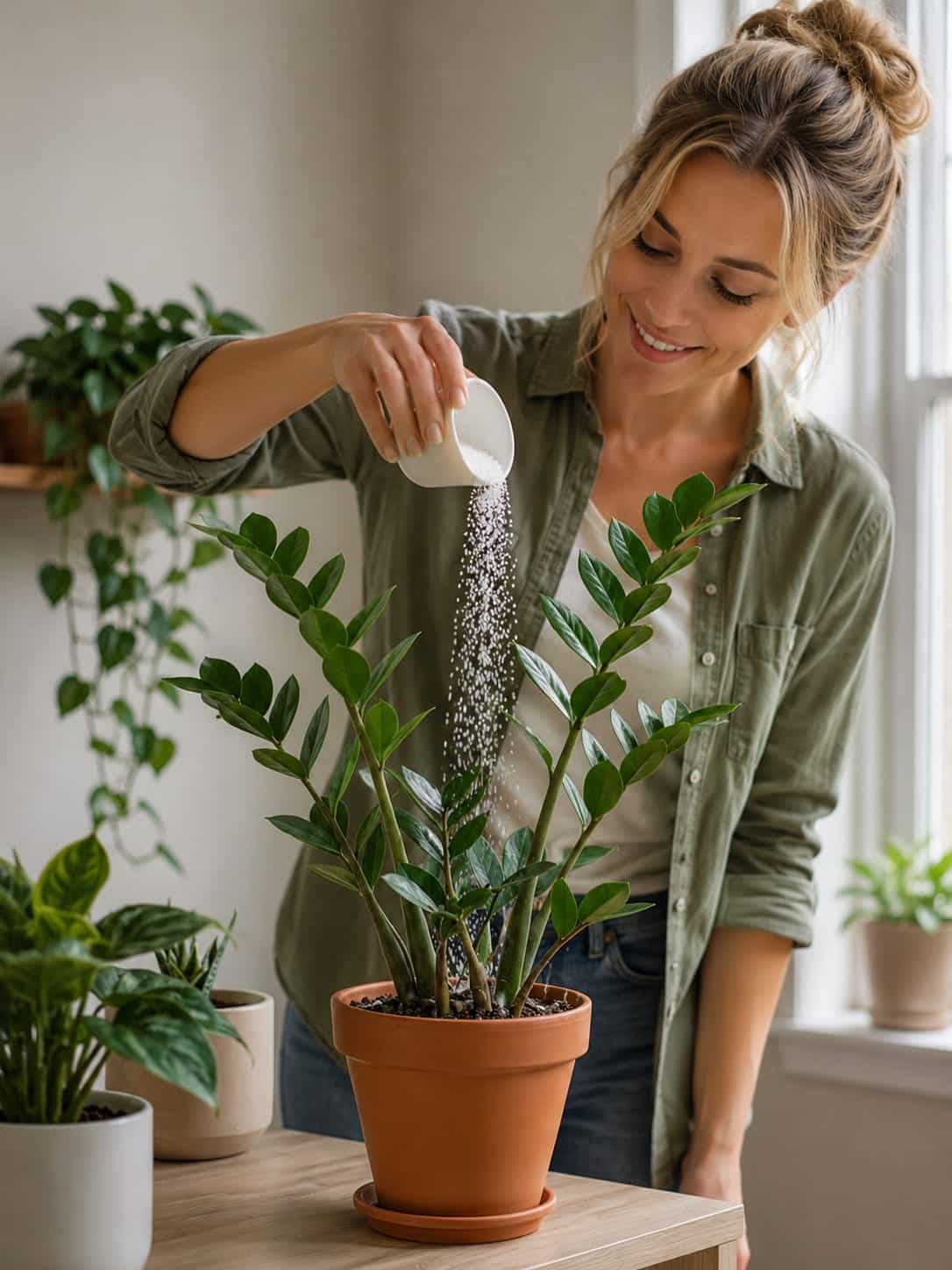
The image of a white powder being sprinkled around a glossy ZZ plant is eye-catching because it suggests a simple secret for stronger growth. And there is a small truth behind it: if the powder is Epsom salt, it can provide magnesium, which helps support chlorophyll and healthy green leaves. But the real secret is moderation.
ZZ plants are slow, strong, and independent. They do not want constant feeding. They do not want wet soil. They do not want heavy powders or weekly homemade treatments. They grow best when their roots are allowed to breathe, their rhizomes are kept from rotting, and their leaves receive enough bright indirect light.
Use Epsom salt only as a gentle occasional supplement. A tiny amount dissolved in water is safer than a dramatic dry sprinkle. Keep it off the leaves, water it through the soil, and let the pot drain fully. Then wait. Watch the new growth, not the old leaves. If the plant responds with firm new shoots and glossy foliage, the treatment may have helped. If nothing changes, the issue is probably light, watering, soil, or natural slow growth.
Smart plant care is not about using more ingredients. It is about using the right ingredient at the right time in the right amount. For ZZ plants, that usually means doing less, not more. Give the plant bright indirect light, airy soil, careful watering, and occasional light feeding. With patience, your ZZ plant can stay glossy, upright, and beautiful for years.