Snake plants are known for being strong, architectural, and almost impossible to ignore. Their upright sword-shaped leaves can turn a plain room into a calm, modern indoor garden. They tolerate neglect better than many houseplants, survive in lower light, and do not demand constant watering. Because of that reputation, many people assume a snake plant can handle anything.
But even snake plants have limits.
When a snake plant begins to decline, it can look shocking. The once-firm leaves start to bend, wrinkle, yellow, dry, or collapse. The tips turn brown. The outer leaves become papery. The soil may look tired, compacted, or crusty. The plant may still have a few upright green leaves in the center, but the older leaves around the edge can look weak and almost lifeless.
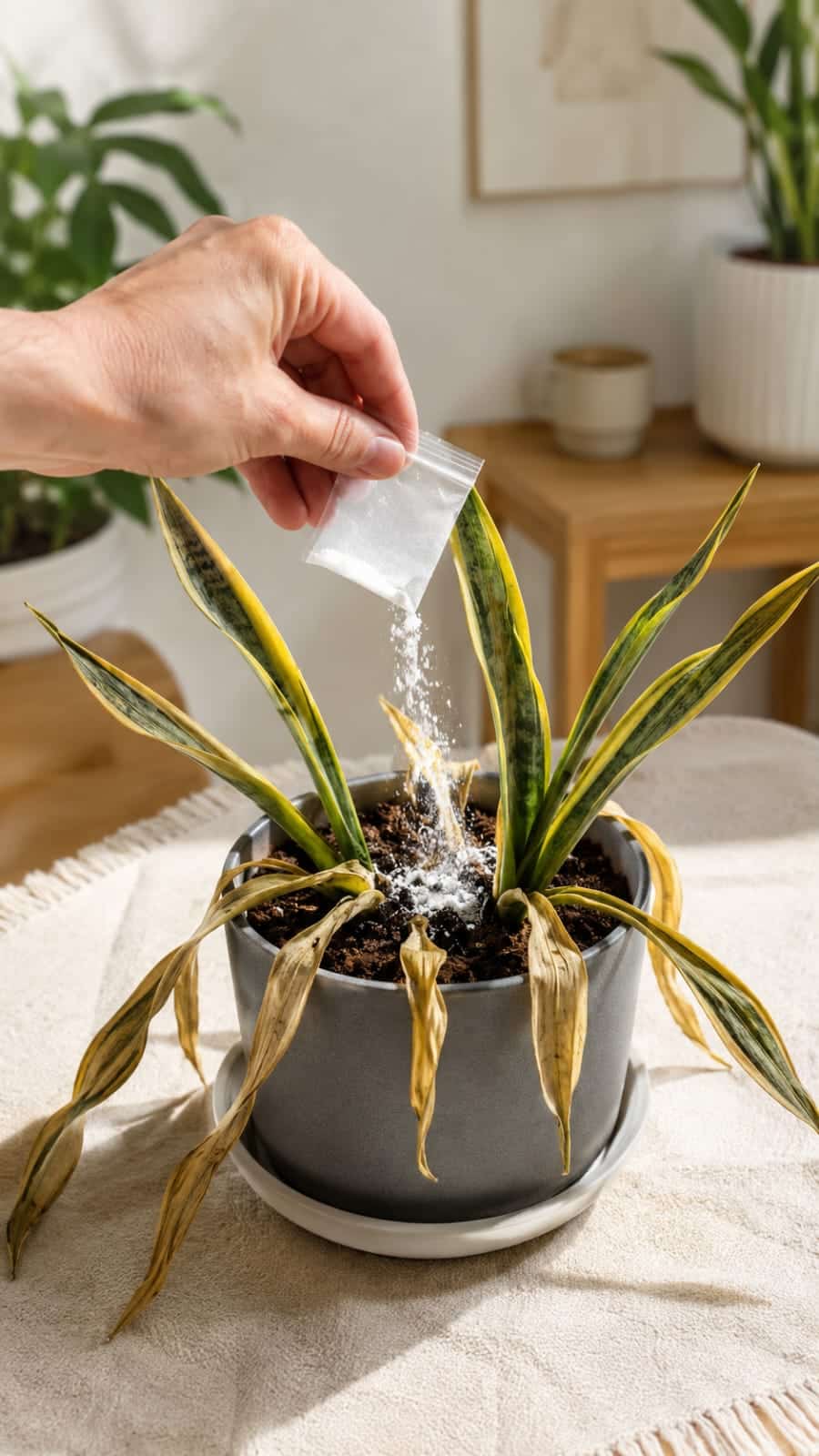
In the image, a hand is sprinkling a white powder over a struggling snake plant. The plant still has some upright variegated leaves, but many lower leaves are dry, yellow, and limp. This is the exact type of situation where people search for a “quick trick” to bring the plant back. The white powder is often presented online as a simple homemade boost, and in many plant-care contexts it is usually shown as Epsom salt.
Epsom salt is magnesium sulfate. It contains magnesium and sulfur, two secondary nutrients that plants use in small amounts. Magnesium helps plants produce chlorophyll, the green pigment that allows leaves to capture light. Sulfur also plays a role in healthy plant growth. Because of this, many gardeners use a tiny amount of Epsom salt to support greener foliage and mild nutrient recovery.
But here is the important truth: Epsom salt is not a miracle cure for snake plants. It cannot fix root rot. It cannot repair dead leaves. It cannot reverse overwatering damage. It cannot replace fresh soil, drainage, sunlight, or a correct watering routine. In fact, if you use too much, it can make the problem worse by creating mineral buildup in the pot.
The smart version of this trick is very different from the dramatic image. You do not want to pour a heavy layer of white powder directly into the crown of the plant. You do not want the powder sitting against weak leaves. You do not want to use it every week. The safe method is to apply a tiny amount to the soil only, water it in gently, and use it only when the plant is actively recovering and the roots are healthy enough to absorb nutrients.
This guide explains how to use the trick safely, when to avoid it, what the white powder can actually do, and how to bring a weak snake plant back with a full recovery routine.
What Plant Is Shown in the Image?
The plant in the image is a snake plant, also known as Sansevieria or Dracaena trifasciata. It has tall, sword-like leaves with green markings and yellow edges. This variegated type is commonly called Sansevieria laurentii.
A healthy snake plant usually has firm, upright leaves. The leaves should feel thick, strong, and slightly leathery. The color should be deep green with clear variegation. The yellow margins should look clean and bright, not pale, mushy, or dry.
The plant in the image is clearly stressed. Several lower leaves are yellow, brown, curled, or limp. The center still has some green upright leaves, which is a hopeful sign. This means the plant may not be dead, but it needs careful recovery. Before adding any supplement, the first job is to understand why it became weak.
What Is the White Powder Trick?
The white powder shown in the image is most commonly interpreted as Epsom salt. Epsom salt is not the same as table salt. Table salt is sodium chloride and can harm plants quickly. Epsom salt is magnesium sulfate, and gardeners sometimes use it as a mild magnesium supplement.
For snake plants, Epsom salt may be used when the plant has pale growth, tired leaves, or old depleted soil. However, snake plants are not heavy feeders. They grow slowly and store water in thick leaves and rhizomes. They do not need frequent fertilizer or constant supplements.
That means Epsom salt must be used very lightly.
The goal is not to “feed” the snake plant heavily. The goal is to offer a tiny mineral boost only if the plant is healthy enough to use it.
What Epsom Salt May Do for Snake Plants
When used correctly, Epsom salt may help support green leaf color and general plant function. Magnesium is part of chlorophyll, so a plant with mild magnesium deficiency may produce healthier-looking new growth after receiving a small amount.
Possible benefits include:
- Supporting greener new leaves
- Helping the plant produce chlorophyll
- Providing magnesium in a mild form
- Supporting recovery after old soil becomes depleted
- Helping slow-growing plants during the active growing season
These benefits are subtle. A snake plant will not transform overnight. Damaged leaves will not become perfect again. You should judge the results by the new growth that appears later, not by the dry leaves already on the plant.
What Epsom Salt Cannot Do
This is the part many plant tricks leave out. Epsom salt cannot solve every snake plant problem. In many cases, a struggling snake plant has a watering or root issue, not a magnesium issue.
Epsom salt cannot:
- Fix root rot
- Repair dead leaves
- Reverse overwatering damage
- Save mushy rhizomes
- Replace balanced fertilizer
- Correct poor drainage
- Make a plant grow in darkness
- Remove pests
- Repair sunburned leaves
- Undo cold damage
If the plant is weak because the roots are rotting, adding minerals will not help. It may stress the plant more. Root health always comes first.
The Most Important Warning
Do not sprinkle a thick layer of Epsom salt on a weak snake plant. Do not pour it into the center crown. Do not let it collect between leaves. Do not use it as if it were powdered food.
Snake plants are sensitive to excess moisture and mineral buildup. They prefer a dry, airy root zone. Too much Epsom salt can create a salty environment in the pot and make it harder for the roots to absorb water properly.
Too much can cause:
- Brown leaf tips
- White crust on soil
- Root stress
- Worse yellowing
- Slower growth
- Leaf edge burn
- Mineral buildup in the pot
With snake plants, less is almost always better.
The Safest Epsom Salt Recipe for Snake Plants
The safest way to use Epsom salt is to dissolve it in water. This prevents concentrated crystals from sitting directly against roots or leaves.
Gentle Epsom Salt Solution
- 1 quart room-temperature water
- 1/4 teaspoon Epsom salt
Directions
- Fill a container with 1 quart of room-temperature water.
- Add 1/4 teaspoon of Epsom salt.
- Stir until fully dissolved.
- Pour the solution onto the soil only.
- Avoid the center crown of the plant.
- Let the pot drain completely.
- Empty the saucer after watering.
- Do not repeat for at least 8 weeks.
This is a gentle dose suitable for a slow-growing plant. If your snake plant is very weak, use even less: 1/8 teaspoon per quart of water.
If You Want to Use the Dry Sprinkle Method
The image shows dry powder being sprinkled directly over the plant. In real care, you should be much more precise.
Dry Method
- Small pot: one tiny pinch
- Medium pot: 1/8 teaspoon
- Large pot: 1/4 teaspoon maximum
Sprinkle the Epsom salt lightly around the soil surface, away from the base of the leaves. Then water lightly so it dissolves. Do not leave crystals sitting on the leaves or inside the crown.
If powder lands on the leaves, wipe it away with a clean damp cloth.
How Often Should You Use It?
Use Epsom salt no more than once every 8 to 10 weeks during the growing season. For most homes, that means spring and summer. Do not use it repeatedly in fall and winter when the plant is growing slowly.
If the plant is already healthy, you may not need it at all. Snake plants do not need constant feeding. Overdoing plant tricks is one of the easiest ways to damage them.
When This Trick Might Help
This trick may be useful only if the plant is not suffering from serious root damage. It may help when the snake plant is slightly tired, has been in old soil for a long time, or has pale new growth despite otherwise good care.
It may be worth trying if:
- The soil drains well
- The pot has drainage holes
- The roots are firm
- The plant is not mushy
- The plant is receiving bright indirect light
- The plant is actively growing
- You have not fertilized recently
If these conditions are not met, fix them first.
When You Should Not Use Epsom Salt
Do not use this trick if the plant is already in trouble from too much water or poor drainage. A stressed snake plant needs correction, not extra minerals.
Avoid Epsom salt if:
- The soil is wet and heavy
- The pot has no drainage holes
- The plant smells rotten
- The leaves are mushy at the base
- The rhizomes are soft
- The soil has white crust
- The plant was recently fertilized
- The plant was recently repotted
- The room is cold and dark
- The plant is declining quickly
In these cases, adding Epsom salt can make the plant worse.
Why the Snake Plant in the Image Looks Weak
The snake plant in the image has several dry, yellow, and limp leaves. This can happen for many reasons, but with snake plants, the most common causes are overwatering, poor drainage, cold damage, underwatering after long neglect, or root decline.
The dry yellow leaves at the bottom may be old leaves dying back, but if many leaves are affected at once, the plant likely experienced stress.
Possible causes include:
- Watering too often
- Using heavy soil
- No drainage hole
- Leaving water in the saucer
- Cold room or cold draft
- Sudden direct sun scorch
- Long drought followed by overwatering
- Root rot
- Old depleted soil
- Mineral buildup from hard water or fertilizer
Before applying any powder, check the plant carefully.
Step-by-Step Recovery Plan for a Weak Snake Plant
If your snake plant looks like the image, do not start by adding more products. Start with a recovery check.
Step 1: Remove Completely Dead Leaves
Leaves that are fully brown, dry, or collapsed will not recover. Use clean scissors or pruning shears to remove them at the base. Cut as close to the soil line as possible without damaging healthy leaves.
Do not pull hard. If a leaf resists, cut it cleanly. Pulling can disturb the rhizome.
Step 2: Check for Mushy Leaves
Dry leaves and mushy leaves tell different stories. Dry leaves may suggest drought, old age, sunburn, or root issues. Mushy leaves usually suggest overwatering or rot.
If the base of a leaf feels soft, wet, or slimy, remove it immediately. Rot can spread.
Step 3: Check the Soil Moisture
Push your finger deep into the soil. Snake plants should not stay constantly wet. If the soil is wet several inches down, do not water. If it smells sour, the roots may be in trouble.
If the soil is bone dry and pulling away from the pot, the plant may need a careful deep watering, but only if the roots are healthy.
Step 4: Check the Pot
The pot must have drainage holes. A snake plant in a pot without drainage is always at risk. Even if the top looks dry, water can sit at the bottom and rot the roots.
If there are no drainage holes, repot the plant into a proper container.
Step 5: Inspect the Roots and Rhizomes
If the plant is seriously weak, slide it out of the pot. Snake plants grow from thick rhizomes under the soil. These rhizomes should be firm. Healthy roots are firm and light tan, cream, or orange-brown depending on the soil.
Bad signs include:
- Mushy rhizomes
- Black roots
- Slimy roots
- Sour smell
- Leaves detaching at the base
- Wet compacted soil
If you find rot, do not use Epsom salt. Trim away rotten sections and repot the healthy parts.
Step 6: Repot if Needed
If the soil is dense, soggy, sour, or compacted, repotting is more important than any supplement. Use a dry, chunky, well-draining mix.
A good snake plant mix can include:
- Cactus or succulent mix
- Perlite
- Pumice
- Coarse sand
- Orchid bark
A simple mix is two parts cactus mix, one part perlite, and one part orchid bark or pumice.
Step 7: Wait Before Feeding
After repotting, do not immediately add Epsom salt or fertilizer. Let the plant settle for 4 to 6 weeks. A freshly disturbed root system needs time to recover.
Step 8: Use the Epsom Salt Only if the Plant Is Stable
Once the plant is firm, draining well, and actively growing, you may use the gentle Epsom salt solution. Do not use it on a rotting or freshly repotted plant.
How to Water Snake Plants Correctly
Watering is the most important part of snake plant care. Most snake plants die from too much water, not too little.
Snake plants store water in their thick leaves and rhizomes. They prefer to dry out between waterings. If you water too often, the roots lose oxygen and begin to rot.
Basic Watering Rule
Water only when the soil is completely dry or almost completely dry.
Depending on your home, this could mean:
- Every 2 to 3 weeks in bright warm rooms
- Every 4 to 6 weeks in low light
- Even less often in winter
Do not water on a fixed schedule. Check the soil first.
Continue to Page 2
Continue to page 2 for more details about this article and the key points many readers miss on the first page.