How to Deep Water a Snake Plant
- Check that the soil is dry.
- Water slowly around the soil surface.
- Let water drain from the bottom.
- Empty the saucer completely.
- Do not water again until the soil dries out.
Never let the pot sit in standing water. A saucer full of water can undo everything.
Best Light for Snake Plant Recovery
Snake plants can tolerate low light, but they recover better in bright indirect light. A plant in a dark corner may survive, but it will grow slowly and may not replace damaged leaves quickly.
For recovery, place the plant near a bright window where it receives indirect light. Morning sun can be helpful, but harsh afternoon sun may burn weak leaves.
Good light options include:
- Bright east-facing window
- A few feet from a south-facing window
- Bright filtered light through curtains
- Under a grow light
If the plant has been in low light, move it gradually. Sudden direct sun can scorch it.
Why Snake Plant Leaves Turn Yellow
Yellow snake plant leaves often mean stress. The most common reason is overwatering, especially when yellow leaves are soft or limp. But yellowing can also happen from drought, old age, cold exposure, or root damage.
Common causes include:
- Overwatering
- Poor drainage
- Cold damage
- Old leaves aging
- Too much direct sun
- Underwatering for too long
- Root rot
- Excess fertilizer
Do not assume yellow leaves mean the plant needs fertilizer. Check watering and roots first.
Why Snake Plant Leaves Become Dry and Crispy
Dry, crispy leaves can happen when the plant has been underwatered for a long time, exposed to too much sun, kept near a heater, or damaged by root problems. Sometimes roots rot first, then leaves dry because they can no longer receive moisture properly.
This is why you should check both the soil and the roots. A dry leaf does not always mean the plant needs more water.
Should You Cut Off Damaged Leaves?
Yes, if the leaves are fully dead, mushy, or badly damaged. Snake plant leaves do not repair torn, brown, or dried sections. Cutting them helps the plant look cleaner and reduces disease risk.
For leaves with only brown tips, you can trim the tips into a natural point shape. For leaves that are mostly dead, remove the whole leaf at the base.
Can You Propagate the Healthy Leaves?
Yes. If the plant has a few healthy leaves but the base is struggling, you can propagate healthy pieces. However, variegated snake plants with yellow edges may lose the yellow variegation when propagated from leaf cuttings. To preserve variegation, division is better.
Leaf Cutting Method
- Cut a healthy leaf into sections.
- Remember which end is the bottom.
- Let the cut pieces dry for 1 to 2 days.
- Place the bottom end in dry, well-draining soil.
- Water lightly after several days.
- Keep in bright indirect light.
Division Method
- Remove the plant from the pot.
- Separate healthy rhizome sections.
- Make sure each section has roots and leaves.
- Repot into dry, airy soil.
- Wait before watering heavily.
Division is the best method for saving variegated snake plant traits.
Best Soil Mix for Snake Plants
Snake plants hate heavy, wet soil. They need a fast-draining mix that allows oxygen around the roots.
Simple Snake Plant Soil Mix
- 2 parts cactus mix
- 1 part perlite
- 1 part orchid bark or pumice
This creates a loose structure that dries faster than regular potting soil.
If you only have regular potting soil, add plenty of perlite or pumice. Do not use dense garden soil in pots.
Choosing the Right Pot
The pot matters. Snake plants prefer pots with drainage holes. Terracotta pots are excellent because they breathe and help soil dry faster. Plastic and ceramic pots can work too, but you must water more carefully.
Do not choose a pot that is too large. A huge pot holds too much wet soil around the roots. Choose a pot only slightly larger than the root ball.
Should You Fertilize a Weak Snake Plant?
Not immediately. If the plant is weak from root stress, fertilizer can worsen the problem. Wait until the plant is stable and showing signs of new growth.
When you do feed, use a balanced houseplant fertilizer or cactus fertilizer at half strength during spring or summer. Once every 6 to 8 weeks is enough.
Snake plants do not need heavy feeding.
Epsom Salt vs. Fertilizer
Epsom salt is not a complete fertilizer. It provides magnesium and sulfur, but not the main nutrients plants need: nitrogen, phosphorus, and potassium.
Use Epsom salt as an occasional supplement only. Use balanced fertilizer for general feeding.
Simple Feeding Schedule
- Spring: half-strength balanced fertilizer
- Early summer: plain water
- Mid-summer: mild Epsom salt solution if needed
- Late summer: half-strength balanced fertilizer
- Fall and winter: no feeding or very little feeding
Always feed only when the plant is healthy and actively growing.
What If the White Powder Is Baking Soda?
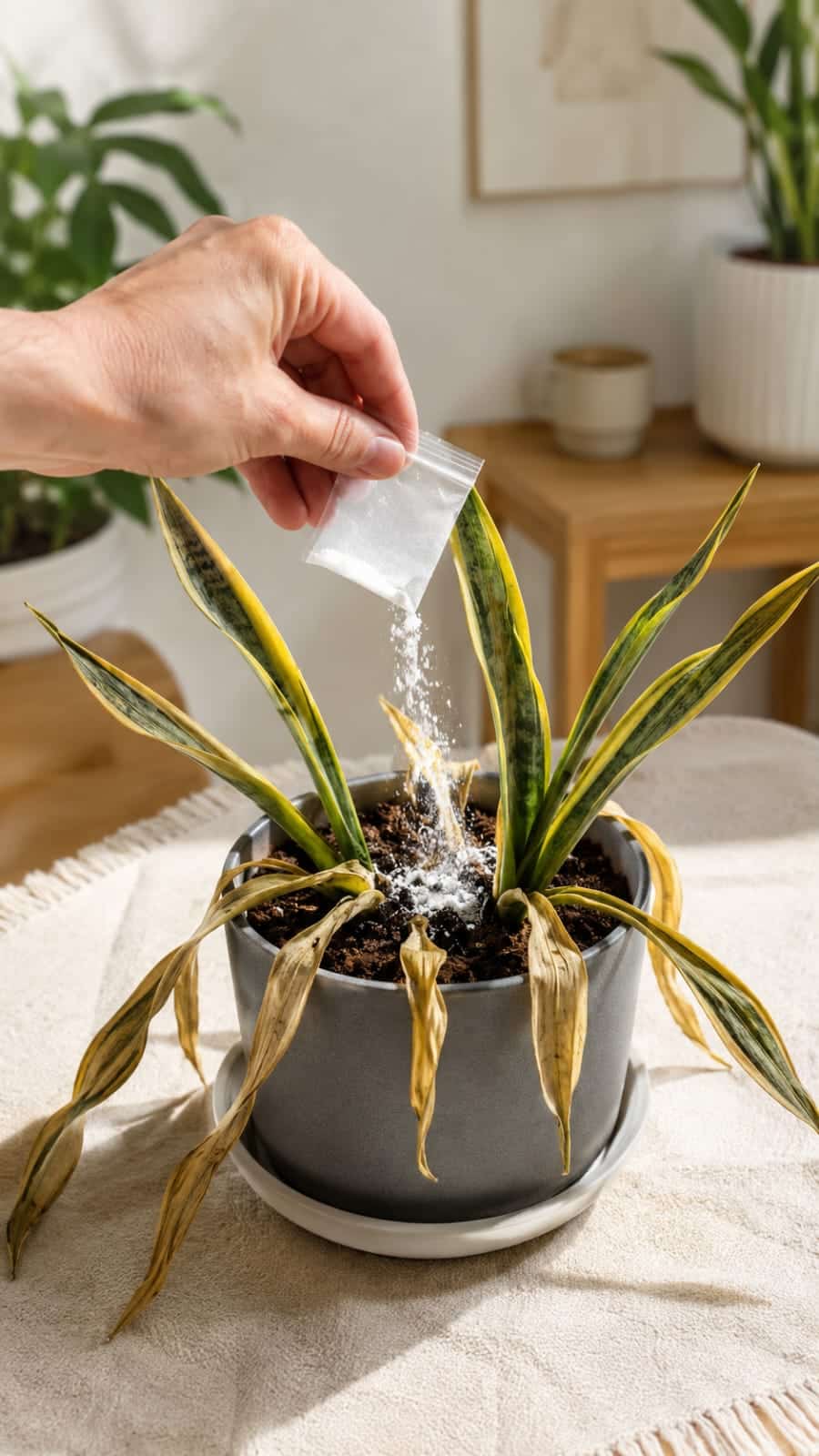
Sometimes white powder in plant images is shown as baking soda. Baking soda is different from Epsom salt. Baking soda contains sodium bicarbonate and is not a good fertilizer for snake plants. Too much sodium can damage roots and disrupt soil balance.
If the white powder is baking soda, do not use it as a soil treatment for snake plants. It is safer to avoid it. Snake plants do not need baking soda in their soil.
What If the White Powder Is Crushed Eggshell?
Crushed eggshells are another common white-powder plant trick. Eggshells contain calcium, but they break down very slowly in pots. They are not a quick fertilizer. If used in large amounts, they can sit on the soil and attract mold or pests if not cleaned properly.
If you use eggshells, wash them, dry them, grind them finely, and use only a small amount. But for snake plants, eggshells are usually unnecessary.
What If the White Powder Is Commercial Fertilizer?
If the powder is commercial fertilizer, follow the label. Do not guess. Too much fertilizer can burn snake plant roots and worsen yellowing.
Snake plants need weak feeding, not heavy feeding.
How to Tell If Your Snake Plant Is Recovering
Recovery is slow. Snake plants do not bounce back overnight. Damaged leaves will not become perfect again, but the plant can produce new growth from healthy rhizomes.
Signs of recovery include:
- Firm remaining leaves
- No new yellowing
- Soil drying normally
- No sour smell
- New shoots emerging from the soil
- Healthy roots during inspection
- Leaves standing more upright
Be patient. A snake plant may take weeks or months to show visible improvement.
What to Do If the Plant Keeps Declining
If the plant continues to decline after you correct watering and light, inspect the rhizomes. Healthy rhizomes are firm. Rotten rhizomes are soft, mushy, or smelly.
If rot is present:
- Remove the plant from the pot.
- Cut away rotten rhizomes and roots.
- Keep only firm healthy sections.
- Let cut sections dry for a day.
- Repot into dry, airy soil.
- Wait several days before watering.
- Keep in bright indirect light.
Do not use Epsom salt during rot recovery.
Quick Recipe Card
Gentle Epsom Salt Support for Snake Plants
- 1 quart room-temperature water
- 1/4 teaspoon Epsom salt
Directions:
- Dissolve completely.
- Pour only onto the soil.
- Avoid the crown and leaves.
- Let the pot drain fully.
- Use once every 8 to 10 weeks during active growth only.
Dry sprinkle option: use only 1/8 teaspoon for a medium pot, then water it in lightly. Do not let powder collect inside the plant crown.
Short Caption for This Trick
If your snake plant looks weak, do not pour a heavy layer of white powder over it. If using Epsom salt, dissolve only 1/4 teaspoon in 1 quart of water and apply it to the soil once every 8 to 10 weeks during spring or summer. Keep it away from the leaves and crown, and let the pot drain fully. Epsom salt is only a magnesium supplement. For real recovery, remove dead leaves, check for root rot, use fast-draining soil, give bright indirect light, and water only when the soil is dry.
Frequently Asked Questions
Is Epsom salt good for snake plants?
It can be used occasionally in a very small amount, but snake plants do not need much. It may help only if the plant needs magnesium and the roots are healthy.
How much Epsom salt should I use?
Use 1/4 teaspoon dissolved in 1 quart of water. For a dry sprinkle, use only about 1/8 teaspoon for a medium pot.
How often should I use Epsom salt on a snake plant?
No more than once every 8 to 10 weeks during active growth. Do not use it weekly.
Can Epsom salt save a dying snake plant?
Not if the plant has root rot or mushy rhizomes. Fix the roots and soil first.
Why are my snake plant leaves yellow?
Yellow leaves are often caused by overwatering, poor drainage, cold damage, old age, or root stress.
Should I remove yellow snake plant leaves?
Yes, remove leaves that are fully yellow, dry, mushy, or collapsing. They will not turn green again.
Can I put baking soda on snake plants?
Baking soda is not recommended as a soil treatment for snake plants because it contains sodium and can harm roots if overused.
What is the best fertilizer for snake plants?
A balanced houseplant fertilizer or cactus fertilizer at half strength during spring and summer is usually enough.
How do I know if my snake plant has root rot?
Look for mushy leaf bases, wet soil, sour smell, black roots, or soft rhizomes.
How do I make my snake plant grow new leaves?
Give it bright indirect light, fast-draining soil, a pot with drainage, careful watering, and light feeding during the growing season.
Final Thoughts
The image of white powder being sprinkled over a weak snake plant looks like a simple rescue trick. It suggests that one ingredient can wake up the plant and bring it back. But real snake plant recovery is more careful than that.
If the powder is Epsom salt, it may provide a small amount of magnesium and sulfur. That can support greener new growth when the plant is healthy enough to absorb nutrients. But it will not repair dead leaves, fix root rot, or replace proper care. Snake plants are slow-growing, drought-tolerant plants that prefer simple routines. They do not want constant supplements.
The best way to save a weak snake plant is to start with the roots. Remove dead leaves. Check the soil. Make sure the pot drains. Look for mushy rhizomes. Repot if the soil is wet, sour, or compacted. Move the plant to bright indirect light. Water only when the soil is dry. Once the plant is stable and actively growing, a tiny Epsom salt treatment may be used as a gentle support.
Use less than you think. Keep it off the leaves. Keep it out of the crown. Let the pot drain. Then wait.
Snake plants recover slowly, but they are resilient. If the center of the plant is still firm and green, there is hope. With dry, airy soil, careful watering, and bright indirect light, your snake plant can push out fresh new shoots and return to its strong upright shape. The trick is not the powder alone. The real trick is knowing when to use it, how little to use, and when the plant needs basic care more than any homemade remedy.