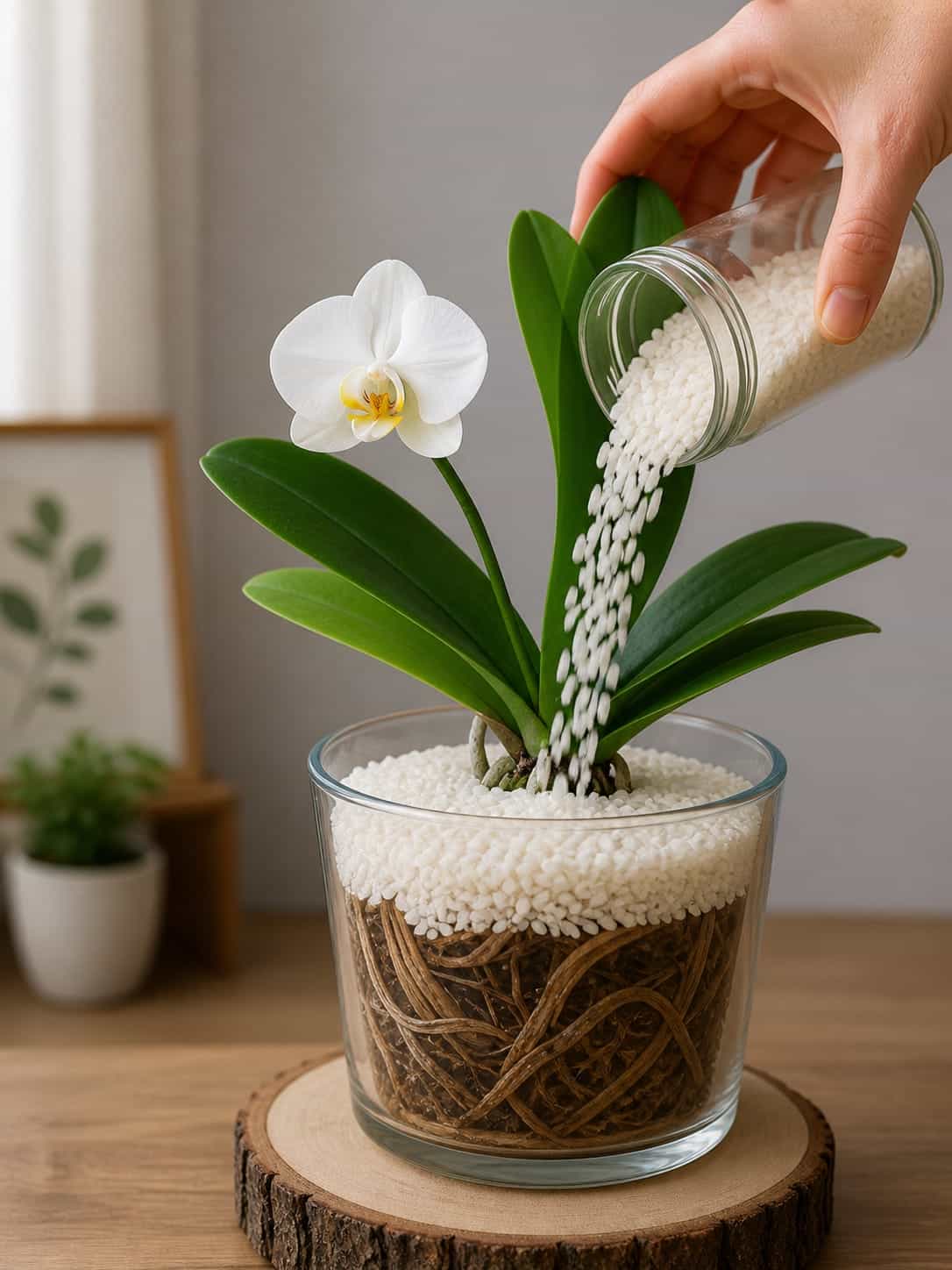
Orchids have a special kind of beauty. Even when they are not covered in flowers, their thick green leaves, silver roots, and graceful growth habit make them feel elegant and calm. When a white orchid blooms, it can look almost sculptural, especially when placed in a clear glass container where the roots and potting material are visible.
The image shows a white Phalaenopsis orchid growing in a clear glass pot. The plant has firm green leaves and a single bright white bloom. Around the base of the plant, a layer of white rice is being poured over the top of the potting medium. Beneath the rice, the container appears to be filled with coarse brown orchid material, likely bark, coconut husk, or woody fibers. The visual effect is striking: clean white rice on top, tangled brown roots or bark below, and a delicate orchid rising from the center.
This kind of image suggests a simple plant-care trick: cover the orchid’s pot with rice to feed the plant, boost roots, encourage blooms, and create a neat decorative finish. It looks natural, inexpensive, and easy. After all, rice is already used in many plant-care hacks, especially as rice water. So the idea of using dry rice as a top layer may seem like a clever shortcut.
But orchids are not ordinary houseplants. Most popular indoor orchids, especially Phalaenopsis orchids, do not grow well in dense, wet, food-like material. Their roots need air, drainage, and a clean potting environment. A thick layer of uncooked rice on top of orchid bark can create several risks if it is used carelessly.
The safest truth is this: rice water can sometimes be used as a very weak occasional rinse, but dry rice grains should not be used as a thick long-term top-dressing for orchids. Rice can absorb water, swell, ferment, grow mold, attract pests, and reduce airflow around the crown and roots. It may look beautiful for a photo, but it is not the best real-life orchid-care method.
In this article, you will learn what the rice top-dressing orchid trick is, why it became popular, what rice can and cannot do for orchids, why a thick rice layer may be risky, safer ways to use rice water, and what actually helps orchids grow strong roots and bloom again indoors.
What Is the Rice Top-Dressing Orchid Trick?
The rice top-dressing orchid trick is a homemade plant-care idea where dry rice grains are poured over the top of an orchid pot. The rice is usually presented as a natural nutrient source, a bloom booster, a root-strengthening trick, or a decorative soil cover.
In the image, the rice is being poured from a glass jar onto the top of the orchid pot. It forms a thick white layer around the base of the plant. Because the orchid is in a clear pot, the rice layer looks clean and attractive against the darker bark-like material underneath.
The idea may come from the popularity of rice water for plants. Rice water is the cloudy water left after rinsing uncooked rice. Some plant owners use it as a mild homemade tonic. But using rice water and using whole rice grains are very different things.
Rice water, when heavily diluted and used occasionally, passes through the pot and drains away. Whole rice grains stay behind. Once they stay in the pot, they can absorb moisture and begin to break down. That is where the risk begins.
What Kind of Orchid Is Shown?
The plant in the image appears to be a Phalaenopsis orchid, often called a moth orchid. This is the most common orchid sold for indoor growing. It has broad, thick leaves and long-lasting flowers that may bloom in white, pink, purple, yellow, or patterned colors.
Phalaenopsis orchids are epiphytic in nature, meaning they grow attached to trees in their native environments rather than buried in heavy soil. Their roots are adapted to cling, absorb moisture quickly, and dry with airflow. This is why indoor Phalaenopsis orchids are usually grown in bark chips, sphagnum moss, coconut husk, or other airy orchid media.
This matters because anything that blocks air around the roots can harm the plant. A layer of rice may look harmless, but if it traps moisture, it can interfere with the orchid’s natural root needs.
Why Rice Looks Like a Good Idea
Rice looks like a good plant-care ingredient for several reasons. It is natural, affordable, easy to find, and already associated with nourishment. Rice water is commonly used in homemade beauty routines and plant hacks, so it feels familiar and gentle.
White rice also looks attractive as a top dressing. It creates a clean, bright surface that can make a plant pot look styled and intentional. In a clear container, the contrast between white rice, brown bark, and green leaves is visually appealing.
For content, images, and plant-care inspiration, rice creates a dramatic “before you know this trick” effect. But attractive does not always mean beneficial. Plant roots respond to biology, air, moisture, and chemistry, not just appearance.
Can Dry Rice Feed Orchids?
Dry rice is not a practical fertilizer for orchids. Although rice contains carbohydrates and small amounts of minerals, those nutrients are not immediately available to the orchid. Whole rice grains would need to break down through microbial activity before any nutrients could become available.
That decomposition process is exactly the problem. In a small indoor orchid pot, breaking-down rice can attract mold, fungus gnats, bacteria, and unpleasant smells. It can also create a damp layer on top of the potting medium.
Orchid roots do not need a layer of food decomposing around them. They need clean air, moisture, and balanced nutrition in a controlled form. A proper orchid fertilizer is much safer and more predictable than uncooked rice grains.
The Main Problem With Rice on Orchid Pots
The main problem is moisture. Rice absorbs water. When you water the orchid, the rice layer can swell and hold dampness at the surface. That damp layer may stay wet longer than the bark beneath it.
For an orchid, this can create several issues:
- Reduced airflow around the crown
- Higher risk of mold
- Fungus gnat attraction
- Sour or fermented smell
- Sticky residue as rice breaks down
- Moisture trapped near lower leaves
- Potential crown or stem rot
Orchids are especially vulnerable when water or damp organic material sits near the base of the leaves. The crown should stay dry and airy. A thick rice layer can make the area around the crown too humid and stagnant.
Why Rice Can Cause Mold
Mold grows where there is moisture, organic material, and limited airflow. Rice provides organic material. When it becomes damp, it creates an inviting surface for mold spores.
In a bright, dry, airy room, a tiny amount of rice might dry quickly. But in most indoor pots, especially glass containers, airflow is limited. If the rice layer stays damp after watering, mold can appear within days.
Mold on the surface is not always immediately deadly, but it is a warning sign. It means the pot environment is too damp or organic material is breaking down. For orchids, this is not ideal.
Why Rice Can Attract Fungus Gnats
Fungus gnats love damp organic material. Their larvae feed on decaying matter and can also nibble tender roots. A thick layer of wet rice on top of orchid bark can become a perfect invitation for gnats.
Once fungus gnats appear, they can spread to other houseplants. They are annoying, and they often indicate that the potting medium is staying too wet.
If you already have fungus gnats, do not use rice on plants. Focus on drying the top layer, improving airflow, removing decaying material, and correcting watering habits.
Why the Clear Glass Pot Matters
The orchid in the image is growing in a clear glass container. Clear pots can be useful for orchids because they let you see the roots and monitor moisture. Many orchid growers like transparent plastic orchid pots for this reason.
However, glass containers can be risky if they do not have drainage holes. Orchids should not sit in trapped water. If a glass container has no drainage, water can collect at the bottom and cause root rot.
In the image, the clear glass container looks decorative. If it has no drainage, a thick rice layer would be even riskier because moisture could be trapped both at the top and bottom.
For real orchid care, the safest setup is a clear plastic orchid pot with drainage and side ventilation, placed inside a decorative outer pot if desired.
Should Orchids Be Grown in Glass?
Orchids can be displayed in glass, but they need careful management. A glass pot with no drainage is not ideal for beginners. Orchid roots need airflow and the ability to dry after watering.
If you love the glass look, use glass as a decorative cover pot. Keep the orchid in a ventilated inner pot. Remove the inner pot to water, let it drain fully, then return it to the glass container.
This gives you the beauty of glass without trapping water around the roots.
Can Rice Be Used as Decoration Only?
Rice may look decorative, but it is not a good long-term decorative top dressing for orchid pots. Unlike stones, clay pebbles, or inert decorative gravel, rice is food. It absorbs water and decomposes.
If rice is used only for a short photo setup, it should be removed afterward. Do not leave it in place after watering. Do not bury it in the potting medium.
For a decorative white top layer, choose something inert instead, such as washed white stones, coarse pumice, or decorative orchid-safe gravel. Even then, keep the layer thin so you can still monitor moisture.
Is Rice Water Safer Than Rice Grains?
Yes, rice water is safer than whole rice grains if it is made and used correctly. Rice water should be weak, fresh, and heavily diluted. It should pass through the potting medium and drain away.
The safest rice water is made from rinsing uncooked rice, not from boiling rice. Cooked rice water is too starchy and may contain salt or food residue.
Even rice water should be used rarely. It is not a complete fertilizer and can still create residue if too strong or used too often.
How to Make Safe Rice Water for Orchids
Here is a safer version of the rice trick:
Ingredients
- 1 tablespoon plain uncooked rice
- 1 cup clean water
- 2 to 3 cups extra water for dilution
- A strainer
Instructions
- Place the uncooked rice in a clean bowl.
- Add 1 cup of water.
- Swirl for 20 to 30 seconds.
- Strain out all rice grains.
- Dilute the cloudy rinse with 2 to 3 cups of clean water.
- Use immediately.
The final liquid should be only faintly cloudy. If it looks thick and milky, it is too strong. Dilute it more.
How to Apply Rice Water to an Orchid
Apply rice water only when the orchid actually needs watering. Do not use it on wet bark.
- Check the roots and potting medium.
- If the roots are silvery and the bark is nearly dry, the orchid may need water.
- Pour the diluted rice water through the bark, not into the crown.
- Let it run out of the drainage holes.
- Allow the pot to drain completely.
- Empty the saucer or outer pot.
- Do not let the orchid sit in rice water.
This method gives the plant a very mild rinse without leaving rice grains behind to rot.
How Often Should Rice Water Be Used?
Use rice water no more than once every six to eight weeks during active growth. Some orchids do not need it at all.
Most waterings should be plain water. For actual feeding, use a balanced orchid fertilizer at a diluted strength. Rice water is optional and should never become the main routine.
If the orchid is not actively growing, skip rice water.
Why Rice Is Not a Fertilizer Replacement
Orchids need balanced nutrients, including nitrogen, phosphorus, potassium, calcium, magnesium, and trace elements. Rice does not provide these in a reliable or complete way.
A proper orchid fertilizer is designed to provide nutrients in forms plants can use. Rice grains sitting on top of the pot are unpredictable. They may break down unevenly or create problems before they offer any benefit.
If your orchid needs feeding, choose a fertilizer made for orchids or a balanced houseplant fertilizer used weakly.
The Better Orchid Feeding Routine
A simple orchid feeding routine is better than rice top-dressing. During active growth, fertilize weakly and consistently. Many orchid growers prefer the phrase “weakly, weekly,” but for casual indoor care, feeding every two to four weeks at reduced strength can be enough.
Flush with plain water between fertilizer applications to prevent salt buildup. Do not fertilize heavily when the orchid is stressed, newly repotted, or dealing with root damage.
Healthy orchids prefer gentle feeding, not strong shocks.
What Actually Helps Orchids Bloom?
Orchid blooming depends on several conditions, not rice. For Phalaenopsis orchids, the most important bloom factors are:
- Bright indirect light
- Healthy roots
- Proper watering
- Fresh airy potting medium
- Gentle fertilizer during growth
- Stable warm daytime temperatures
- Slightly cooler nights for several weeks
- Patience after the previous bloom cycle
If your orchid has healthy leaves but no blooms, it may need more light or a cooler night period. Rice on the pot surface will not replace those natural triggers.
Best Light for Phalaenopsis Orchids
Phalaenopsis orchids like bright indirect light. Direct harsh sun can burn the leaves, but too little light can prevent blooming.
A bright east-facing window is often ideal. A south or west window can work if filtered by a sheer curtain. If the orchid’s leaves are very dark green and it never blooms, it may be in too little light. If the leaves are yellowish or scorched, it may be receiving too much direct sun.
Light is one of the biggest reasons orchids fail to rebloom indoors.
Best Potting Medium for Orchids
Phalaenopsis orchids should not be planted in regular potting soil. They need a chunky, airy medium. Common options include:
- Orchid bark
- Coconut husk chips
- Sphagnum moss, used carefully
- Perlite
- Charcoal
- Clay pebbles
The potting medium should hold some moisture but still allow air to reach the roots. If the medium breaks down into a dense, soggy mass, repot the orchid.
Rice grains do not improve orchid structure. They can do the opposite by holding moisture and filling air spaces.
When to Repot an Orchid
Repotting may be necessary if the bark is old, compacted, sour-smelling, or broken down. Orchids usually need repotting every one to two years, depending on the medium and watering habits.
Signs your orchid may need repotting include:
- Bark looks crumbly or soil-like
- Pot smells sour
- Roots are rotting
- Water drains poorly
- Fungus gnats appear
- Roots are overcrowded
- The plant dries too quickly because the pot is packed with roots
Repotting into fresh orchid bark will do more for root health than adding rice.
Why the Orchid Crown Must Stay Clear
The crown is the central area where orchid leaves meet. It is one of the most important areas to protect. Water, rice, moss, or debris should not sit inside the crown.
If moisture remains in the crown, crown rot can develop. Crown rot can kill a Phalaenopsis orchid because the plant grows from that central point.
In the image, rice is being poured close to the base of the leaves. In real care, keep any top dressing away from the crown. The crown should be visible, dry, and airy.
Can Rice Damage Orchid Roots?
Rice can indirectly damage roots by changing the pot environment. As rice absorbs water and decomposes, it can reduce airflow, encourage microbial growth, and keep the top of the pot too wet.
Orchid roots should be firm, not constantly damp. Healthy roots may turn green when watered and silver when dry. If they become brown, mushy, hollow, or slimy, root rot may be developing.
If rice has been left in the pot and the roots begin to decline, remove the rice and inspect the root system.
Continue to Page 2
Continue to page 2 for more details about this article and the key points many readers miss on the first page.