Orchids are some of the most rewarding houseplants to grow, but they can also make plant owners nervous. One month they look perfect, with glossy leaves and elegant flowers. Then the blooms fade, the stems stand bare, and everyone starts wondering what to do next. Should you cut the spike? Should you feed it? Should you repot it? Should you try one of those kitchen tricks that promises new flowers fast?
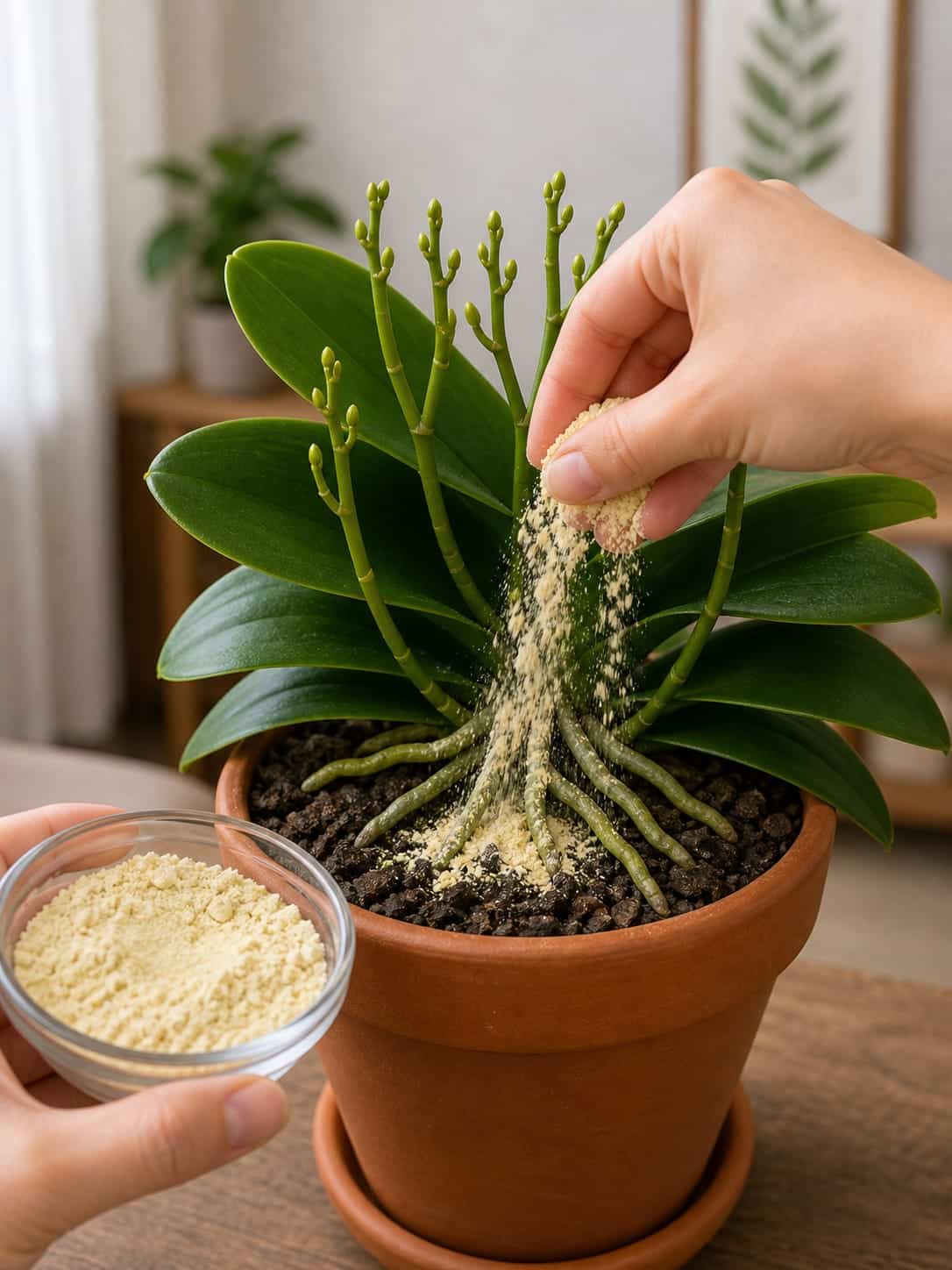
The image shows a healthy Phalaenopsis orchid in a terracotta pot. The plant has broad, firm green leaves, visible aerial roots, and several upright flower spikes with unopened buds. A hand is sprinkling a pale yellow powder over the base of the orchid, while another hand holds a small glass bowl filled with the same powder. The powder looks like a homemade plant supplement, possibly ground eggshell, cornmeal, turmeric-colored powder, or a fine organic root booster.
At first glance, this looks like a simple bloom trick: sprinkle yellow powder around the orchid, and the flower spikes will grow stronger. The image is visually appealing because the orchid already looks healthy and full of buds. It suggests that the powder may be the secret behind the plant’s impressive growth.
But orchids are sensitive. Their roots need air, not heavy dust. Their potting mix needs drainage, not powdery buildup. Their crowns need to stay dry, not packed with fine particles. A yellow powder can be helpful only if it is the right material, used in the right amount, and kept away from the crown and aerial roots. Used incorrectly, it can cause mold, clog the bark, attract pests, or irritate roots.
The safest interpretation of this trick is a tiny amount of finely ground eggshell powder or a very mild plant-safe mineral supplement used as an occasional top dressing. It should never be turmeric, spice powder, flour, cornmeal, sugar, yeast, baking powder, or any unknown kitchen ingredient. Orchids do not need random powders sprinkled over their roots.
In this guide, you will learn what the yellow powder orchid trick might be, whether it can help an orchid bloom, how to use mineral powders safely, what ingredients to avoid, and what actually helps Phalaenopsis orchids produce strong spikes and long-lasting flowers indoors.
What Is the Yellow Powder Orchid Trick?
The yellow powder orchid trick is a homemade plant-care idea where a small amount of pale yellow or beige powder is sprinkled over the orchid’s potting medium. It is usually presented as a natural way to strengthen roots, encourage flower spikes, improve blooming, or revive a tired orchid.
In the image, the powder is being applied around the base of the plant, where the roots and spikes emerge. That is also the most sensitive area of a Phalaenopsis orchid. The plant’s crown, roots, and lower leaf bases are all close together. If powder collects there and becomes damp, it may create problems.
For that reason, the safest version of this trick should be extremely light. Think of it as a tiny mineral dusting on the outer bark surface, not a thick coating over roots and stems.
What Could the Yellow Powder Be?
The powder in the image could represent several different things. Some are safer than others.
Possible plant-safe interpretations include:
- Finely ground eggshell powder
- A mild calcium supplement labeled for plants
- A tiny amount of bone meal used carefully
- Rock dust or mineral dust labeled for plants
- A powdered orchid fertilizer used according to the label
Possible unsafe interpretations include:
- Turmeric powder
- Curry powder
- Cornmeal
- Flour
- Yeast
- Sugar powder
- Baking powder
- Household cleaner
- Medication powder
- Unknown garden chemical
Only plant-safe products should be used around orchid roots. If the powder is not intended for plants, do not put it in an orchid pot.
The Safest Version: Ground Eggshell Powder
If you want a safe homemade version of this trick, ground eggshell powder is one of the more reasonable options. Eggshells are mostly calcium carbonate. Calcium can support plant cell structure, but it is not a quick bloom booster. It breaks down slowly, especially in orchid bark.
Eggshell powder should be used sparingly. A tiny pinch is enough. Too much fine powder can settle into the bark, reduce airflow, and create a chalky buildup.
Also, eggshell powder must be prepared properly. Raw eggshells can smell, attract pests, or carry residue. Clean and dry them first.
How to Make Eggshell Powder for Orchids
To make a safer eggshell powder, use clean shells and grind them very finely.
Ingredients
- Clean eggshells
- Hot water for rinsing
- A baking tray
- A grinder, blender, or mortar and pestle
Instructions
- Rinse eggshells thoroughly to remove egg residue.
- Let them dry completely.
- Bake them at low heat for 10 to 15 minutes to dry them further.
- Allow them to cool.
- Grind into a fine powder.
- Store in a dry jar.
Do not use wet or dirty eggshells. Do not leave large shell pieces around the orchid crown. Clean preparation matters.
How to Apply Eggshell Powder Safely
For orchids, less is better. Use only a tiny amount.
- Make sure the orchid is healthy and the bark is not wet.
- Take a small pinch of eggshell powder.
- Sprinkle it lightly on the outer edge of the bark surface.
- Keep it away from the crown and leaf bases.
- Avoid coating aerial roots heavily.
- Do not create a thick powder layer.
- Water normally at the next watering.
- Repeat rarely, no more than every few months.
The image shows a fairly heavy sprinkle over the roots. In real care, that is more than necessary. A dusting should be barely visible.
Can Eggshell Powder Make Orchids Bloom?
No, eggshell powder cannot force an orchid to bloom. It may add calcium very slowly, but blooming depends on much more important factors: light, root health, temperature, watering, plant maturity, and proper feeding.
If an orchid has flower spikes and buds like the plant in the image, it is already in a blooming cycle. The powder did not create instant buds. Flower spikes form over time when the plant has enough stored energy and suitable conditions.
Eggshell powder may be a minor supplement, but it is not the secret to orchid blooms.
What Actually Makes Phalaenopsis Orchids Rebloom?
Phalaenopsis orchids rebloom when their basic needs are met. The real reblooming formula includes:
- Bright indirect light
- Healthy roots
- Fresh airy orchid bark
- Correct watering
- Gentle balanced fertilizer
- Stable warm conditions
- A slight nighttime temperature drop for several weeks
- Patience after the previous flowering cycle
If your orchid is not blooming, the first thing to check is light. Many indoor orchids survive in low light but do not rebloom there. Moving the plant to brighter indirect light often helps more than any homemade powder.
Why the Orchid in the Image Looks Healthy
The orchid in the image already appears strong. It has thick green leaves, multiple spikes, and visible roots. The flower buds are still closed, which means the plant is preparing to bloom.
This kind of growth usually comes from good overall care. The plant likely has enough light, decent root health, and stored energy. A powder sprinkled at this stage should be used cautiously because the plant is already doing well.
When an orchid is healthy and budding, avoid major changes. Sudden overwatering, repotting, strong feeding, or heavy additives can cause bud blast, where buds yellow and drop before opening.
Can Powder Cause Bud Blast?
Yes, indirectly. Bud blast can happen when an orchid experiences stress. A heavy powder application may not directly make buds fall, but if it leads to sour bark, root irritation, mold, or watering changes, the plant can become stressed.
Common causes of bud blast include:
- Sudden temperature changes
- Cold drafts
- Hot dry air
- Underwatering
- Overwatering
- Low humidity
- Root stress
- Moving the plant during bud development
- Strong fertilizer or chemical exposure
When buds are forming, keep care steady. This is not the time for heavy experiments.
Why Fine Powders Can Be Risky for Orchids
Phalaenopsis orchids are usually grown in bark because bark creates air pockets. The roots need those air pockets. Fine powders can fall between bark pieces and fill the spaces that should hold air.
If too much powder is added, the potting medium may become denser. When watered, powder can turn pasty or cling to roots. This may slow drying and reduce oxygen around the roots.
That is why even plant-safe powders should be used sparingly. Orchids are not like garden vegetables that can tolerate amendments mixed into soil. Their roots need an open structure.
Why You Should Avoid Turmeric on Orchids
Because the powder is yellow, some people may assume it is turmeric. Turmeric is often promoted in plant hacks as an antifungal or healing powder. However, sprinkling turmeric into an orchid pot is not a reliable orchid-care practice.
Turmeric is a kitchen spice, not an orchid fertilizer. It can stain roots and bark, create residue, and behave unpredictably when wet. If used too heavily, it may irritate the root zone or contribute to buildup.
For orchid wounds, it is better to use clean tools, allow cuts to dry, and maintain good airflow. Do not coat a healthy orchid’s root zone with turmeric powder.
Why You Should Avoid Flour or Cornmeal
Flour and cornmeal should not be used in orchid pots. They are food ingredients that can mold quickly when damp. They can attract insects and create a sour smell.
In a bark mix, flour or cornmeal can become sticky and clog airflow. This is especially bad for orchids because root oxygen is essential.
Any powder that behaves like food when wet should stay out of orchid pots.
Can Bone Meal Be Used on Orchids?
Bone meal is sometimes used as a phosphorus source in gardening. However, it should be used cautiously with orchids. It can be too heavy, slow, or unsuitable depending on the potting setup. It may also attract pets or pests if used indoors.
If you use bone meal, it must be labeled for plants and used in a very tiny amount. For most indoor orchid growers, a balanced orchid fertilizer is easier and safer.
Do not use bone meal as a dramatic bloom booster. Orchids do not need heavy feeding to bloom.
Can Powdered Orchid Fertilizer Be Used?
Yes, but only according to the product label. Powdered orchid fertilizer is usually meant to be dissolved in water, not sprinkled directly onto roots. If fertilizer powder is applied dry, it can burn roots when it becomes concentrated during watering.
If your yellow powder is actually fertilizer, dilute it in water as directed. Use a weak solution. Do not pour dry fertilizer powder over the orchid crown or aerial roots.
Orchid roots are sensitive to concentrated salts.
Best Fertilizer Routine for Orchids
A reliable orchid feeding routine is simple. During active growth, use a balanced orchid fertilizer at a weak strength. Many growers use quarter-strength or half-strength fertilizer. Feed only when the plant is healthy and the roots are functioning.
Water with plain water between feedings to flush away excess salts. Do not fertilize heavily when the orchid is stressed, newly repotted, or suffering from root rot.
Gentle and consistent feeding is better than strong occasional doses.
Can Eggshell Powder Replace Fertilizer?
No. Eggshell powder is not a complete fertilizer. It mainly contributes calcium slowly. It does not provide a balanced supply of nitrogen, phosphorus, potassium, magnesium, and trace elements.
If your orchid needs nutrition, use proper orchid fertilizer. Eggshell powder can be an occasional minor supplement, but it cannot replace a feeding routine.
What Healthy Orchid Roots Should Look Like
The orchid in the image has visible aerial roots around the base. Healthy orchid roots are firm. They may be silvery or pale when dry and green when wet. They can grow over the pot edge or across the bark surface, and that is normal.
Do not cut aerial roots just because they look wild. They help the plant absorb moisture and support itself.
Dead or rotten roots are mushy, hollow, black, brown, or papery. If roots are rotting, powder will not fix them. The orchid needs root inspection and fresh potting medium.
Should Powder Touch Aerial Roots?
It is best not to coat aerial roots with powder. A tiny incidental dusting is unlikely to ruin a healthy plant, but a heavy layer can cling to roots and interfere with their natural wet-dry cycle.
Aerial roots are meant to breathe. Keep them clean and exposed. If powder sticks heavily to them, gently rinse it off during the next watering and let the plant drain well.
Keep the Crown Clear
The crown is the central growing point where the leaves meet. This area should stay dry, clean, and open. Powder should never collect in the crown.
If powder gets trapped between leaves, it can hold moisture after watering or misting. That creates a risk of crown rot.
When applying any amendment, aim for the outer bark surface and avoid the central leaf base.
How to Water After Using Powder
If you apply a tiny amount of eggshell powder, do not immediately flood the plant unless it actually needs watering. Watering should still be based on root and bark moisture.
When the orchid needs water, pour plain water through the bark and let it drain completely. Do not let the pot sit in runoff. If you notice powder clumping, flush gently with plain water.
If the powder creates a paste, you used too much. Remove what you can from the surface.
How Often Should You Use Yellow Powder?
If the powder is eggshell or a plant-safe mineral dust, use it rarely. Once every three to four months is more than enough. Many orchids do not need it at all.
If the powder is fertilizer, follow the label and dilute it properly. Do not sprinkle dry fertilizer powder directly onto the potting medium unless the product specifically says to do so.
For orchids, repeated powder applications can build up and reduce airflow. Less is better.
When Not to Use the Powder Trick
Do not use this trick if the orchid is stressed, newly repotted, suffering from root rot, showing yellow leaves, or dropping buds. Also avoid it if the bark is old, moldy, sour-smelling, or staying wet too long.
Do not use powder during a pest problem. Fine organic powders may make the pot more attractive to gnats or other insects.
Do not use powder if you are unsure what it is. Mystery additives do not belong near orchid roots.
What to Do If You Already Used Too Much
If you sprinkled a heavy amount of powder on your orchid, remove the excess. Use a spoon, soft brush, or your fingers to gently lift powder from the bark surface. Avoid damaging roots.
If powder fell deep into the bark and clumped, consider repotting into fresh orchid mix, especially if you notice mold, odor, or root decline.
If the plant seems fine, simply return to plain water and normal care. Do not add more fertilizer or homemade tricks right away.
Signs the Trick Is Being Used Safely
The trick is being used safely if the bark remains airy, the roots stay firm, the crown stays clean, and no mold or smell appears. The orchid should continue opening buds normally and producing healthy leaves and roots over time.
There should be no sticky buildup, no powder crust, no fungus gnats, and no yellowing after application.
If the powder disappears gradually without changing the pot environment, the amount was likely small enough.
Continue to Page 2
Continue to page 2 for more details about this article and the key points many readers miss on the first page.