African violets are small, charming houseplants with a surprisingly emotional effect on a room. Their soft, rounded leaves, velvety texture, and cheerful purple, pink, white, or blue flowers make them feel gentle and nostalgic. Many people remember them from a grandmother’s windowsill, a sunny kitchen shelf, or a cozy corner where the plant seemed to bloom almost all year. When an African violet is healthy, it can look like a miniature bouquet growing from a pot.
But African violets can also become frustrating. The flowers fade. The leaves turn yellow around the edges. The plant stops blooming. Buds form but fail to open. The center looks crowded. The soil stays damp. The plant sits on the windowsill with a few tired leaves and no new energy. When that happens, plant lovers often start searching for simple tricks to revive it.
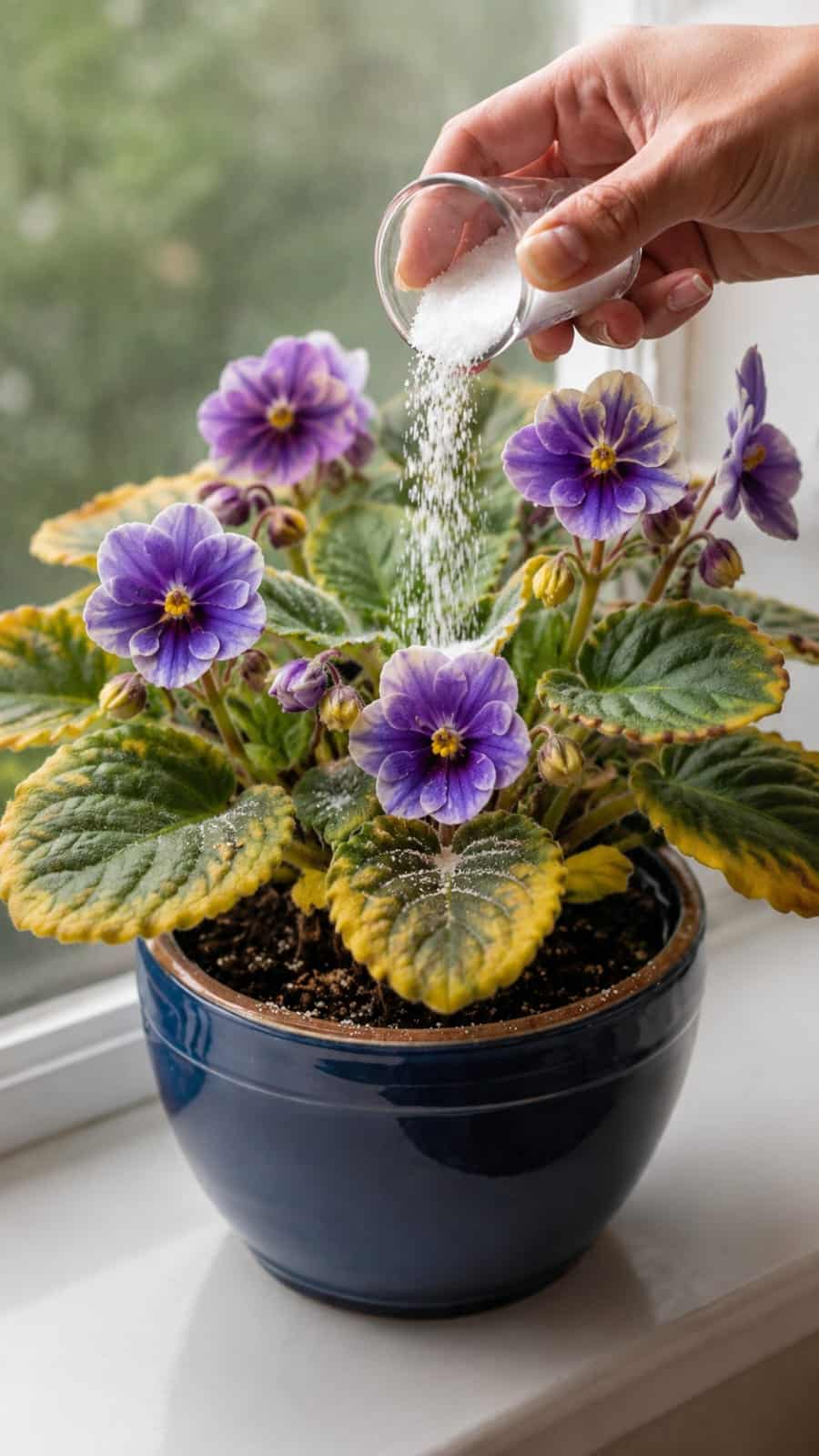
In the image, a hand is sprinkling a white crystalline ingredient over a blooming African violet. At first glance, it may look like sugar, Epsom salt, or another household powder. These kinds of tricks are popular because they feel easy and natural. A small spoonful from the kitchen or bathroom cabinet seems much less intimidating than a bottle of chemical fertilizer. But with African violets, small details matter. A little can help in very specific situations, while too much can harm the roots, attract pests, burn leaves, or damage the delicate soil balance.
This guide focuses on the safest interpretation of the trick: using a very tiny amount of sugar water or mild Epsom salt solution carefully, depending on what problem your African violet has. However, it is important to be honest from the beginning: African violets do not need sugar sprinkled directly on their leaves or flowers. Sugar is not a true fertilizer. It does not replace light, proper watering, correct soil, or balanced African violet food. If used carelessly, sugar can attract fungus gnats, ants, mold, and bacteria.
The smart version of this trick is not dumping white crystals over the plant. The smart version is understanding what the plant needs, using any household additive in a controlled and diluted way, and applying it only to the soil when appropriate. For African violets, gentle care wins every time. In this article, we’ll also review the best African violet fertilizer, top-rated potting mix, and where to buy Epsom salt for plants at the best price.
What Plant Is Shown in the Image?
The plant appears to be an African violet. African violets are beloved indoor flowering plants known for their compact growth, fuzzy leaves, and colorful blooms. Their flowers often appear in clusters above the foliage, and their leaves usually grow in a circular rosette.
The plant in the image has purple flowers with yellow centers and rounded leaves with yellowing edges. The yellowing leaf margins may suggest stress, aging leaves, watering issues, nutrient imbalance, mineral buildup, or light problems. The plant is still blooming, which is a good sign, but the foliage shows that the care routine may need some adjustment.
This is important because when a plant is blooming but the leaves are yellowing, the solution is rarely one miracle ingredient. The best approach is to check the full care routine: light, watering, pot size, soil, fertilizer, humidity, and leaf hygiene.
What Is the White Powder Trick?
The white powder in the image could be interpreted in several ways. It may look like sugar, Epsom salt, or a powdered fertilizer. Each one has a different effect.
Sugar is sometimes used by gardeners in diluted water as a microbial or temporary energy-support trick, but plants make their own sugars through photosynthesis. Sprinkling dry sugar on soil or leaves is not a good regular practice for houseplants.
Epsom salt is magnesium sulfate. Some gardeners use it when plants show signs of magnesium deficiency, but it should be diluted in water and used sparingly. It is not a complete fertilizer. You can buy Epsom salt for plants online or at garden centers for as little as $5–10 per bag.
Powdered fertilizer can feed plants, but it must be used at the correct dose. African violets are sensitive to fertilizer burn, so strong feeding can damage roots.
Because the image shows crystals being sprinkled directly over flowers and leaves, the safest advice is this: do not copy the image literally. Do not sprinkle dry crystals onto African violet leaves or blooms. African violet leaves are fuzzy and can trap particles and moisture, which may lead to spots, rot, or damage.
The Best Safe Version of This Trick
The safest version is to avoid sprinkling anything directly on the foliage. If you want to try a household boost, dissolve it in water first and apply it carefully to the soil, not the leaves.
For African violets, there are two possible safe options:
- A very weak sugar-water soil drench used rarely
- A very weak Epsom salt solution used only when magnesium deficiency is suspected
However, for most African violets, the best option is a balanced African violet fertilizer diluted to half or quarter strength. That is more reliable than sugar or Epsom salt. For a review of the top 5 African violet fertilizers and where to find discount codes for plant food, keep reading.
Why You Should Not Sprinkle Dry Sugar on African Violets
Sugar may seem harmless because it is natural and common in the kitchen. But in a flowerpot, sugar can create problems quickly. Dry sugar on the soil can become sticky when watered. It may feed microbes too aggressively. It may attract ants, gnats, fruit flies, or mold. If it lands on fuzzy African violet leaves, it can stick there and be difficult to remove.
Problems caused by dry sugar can include:
- Sticky soil surface
- Fungus gnats
- Ants
- Mold growth
- Unpleasant smell
- Bacterial growth
- Leaf spotting if sugar sits on damp leaves
- Root stress if the soil balance changes
African violets are not heavy-feeding outdoor vegetables. They are compact indoor plants with delicate roots. They prefer consistency, not sugary shocks.
Can Sugar Help African Violets Bloom?
Sugar does not directly make African violets bloom. Plants create their own sugars through photosynthesis. When an African violet receives enough light, it produces energy inside its leaves and uses that energy for roots, leaves, and flowers.
If a violet is not blooming, the most common causes are:
Not enough light
Too much direct sun
Irregular watering
Old compacted soil
Too large a pot
Lack of balanced fertilizer
Cold temperatures
Crowded crown
Exhaustion after a bloom cycle
A tiny sugar-water treatment may temporarily feed soil microbes, but it will not replace the plant’s need for light. If the plant cannot photosynthesize well, added sugar will not solve the problem.
If You Still Want to Try Sugar Water, Use This Safe Method
If you want to try the sugar trick as an occasional experimental boost, use a very weak solution and apply it only to the soil. This is not a required treatment. It is optional and should be used carefully.
Ingredients
- 1 cup room-temperature water
- 1/8 teaspoon white sugar
Steps
Add 1/8 teaspoon sugar to 1 cup of room-temperature water.
Stir until fully dissolved.
Make sure the African violet soil is slightly dry, not wet.
Apply a small amount to the soil edge only.
Keep the liquid away from leaves, flowers, and the crown.
Let excess water drain away.
Do not repeat for at least 6 to 8 weeks.
This is a very weak mixture. Do not make it stronger. Do not use it weekly. Do not pour it over the flowers. Do not use it if you already have fungus gnats, mold, or a sticky soil surface.
When Sugar Water Is a Bad Idea
Skip sugar water completely if your African violet has any of these problems:
- Fungus gnats
- Mold on soil
- Wet soil that does not dry
- Rotting crown
- Soft leaves
- Root rot
- Ants nearby
- Sour-smelling soil
- Poor drainage
- Very low light
In these situations, sugar can make the problem worse. Correct the growing conditions first.
What About Epsom Salt? (And Where to Buy It Cheap)
If the white powder is meant to represent Epsom salt, the advice is different. Epsom salt contains magnesium and sulfur. Magnesium is part of chlorophyll, which plants use for photosynthesis. In some cases, magnesium deficiency can contribute to yellowing between veins or weak-looking foliage.
However, African violets do not need frequent Epsom salt treatments. Too much can create nutrient imbalance. Epsom salt is not a complete fertilizer because it does not provide nitrogen, phosphorus, potassium, calcium, or trace elements in a balanced way.
Use Epsom salt only occasionally and only in a diluted form. You can buy Epsom salt for plants at any garden center or online. Look for organic Epsom salt or affordable bulk options – a 5‑pound bag often costs under $10. Many brands offer free shipping on Epsom salt if you order through Amazon or Walmart. For the best value Epsom salt for African violets, check customer reviews to ensure it dissolves easily.
Safe Epsom Salt Solution for African Violets
Ingredients
- 1 quart room-temperature water
- 1/4 teaspoon Epsom salt
Steps
- Dissolve 1/4 teaspoon Epsom salt in 1 quart of water.
- Stir until fully dissolved.
- Use it as a soil watering only.
- Avoid wetting leaves and flowers.
- Let the pot drain fully.
- Use no more than once every 2 to 3 months.
This solution is mild. Stronger is not better. If your African violet already receives a balanced fertilizer, it may not need Epsom salt at all.
Why Yellow Leaf Edges Matter
The African violet in the image has yellowing leaf edges. This does not automatically mean it needs sugar or Epsom salt. Yellow edges can happen for many reasons.
Possible causes include:
- Natural aging of older leaves
- Too much direct sunlight
- Cold water touching leaves
- Fertilizer burn
- Mineral buildup in soil
- Overwatering
- Underwatering
- Low humidity
- Old soil
- Nutrient imbalance
Before adding anything, observe the plant carefully. Are only the oldest outer leaves yellowing? That may be normal aging. Are many leaves yellowing at once? That suggests a care problem. Are the edges dry and crispy? Light, fertilizer, or watering may be involved. Are the leaves soft and limp? Roots may be stressed.
The Real Secret to African Violet Blooms: Best Products to Buy
African violets bloom best when their care is steady. They do not need dramatic treatments. They need the right balance of light, water, fertilizer, pot size, and warmth.
The most important bloom factors are:
- Bright indirect light
- Consistent moisture without soggy soil
- Small pot size
- Loose African violet soil
- Balanced fertilizer
- Warm room temperatures
- Good humidity
- Clean crown and leaves
- Regular removal of spent flowers
If these are right, African violets can bloom repeatedly. If these are wrong, no sugar trick will solve the issue.
To get the best results, invest in top-rated African violet supplies. Here are the best products for sale online and in garden centers:
- Best African violet fertilizer: Look for a specialized 12-36-14 or 15-30-15 formula. Brands like Schultz, Miracle-Gro, and Espoma offer liquid African violet food for under $10. Check reviews on Amazon before buying.
- Best potting mix for African violets: A light, perlite-rich mix such as Hoffman or Espoma. Avoid cheap all‑purpose soil. Compare organic vs. non‑organic mixes – organic is often better for long‑term health.
- Best pots for African violets: Small ceramic or plastic pots with drainage holes (2 to 4 inches wide). Self‑watering pots are also popular – read buying guides to find the most affordable self‑watering African violet pots.
- Where to buy Epsom salt for plants: Local drugstores, Walmart, Home Depot, or online. Look for cheap Epsom salt without added fragrances.
Best Light for African Violets
African violets need bright, gentle light. They usually do well near an east-facing window or a bright north-facing window. They can also grow under LED grow lights. Direct hot sun can burn the leaves, while too little light prevents blooming.
Signs of too little light include:
- Few or no flowers
- Long stretched leaf stems
- Leaves reaching upward
- Dark green foliage with little blooming
- Slow growth
Signs of too much light include:
- Yellow leaves
- Bleached patches
- Brown crispy spots
- Leaves curling downward
- Tight crowded center growth
If your violet is not blooming, improve the light before trying any homemade trick. Consider buying an affordable LED grow light for African violets – many models are on sale for under $30 with good customer reviews.
How to Water African Violets Properly (Watering Supplies for Sale)
Watering is one of the biggest reasons African violets struggle. They like evenly moist soil, but they do not like soggy roots. They also dislike cold water on their fuzzy leaves.
Best Watering Method
Bottom watering is often safest. Place the pot in a shallow dish of room-temperature water and let the soil absorb moisture through the drainage holes. After 20 to 30 minutes, remove the pot and pour away any leftover water. This keeps the leaves dry and helps prevent spotting. You can buy bottom watering trays for African violets online – they are cheap and reusable.
Top Watering Method
If you water from the top, use a narrow-spout watering can. Pour carefully onto the soil, not the leaves or crown. Use room-temperature water. Let excess water drain completely. Never let African violets sit in standing water for hours.
Why Room-Temperature Water Matters
African violet leaves can develop spots if cold water touches them. The fuzzy leaf surface is sensitive. Cold droplets can damage cells and leave pale or brown marks.
Always use room-temperature water. Avoid splashing the leaves. If water lands on the leaves, gently blot it with a soft tissue.
Best Soil for African Violets (Buying Guide & Reviews)
African violets need a light, airy mix. Regular garden soil is too heavy. Standard potting soil may also hold too much water unless amended.
A good African violet mix should be:
- Light
- Loose
- Well-draining
- Slightly moisture-retentive
- Rich but not dense
You can buy African violet potting mix or make a simple blend using peat or coco coir, perlite, and vermiculite. The goal is moisture plus oxygen. Roots need both.
Top-rated African violet soil brands (for sale):
- Espoma Organic African Violet Potting Mix – excellent reviews, affordable, often available at Home Depot or Amazon.
- Hoffman African Violet Soil Mix – a favorite among hobbyists; cheap and reliable.
- Miracle-Gro African Violet Potting Mix – widely available, but some gardeners prefer organic options.
Always check the latest prices and discounts before buying. Many online stores offer free shipping on orders over $25.
Continue to Page 2
Continue to page 2 for more details about this article and the key points many readers miss on the first page.