Geraniums are usually seen as strong, cheerful, almost unstoppable flowering plants. They sit in porch pots, balcony planters, window boxes, and patio containers, filling the space with rounded leaves and clusters of bright blooms. When they are happy, they look generous and effortless. A healthy geranium can flower for months, especially when it receives enough sunlight, steady watering, and regular deadheading.
But even geraniums can have bad seasons. One week the plant looks full and fresh, and a few weeks later the leaves begin to brown around the edges. The flower heads dry before opening. The stems look tired. The soil stays wet in some places and dry in others. The plant still has life, but it no longer has that thick, green, blooming look everyone wants.
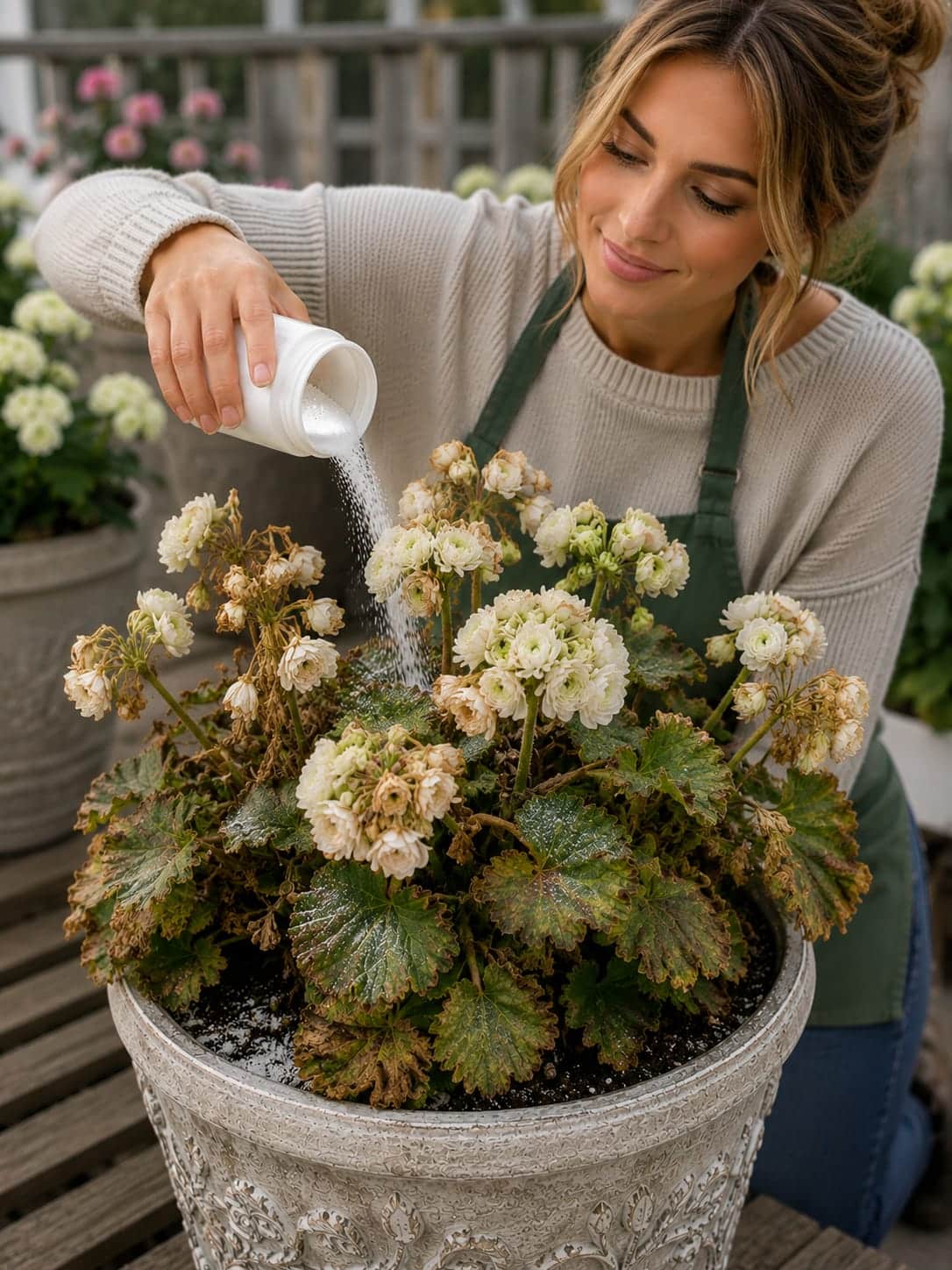
In the image, a gardener is sprinkling a white granular powder around a struggling white geranium. The leaves are brown and crispy around the edges, some flowers are fading, and the plant looks stressed. This type of white powder is often shown as Epsom salt, a popular garden supplement made of magnesium sulfate. Many gardeners use it because magnesium supports chlorophyll, the green pigment plants need for photosynthesis. When a plant is low in magnesium, leaves may look pale, tired, or yellowed between the veins.
However, this trick must be used carefully. Epsom salt is not magic. It is not a complete fertilizer. It cannot repair dead leaves, reverse root rot, or force a plant to bloom overnight. If the geranium is suffering because of overwatering, poor drainage, too much heat, old soil, pests, or lack of sunlight, Epsom salt alone will not solve the problem. In fact, using too much can make things worse.
The smart version of this trick is simple: use a very small amount, apply it only to the soil, water it in properly, and combine it with the real recovery steps a weak geranium needs. That means trimming dead flowers, removing damaged leaves, checking the roots, improving light, refreshing the soil if needed, and adjusting watering.
What Is the White Powder Trick for Weak Geraniums?
The white powder trick is usually an Epsom salt treatment. Epsom salt contains magnesium and sulfur. These are secondary nutrients, meaning plants need them, but not in the same large amounts as nitrogen, phosphorus, and potassium.
Magnesium helps plants produce chlorophyll. Chlorophyll allows leaves to capture light and turn it into energy. Sulfur helps with plant proteins and general growth processes. When a plant is mildly deficient in magnesium, an Epsom salt treatment may help new growth look greener and more energetic over time.
For geraniums, gardeners sometimes use Epsom salt when the plant looks weak, pale, or slow to bloom. It is especially common in container plants because nutrients can wash out of pots during watering. But it should be treated as a supplement, not as the main food source.
Why the Geranium in the Image Looks Stressed
The plant in the image still has blooms, but the foliage shows stress. The leaves have brown edges, some flowers are dry and faded, and the plant looks uneven. This can happen for several reasons.
Common causes include:
- Too much water or poor drainage
- Soil that has become compacted
- Old potting mix with mineral buildup
- Too much fertilizer
- Not enough fertilizer
- Hot sun combined with dry soil
- Cold damage
- Pests such as spider mites, aphids, or caterpillars
- Fungal leaf issues from wet foliage
- Natural aging of older leaves and spent flowers
This is why the first step is not simply sprinkling more powder. The first step is reading the plant. A geranium with crispy brown leaf edges may need better watering, not magnesium. A geranium with yellowing leaves and soggy soil may have root trouble. A geranium with faded flowers may simply need deadheading. Epsom salt can be part of the routine, but it should never replace diagnosis.
What Epsom Salt Can Do for Geraniums
Used correctly, Epsom salt may support a geranium that needs magnesium. It may help the plant produce greener new leaves and recover some vigor when the rest of the care routine is already good.
Possible benefits include:
- Supporting chlorophyll production
- Helping pale new growth look healthier
- Supporting photosynthesis
- Improving overall leaf color over time
- Helping container plants that may have depleted magnesium
- Supporting recovery after a heavy blooming period
These benefits usually show up in new growth, not old damaged leaves. Brown, crispy leaves will not become perfect again. Dry flower heads will not rehydrate. A plant responds by producing healthier new growth after the problem is corrected.
What Epsom Salt Cannot Do
It is important to be realistic. Epsom salt is often oversold as a miracle garden cure, but it has limits.
Epsom salt cannot:
- Fix root rot
- Replace balanced fertilizer
- Repair brown dead leaves
- Bring back dead flowers
- Correct poor drainage
- Make a low-light geranium bloom heavily
- Remove pests
- Stop fungal disease
- Undo fertilizer burn
- Save a plant that is being watered incorrectly
If a geranium is weak because the roots are damaged, adding Epsom salt can actually add more stress. Root problems must be corrected first.
The Safest Epsom Salt Recipe for Weak Geraniums
The safest way to use Epsom salt is to dissolve it in water. This spreads the magnesium evenly and prevents concentrated crystals from sitting against tender roots or stems.
Ingredients
- 1 gallon of room-temperature water
- 1 tablespoon of Epsom salt
Steps
- Fill a watering can with 1 gallon of water.
- Add 1 tablespoon of Epsom salt.
- Stir until completely dissolved.
- Water only the soil around the geranium.
- Avoid wetting the flowers and leaves.
- Let the pot drain fully.
- Do not repeat for 4 to 6 weeks.
For a weak or stressed geranium, you can make the mixture even gentler by using 1 teaspoon of Epsom salt per gallon for the first treatment. A weak plant does not need a strong shock. It needs a gentle recovery plan.
If You Want to Sprinkle It Dry
The image shows a dry sprinkle method. This can be done, but it must be done carefully. Do not pour a thick layer over the plant. Do not sprinkle it over flowers. Do not let crystals collect in the crown or on the leaves.
Dry Sprinkle Method
- Use 1 teaspoon Epsom salt for a medium pot.
- Sprinkle it lightly and evenly over the soil surface.
- Keep it away from the main stem.
- Do not sprinkle it on the flowers.
- Water thoroughly afterward.
- Use no more than once every 6 weeks.
If the plant is in a small pot, use only half a teaspoon. If the plant is in a very large patio container, 1 to 2 teaspoons may be enough. More is not better.
Why You Should Not Sprinkle Epsom Salt on Leaves and Flowers
Although the image shows powder falling over the top of the plant, the practical method is to keep it on the soil. Geranium flowers and leaves do not need dry salt sitting on them. Crystals can leave residue, draw moisture, or create spotting if they remain on wet foliage.
The roots absorb dissolved nutrients from the soil. That is where the treatment belongs.
Step-by-Step Recovery Plan for a Weak Geranium
If your geranium looks like the plant in the image, do not rely on one ingredient. Use a full recovery routine.
Step 1: Remove Dead Flowers
Start by deadheading. Dry flower clusters drain energy and make the plant look worse than it is. Follow each faded flower stem down to where it meets the plant and snap or cut it off. Do not just pull off the petals. Remove the whole spent flower stem. This encourages the plant to redirect energy toward new buds and leaves.
Step 2: Remove Badly Damaged Leaves
Leaves with crispy brown edges will not heal. If a leaf is mostly brown, yellow, or dry, remove it. This improves airflow and makes it easier to see the plant’s healthy parts. Do not remove every slightly imperfect leaf at once. The plant still needs leaves to photosynthesize. Remove the worst leaves first.
Step 3: Check Soil Moisture
Push your finger about one inch into the soil. If it is wet and heavy, do not water yet. If it is dry, water deeply. Geraniums like soil that dries slightly between waterings. They dislike soggy roots.
Step 4: Check Drainage
Make sure the pot has drainage holes. Water should be able to escape. If the decorative container has no drainage, the plant may be sitting in trapped water. That can cause root rot and yellowing leaves.
Step 5: Inspect for Pests
Look under the leaves and around stems. Aphids, spider mites, whiteflies, and caterpillars can weaken geraniums. If pests are present, treat them before using supplements.
Step 6: Improve Light
Geraniums need bright light to recover and bloom. Outdoors, they usually like several hours of sun. Indoors, they need the brightest window available. A weak geranium in low light will not bounce back quickly.
Step 7: Apply the Epsom Salt Solution
Once the plant is cleaned up and the soil is not already soaking wet, apply the mild Epsom salt solution to the soil. Let it drain fully.
Step 8: Wait and Watch New Growth
Do not expect old leaves to become perfect. Watch the new leaves that appear over the next two to four weeks. If the new growth is greener and stronger, the plant is improving.
How Often Should You Use This Trick?
For weak geraniums, use Epsom salt no more than once every 4 to 6 weeks during active growth. If the plant is severely stressed, use it only once and then wait. Repeated applications can create mineral buildup.
During winter or dormancy, skip Epsom salt unless the plant is actively growing under strong light.
Best Time of Day to Apply It
Apply the solution in the morning. Morning application gives the plant time to dry and reduces the risk of moisture sitting overnight. If you accidentally splash leaves, morning warmth and airflow help them dry faster.
Avoid applying during intense afternoon heat, especially if the plant is outdoors. Stressed roots do not need heat plus fertilizer-like treatments at the same time.
Why Balanced Fertilizer Still Matters
Epsom salt contains magnesium and sulfur, but geraniums also need nitrogen, phosphorus, potassium, calcium, and trace elements. If you use only Epsom salt, the plant may still be hungry.
A proper geranium fertilizer or balanced flowering plant fertilizer is more complete. Use Epsom salt only as an occasional supplement.
Simple Feeding Routine for Geranium Recovery
Once the plant begins improving, follow a gentle feeding routine:
- Use balanced liquid fertilizer at half strength every 2 to 4 weeks during active growth.
- Use Epsom salt solution only once every 4 to 6 weeks if needed.
- Do not overfeed a weak plant.
- Flush the pot with plain water occasionally to prevent salt buildup.
If the soil already has slow-release fertilizer granules, be extra careful. Adding too many supplements can burn the plant.
How to Flush the Pot If You Overdid It
If you used too much Epsom salt or fertilizer, flush the pot with plain water.
- Take the pot to a place where water can drain freely.
- Slowly pour plain water through the soil.
- Let the water run out of the drainage holes.
- Repeat once if there is heavy buildup.
- Let the pot drain completely.
- Do not fertilize again for several weeks.
Flushing helps remove excess minerals from the soil.
Why Brown Leaf Edges Happen on Geraniums
Brown leaf edges can be confusing because many problems look similar. Epsom salt only helps if magnesium deficiency is part of the issue. It will not fix every brown edge.
Common causes of brown edges include:
- Inconsistent watering
- Too much fertilizer
- Mineral buildup
- Hot sun with dry soil
- Cold damage
- Root stress
- Old leaves aging naturally
- Fungal or bacterial leaf problems
If the brown edges are dry and crispy, check watering and heat. If leaves are yellow and soft, check roots. If spots appear after leaves stay wet, improve airflow and avoid overhead watering.
How to Water Geraniums the Right Way
Geraniums prefer a deep watering followed by a slight drying period. Do not water lightly every day. Shallow watering keeps the top wet and encourages weak roots.
Water when the top inch of soil feels dry. Then water until excess drains from the bottom. Empty the saucer afterward. If the pot is outdoors and exposed to hot sun, it may need water more often. If it is in shade or indoors, it may need less.
Why Overwatering Makes Geraniums Look Weak
Many people see a wilting plant and assume it needs water. But overwatered geraniums can also wilt because their roots cannot breathe. When roots sit in soggy soil, they become weak and may rot. Then the plant cannot absorb water properly, even though the soil is wet.
Signs of overwatering include:
- Yellow leaves
- Soft stems
- Soil that stays wet for days
- Sour smell
- Wilting despite wet soil
- Brown mushy roots
If your geranium shows these signs, do not apply Epsom salt yet. Fix drainage and root health first.
How to Check the Roots
If the plant continues declining, gently slide it out of the pot. Healthy roots are firm and usually white, cream, or light tan. Rotten roots are brown, black, mushy, or smelly.
If many roots are rotten:
- Trim away mushy roots.
- Remove sour old soil.
- Repot into fresh, well-draining mix.
- Use a pot with drainage holes.
- Water lightly at first.
- Wait before fertilizing.
A plant with root rot needs recovery time, not more supplements.
Best Soil for Weak Geraniums
A weak geranium often benefits from fresh soil. Old potting mix can become compacted and salty. It may hold too much water or dry unevenly.
A good geranium mix should be:
- Loose
- Well-draining
- Moderately rich
- Light enough for oxygen to reach roots
You can use quality potting mix with extra perlite added. Avoid heavy garden soil in containers.
Continue to Page 2
Continue to page 2 for more details about this article and the key points many readers miss on the first page.