Should You Repot a Struggling Geranium?
Repot if the soil is sour, compacted, full of mineral crust, or staying wet too long. Also repot if roots are crowded and circling tightly around the pot.
Do not repot during the hottest part of the day. After repotting, keep the plant in bright but gentle light for a few days while it adjusts.
How to Repot a Weak Geranium
- Remove faded flowers and dead leaves first.
- Slide the plant gently from the pot.
- Shake away loose old soil.
- Trim dead roots if needed.
- Choose a pot with drainage.
- Add fresh potting mix.
- Set the plant at the same depth it was growing before.
- Fill around roots gently.
- Water lightly.
- Wait 2 to 3 weeks before feeding strongly.
If the plant was badly stressed, skip Epsom salt until you see new growth.
Best Light for Geranium Recovery
Geraniums need strong light to bloom. A weak geranium placed in shade may survive but stay thin and tired. Give it bright light, but be careful with sudden intense sun if it has been stressed.
If the plant was in shade, move it gradually into more light over several days. Sudden hot sun can scorch weak leaves.
Ideal conditions include morning sun and bright afternoon light. In very hot climates, afternoon shade can help prevent burning.
Deadheading: The Bloom Trick That Works Better Than Most Powders
If you want more geranium flowers, deadheading is one of the most reliable tricks. Old flower heads signal the plant to finish that bloom cycle. Removing them encourages the plant to produce more buds.
To deadhead:
- Find the faded flower cluster.
- Follow its stem down to the base.
- Snap or cut it off cleanly.
- Remove any dried petals from the soil surface.
Do this regularly. A clean geranium blooms better and has fewer disease problems.
Pruning Weak Geraniums
If the plant is leggy or uneven, light pruning can help. Cut back long, weak stems to encourage branching. Do not remove all foliage at once. A stressed plant needs leaves to recover.
Prune gradually:
- Remove dead stems first.
- Cut back very leggy stems by one-third.
- Pinch soft growing tips to encourage bushiness.
- Wait for new growth before pruning more.
Can Epsom Salt Revive Dried Flowers?
No. Dried flowers are finished. Remove them. Epsom salt may help future growth if magnesium is lacking, but it will not revive old blooms.
Can Epsom Salt Make Geraniums Bloom Faster?
Only indirectly. If the plant is low in magnesium and otherwise healthy, correcting that deficiency may help the plant grow and bloom better over time. But if the plant lacks sun, fertilizer, or proper watering, Epsom salt will not make it bloom faster.
What If the Plant Has White Powder Already on the Soil?
Sometimes white powder on soil is not Epsom salt. It may be mineral buildup from hard water or fertilizer. If you see white crust on the soil or pot rim, do not add more minerals immediately. Flush the pot first.
Mineral buildup can stress roots and cause brown leaf edges. Adding Epsom salt on top of mineral buildup may worsen the problem.
How to Tell If the Plant Is Improving
Recovery takes time. After correcting care and applying a gentle treatment, watch for new growth.
Good signs include:
- New leaves emerging greener
- Stems becoming firmer
- Soil drying at a normal pace
- New buds forming
- Less leaf yellowing
- No sour smell from the pot
- Healthier overall shape after pruning
Old damaged leaves may still look bad. Judge the plant by what it produces next.
When to Stop Using Epsom Salt
Stop if you notice:
- Brown edges getting worse
- White crust on soil
- Wilting after application
- Soil staying wet too long
- Leaves turning yellow quickly
- No improvement after two treatments
If there is no improvement, the problem is probably not magnesium deficiency.
Can You Use This on All Geranium Types?
This method can be used cautiously on zonal geraniums, ivy geraniums, and scented geraniums, but the response may vary. Some geraniums bloom heavily and feed more actively. Others are grown mostly for foliage.
Always use a light dose first. Container plants are more sensitive to buildup than plants growing in the ground.
Outdoor vs. Indoor Geraniums
Outdoor geraniums usually receive stronger light and better airflow, so they can often recover faster. Indoor geraniums may be more delicate because they get less sun and their soil dries slower.
For indoor geraniums, use a weaker dose:
- 1 teaspoon Epsom salt in 1 gallon of water
- Apply to soil only
- Use no more than once every 6 weeks
Also make sure the indoor plant is near a very bright window.
Natural Recovery Mix for Weak Geraniums
If your geranium is weak, the best “natural trick” is often a care reset:
- Fresh potting mix
- Good drainage
- Morning sun
- Deadheading
- Light pruning
- Balanced fertilizer
- Occasional Epsom salt only if needed
Plants recover from systems, not single ingredients.
Quick Rescue Routine
Here is a simple rescue plan you can follow today:
- Remove all dead flower heads.
- Remove the worst brown leaves.
- Check the soil moisture.
- Make sure the pot drains.
- Move the plant to bright light with good airflow.
- Water only when the top inch of soil is dry.
- Apply a mild Epsom salt solution if the plant is actively growing.
- Wait two weeks and watch new growth.
- Feed lightly with balanced fertilizer once recovery begins.
- Repot if the soil is old, sour, or compacted.
Quick Recipe Card
Gentle Epsom Salt Recovery Drink for Geraniums
- 1 gallon room-temperature water
- 1 tablespoon Epsom salt
For very weak plants: use only 1 teaspoon per gallon for the first treatment.
Directions:
- Dissolve completely.
- Pour around the soil only.
- Avoid flowers and leaves.
- Let the pot drain fully.
- Use once every 4 to 6 weeks during active growth.
Short Caption for This Trick
For weak geraniums with pale leaves and tired blooms, dissolve 1 tablespoon of Epsom salt in 1 gallon of water and pour it gently around the soil once every 4 to 6 weeks. For very stressed plants, start with only 1 teaspoon per gallon. Do not sprinkle heavy crystals on flowers or leaves, and do not use Epsom salt as a replacement for fertilizer. First remove dead blooms, check drainage, improve sunlight, and water only when the top inch of soil feels dry.
Frequently Asked Questions
Is Epsom salt good for weak geraniums?
It can help if the plant is low in magnesium, but it will not fix every problem. Use it as a supplement, not a complete fertilizer.
How much Epsom salt should I use?
Use 1 tablespoon per gallon of water for healthy active plants. For weak plants, start with 1 teaspoon per gallon.
Can I sprinkle Epsom salt directly on geranium leaves?
No. Keep it on the soil. Leaves and flowers do not need dry crystals on them.
How often should I use it?
Once every 4 to 6 weeks during active growth is enough. Do not use it weekly.
Will Epsom salt bring back dead flowers?
No. Dead flowers should be removed. Epsom salt may support future growth if magnesium is lacking.
Why are my geranium leaves turning brown?
Brown leaves can be caused by inconsistent watering, heat stress, fertilizer burn, poor drainage, old soil, pests, or root problems. Magnesium deficiency is only one possible cause.
Should I water after sprinkling dry Epsom salt?
Yes. Always water it in so it dissolves and moves into the soil evenly.
Can too much Epsom salt hurt geraniums?
Yes. Too much can cause mineral buildup and nutrient imbalance. Use small amounts and flush the pot if needed.
What is better for geranium blooms?
Bright light, deadheading, balanced fertilizer, proper watering, and good drainage are more important than Epsom salt.
Should I repot a weak geranium?
Repot if the soil is compacted, sour-smelling, staying wet too long, or full of mineral crust. Fresh soil may help more than supplements.
Final Thoughts
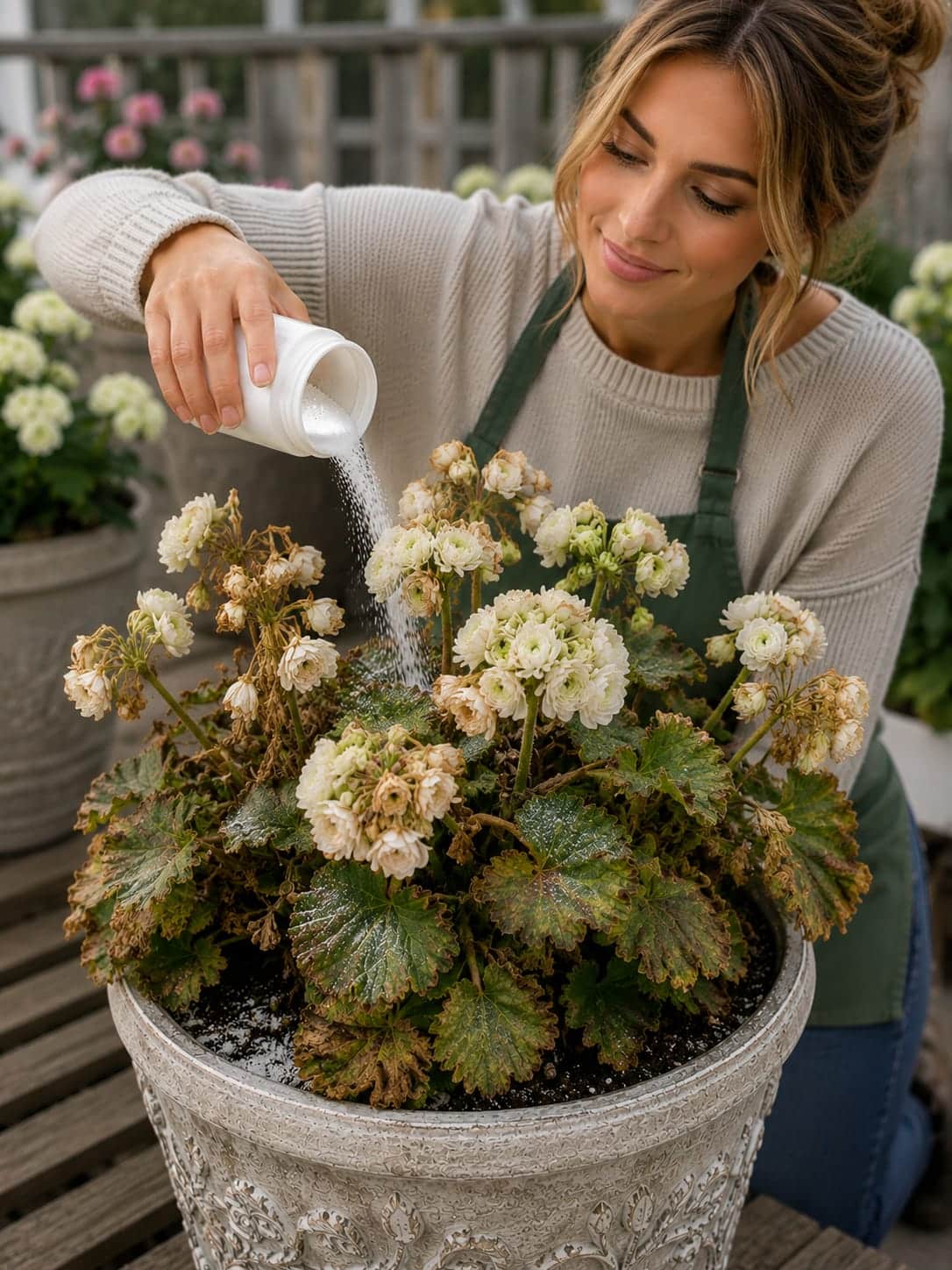
The image of white powder being sprinkled over a weak geranium is dramatic because it feels like a simple rescue secret. And there is some truth behind the idea: Epsom salt can help plants when magnesium is lacking. For container geraniums that have been blooming heavily, a small magnesium boost may support greener new growth and stronger recovery.
But the trick only works when it is used wisely. A weak geranium does not need a heavy layer of salt. It needs careful attention. Remove dead flowers. Trim damaged leaves. Check the roots. Fix drainage. Give the plant bright light. Water deeply, then let the soil dry slightly. Feed with a balanced fertilizer when the plant is ready. Use Epsom salt only as a gentle supplement, not as a cure-all.
The most important thing to remember is that damaged leaves will not become perfect again. Recovery appears in new leaves, new stems, and new buds. Be patient. Give the plant two to four weeks to show signs of improvement. If it continues to decline, look deeper into the roots and soil rather than adding more powder.
Smart gardeners do not chase miracles. They use small tricks as part of a bigger care plan. A tiny amount of Epsom salt may help a tired geranium, but sunlight, drainage, pruning, and steady watering are what truly bring it back. With the right care, even a tired geranium can push out fresh green leaves, form new buds, and return to the full blooming beauty that makes these plants so loved.