Orchids are some of the most beautiful houseplants a person can grow, but they can also be some of the most misunderstood. When an orchid is blooming, it looks almost unreal: tall flower spikes, delicate petals, glossy leaves, and thick roots that seem to twist in every direction. But once the blooms begin to fade, many orchid owners panic. The plant looks tired. The leaves may yellow at the tips. The flower stems may dry. The bark may look old. The roots may seem dull or thirsty. Suddenly, that elegant orchid looks fragile.
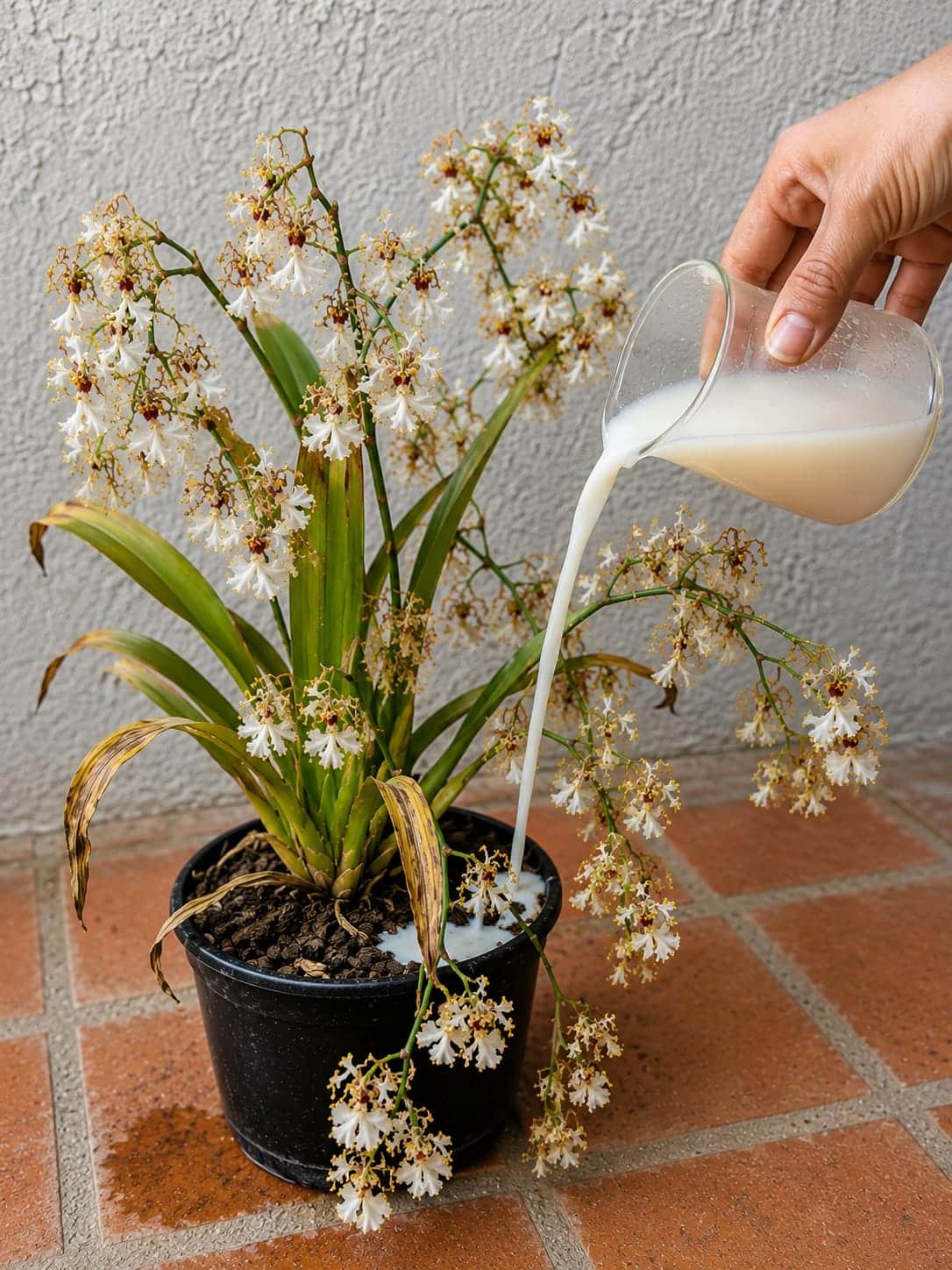
In the image, a hand is pouring a pale, milky liquid into the pot of a tired orchid with fading white flowers. This liquid looks like rice water, one of the most popular natural plant-care tricks used by houseplant lovers. Rice water is the cloudy water left after rinsing or soaking rice. Many gardeners use it because it contains small amounts of starches and trace nutrients that may support soil microbes and gentle plant growth when used correctly.
But orchids are not ordinary houseplants. They do not grow like pothos, peace lilies, basil, or garden flowers. Most common orchids, especially Phalaenopsis and Oncidium-type orchids, grow with roots that need air as much as moisture. Their roots are usually planted in bark chips, not dense soil. That means any homemade liquid must be used carefully. Too much rice water, or rice water that is too thick, fermented, or poured too often, can clog the orchid mix, attract fungus gnats, encourage mold, and damage roots.
The smart version of this trick is not pouring heavy rice starch into the pot every week. The smart version is using very diluted, fresh rice water occasionally, only when the orchid is actively growing, and always letting the pot drain completely. Rice water can be a gentle support, but it is not a miracle cure, not a true complete fertilizer, and not a replacement for proper orchid care.
If your orchid looks weak, faded, or tired after blooming, rice water may be one small part of the recovery routine. The bigger secret is checking the roots, refreshing old bark when needed, watering correctly, giving bright indirect light, and allowing the orchid time to rebuild energy.
What Is the Rice Water Orchid Trick?
The rice water orchid trick uses the cloudy water left from rinsing or soaking plain rice. Instead of throwing that water away, some growers dilute it and pour a small amount through the orchid’s potting mix. The idea is that rice water contains trace minerals and starches that may gently feed beneficial microbes around the roots.
Rice water is popular because it feels natural, cheap, and simple. Most people already have rice in the kitchen, and the water looks mild compared with strong chemical fertilizers. It also has a soft, milky appearance, which makes it look like a homemade plant tonic.
However, orchids need a very light touch. A thick cloudy liquid can become a problem if it sits in bark. Orchid roots need oxygen. If the bark becomes sticky, sour, or clogged, the roots can suffer. So this trick must be used in a diluted and controlled way.
What Kind of Orchid Is Shown?
The orchid in the image appears to be an orchid with long branching sprays of small white flowers, possibly an Oncidium-type orchid or a related intergeneric orchid. These orchids often produce many smaller blooms on arching stems. They are different from the large round flowers of Phalaenopsis orchids, but their care principles are similar in one important way: their roots still need air, drainage, and a loose potting medium.
The plant in the image looks stressed. Some leaves have yellowing and brown tips. Several flowers are fading. The potting medium appears chunky, likely bark or a bark-based orchid mix. This means the plant should never be treated like a normal soil plant. Any liquid must run through freely and drain away.
Why Orchid Growers Use Rice Water
Orchid growers use rice water because it may provide a gentle natural boost. It is not strong like commercial fertilizer, but it can support the growing environment when used sparingly.
People use rice water for orchids because they hope it may:
- Support beneficial microbes in the potting medium
- Provide tiny amounts of plant-friendly nutrients
- Encourage healthier-looking new roots
- Help tired plants recover after blooming
- Support greener new leaves over time
- Act as a mild natural tonic between regular fertilizer applications
These benefits are subtle. Rice water will not make a dying orchid suddenly bloom again. It will not repair rotten roots. It will not save an orchid planted in old, broken-down bark. It will not replace proper orchid fertilizer. Think of rice water as a gentle support, not the main treatment.
What Rice Water Can Actually Do
Fresh diluted rice water may add small amounts of starch, minerals, and organic matter to the root zone. In a healthy potting mix, this may support microbial activity. Microbes help break down organic matter and may contribute to a healthier root environment.
Rice water may be useful when:
- The orchid is actively growing new leaves or roots
- The potting medium is fresh and drains well
- The plant is not suffering from rot
- You use a very diluted mixture
- You apply it only occasionally
The key is that the orchid must already have decent conditions. Rice water works best as a small addition to good care, not as a rescue for serious root problems.
What Rice Water Cannot Do
Rice water is often presented online as if it can transform any weak orchid. That is misleading. Rice water has limits.
Rice water cannot:
- Force an orchid to bloom immediately
- Replace orchid fertilizer
- Fix root rot
- Repair dead leaves
- Revive flowers that are already fading
- Correct poor light
- Replace repotting
- Remove pests
- Stop fungal disease
- Save a plant in soggy, decomposed bark
If the orchid is declining because its roots are rotten, the first step is root care and repotting. If the plant is not blooming because it lacks light, rice water will not solve that. If the bark smells sour, adding rice water can make the problem worse.
The Biggest Warning: Never Use Thick or Fermented Rice Water on Orchids
This is the most important part of the method. Orchids should not receive thick, starchy, fermented, sour, or old rice water. That kind of liquid can feed mold, bacteria, and fungus gnats. It can also clog the air spaces in bark.
Avoid rice water that is:
- Thick like milk
- Sour-smelling
- Fermented for days
- Mixed with sugar
- Mixed with salt
- Left at room temperature too long
- Made from seasoned or cooked rice with oil or spices
For orchids, fresh and weak is the rule. If the rice water smells strange, throw it away.
The Safest Rice Water Recipe for Orchids
This is the safest version for most orchids.
Ingredients
- 1 tablespoon plain uncooked white rice
- 2 cups room-temperature water
- Extra plain water for dilution
Steps
- Place 1 tablespoon of plain uncooked rice in a clean bowl.
- Add 2 cups of room-temperature water.
- Swirl the rice gently for 20 to 30 seconds.
- Strain out the rice.
- Take 1 part rice water and mix it with 3 parts plain water.
- Use the diluted liquid immediately.
The final mixture should be only slightly cloudy. It should not be thick, creamy, or sticky. If it looks too white, dilute it more.
How to Apply Rice Water to Orchids
Apply rice water the same way you would water an orchid: through the potting medium, not over the leaves or flowers.
- Check that the orchid pot has drainage holes.
- Make sure the bark is nearly dry, not soaking wet.
- Pour a small amount of diluted rice water through the potting mix.
- Avoid the crown, leaf bases, and flowers.
- Let the liquid drain completely.
- Empty the saucer fully.
- Do not let the orchid sit in rice water.
For a medium orchid pot, use only enough liquid to moisten the bark and run through. Do not flood the plant with a large amount of starchy liquid.
How Often Should You Use Rice Water on Orchids?
Use rice water rarely. Once every 4 to 6 weeks during active growth is enough. If the orchid is not actively growing, skip it.
A good schedule is:
- Spring and summer active growth: once every 4 to 6 weeks
- Fall: only if the plant is still growing
- Winter: usually skip unless under strong grow lights
- After repotting: wait at least 3 to 4 weeks
- During root rot recovery: do not use
More frequent use can cause buildup, sour smell, mold, or gnats.
Should You Use Rice Water While the Orchid Is Blooming?
You can use a very diluted rice water treatment while an orchid is blooming, but it is not necessary. Blooming orchids are often sensitive to changes. If the plant is already flowering, avoid dramatic treatments.
If the orchid is blooming and healthy, plain water and stable care are usually better. If the flowers are fading naturally, rice water will not stop them from aging. Flowers have a life cycle. When they are finished, they dry and fall. That does not mean the orchid is dying.
Why the Flowers in the Image Are Fading
The flowers in the image look partly spent. This is normal if the orchid has been blooming for a while. Orchid flowers do not last forever. Some last weeks, some last months, depending on the type, temperature, humidity, and care.
Fading flowers may be caused by:
- Natural bloom aging
- Heat stress
- Underwatering
- Overwatering
- Sudden temperature changes
- Low humidity
- Root stress
- Drafts
Rice water will not revive flowers that are already finished. The goal is to support the plant after blooming so it can grow stronger roots and prepare for future blooms.
What to Do After Orchid Flowers Fade
Once the flowers fade, the orchid enters a recovery phase. This phase is very important. The plant needs time to produce new roots, leaves, and stored energy.
After flowers fade:
- Remove dried flowers gently.
- Cut dead flower spikes only when they are fully dry.
- Leave green spikes if the orchid type can rebloom from them.
- Check the roots.
- Refresh the potting medium if it is old.
- Give bright indirect light.
- Water correctly.
- Feed lightly during active growth.
Rice water can be used later as a mild support, but only if the roots are healthy and the pot drains well.
Check the Roots Before Using Rice Water
Before pouring rice water into an orchid pot, check the roots. Roots tell the truth about orchid health.
Healthy Orchid Roots
- Firm
- Green when wet
- Silvery or pale when dry
- Plump
- Not mushy
- No sour smell
Unhealthy Orchid Roots
- Brown and mushy
- Black and soft
- Hollow and papery
- Slimy
- Smelly
- Collapsed
If the roots are unhealthy, skip rice water. The plant needs cleaning, trimming, and repotting.
When Not to Use Rice Water
Do not use rice water if the orchid is already struggling with root or potting problems.
Avoid rice water if:
- The potting mix smells sour
- There is mold in the bark
- You have fungus gnats
- The roots are mushy
- The pot has no drainage
- The bark is old and broken down
- The plant was recently overwatered
- The orchid is newly repotted
- The room is cold and dark
- The orchid is severely dehydrated
In these cases, rice water may worsen the situation. Use plain water and fix the root environment first.
Rice Water vs. Orchid Fertilizer
Rice water is not the same as orchid fertilizer. Orchid fertilizer is designed to provide nutrients in measured amounts. Rice water is unpredictable. Its nutrient content depends on the rice type, how long it soaked, how much water was used, and whether it was rinsed or fermented.
For long-term orchid health, use a proper orchid fertilizer at a weak dose. A common approach is “weakly, weekly,” meaning a very diluted fertilizer used during active growth, with occasional plain-water flushing. Many home growers prefer fertilizing every 2 to 4 weeks at half or quarter strength.
Rice water can be an occasional natural supplement, but it should not replace balanced orchid feeding.
Can Rice Water Cause Mold?
Yes, especially if it is too thick or used too often. Rice water contains starch. Starch can feed microbes. In a healthy, airy pot, a tiny amount may be fine. In a damp, stagnant pot, it can become mold food.
To avoid mold:
- Use only fresh rice water
- Dilute it heavily
- Use it rarely
- Apply only to well-draining bark
- Keep the pot airy
- Never let the orchid sit in runoff
- Skip it in cool, dark conditions
Can Rice Water Attract Fungus Gnats?
Yes, if the potting mix stays wet or contains too much organic residue. Fungus gnats love moist, decomposing material. Thick rice water can encourage the kind of environment they like.
If you already have fungus gnats, do not use rice water. Let the potting medium dry more between waterings, improve airflow, and consider repotting if the bark is decomposed.
Should You Ferment Rice Water for Orchids?
For orchids, fermented rice water is risky. Some gardeners ferment rice water for outdoor plants, but orchids in pots are more delicate. Fermented liquids can become acidic, sour, and microbe-heavy. They may smell bad and create problems in orchid bark.
If you are growing orchids indoors or in containers, fresh diluted rice water is safer than fermented rice water.
Should You Use Cooked Rice Water?
Do not use thick water from cooked rice unless it is extremely diluted and completely plain. Cooked rice water is usually much starchier than rinse water. It can become sticky and clog the potting medium.
If you use cooked rice water at all, it must contain no salt, no oil, no spices, and no seasoning. It should be diluted until barely cloudy. For orchids, rinse water is safer than cooked rice water.
Best Watering Routine for Orchids
Rice water works only if your normal watering routine is correct. Most orchids prefer a cycle of moisture and air. The roots should not stay wet constantly.
A basic orchid watering routine:
- Check the potting medium.
- Water when the bark is nearly dry.
- Use room-temperature water.
- Pour water through the potting mix.
- Avoid the crown and leaf bases.
- Let everything drain completely.
- Empty the saucer.
Never water just because the calendar says so. Check the plant and potting mix first.
Why Drainage Is Essential
The orchid in the image is in a black nursery pot, which likely has drainage holes. That is good. Orchids should never sit in a pot without drainage. Water must run out freely.
If your orchid is inside a decorative cachepot, remove the inner pot when watering. Let it drain fully before placing it back. Standing water around the roots can cause rot.
Best Potting Mix for Orchids
Most common orchids grow best in a chunky mix. This may include bark, charcoal, perlite, lava rock, sphagnum moss, or coconut husk chips, depending on the orchid type and your climate.
A good orchid mix should:
- Allow airflow
- Drain quickly
- Hold some moisture without staying soggy
- Support the roots physically
- Resist compacting too quickly
If the mix has broken down into fine, soil-like material, it is time to repot. Rice water should never be poured into sour, old, compacted orchid mix.
When to Repot a Tired Orchid
Repotting is often the real solution for orchids that look weak. If the bark is old, the roots cannot breathe properly. The plant may decline even if you water and feed correctly.
Signs your orchid needs repotting include:
- Bark looks crumbly
- Pot smells sour
- Roots are rotting
- Water drains slowly
- Fungus gnats appear
- Plant wobbles badly
- Roots are packed tightly
- Mix stays wet too long
If you see these signs, repot before trying rice water.
Continue to Page 2
Continue to page 2 for more details about this article and the key points many readers miss on the first page.