ZZ plants are famous for being almost impossible to kill. Their glossy green leaves, upright stems, and sculptural shape make them one of the easiest houseplants for beginners. They can handle low light better than many indoor plants, they do not need constant watering, and they can sit quietly in a corner for weeks without complaining. That is why so many people love them in apartments, offices, bedrooms, hallways, and bright living rooms.
But even a tough ZZ plant can slow down. Sometimes it stops producing new shoots for months. Sometimes the leaves lose their deep shine. Sometimes the stems look healthy, but the plant feels “frozen,” as if it is alive but not actively growing. This is when many plant owners start looking for a gentle boost.
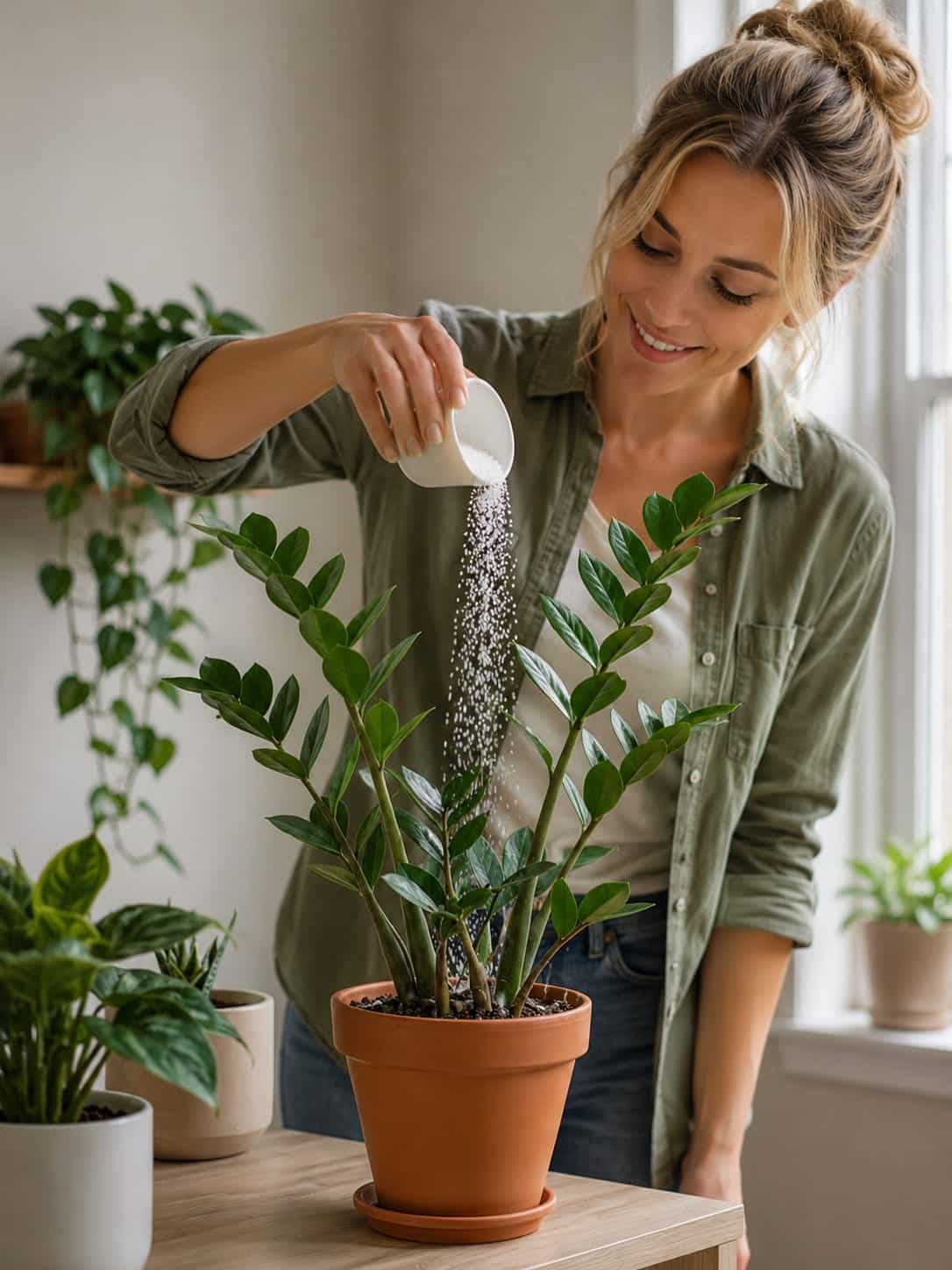
In the image, a woman is sprinkling a white granular powder around a healthy-looking ZZ plant. This kind of white powder trick is often shown as Epsom salt, a household ingredient made of magnesium sulfate. Gardeners use it because magnesium supports chlorophyll, the green pigment plants need for photosynthesis. Sulfur also plays a role in healthy plant processes. When used carefully, a small amount of Epsom salt can be a mild supplement for some potted plants.
However, ZZ plants are not heavy feeders. They grow from thick underground rhizomes that store water and energy. They prefer light, well-draining soil and do not like being overwatered or overfed. This means the trick must be used very carefully. A tiny amount may help support greener growth if the plant is low in magnesium, but too much can create mineral buildup and stress the roots.
The smart version of this trick is not to pour a heavy layer of powder over the plant. The smart version is to use a small measured amount, keep it on the soil only, water it in gently, and repeat only rarely during active growth.
What Plant Is in the Image?
The plant in the image appears to be a ZZ plant, also called Zamioculcas zamiifolia. It has thick upright stems with glossy oval leaves arranged in pairs. ZZ plants are loved because they look clean, modern, and elegant while requiring very little care.
A healthy ZZ plant usually has:
- Thick upright stems
- Glossy dark green leaves
- Firm leaflets
- Slow but steady growth
- Thick underground rhizomes
- A strong tolerance for occasional neglect
The plant in the image looks generally healthy. The leaves are green and shiny, and the stems are firm. This means the white powder should not be used as an emergency rescue. It should be treated as a gentle occasional supplement, not a desperate cure.
What Is the White Powder Trick?
The white powder is commonly interpreted as Epsom salt. Epsom salt is magnesium sulfate, and it is often used by gardeners to support green leaves and healthy growth when magnesium is lacking. Magnesium is important because plants use it to make chlorophyll. Without enough magnesium, leaves may become pale or yellowish, especially between the veins.
For a ZZ plant, Epsom salt may be used when:
- The plant has not produced new growth for a long time
- The leaves look dull or pale
- The plant is in old potting mix
- The plant has been watered with hard water for a long time
- The plant has not been fed during the growing season
But Epsom salt is not a complete fertilizer. It does not contain nitrogen, phosphorus, or potassium. It cannot replace a balanced houseplant fertilizer. It is only a magnesium and sulfur supplement.
What Epsom Salt Can Do for a ZZ Plant
Used correctly, Epsom salt may gently support the plant’s ability to produce healthy green leaves. It can be helpful if the potting mix is low in magnesium or if the plant has been growing in the same soil for a long time.
Possible benefits include:
- Supporting chlorophyll production
- Helping new leaves look greener
- Supporting steady growth during spring and summer
- Helping a tired plant recover from mild nutrient imbalance
- Adding magnesium without using a strong fertilizer
These benefits are subtle. A ZZ plant will not double in size overnight. It will not suddenly send up ten new shoots after one sprinkle. ZZ plants naturally grow slowly, and even a healthy plant may only produce a few new stems in a season.
What Epsom Salt Cannot Do
This is where many plant tricks become misleading. Epsom salt is useful only in certain situations. It is not magic.
Epsom salt cannot:
- Fix root rot
- Repair yellow leaves that are already dying
- Replace balanced fertilizer
- Make a ZZ plant grow fast in low light
- Save a plant sitting in soggy soil
- Repair sunburned leaves
- Remove pests
- Force instant new shoots
- Correct poor drainage
If your ZZ plant is weak because it has been overwatered, Epsom salt will not help. In fact, adding any supplement to a stressed root system can make things worse. Root health comes first.
The Safest Way to Use Epsom Salt on a ZZ Plant
The safest method is to dissolve Epsom salt in water. This helps spread the magnesium evenly through the soil and prevents concentrated crystals from sitting near the roots.
Gentle ZZ Plant Epsom Salt Recipe
- 1 quart room-temperature water
- 1/4 teaspoon Epsom salt
Directions
- Fill a container with 1 quart of room-temperature water.
- Add 1/4 teaspoon of Epsom salt.
- Stir until the crystals dissolve completely.
- Pour the solution slowly around the soil, not on the leaves.
- Let the pot drain fully.
- Empty the saucer after watering.
- Use only once every 8 to 10 weeks during active growth.
This is a mild dose because ZZ plants are slow-growing and do not need heavy feeding.
If You Want to Sprinkle It Dry
The image shows a dry sprinkle method. This can be done, but you must use a very small amount. Do not copy the image by pouring a visible shower of powder over the leaves. Keep the powder on the soil only.
Dry Sprinkle Method
- Small pot: one tiny pinch
- Medium pot: 1/8 teaspoon
- Large pot: 1/4 teaspoon maximum
Sprinkle lightly over the soil surface, away from the base of the stems. Then water normally so the crystals dissolve. Do not repeat for at least 8 to 10 weeks.
Why You Should Not Sprinkle Epsom Salt on the Leaves
The leaves of a ZZ plant are thick, waxy, and glossy. They do not need dry crystals sitting on them. Powder can leave residue, dull the shine, and collect in leaf joints. Nutrients are absorbed mainly through the roots, so the soil is the correct place to apply the treatment.
If powder lands on the leaves, wipe them gently with a damp cloth.
When to Use This Trick
Use this trick only when the plant is actively growing. For most homes, that means spring and summer. If your ZZ plant is producing a new shoot, opening fresh leaves, or standing in bright indirect light, it is more likely to use the added magnesium.
Good times to use it include:
- Spring growth season
- Early summer
- When new shoots are appearing
- After months of no feeding
- When leaves look slightly dull but roots are healthy
Avoid using it during winter dormancy, especially if the plant is in low light and barely growing.
When Not to Use Epsom Salt
Do not use this trick if the plant is already stressed by watering or root problems.
Avoid Epsom salt if:
- The soil is wet and heavy
- The pot has no drainage holes
- The plant has yellow soft stems
- The rhizomes are mushy
- The leaves are yellowing from overwatering
- The plant was recently fertilized
- There is white crust on the soil
- The plant is in very low light
- The plant was recently repotted
In those cases, the plant needs care correction, not more minerals.
How Often Should You Use It?
For ZZ plants, less is better. Use Epsom salt only once every 8 to 10 weeks during active growth, and only if needed. Many ZZ plants do not need it at all.
If the plant is already healthy and glossy, skip it. A healthy ZZ plant does not need constant supplements. Overfeeding is more dangerous than underfeeding with this plant.
Signs Your ZZ Plant Might Need a Gentle Boost
A ZZ plant may benefit from light feeding or magnesium support if it shows mild signs of nutrient shortage while the roots are healthy.
Possible signs include:
- New leaves look pale
- Growth has slowed during spring or summer
- The plant has been in the same soil for years
- The leaves look dull despite proper watering
- The plant has not been fertilized in a long time
These signs do not automatically prove magnesium deficiency. They simply suggest the plant may need better overall nutrition.
Signs the Problem Is Not Magnesium
Many ZZ plant problems are caused by water, not nutrients. If the plant is yellowing, drooping, or becoming soft, check watering first.
The problem is probably not magnesium if you see:
- Soft yellow stems
- Mushy rhizomes
- Wet soil that stays wet for days
- A sour smell from the pot
- Blackened stem bases
- Leaves falling after overwatering
These signs point to root or rhizome rot. Epsom salt will not fix rot.
The Most Important ZZ Plant Rule: Do Not Overwater
ZZ plants store water in thick underground rhizomes. These rhizomes are like little reservoirs. Because of this, the plant does not need frequent watering. Overwatering is the number one way people damage ZZ plants.
Water only when the soil has dried out significantly. In many homes, that may mean every 2 to 4 weeks, depending on light, pot size, temperature, and soil type.
Before watering, check the soil with your finger or a moisture meter. If the soil still feels damp several inches down, wait.
How to Water a ZZ Plant Correctly
- Check that the soil is mostly dry.
- Water slowly until water drains from the bottom.
- Let the pot drain fully.
- Empty the saucer.
- Do not water again until the soil dries out.
Never let a ZZ plant sit in standing water. The roots and rhizomes can rot quickly in soggy conditions.
Best Soil for ZZ Plants
ZZ plants need a loose, well-draining potting mix. A dense, heavy mix holds too much moisture and can suffocate the roots.
A good ZZ plant mix can include:
- Regular indoor potting mix
- Perlite
- Pumice
- Coarse orchid bark
- A little cactus mix
A simple mix is two parts potting soil, one part perlite, and one part orchid bark or cactus mix. This keeps the soil airy and prevents it from staying wet too long.
Best Light for ZZ Plants
ZZ plants tolerate low light, but they grow better in bright indirect light. A plant in low light may survive for a long time, but it will grow slowly. If you want new shoots, give it more light.
Best light conditions include:
- Bright indirect light near a window
- Morning sun filtered through a curtain
- A few feet back from a bright window
- Under a grow light if the room is dark
Avoid harsh direct afternoon sun, which can scorch the leaves.
Why Your ZZ Plant Is Not Growing
ZZ plants are naturally slow, but if yours has not grown in months, one of these reasons may be responsible:
- Low light
- Winter dormancy
- Old depleted soil
- Too little fertilizer during active season
- Pot is too large and soil stays wet
- Roots are stressed
- Plant is recovering from overwatering
Epsom salt may help only if nutrition is part of the issue. If the plant is in a dark corner, more light will help more than any powder.
How to Encourage New ZZ Plant Shoots
To encourage new growth, focus on the full care routine:
- Place the plant in bright indirect light.
- Use a pot with drainage holes.
- Use airy, well-draining soil.
- Water only when the soil is mostly dry.
- Fertilize lightly during spring and summer.
- Use Epsom salt rarely if needed.
- Keep the plant warm and away from cold drafts.
New ZZ shoots usually emerge from the soil as thick green spears. They grow slowly, then unfold into glossy leaves.
Should You Fertilize ZZ Plants?
Yes, but lightly. ZZ plants do not need much fertilizer. A balanced houseplant fertilizer used at half strength once every 6 to 8 weeks during spring and summer is usually enough.
Do not fertilize heavily. Too much fertilizer can burn roots and cause mineral buildup.
Epsom Salt vs. Fertilizer
Epsom salt is not fertilizer. It only supplies magnesium and sulfur. A balanced fertilizer supplies the main nutrients: nitrogen, phosphorus, and potassium.
Use fertilizer for general feeding. Use Epsom salt only as an occasional magnesium supplement.
A simple schedule:
- Spring: balanced fertilizer at half strength
- Early summer: plain water
- Midsummer: very mild Epsom salt solution if needed
- Late summer: balanced fertilizer at half strength
- Fall and winter: reduce or stop feeding
Continue to Page 2
Continue to page 2 for more details about this article and the key points many readers miss on the first page.