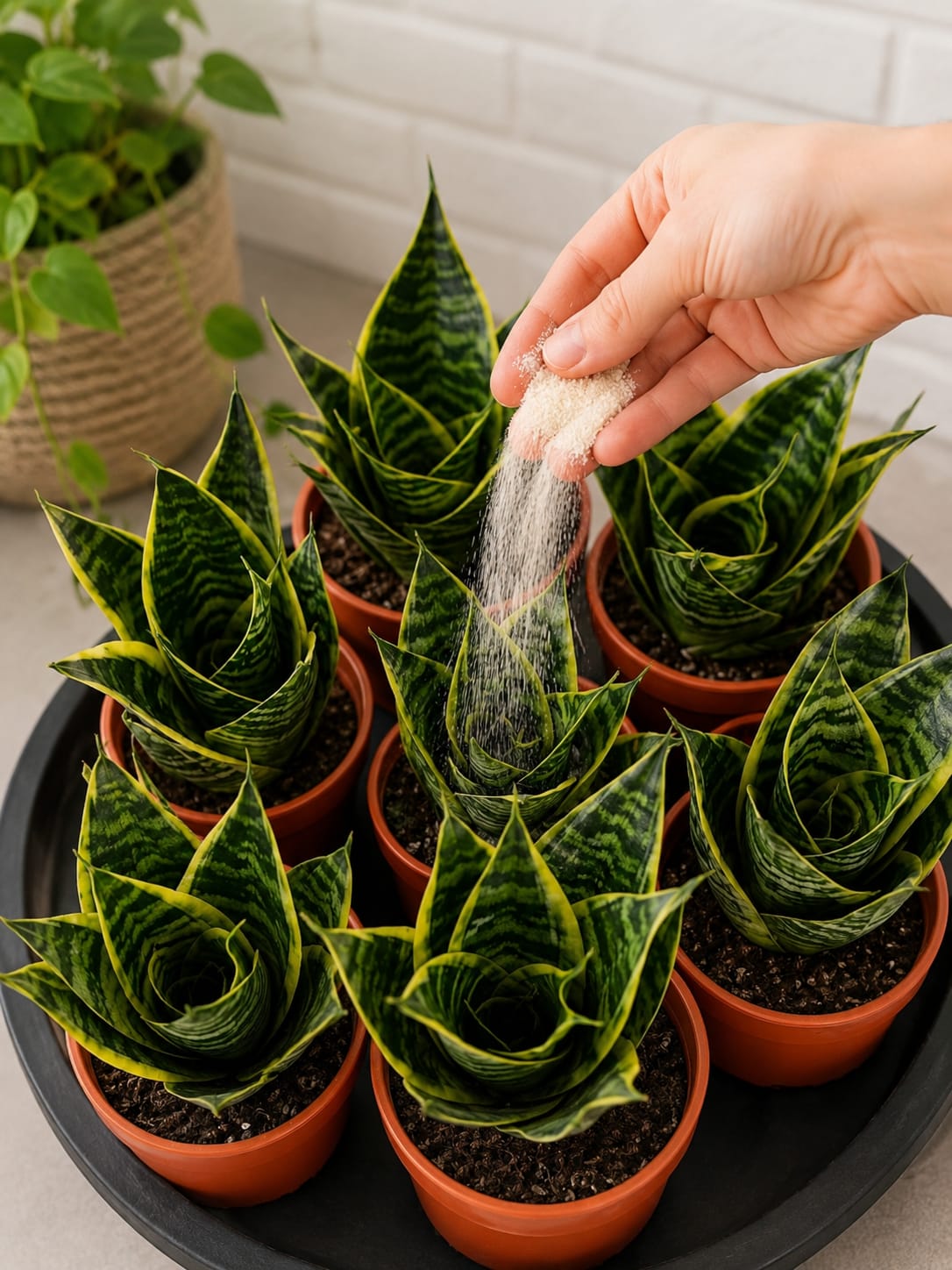
Snake plants are famous for being almost impossible to ignore in home decor. Their upright sword-shaped leaves, dark green markings, yellow edges, and sculptural form make them one of the easiest houseplants to use in a stylish indoor space. Even a small snake plant can make a shelf, desk, bedroom corner, bathroom counter, or living room table feel cleaner and more designed.
But even though snake plants are known as low-maintenance plants, they can still become weak. Some stop growing for months. Some produce small curled leaves. Some lean to one side. Some lose their deep color. Others look alive but not truly strong. This is why many plant lovers look for simple tricks that support the root zone and encourage healthier growth from below.
One popular method is sprinkling a small amount of white powder gently across the soil surface around weak snake plants. The idea is not to cover the leaves, not to bury the crown, and not to use a heavy amount. The powder is added lightly over the top layer of soil, usually near the base of the plant, where moisture, roots, and soil life interact.
The exact white powder should always be chosen carefully. In plant care, white powder may refer to a plant-safe mineral amendment, a rooting-support powder, a mild fertilizer powder, crushed eggshell powder, agricultural lime, diatomaceous earth, or another soil-support product. Because each material works differently, the safest rule is simple: only use a powder that is clearly safe for indoor plants, and use it in a very small amount.
This article explains the idea as a practical snake plant care trick, while also showing how to make the plant look beautiful indoors. The goal is healthier roots, cleaner growth, stronger leaves, and a more elegant plant display.
Why Snake Plants Sometimes Become Weak
Snake plants are tough, but they are not magic. They survive neglect better than many houseplants, but long-term weakness usually begins in the pot. The leaves may look firm for a while, but the roots can slowly struggle if the soil is too wet, too compacted, too dry for too long, or lacking airflow.
A weak snake plant may show signs such as:
- Slow or no new growth
- Leaves curling inward
- Leaves leaning or falling over
- Pale green color
- Soft bases near the soil
- Yellowing leaves
- Dry brown tips
- Small new shoots that do not develop well
- Soil that smells unpleasant
- Roots that are weak, black, or mushy
Most snake plant problems come from the root zone. That is why a soil-surface trick can make sense when used correctly. The goal is to support the hidden part of the plant, not just make the leaves look better for a few days.
What the White Powder Trick Is Supposed to Do
The white powder trick is usually used as a gentle soil-support method. A small amount is sprinkled lightly across the soil surface, especially around the base of the snake plant. After that, normal care continues. It is not meant to be a dramatic rescue treatment or a replacement for proper watering.
This method may help by:
- Improving the top layer of soil
- Supporting root-zone balance
- Discouraging surface moisture problems
- Adding mild minerals depending on the powder used
- Helping weak plants recover when combined with better care
- Keeping the pot surface looking cleaner
- Creating a more finished decorative appearance
The important word is “gentle.” Snake plants do not need aggressive feeding. They grow slowly and prefer stable conditions. A light sprinkle can be part of a care routine, but too much powder can stress the roots.
Why the Powder Should Go on the Soil, Not the Leaves
Snake plant leaves are thick, waxy, and decorative. They should stay clean. When powder collects on the leaves, it can make the plant look dusty and neglected. It may also settle into the central leaf rosette, where it can hold moisture and create problems.
The best place for this trick is the soil surface because:
- The roots are below the soil
- The base of the plant is where new growth begins
- The soil surface often shows early signs of moisture issues
- The leaves stay clean and glossy
- The plant keeps its elegant indoor look
When applying any powder, avoid filling the center of the plant. The crown should stay clean and dry. Snake plants dislike trapped moisture around the base, especially in low light or cool rooms.
Possible Types of White Powder Used Around Snake Plants
Different white powders have different purposes. It is important not to treat all white powders as the same thing. Some are safe in small amounts, some should be used only for specific problems, and some should not be used on houseplants at all.
1. Mineral Soil Amendment
Some plant-safe mineral powders are used to improve soil balance. These may support the structure or chemistry of the growing medium. They should be used lightly and only when appropriate for the plant.
2. Rooting Support Powder
Rooting powders are often used for cuttings or divisions. They may help encourage root development when propagating snake plants. However, they are not usually necessary for a healthy established plant.
3. Diatomaceous Earth
Diatomaceous earth is a fine white powder sometimes used on the soil surface to help manage crawling pests when kept dry. It should not be inhaled, and it loses much of its effect when wet. It must be used carefully indoors.
4. Crushed Eggshell Powder
Eggshell powder is often used as a homemade calcium source, but it breaks down slowly. It should not be expected to create instant growth. If used, it should be very finely crushed and applied sparingly.
5. Mild Fertilizer Powder
Some dry fertilizers are pale or white. These can feed plants, but snake plants need only light feeding. Too much fertilizer can burn roots or cause buildup.
6. Agricultural Lime
Lime can change soil pH and add calcium. It should not be used casually unless the soil actually needs it. Too much can make the soil unsuitable for the plant.
The safest approach is to identify the powder first. Never add random household powder simply because it looks similar.
How to Use the White Powder Trick Safely
If you want to try this method for a weak snake plant, use a careful routine. The plant should not be rotting, and the soil should not be soggy. A powder treatment works best as a gentle support step, not as an emergency fix for a dying plant.
- Check the snake plant first. Make sure the base is firm, not mushy.
- Touch the soil. It should be dry or only slightly moist, not wet.
- Use a plant-safe powder only.
- Take a very small amount between your fingers or on a small spoon.
- Sprinkle it lightly over the soil surface.
- Keep the powder away from the central leaf crown.
- Do not cover the soil with a thick white layer.
- Wait before watering unless the product instructions say otherwise.
- Watch the plant over the next few weeks.
A small amount is enough. The goal is to support the pot environment, not bury the plant in powder.
When This Trick Can Help
This trick may be useful when the snake plant is generally alive and stable but looks weak, slow, or tired. It works best when combined with improved light, better watering, and good soil drainage.
It may make sense when:
- The plant has slow growth but firm leaves
- The soil surface looks tired or compacted
- The plant has been recently divided
- Small pups are emerging and need support
- The pot is clean and drains properly
- The grower wants a gentle root-zone care step
It is not a cure-all. A weak plant usually needs a full care adjustment, not one single ingredient.
When Not to Use White Powder
There are times when this method should be avoided. If the snake plant has serious root rot, a white powder will not solve the real problem. The plant needs inspection, trimming, drying, and repotting.
Do not use this trick if:
- The plant base is mushy
- The pot smells rotten
- The soil is wet and heavy
- The plant has black roots
- The leaves are collapsing from the base
- You do not know what the powder is
- The pot has no drainage and stays wet
- The plant was recently over-fertilized
In these cases, fix the root problem first. Remove the plant from the pot, cut away rotten roots, let healthy parts dry, and repot in a fast-draining mix.
The Real Secret: Fast-Draining Soil
No powder can replace good soil. Snake plants need a loose, airy, fast-draining mix. Heavy soil keeps too much moisture around the roots, which can lead to rot.
A good snake plant mix may include:
- Cactus or succulent soil
- Perlite
- Pumice
- Coarse sand
- Small bark pieces
- A little regular potting mix for organic matter
The soil should hold the plant upright but still allow water to move through quickly. If water sits in the pot for too long, the roots can suffer.
Best Watering Routine After Using the Trick
Watering is the most important part of snake plant care. Many weak snake plants are not weak because they need more fertilizer. They are weak because the watering routine is wrong.
After applying a small amount of plant-safe powder, do not rush to soak the soil unless the product requires watering in. In many cases, it is better to wait until the soil is dry and then water normally.
A good watering routine is:
- Let the soil dry out between waterings
- Check deeper than the top layer
- Water thoroughly when the mix is dry
- Allow extra water to drain away
- Never leave the pot standing in water
- Water less in winter or low light
- Use room-temperature water
Snake plants store water in their thick leaves. They can handle dryness better than soggy soil. When in doubt, wait a little longer before watering.
Continue to Page 2
Continue to page 2 for more details about this article and the key points many readers miss on the first page.