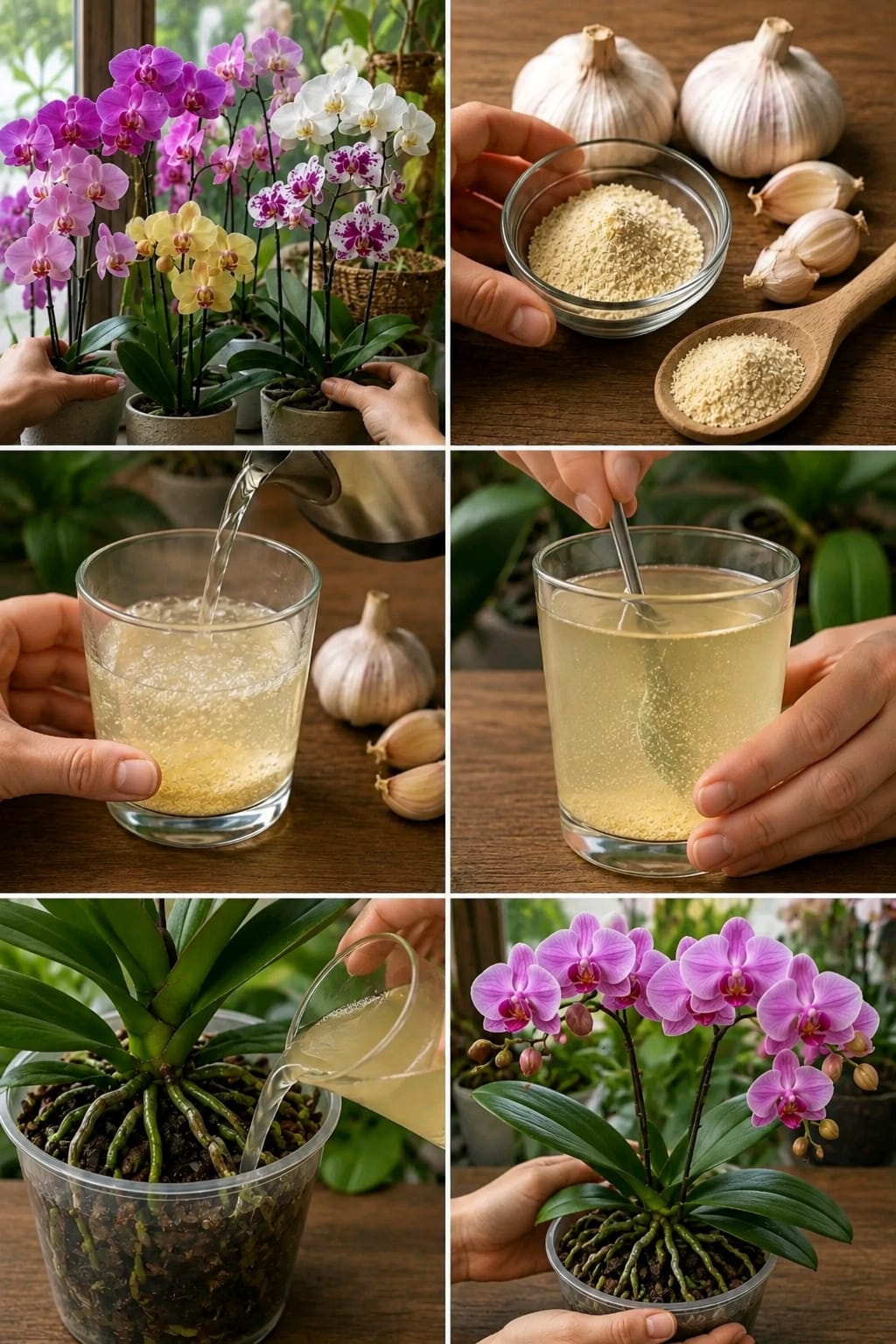
Orchids have a special way of making any indoor corner look more refined. Their glossy green leaves, exposed roots, tall flower spikes, and soft colorful blooms can turn a simple windowsill into a luxury plant display. A healthy orchid does not need much decoration to look expensive. When the leaves are firm, the roots look clean, and the flowers open gracefully, the whole plant becomes a living centerpiece.
That is why many orchid lovers become curious about simple root-care tricks. One popular idea is using a very light garlic-based tonic around orchid roots. The goal is not to pour a strong kitchen mixture into the pot or force instant flowers. The real idea is to use a mild, diluted garlic water carefully as an occasional root-zone refresh, especially when the orchid looks tired, slow, or dull after blooming.
Garlic is often discussed in home gardening because it has a strong natural smell and contains sulfur-like compounds. Some growers use garlic water as a very mild plant-care rinse or root-zone support step. However, orchids are sensitive plants. Their roots need air, gentle moisture, and clean growing conditions. Because of that, any garlic method must be weak, strained, and used rarely. Too much garlic can create smell, residue, irritation, or root stress.
The safest way to understand this trick is simple: it is not a miracle fertilizer. It is a careful orchid root-care routine built around a very diluted garlic infusion, proper watering, fresh orchid bark, bright indirect light, and a clean decorative setup. When used correctly, it can become a small part of a healthier orchid-care rhythm.
Why Orchid Roots Matter More Than the Flowers
Most people notice orchid flowers first. The blooms are colorful, elegant, and long-lasting. But the real health of the orchid begins below the leaves, around the roots. If the roots are firm and active, the plant can hold moisture better, support new leaves, and prepare for future flower spikes. If the roots are weak, the flowers may fade faster and the leaves may become limp or yellow.
Many common orchids, especially Phalaenopsis orchids, grow with thick roots that like airflow. These roots are not designed to sit in heavy soil. They naturally prefer bark, moss, charcoal, or airy orchid mix. Healthy roots may look green after watering and silvery-gray when dry. This color change is normal and helps growers know when the orchid is ready for water again.
Healthy orchid roots help the plant:
- Absorb water gently
- Stay firm in the pot
- Support new leaves
- Recover after flowering
- Produce new root tips
- Prepare for future blooms
- Maintain a clean decorative look
When roots are unhealthy, the orchid may still look attractive for a short time, but decline usually follows. Leaves may wrinkle, turn yellow, or soften. Buds may fall before opening. Flower stems may dry too quickly. This is why any orchid trick should focus first on root health, not only on flowers.
What the Garlic Orchid Tonic Is Meant to Do
A garlic-based orchid tonic is usually presented as a light root-support liquid. It is made by mixing a small amount of garlic powder or crushed garlic with water, allowing the water to absorb some of the garlic properties, then straining and diluting it before use.
The purpose is usually to:
- Refresh the root zone
- Support cleaner orchid care
- Discourage unpleasant pot conditions
- Give tired orchids a gentle care step
- Help growers inspect roots more often
- Encourage a cleaner watering routine
This does not mean garlic water should be treated as a complete orchid fertilizer. Orchids still need proper light, correct watering, and a balanced orchid fertilizer during active growth. Garlic water is only a small occasional support step, not the main source of nutrition.
Why the Tonic Must Be Very Light
Orchids are not heavy feeders. Their roots can be damaged by strong mixtures, thick liquids, salty fertilizers, or organic residue trapped in the pot. Garlic is powerful, so it should never be used in a strong concentration around orchid roots.
A light tonic is safer because it reduces the risk of:
- Root irritation
- Strong smell in the pot
- Fungal growth from leftover particles
- Sticky residue around bark
- Stress to young root tips
- Moisture staying too long in the medium
The best rule is to make the mixture weaker than you think you need. Orchids respond better to gentle consistency than dramatic treatments.
A Gentle Garlic Root Tonic Recipe for Orchids
For a careful orchid routine, the garlic tonic should be mild, strained, and diluted. The goal is a pale, watery liquid, not a thick garlic solution.
Ingredients
- 1 small garlic clove or 1/4 teaspoon garlic powder
- 1 cup clean warm water
- 2 to 3 cups extra clean water for dilution
- A fine strainer or clean cloth
- A spoon or small watering cup
Method
- Crush one small garlic clove lightly or use a tiny amount of garlic powder.
- Add it to one cup of warm water.
- Let it sit for 20 to 30 minutes.
- Strain very well so no garlic pieces remain.
- Dilute the strained liquid with two to three cups of clean water.
- Use only a small amount around the orchid roots.
The final liquid should be very weak. If it smells extremely strong, dilute it more. If particles remain, strain it again. Orchid bark should not be filled with garlic pieces because they can rot and attract pests.
How to Apply Garlic Water to Orchid Roots
The application is just as important as the recipe. Never pour garlic water into the crown of the orchid. The crown is the center where the leaves meet. If liquid sits there, the orchid may develop crown rot.
Use this safe method:
- Check that the orchid is not already soaking wet.
- Look at the roots and growing medium.
- Use a spoon or small cup instead of flooding the whole pot.
- Apply the liquid near the bark and visible roots.
- Avoid the leaves and crown.
- Let all extra liquid drain away.
- Keep the orchid in bright indirect light afterward.
A small amount is enough. For a small orchid, one or two spoonfuls around the roots may be plenty. For a larger orchid, use a little more, but still avoid soaking the entire pot with garlic water.
When This Garlic Trick Makes Sense
This root tonic makes the most sense when the orchid is mostly healthy but needs a gentle refresh. It can be used after flowering, during recovery, or when the plant looks slightly tired but still has firm leaves and living roots.
It may be useful when:
- The orchid has firm green leaves
- The roots are mostly healthy
- The potting medium smells clean
- The plant has recently finished blooming
- The grower wants a light root-care routine
- The orchid is not sitting in wet old bark
It is not suitable when:
- The roots are black and mushy
- The pot smells sour
- The crown is soft
- The leaves are collapsing
- The bark is old and broken down
- The plant is already overwatered
If an orchid is rotting, a tonic will not solve the problem. The orchid needs to be removed from the pot, cleaned, trimmed, and repotted into fresh orchid medium.
How Often to Use Garlic Water on Orchids
This method should not be used often. Orchids prefer a simple routine. Too many homemade mixtures can create buildup and stress the roots.
A safer schedule is:
- Use once every 4 to 6 weeks at most
- Use only during active growth or recovery
- Skip during cold, dark periods
- Stop if any smell, mold, or residue appears
- Return to plain water for regular watering
Plain water should remain the main watering source. A balanced orchid fertilizer can be used lightly during the growing season, but garlic water should stay occasional.
Why Straining the Mixture Is Essential
One of the biggest mistakes with homemade orchid tonics is leaving particles in the liquid. Garlic powder, crushed garlic, rice, banana, eggshell, or other organic particles can settle in the bark. Once trapped, they may decay and create odor, mold, or fungus gnat problems.
Always strain the tonic because it keeps the orchid pot cleaner. A clean liquid is easier for the roots to handle and less likely to create problems. If the mixture looks cloudy, that can be normal, but it should not contain visible chunks.
What to Avoid With Garlic Orchid Care
Garlic can be helpful only when used carefully. Strong garlic water is not better. More frequent use is not better. Pouring it directly over the crown is not better.
Avoid these mistakes:
- Using too much garlic powder
- Leaving garlic pieces in the pot
- Applying garlic water every week
- Pouring it into the orchid crown
- Using it on rotten roots
- Using it with strong fertilizer at the same time
- Letting the pot sit in the liquid
- Using fermented or spoiled mixtures
- Ignoring old compacted bark
With orchids, the safest care is usually light, clean, and controlled.
Best Orchid Medium for Healthy Roots
No root tonic can replace the right growing medium. Orchids need a mix that allows oxygen to reach the roots. Regular houseplant soil is usually too dense and can suffocate orchid roots.
Good orchid medium options include:
- Orchid bark
- Sphagnum moss
- Charcoal
- Perlite
- Coconut husk chips
- Lava rock
Bark is great for airflow. Moss holds more moisture and may work in dry homes, but it must not stay wet too long. Charcoal can help keep the mix cleaner. Perlite creates air pockets. A clear pot with drainage holes makes it easier to watch the roots and prevent overwatering.
How to Know When an Orchid Needs Water
Many orchids suffer from too much water, not too little. The best time to water is when the roots and medium are nearly dry. If the orchid is in a clear pot, check root color. Green roots usually mean moisture is still present. Silvery roots often mean the plant may be ready for water.
Watering signs to check:
- Roots look silver-gray
- The pot feels lighter
- Bark pieces look dry
- No condensation appears inside the pot
- Leaves are firm but the medium is dry
Do not water only by calendar. A plant in bright light may dry faster than one in a cool room. A moss-filled pot dries slower than a bark-filled pot.
Can Garlic Water Make Orchids Bloom Faster?
Garlic water alone cannot force orchids to bloom. Blooms depend on several factors, including light, root health, temperature, maturity, and the plant’s natural cycle. A gentle garlic tonic may support root care, but it is not a bloom switch.
Orchids bloom better when:
- The roots are healthy
- The plant receives bright indirect light
- The leaves are firm and green
- The potting medium is fresh
- Watering is balanced
- Fertilizer is used lightly during growth
- The plant receives a suitable rest period
If an orchid refuses to bloom, low light is often the reason. Many orchids survive in low light but need brighter indirect light to flower well.
How to Encourage Orchids to Rebloom Naturally
After orchid flowers fade, the plant enters a recovery stage. During this time, it may grow roots and leaves before producing another spike. Patience is important. Do not overload the orchid with tonics or fertilizers immediately after blooming.
To encourage reblooming:
- Place the orchid near bright indirect light
- Water only when the medium is nearly dry
- Feed lightly during active growth
- Keep roots airy
- Trim only dead flower spikes
- Protect the plant from cold drafts
- Allow gentle nighttime cooling if suitable
A light garlic tonic can be used occasionally during recovery, but the plant’s main needs remain light, roots, air, and balanced moisture.
How to Style Orchids for a More Expensive Indoor Look
Orchids already look elegant, but the right styling makes them feel even more luxurious. A clean orchid display should highlight the flowers and leaves without making the area feel cluttered.
Beautiful orchid styling ideas include:
- Use a white ceramic outer pot
- Place a clear orchid pot inside a decorative cachepot
- Add natural bark as a clean top layer
- Use simple black stakes for flower stems
- Place orchids on a wooden tray
- Group two or three orchids in matching pots
- Keep the surrounding area simple
Orchids pair beautifully with wood, stone, linen, glass, and neutral colors. Their flowers become the main decorative feature, so they do not need bright or busy containers.
Best Places to Display Orchids
Orchids prefer bright indirect light. They should not be placed in harsh direct afternoon sun, but they also should not be hidden in dark corners. A bright windowsill with filtered light is often ideal.
Good orchid display locations include:
- East-facing windows
- Bright kitchen counters
- Living room plant shelves
- Bathroom counters with natural light
- Bedroom dressers near a window
- Covered balconies
- Dining room sideboards
- Home office desks
Avoid placing orchids near heaters, air conditioners, cold windows in winter, or direct hot sun. Stable conditions help flowers last longer.
How to Create a Clean Orchid Care Station
A small orchid care station can make your plant routine easier and more attractive. It also helps keep tonics, tools, and watering supplies organized.
A simple orchid care station may include:
- A small glass jar for diluted tonic
- A spray bottle for plain water around the air, not the crown
- Clean scissors for trimming dead spikes
- Fresh orchid bark
- Clear pots with drainage
- Soft cloth for wiping leaves
- Plant labels
Keep everything clean. Orchids look best when their care area is tidy and intentional.
Continue to Page 2
Continue to page 2 for more details about this article and the key points many readers miss on the first page.